Jim Harenchar - CEO @ Response Marketing Group
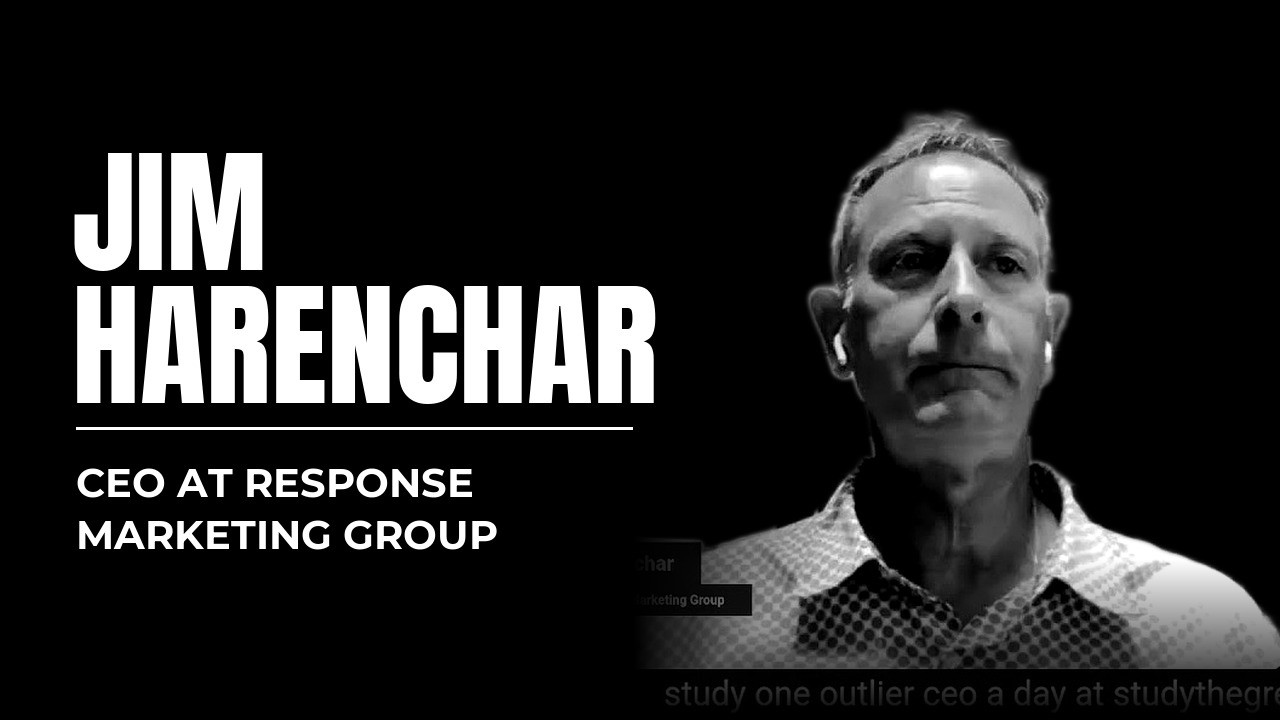
In this episode of the CEO Wisdom Pod, host Charles Cormier interviews Jim Harenchar, President and CEO of Response Marketing Group (RMG). Jim shares his personal background, from a government studies degree and early sales roles at a Fortune‑500 company to his long tenure in marketing and data analytics. He recounts RMG’s history: founded in the 1980s, acquired by Snyder Communications and later lost within a large holding company, then revived in 2013 with a small office and a focus on data‑driven customer segmentation. The conversation delves into RMG’s core offerings—data analytics, predictive modeling, and proprietary identity‑resolution technologies (SmartPixel, Bullseye) and the upcoming Audience Builder CRM platform. Jim explains how the firm serves a diverse client base (hospitality, tourism, financial services, nonprofits, veterinary healthcare) and targets senior marketing leaders (CMOs, VPs, directors). He outlines the dual business model of managed services and a self‑service SaaS layer, pricing ($10k‑$7k per month for products), and the competitive advantage of delivering granular, owned visitor profiles. A detailed Ritz‑Carlton case study illustrates how RMG’s segmentation uncovered distinct traveler personas and drove customized creative, leading to higher ROI. Jim discusses growth tactics—speaking engagements, LinkedIn, blog, word‑of‑mouth—and future objectives, including expanding the SaaS product line while maintaining compliance. The interview ends with contact information (website, LinkedIn, blog).
Chapters
Welcome to another CEO Wisdom Pod. We have Jim Harranchar with us today, President and CEO at Response Marketing Group. Jim's all about marketing strategy, data analytics in the Greater Richmond area, which is close to Washington and Virginia Beach and all kinds of good things. So Jim, welcome to the podcast. Tell us a bit more about yourself and what you've been up to.
Yeah, thanks, Charles. Uh, let's see, it's been a busy summer. I, uh, actually took my first trip to Asia. I had a son, my oldest child graduated from college, and he picked a trip to take, and so we went to Japan. Nice. So my wife and two kids, and it was a lot of fun. So, uh, we did not know a word of Japanese, but that was not an inhibitor. Uh, fantastic country, the people are fabulous. We really, really enjoyed it. Long trip, 13 and a half hours, uh, from Washington, D.C. to Tokyo, but we had a great trip. So anyway, our firm, as you mentioned, um, located in Richmond, Virginia, although we serve both, uh, domestic and international, uh, clients, do a lot of work in the tourism industry. We started in October, we will be 40 years old, so we have been doing marketing analytics and data-driven technology for a long time. Probably almost as old as you are. Uh, and, uh, so, um, we've got a lot of experience in it. I have not been here— I did not start the firm. I joined in '94, uh, and I was here till about 2002. I left for a number of years, actually ran a general ad agency for 10 years, and then came back in about 2013 and have been doing my second tour of duty as, uh, CEO of RMG.
Love it. And you started out in sales, right? So I did. A lot of folks back then, pretty sure my dad did as well, but he— because he's a marketing consultant, right? He started out in, uh, in sales, and then people started to understand that selling is easier if marketing is good. When did you officially transfer to marketing, if you ever transfer? Because I'm pretty sure most of your philosophies are still sales-related.
Yeah, I think to some degree. I mean, I was not a business major in college, for example. I was a government major. I thought I was going to go work for the Foreign Service. That was my lifelong dream. Didn't turn out that way, so I had to pay the bills, so I got a sales job. And I would tell you that for me, Charles, the biggest thing that impacted my life— I went to work for a Fortune 500 company, who had a spectacular sales training program. And I think, um, coupled that with when I, I started actually at Sears, which you may or may not remember that firm. They don't exist anymore. Um, but started in, in retail and decided that was not for me. So went into very much more of a traditional sales background. But I had spectacular sales training. And I think the thing that I, I learned early on was that Building relationships is so valuable regardless of what you do, right? What industry you're in, the ability that you have to be able to talk to people, to get them to open up, to be able to have conversations, to share honestly both the good and the bad. Inevitably in every relationship that's going to happen, both your business relationships and your personal relationships. So I think those skills related to sales are critically important. I would say I pivoted to marketing probably after I had been at Response Marketing Group for the first 4 or 5 years, when you had to be able to sit in a room full of senior-level decision makers at a corporate level and understand how to explain what strategy and marketing really was, especially in a data-driven environment. And so if you didn't, you were a little shallow. And I think that you lost a lot of value in terms of representing your product or your services. And the company. And so I had to become a student of the industry. Uh, that's not to say I would put myself with the, uh, kind of the marketing hall of fame, but I do think that I can navigate my way around after 40 years in this business.
That's a long career you had and lots of successful roles here. The first thing I read, right, like with Brand Worldwide/Response Marketing Group, um, 4.2 billion multinational holding company serves Fortune— well, global 1,000 companies and generating $450 million in revenue. And you were EVP of that. That was an early win, wasn't it?
Yeah, it was. You know, we started that company, and kudos to the original 3 founders. As I said, I was not one of those. I came in as a salesperson, ultimately led the sales and marketing team uh, after, uh, having been there probably about 5 or 6 years. And, um, we were acquired, uh, by Snyder Communications. A lot of people may know the name Dan Snyder, formerly the owner of what was the Washington Redskins at one time. But apart from his sports interest, he had the vision to be able to create a large roll-up of both general agencies and data-driven marketing firms. And so custom boutiques all the way up to, uh, large very large ad agencies, and he spun that off to become part of the Havas network. So we were bought and, and one of the subsidiaries of the largest media holding company and advertising group in the world back in the early to mid-2000s, right?
And Right Minds after that— well, the first, uh, the question like I need to ask, uh, for all of these companies: were you always like entrepreneurial inside of you? Because I mean, starting your own business back then wasn't the trend, right? Was way more comfortable to accept a multi-six-figure job a year. So what was your mindset back then? Was it just like comfort and I don't know, feeding the family? You had your kids also back then. When did you start like getting like CEO roles, right? And launching your own things?
Probably, so when I felt like my dad sounds like a little bit like yours, right? My dad grew up in an environment where you went to work for a company, you learned a lot of skills. My dad worked for basically one company for almost 50 years, 46, 47 years. They treated him exceptionally well. It was a large Fortune 1000 company. I kind of started down that path, but one of the things that I realized was that after a short experience at Sears, just had an opportunity to go with more of a startup. I wouldn't call it a true startup like you would've found in the '90s and the early 2000s in the dot-com area, era. But I found that I fit in well there in terms of you had a lot of freedom and flexibility to have an impact on a lot of different aspects of the business. And that fit my personality, fit my interests. I did have some stints in larger companies and found that they can be stifling, depending, depending upon what role you play and how you have networked yourself within an organization. And so, you know, really when I got into probably the mid to late 2000s, so thinking more like post-2010, I realized that putting my success in my own hands was something that I had a great faith in myself. And so being able to, you know, directly impact business, make the decisions as opposed to, as I always used to joke, it's tough to have to implement somebody else's bad decision and bite your lip.. And so I decided that I would implement my own bad decisions.
I want to fast forward to Response Marketing Group, right? So you've been 10 years there. What's been the evolution of the company?
So as I said, the company sold back in, in 2000, and really we got lost. I left in 2002, was gone for 10 years. The company got lost in that gigantic holding company environment. I think we were a data analytics firm that built models and did customer segmentation in a world of traditional ad agencies, and they didn't know what to make of us or how to use us and sort of lost their way. So the original founder and I stayed in touch. We used to meet for breakfast, lunch, play a couple rounds of golf a year. And as we got into about 2012, 2013, it occurred to me that we still had relevance. Even at that point in time, the company was 28, 30 years old. We still had relevance because of the role that data was playing and the large datasets that were available and the technology that allowed us to be able to measure and manage data at scale. So I said, let's, let's think about, you know, potentially restarting this. And we did. And literally, we started Charles in an office that was maybe 10 feet by 12 feet, and we used to sit across a round table from each other making phone calls, leveraging our Rolodex and our old contacts to try to say, hey, we think that you remember RMG, used to work with us in the past 10, 12 years ago. We've restarted the company, kind of one of those, hey, we got the band back together, uh, would you be, would you be interested? And so we built the business from nothing, uh, up to where we are today. So I think a lot of it was leveraging the goodwill that we had and the value proposition, which really resonated with a lot of folks. We did great work in the '80s, '90s, and 2000s. And so people were willing to say, yeah, let's talk again.
And what do you guys do fundamentally? Because Response Marketing Group, right? And then when I land on a website, it's like, no, every visitor, it's like identifying their emails and where they come from and so forth. So what's the— what's the core service or software you offer?
Yeah, so, so our heritage really is in data analytics and customer segmentation and profiling. So that dates back to the '80s. Now, when I started, again, I'm dating myself, there were only two direct-to-consumer marketing channels. There was telemarketing and there was direct mail. And so telemarketing was that dreaded thing when the phone rang at 6 o'clock and you were eating dinner and dad said, no one answers that phone. And then direct mail, we used to mail back in the, in the day, we would mail 300 to 400 million pieces of direct mail. But that was all built on the foundation of data, meaning that we would either take customer data and we would build predictive models to say, if Charles Cormier is the ideal customer for a home equity line of credit, how do we find more Charles? Um, now let's fast forward to today. The difference is we don't have 2 channels, we have 22 channels. And so a lot of folks have struggled to understand, I still have a finite budget. I had a finite budget in the past, I have a finite budget in the future. And for some clients, that budget might be a million dollars. For some clients, that budget might be $100 million, but it's still finite. And so how do you measure response attribution? How do you drive return on ad spend? How do you measure ROI? That hasn't changed in 40 years, as old as this company is. I think if anything, it's become harder to measure true response attribution, uh, with 23 channels versus 2 channels. And so we partner with clients to understand what's the data you have What's the data you do not have? And how do we better use that to target those people that are likely to buy your product? And how do you engage with those individuals to get repeat revenue?
How much clients do you have right now? You said the 30%, uh, year-to-year growth rate since COVID So what is that, hundreds of clients? Or—
yeah, we, we are— well, we're just shy of, just shy of probably 100. You know, and we've had wonderful growth, a lot of it word of mouth, a lot of it traditional, you know, picking up the phone and calling somebody and saying, hey, or a lot of networking, right? So we present at conferences. I'm fortunate enough to be a speaker 4 or 5 times a year. So that presents itself with a number of great opportunities for us.
Right. And the clients I read here, hospitality, right? B2B seems like it's very tourism.
Right?
Uh, hotels, restaurants, conferences. Uh, how do you get a hold of these people? How do you market to them?
Yeah, we still do financial services. We do some nonprofit work. We do some work in the— I'm going to call it healthcare, it's more the veterinary business. But, um, what we do is, uh, you know, like everybody else, you know, we're promoting across many of the social channels. So you'll find us with a strong presence in LinkedIn. Uh, we regularly update our blog with our success stories. We do a lot of white papers and case studies so that we let people know the success that we are having. We pivoted, Charles, in probably about 19— well, let me back up. In 1994, we really went at RMG, we went heavily into the tourism space, more on the hotel side. So we were working with the Disneys and the Marriotts and the Ritz-Carltons and the Hiltons of the world, um, in their actual timeshare. Uh, they don't like to use that word anymore, uh, it's vacation ownership now. But on the timeshare side, where we were building predictive models to say, look, if We've got availability on our timeshare segment. That's like selling a mortgage 52 times a year. So how do we identify people that would be interested in, in a week's vacation? So that's where we started. We migrated that into the traditional hotel side, and now we work with destinations. So we'll work with state tourism offices, we'll work with convention and visitors bureaus, we work with independent resorts, lodges, and attractions to help them to say, um, who are the people that are actually feet on the street. A state tourism office, I'll use my home state of Virginia. They have a budget of $40 million, yet they can't tell you who actually comes to visit in the state of Virginia. They're promoting Virginia is for lovers, but they can't tell you if Jim Herenschar has ever been in the state. For us, that was a great miss. It was a tremendous opportunity to be able to reveal what that customer journey looks like. The person that goes on the website, looks at the state of Virginia's website, and actually then says, oh, I'm, you know, I might want to stay in Washington, in Northern Virginia, I might want to stay in Central Virginia, I might want to stay on the beach, I might want to go to the mountains. While I'm there, what are the best restaurants in Richmond, or what have you? So helping our clients understand what is the interest level of the visitor on your website, and then do they actually physically show up as feet on the street.
Interesting. Um, so for this year, what are your main objectives as a CEO? Because the— you glue— you, you grew the client base substantially? I guess retention rate is somewhat stable, right? So what are your top goals for this year?
Yeah, so we continue to introduce folks to the concept of identity resolution, which means a number of things to different people, but for us it's really two proprietary technologies that we launched back in 2001, and that is the ability to place a pixel on your website and de-anonymize that site visitor. So, you know, Google Analytics is great. GA4 is wonderful. It's 20 years old now, but it's aggregate census data. What we're looking at is the ability to say that Jim Harenchar was on your website and Jim is this age and Jim has this many kids and Jim makes this money and Jim has these interests. Charles was on your page and he's dramatically different. He's this age. He has no kids, you know, whatever the case might be. So understanding exactly what that website visitor looks at, what ads they click on, because everybody is trying to understand where do I put my ad dollars, which of my ads are performing the best. I'm targeting, for example, African American women and families with kids making $100,000 that live in Dallas, Texas. Is that who's actually coming to your website? GA4 can't tell you that. That's census data, and it also includes a lot of bot spiders and other non-traffic. So we remove all of that. We have technology now that allows us to get down to that granular level. Some people are comfortable with that, Charles. Others look at it and they kind of glaze over like, how is that even legal? How can you do that? Well, the reality is it's legal. It's all fully compliant. And we're delivering data back to the client now that tells them exactly who that visitor is. But not only that, they own that visitor's information. So now they can engage with that person, whether that's email, whether that's targeted ad buying, whether that's video. Whatever channel you want to use, we are empowering you to be able to have that one-to-one conversation based on the interests of that individual, right?
And when are you gonna separate, uh, service from software? Is there gonna be a point in which gonna be fully SaaS and you're gonna offer your own website identification? And then if you eventually do that, isn't there like tons of competition in that space? Like it's almost become commodified to offer to identify the website visitors. I can name like at least 10 companies that do that.
Um, well, you might be able to name 10 companies do that, but you probably can't name one other than RMG that actually delivers that data to the client and they own it, right? So there's a lot of folks out there that can de-anonymize and pixel sites, but what they don't share is the full customer profile with 250 demographics. So you did hit the nail on the head. What's the plan? The plan is actually to have bifurcate our revenue stream into two two, two structures. The first is basically a standalone self-service model where someone can subscribe and they can get the pixel. And then we also build geo frames around locations so that we can de-anonymize that visitor. So if you are Richmond, Virginia, for example, and you want to know not just who comes to your website but who's actually walking on your sidewalks and where are they from, so we can provide that data and you can have it in a self-service model or it's managed services. And that's where we look for the largest percentage of our revenue is coming out of the managed services side where our team is actually building custom models, doing custom segmentation for you, and then serving that advertising if in fact you don't have an agency partner to do so.
And right now with the service/agency model, how much do you charge to work with a client? Say I hired you, right? What does the contract look like? And yeah, what can I expect in terms of ROI?
Yeah, so most of the time you're, you're looking at one, if not both, of our proprietary ad tech products. So Bullseye is our geo-framing and SmartPixel is our pixeling, and those products are $10,000 a month to deploy. And then if you want, we're, we're getting ready actually, and we're in, in beta testing right now with some clients over a new launch we're really excited about called Audience Builder. It's basically a CRM tool that also includes the ability to do email and ad serving out of the data that you would ingest from our proprietary ad technology. So add on another $5,000 to $7,000 a month for our custom audience builder CRM platform. Uh, so ROI on that for our clients typically is fantastic because we're very price competitive. We are, uh, significantly under Salesforce, for example, but some of the other players in the space like HubSpot, Marketo, SimpleView, Tempest, we're significantly under where their price point is and delivering a much more valuable service, right?
And don't you have like an emailing platform? Uh, you know, what happens after I've identified the customers? It's just like autopilot stuff of like, hey, you've been on my website and I noticed that blah blah blah, uh, and take this action, right? Do you have like a follow-up piece to after you've identified their data?
So we have an agnostic platform that warms email for you across a variety of different EMS, you know, email service or servers. So you can pick and choose which you want to use— AWS, Google, all, you know, all of them, all of the top 3 primarily. And so you can then either design your own creative. We have creative services that we can design it for you. You can take agency creative and you can drop it in. You customize those segments. So for example, if you want to start an e-newsletter going out to those folks that attended a festival event or a concert last year, and now you want to stay engaged with them to keep them aware of other types of musical events and venues that you offer, you can create a custom segment and then you can structure an outbound email that'll auto-send either weekly, monthly, or on what— on whatever frequency you want.
Interesting. Your price tag, they seem like they're adequate for, I don't know, at least $10 or $50 million revenue a year type of companies, right? So what types of roles do you typically target? Is it CMO role in these, um, large hospitality types of companies?
It is, exactly. Yeah, we're looking for a CMO. In some of the cases where you're looking at independent lodges and inns and hotels, we're looking at the CFO or the COO who might be wearing multiple hats. But yeah, primarily it's the CMO, director of marketing, VP marketing, somebody in that role that understands kind of at a broad base, here's all of the technology that I have, my ad set now, my agency partner and relationships. And I want to make sure, Charles, I make this clear. We don't want to replace an ad agency. We have a lot of folks when we have an initial conversation, we're like, oh, I got an agency, they're doing that. And I was like, well, we're not really a media buying firm and we're not a creative firm. What we are is we are a data firm at our core. We just offer services. If you have an agency relationship, we play very nicely in the sandbox with agency partners. We've got a great case study with the Ritz-Carlton where we took all of their customer data over the last 3 years and we examined that to understand what were the 3 highest revenue generating customer segments. And what we found is they were very distinct. You had a, a business traveler segment which booked anywhere from 30 days to 60 days out. You had a celebrator segment, somebody that was celebrating something, a wedding, an anniversary, 10 years clear of cancer. They booked anywhere from a week to 3 months in advance. And then you had a sun seeker, a person who took a beach vacation every year, and they booked 11 months in advance. And all of those are distinctly different. So why serve them the same type of advertising and messaging? The other thing that we found is if I asked you, what did you ever think of when you If I tell you a Ritz-Carlton ad, what do you think of? Well, most of the time it's a white couple in their, in their 60s standing on a beach or a boat. Well, when we looked at the data, we found that 72% of their customers had a child 17 or under in the household. So why are you not showing kids building sandcastles or on a stand-up paddleboard? So we, working with the agency partner, helped them develop custom landing pages for each of those segments. So now you're serving very distinct copy, creative messaging, and offers to a relevant audience as opposed to the same thing for everybody.
Right. Yeah, no, that's intriguing. Love it. And eager to see the, the next moves, right? Like the software move in the next couple of years. Jim, where can people find out more about you?
The first place, obviously, on our website, www.rmg-usa.com. You can keep up with us on LinkedIn. We have a robust profile there where we're posting quite frequently, and we also have a blog on our site where we talk about some of the most meaningful issues in our industry today.
There you go. So that was Jim and Charles Cormier for another CEO
More from Charles


Founder Wisdom: the audiobook, version 2 (5 hours of stories from founders and CEOs)

8 CEO Questions I Love Asking: the audiobook (64 founders answer, in their own words)





