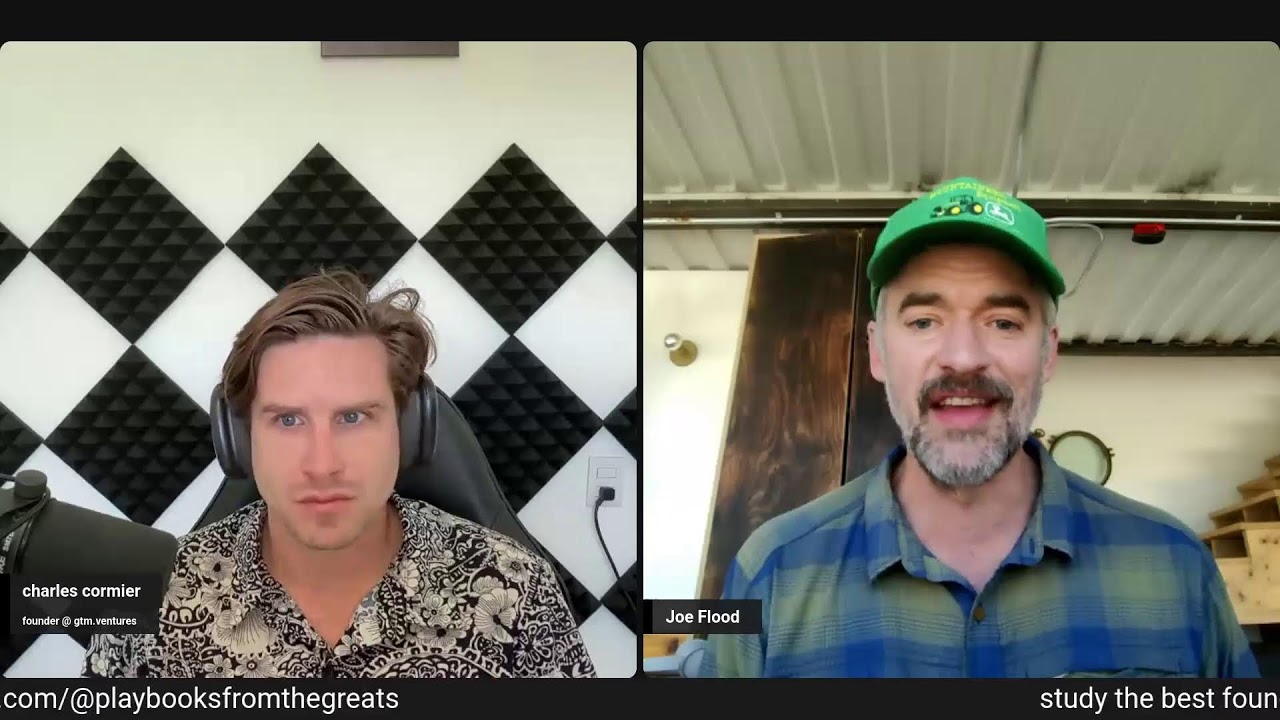
Joe Flood left journalism to start N2 Communications, a consultancy that applies investigative storytelling skills to corporate clients building fundraising decks and reports. He explains how the collapse of newspaper advertising pushed journalists toward new models like Substack, and how N2 uses talent arbitrage to translate complex subjects for different audiences.
Chapters
Welcome to another Founder Wisdom podcast. We have Joe Flood with us today. He's the founder and CEO at, uh, N2 Communications, a reporter and author, Substack writer on, uh, data, AI, and history in Kyle, South Dakota. Uh, Joe, welcome to the pod. Tell us a bit more about yourself and what you're up to.
Thanks, man. Actually coming from Manderson, South Dakota. I moved down the creek a bit. Uh, but, uh, probably, probably doesn't, uh, that doesn't mean a whole lot to, uh, the audience, but in the Badlands, South Dakota. Thanks for having me on. Yeah. Where should we, where should we kick things off?
Yeah, well, you briefly told me about your story. You were archery coach, quite intriguing, then guess became a journalist, you saw the writing on the wall, maybe start with that writing on the wall, right? Because even to this day, there's still journalists, I'm not sure what they think will happen. But with AI, it became like super duper obvious. AI was before, was, yeah, after your time, right, when you saw the writing on the wall. So yeah, what happened? What made you think about switching career?
Social media was the big problem for the sort of journalism industry and publishers of any kind. That was the big thing that essentially you go from this world where journalism that worked well in certain ways but had essentially an advertising monopoly before, actually even before social media. Craigslist is a good example of that where The only way to do all these things used to be the want ads, the personal ads, all these places in a newspaper. And then suddenly with the internet and particularly with social media, they just lose that advertising monopoly. And so the industry really struggled to pay people well after that. And particularly for what I did, journalism still is— I never really used the term journalist because it's so broad. I was a reporter.. I wasn't a commentary person. I didn't do opinions. I wasn't, you know, talking about sort of political horse race stuff. It was reporting. You gather facts and you gather new facts that are relevant to what's going on in the world and you put them out there. Um, and then, you know, what the, the, the rest of the journalism world sort of comments on that, right? They talk about the implications of it, but there's very few people who are doing real information gathering, new data, both in the form of literal spreadsheet data, but just sort of any information. I'm using it kind of broadly because I was in the sort of investigative journalism world, data journalism, things like that. And those worlds are hard and they're expensive and the stories take a long time. And journalism, as the money started to dry up, it increasingly did not spend money on those kinds of stories. And so in the freelance world, this is particularly obvious because the rates went way down and Things got clickbaitier and all that. And so I had started doing some essentially the same work from a skillset standpoint as a consultant for companies. You know, like I started with actually a former journalist friend of mine. He had been after college, we were in college together, worked for the newspaper in college together. He became, went to the Marines and then went to business school and founded a data science company, co-founded a data science company. And so I started doing the same kind of work I'd always been doing for him. I was gathering new information, analyzing data, thinking about the audience that we were talking to. How do you tell that story as compellingly as possible? How do you do all these sorts of things? And so N2 really became the model from there of like the, with social media, newspapers lost a ton of revenue and a ton of attention. Uh, and so that really hurt, you know, like 80% of newspapers don't exist anymore. Like, it just— they're gone. Um, and those jobs are gone. The industry was just utterly, utterly decimated, uh, particularly, you know, the real reporting stuff, not sort of commenting on things, on things. And so, um, I needed to get paid. I knew there were a lot of people like me that needed to get paid, uh, extremely competent hardworking people working in an industry that were extremely committed to it. And so the other flip side of social media was that it sort of allowed or forced companies to become publishing companies. And publishing's a specific industry, and like any industry, it's always had problems. I don't think publishing industry's downfall over the last 10 or 20 years it's not so much about that they were so bad at publishing itself. In fact, the industry was pretty good. I think we've seen an incredible collapse of honesty, fairness, accuracy, all these sorts of things as the industry has collapsed and all these new things jump in and they're not as good. They just don't have the ethics. They don't have the work ethic that I think a lot of the old school newspaper industry did. The issue was a monetization problem. And so what I knew about storytelling from a world where people focused pretty much exclusively on storytelling and got paid okay to do it, you know, enough to be middle class, you could bring those best practices to these other industries that had no idea how to do this work. And you could really find huge gains to be had because, you know, why would a tech company know anything more about publishing than a publishing company would know about tech? And famously, publishing companies have done a really bad job of understanding tech and adapting to it. And so that was really our, you know, talent arbitrage, which is the heart of any consulting company, that you have a skill set and a group of people that work in a certain kind of way, and you can bring them to other industries where they can do that work in a way that's valuable to the clients. So that was really at the core of starting the company.
If investigative journalism is useful for society to some extent, right? Because I think some of them just profit from dissing people, which is disgusting, especially when you diss founders and CEOs, my favorite people. But is not profitable, like investigative journalism is very expensive and long and you need to publish a book or whatever. How can we keep on making it profitable? For example, I'm using AIs nowadays to write a sponsor of this podcast. It's called The Greats and we cover founders and CEOs' biographies. We use NotebookLM to scrape all that content about founders and CEOs, right? And we'll scrape the full web. The web is generally good. I know that investigative journalism is more than that. It's like talking to people, asking questions and so forth, which is a pain. Obviously you could still use AI to do that, but be a bit weird. Michael, yeah, my question is sort of how can we keep investigative journalism up if it's not super profitable? You have a Substack as well. Love that business model. So tell us a bit more about that.
Yeah, I mean, Substack is a really interesting example of a place where, you know, that has sort of adapted to a more of a creator economy versus what used to be a sort of like institutional economy that lived off of an advertising monopoly. Essentially, and then subsidized, it paid for the journalism. And I think that, listen, it's tough. A lot of things aren't that profitable without certain kinds of help. And I think there's a lot of problems that happen in journalism. One was just the spoonful of sugar that helps the medicine go down. I think the thing we realized was newspapers always knew that the sports section and the business section, uh, and like the gossip pages drove sales to a large extent. Um, and the, the idea was that you always had— that you had those sections, um, and then you also had investigative sections and the literature section and the art section, which didn't just focus on the most popular arts, right? Because it was on like, get out there to go see the— go see this theater project, go see this small thing, go see this new band, you know, like not just the things like go see the thing that everyone's seeing anyway. There was a realization of that. And then once we had the analytics though, 'cause you didn't really know, like people bought a newspaper, you didn't know what they read. But as soon as you could see with like content analytics, it became very clear what was really driving this. And then suddenly people were like, wait, why don't we just have a sports page? We'll just do, we'll be a pure sports page, a sports website alone, ESPN and a million places. We don't need to bother paying for investigative journalism. We'll just save all that money. It's not gonna hurt our clicks. ESPN in some places did continue to do that stuff for a long time, but because there was a prestige attached to it and things like that. I think it's extremely difficult. I mean, we've had a million different iterations of this is how journalism will work. It'll be funded by billionaires. Hasn't worked great. It'll be funded by nonprofits and sometimes there's some stuff there. I'm not entirely sure. I think one thing we'll see is simply that we will start to lose a lot because we don't have journalists. If you don't have a local journalist, local corruption is incredibly easy to commit. It just is. It's not very hard. It's extremely easy to just have kickbacks between all kinds of places, to have corrupt dealings and all that sort of stuff, because who's going to find out? If there isn't somebody digging around. And that is a tough thing. And I think a lot of people are very critical investigative journalists. Frankly, a lot of people like that, they're not always the easiest people to get along with. They're not, you know, like they're sort of tough, hard-nosed people that get out there and do that work. And so, you know, I think that question is up in the air on how this is gonna work. There are still places that do it. You know, there's still a media ecosystem that lives off of an investigative reporter breaking new info and then a million other people blab about it, uh, on TV and podcasts and sort of like make their living that way. Um, but you know, it's a hard business to crack.
I think, uh, the stack would be like around what I mentioned. So NotebookLM, like deep AI scraping, AI interviewers, but also like mention the ethics of investigative journalism. It's like, hey, I'm making money off exposing this, you know. And maybe some disclaimers as well when you expose people, because some people might be liars, but they did bring some good to society. And I feel that sometimes, like, misrepresented in investigative journalism. Uh, for example, Jay Shetty, right? Like, Jay Shetty, the meditation guy, lied about a bunch of things about him, uh, but still a net add-on for society. I feel he brought meditation to the masses, or Uh, say Bear Grylls, right? In your days, Bear Grylls, uh, he was claiming to survive in the wild, but, uh, it was all manufactured, right? Like, he was like sleeping in a motel while, uh, eating elephant shit, you know, just for stunt on the camera. But still, the guy brought a lot of value to this world. So I think it would be with this caveat. Talking about your background, right, it's pretty fascinating. You started at Harvard, you wrote for the Harvard Crimson, then investigative journalism, then archery coach. Like, tell me about that. That tangent seems like a passion. Then, yeah, your own Substack, your own podcast. Like, tell me, tell me about like who you are as a human being. Do you just like touching as many facets of the equation to get as much data as possible, or is it more of a Nicky Guy play? Tell me a bit more.
Yeah, I mean, I think that's pretty well put. I'm always interested. I mean, I just get really interested in stuff. I mean, that's kind of the bottom line. And like, I don't, I never really had a lot of preconceived notions about what I needed to do in life. You know, my dad dropped outta high school to go into the Marines. My mom had worked her way through college bagging groceries. So I was really lucky in that way. I was like a deeply middle-class kid in that way, right? Like one parent went through college. She's the first one in her family. One parent didn't graduate high school. So I got to see all these sort of different worlds and they didn't really put a lot of pressure on me to do— I went and studied up and got myself a partial academic scholarship to high school. I got into Harvard and they said, "Ah, you seem to be doing all right. Do what you want." And so after college, I was really interested in teaching because good teaching is what gave me a chance. I didn't grow up that hardscrabble. It was suburban Massachusetts. You know what I mean? Like, it wasn't like I wasn't like growing up in like some, you know, heinously dangerous kind of place or something like that. But I wanted to get out. I have big dreams and ambitions. And teachers are what let me do that stuff. They gave me those opportunities. So I'd gone on some service trips. I went to a Catholic high school outside of Boston, very much a service-oriented school. Like that was kind of the job one of what they instilled in you along with, you know, hard, you know, basic education stuff, uh, and a lot of sports. Big, big jock school. I always loved that. I, you know, played sports all through, all through my life. But, um, and so I'd gone on a trip in, you know, like a spring break, alternative spring break type thing to bring the suburban white boys, uh, out to, uh, somewhere else. And we'd come to South Dakota, uh, Pine Ridge Reservation. There's a school out here, um, Red Cloud school, Makhpiya Luta in the Lakota language, that had a volunteer program. There was a guy at the time who was, you know, I was a junior in high school, he was fresh out of college, and he was a volunteer at this school. He'd gone to my high school, and so I was like, oh cool, this sounds like a cool thing to do in 5 years when I graduate from high school, or excuse me, when I graduate from college. And then it was 5 years later and I was graduating from college and it still sounded like the coolest thing I could do. And so came out and was a teacher a coach, bus driver, all kinds of stuff like that. And then fell into archery kind of randomly and really fell in love with doing it, just shooting myself and learning how to make bows. And like, you know, bought a kit online and made my own crappy bow and then learned how to make better ones and, you know, bought sort of more competition hunting type bows and sort of fell into it when I was at the tribal college, Oglala Lakota College here. And was the archery coach at the college for a number of years. We were 2013 men's and women's national champs, US Collegiate Archery Association. A lot of success. My former student, an archer, she now teaches at the college and she runs the team nowadays. So yeah, so I've always sort of fallen into— journalism was great, and why the work N2 does is so interesting because you get this chance to dive into these worlds. What did I know about the dead middle of America coming from the suburbs of Boston, nothing. And so I've kept my ears open and asked questions, learned a lot. Journalists, same thing, all the worlds I covered and things that I got into. And then it's the same work with the work we do as a company. You know, like our thing is like the client's story. Like that's our laser focus. It's what the client, we don't have rules, we don't have models, we don't have like a series of like, you know, templated best practices we work off of. We got a lot of repetition. To choose from, but our thing is that every client has their own story and they're telling it to a different audience. A lot of times we deal with sort of B2B audiences. We do a lot of work with LPs, limited partners, with investors. In other words, we do a lot of work there with fundraising decks and quarterly and annual reports, newsletters, podcast production, stuff like that. Do a lot of work there. We do a lot of work in technical documentation. That sort of the really nitty-gritty nerdy stuff that like, you know, are like when you're filing RFP responses, you know, you file a bigger technical response to build a building for, you know, a government or something like that. So we work in these really sort of diligent niche-oriented sort of subspecialty parts of these big worlds. And I don't know, I've always found that fascinating. You get this like learning curve, you know, like working for a hedge fund deeply, it's It's like getting paid to get a master's in economics, you know, like all these sorts of things that like, you know, I always thought about that. I never went to grad school. We have a ton of people that work for us who are academics and went to grad school. And I always joked, it was like, you know, you get, you can get paid to learn a lot of the same stuff by doing, you know, when you get to dive into these companies because you get right to the nerve center. I mean, that's the cool thing about storytelling. You're talking to the founders, the CEOs, the stakeholders, you talk to the real, the technical experts, you know, the forward deployed engineers, whoever it is. And these worlds are so fascinating to dive in and learn about it. And then you get to do what I really think is the core job of a storyteller. It's translation. You know, you've gotta know something well enough that the people who really live it are like, yep, we sign off. This is real. I was just listening to a Taylor Sheridan interview, you know, the Landman, Yellowstone showrunner. He's saying like, Yellowstone, I made it for ranchers first. It had to pass their muster. Landman, it needed to get by the roughnecks. It needed to get by the people who do these things in real life. But then the next job is how do you translate that to a couch in the suburbs or wherever, anywhere, like city, suburbs, rural, whatever it is? How do you translate that to somebody who has a different experience and doesn't understand these worlds? How do you make this real so that they say, in our case with N2, they say, maybe that is how our pension fund should invest. Maybe I should look at, use, like hire these guys, make, I should be a customer of this service, this product, whatever it is. And so that core sort of storytelling thing translates. I like to say we're very broad and we're very narrow. Like we do, storytelling is very big, but we're not a PR company. We don't reach out to journalists and run influence campaigns. We do a little bit of marketing campaign here and there, stuff like that. But that's not at the core of what we do. We're not like a placement firm, like a consultant that gets you in front of investors. They get your pitch deck in front of investors that'll hopefully invest in you. But we create the content that those firms use. We tell those stories. That's our sort of laser focus, but it means we get to work in all these cool, broad, diverse places. And you get to be a little mini expert in all these things. And that's always been journalism, teaching, all these things were jobs for me that, because I was like, it was an excuse to learn about stuff. And then have fun trying to figure out how to tell it to different people and help them learn. I was just always been a learner, you know, uh, and making it easy for other people to do the same has always been kind of my thing.
Is it still profitable to own a publishing— a news outlet like the New York Times, for example? And have some research standards gone down? I know that, for example, New York Times is partly owned by Carlos Slim. There's Washington by Jeff Bezos. Is there bias in there? For example, New York Times, it really struck me not so long ago when they covered the one-man billion-dollar company Medvy, right? And they totally forgot to mention that this company was under FDA investigation. That's like basic journalism 101 and just like one AI search away. But like the full article is about being like, holy shit, this This is crazy. So, so good, right? While the full company is a cautionary tale in waiting, it's like an FTX unraveling right after— right under our eyes. So two questions here: is it still profitable to own such a company? And two, have the standards diminished, generally speaking?
Well, it's— I mean, the New York Times is a profitable company, and there's a number of media companies that are profitable. Even the really, like, these— right now we just, you know, NBC, Comcast, Universal, they're spinning off the, the cable channels, and we just saw this with these different mergers that's happening in this world. These are still profitable companies, these cable channels, including news channels. The profits are shrinking, but they are still profitable. So there are places. What's really changed is that there's no longer— it's no longer profitable to run a local newspaper in the ways that it used to be in these independent sort of places. And as far as bias goes, bias is inherent. 'Cause you have humans involved. And bias is inherent in AI because humans built it and humans trained it and humans dial up the temperature or dial down the temperature and humans weight things and all that sort of stuff. Like it's inherent to what's going on. Objectivity is not possible. But that doesn't mean we shouldn't strive for it. And I think that's something that gets lost in that. I think it is, you can always find bias in anything that happens. Anybody, you know, like it's going to happen.. But I don't think that's an excuse for not trying to be as unbiased as possible. We get into this, yeah, but ism of like, well, this other person made a mistake, so I'm totally justified in doing whatever I want. It's easy to fall into that real moral relativism stuff, which is an interesting philosophical argument, but not one I particularly hold. I grew up Catholic, Irish Catholic, Catholic schools, stuff like that. I think that there is such a thing as sort of truth and we can, and like good service and good deeds and we should be striving for them. But yeah, it's inherent that there's always going to be biases. It's going to be really hard to, it's hard to bite the hand that feeds you and continue to come in and have it continue feeding you. And so people are naturally going to move away from doing that. So you have to find ways to sort of fight against that.
Seems you've engineered like an ideal life for yourself, right? Like you're quite different from normal founders that I speak that go into the grind. Your clients, are they organically attracted to you? Do you get fully like referrals or do you have actual go-to-market systems to get new clients?
We very much do not have go-to-market systems. Sales funnel, et cetera stuff. We're pretty bad about that. It's a thing we started to do a little more. We mostly live off referrals. We stick with clients. Of course, we work in the tech world. There's a lot of turnover in the tech world, right? So inherently you're gaining, losing, some things aren't great fits, but by and large, we keep clients for many years. I mean, we have clients we've had for 10, 11, 12 years. And so that's as anyone who's been to Got an MBA, I'll tell you, far easier to keep a client than to gain one. Far cheaper, far easier. And that's one of the biggest ways is that we keep most of our client base. And then yeah, referrals. People that reach out because they've heard about us from a friend, people that go from one company to another. We love venture capital and private equity firms that refer us to portfolio companies. That's always awesome. You get that foot in the door., because you're, you're, you're kind of white labeled. You're like a trusted, you know, vendor that, you know, does what they say and stick around and, you know, you're there, uh, and you fix mistakes. Um, so that's, you know, of course, always happy to have more. That's our biggest challenge is always growth. We're, we're ready for more. Um, so, you know, thanks for having me on. Way to get the word out.
Yes. And your Substack, right? Like, yeah, isn't, isn't that like exposure from you? And you can be like, hey client, you should start your Substack, whether it's like a free funnel to attract people, or you could even have it paid, and, uh, that could be a monetize— an entirely new monetization channel for you.
Yeah, absolutely. We do a lot of Substack work with clients that, you know, helping edit, write, build, you know, and, and then just manage, because there's a lot of process management. I, I joke sometimes, you know, like, the thing that people forget when they— or they never knew in the first place when they're figuring out how to do a publishing organization, how to tell these stories at scale, is that there's a masthead on a magazine, if you remember, a newspaper. There's the byline, right? The person who wrote the story. There's usually a name with the photographer, but then there's this masthead in it, particularly back in the day, long list of people, and it was sort of unclear what they did, but they were so involved in all of it. And it's a lot of those parts and people and things like that. And that includes everything from fact-checking, copy editing, scheduling sends, dealing with problems, all that sort of stuff. So we do a lot of work with clients on Substack and that space. My Substack is mostly my old journalism. It's really, it's mostly been, I have a, I got the audio rights back to my book that I wrote about New York City in the 1970s. The city kind of burns down and goes bankrupt. It's a history of how that happens. And so I, back then there weren't as many audiobooks getting produced. And so my publisher, Riverhead Penguin, was kind enough to give me the audio writes back and said, like, go for it, go right ahead. So I do sort of like a weird— I called it the, um, I called it a, um, what was it, uh, video podcast audiobook, uh, is my jokey term for it. But it's basically sort of an audiobook, sort of a video thing. We're looping in archival materials and images and things like that as I basically sort of read and riff on the book. So it's kind of a, it's a kind of a history podcast, and we publish a transcript and stuff like that too. So that's actually much less end-to. That's very much just like me doing it to sort of scratch that creative itch. But yes, I certainly knew about Substack because we do a lot of work on it for clients. It's a great place to publish. You find niche interests, you find niche audiences. Maybe it's a loss leader, but we have a lot of clients that do good money on the subscriptions, usually because they have really good proprietary data. There's something that they are doing that's producing research that no one else is, and people will pay for it.
What's next for you? What are your top goals for this year?
Well, I mean, I think, you know, as a company, it's always growth. You know, I think it's inherent that we only do— we work with like great companies, you know what I mean? That we— companies that like— we like, that, you know, kind of get how we operate, we get how they operate. And so we're sort of laser-focused on growth wherever we can and figuring out new clients and new projects and things like that. Where does this world shake out with AI and technology changes? That's always a key thing. I think ultimately, whatever the— ultimately, key skilled people at the wheel are the important thing for anything. I mean, I think about music, right? Beethoven needed a whole symphony orchestra. Timbaland, Dr. Dre, laptop, drum machine, very little, but they need far less than Beethoven did. But you do need to be Timbaland or Dr. Dre. I don't suddenly turn into a genius record producer because you put the record machines in front of me, because that's not a skillset I have. It's not a thing I've spent thousands of hours working on. Ultimately, the best stories are gonna be told by the people that work the hardest at storytelling. And that's really at the core of what we do is line up the best writers, producers, all these sorts of people with companies to tell those stories. So like, you know, but you know, navigating how technology changes, where the investment cycles are running, all that stuff is, you know, always a fascinating and interesting one.
That's super interesting. Yeah, I'd love your background, everything you're up to. Yeah, I can see lots of, uh, lots of potential on the business side of things, even if it seems like more of a lifestyle business. Is there like some scalability to your business? Uh, could, could it be sold one day? Uh, or is it just like pure cash cow type of business?
Um, you know, that's— it's a great question. I mean, like, M&A acquisition stuff is not really my, uh, you know, forte and things like that. But, um, you know, scalability was always a key part of what we did. Services companies don't scale the way that like SaaS does, for example. You know what I mean? I mean, nothing scales like SaaS. AI doesn't scale like SaaS because of the compute needs. You know what I mean? Like you have to recompute every single time. It's quite expensive. It's not like printing another copy of a piece of software and shipping it. But services companies can scale to a large extent. You know, like there are law firms, consulting firms, talent agencies. There are places. So we always looked at these kind of business models of how these places grow. And for me, my ideal position is sort of like absentee publisher, a Conde or a Nast or something like that. You put people in charge of their publication, of that client, of that project, and then you give them room to operate. I think that, I like to think that I hire great people. They don't need me staring over their shoulder all the time. I come in, I like to edit stuff and get last set of eyes on a lot of things, especially big projects or clients I really know well. But it scales if you have really good people that you put in place who can run their stuff. I almost said not stuff. I'm not a teacher anymore. I will curse a little more in my normal life than usual, but kept it clean there. People that run their stuff, they don't need— that's a scalable operation because you just give them infrastructure. And they can do it themselves. If you don't need to have this central command and control sort of structure where there's a bureaucrat at the center who's poking into everything and meddling in people's businesses and things like that, that's not how great stories are told. The movie industry used to have a lot fewer executives. I referenced that Taylor Sheridan interview I just heard yesterday on the Bill Subbits podcast because I think it's really interesting. He talks about back in the '70s when there were so many great movies coming out, you had a producer, they let writers and directors run free and do their thing. Nowadays, it's a ton of people in suits who like have a lot of thoughts on creativity, which is not their focus. You know, they're marketing folks or they're like, you know, business folks or whatever. I love, I get to like, and in my business that means spending less money. I don't need a lot of bureaucracy. I let good operators do their thing and tell those stories. You line them up with the clients, they handle it. Then my job is to go out and find the next client, find the next person to run that story and really tell it for that client and move on from there. And what N2 does is provide infrastructure. You know what I mean? The billing, the insurance, security, all these different things that you can turn someone who might be an independent operator, like a one-person consulting shop, Suddenly they can become a whole team because I've got talent I can line them up with and because I've got infrastructure for them. That's really kind of our play in a lot of ways. And it's why we have awesome, awesome talent because they get to show up and they get the freedom and the creativity of running their own firm, but they get a little bit of that scale and reach and ability, you know, and sort of like deal flow of something larger. And so, yeah, I mean, we found that you can scale quite effectively. I mean, you know, what things that we do all the time, we set up these projects Sometimes like large RFP response projects. You're just building like a, essentially a hundreds of thousands of dollar operation from our side to get a hundreds of millions of dollars contract. You build it up and then you shut it down in the course of a few months. That's scalable. You just need more reps because you can do more and more of them as you go. It's the same way film works. I had some time, spent some time working independent film for a while. And it's the same thing. You build a, or large films. You build a company and then you shut it down. If you can just figure out what that sort of connective tissue is for the publisher, for the production company, that makes it more efficient to build those companies and tell those stories, and then if needed shut them down because the movie's done being made or because the RFP got, you know, got awarded. You know, you can keep on doing that stuff over and over. The publishing world was always pretty scalable in in these ways, in that way. It just lost its monopoly on advertising and on attention and it hasn't quite figured out what to do about that. But to my mind, the core people telling those stories, my job is to get them paid, get them a job, get them a career so they can keep on doing that stuff and telling those stories 'cause I think it's such an important role for society. And so we get to do that and like I said, we're not scaling like a search engine or anything like that,, but we're able to scale really effectively because we're decentralized, because we give people freedom and creativity to tell those stories the way they think is best. And like, and stay laser focused on what the client needs. You can build up and you can scale and you can grow and you can add partners and you can add, you know, we do a ton of work with a lot of what initially people would say like, isn't that a competitor? You know, like it's not like, it's like a, you know, vendor and specialty vendors and things like that. And my thing was always, there's no such thing as competitors. There's just unrealized partnerships, which again is part of the storytelling industry. You look back and it's like, you know, these big TV networks, right? They might predict, like NBC would be running shows that were produced by CBS all the time, you know, and like buying movies from here. And like, these are industries that have always, because you're cobbling together these storytelling units, it's the most efficient way to do it. They were always competing with each other, but also doing tons of business with each other because that's the way that, because artificial impediments to telling these stories is no good. And so we're able to do a lot of that. We scale with video firms and with production companies and specialty firms and things like that. So we've always found it not easy to scale, but very much doable in a way that that sort of old tired dogma, services don't scale, I don't know. There's plenty of skilled services companies out there. So if it's impossible to do it, why is it happening all the time? It's not as easy as other businesses maybe, but it can still work.
Yes, it's interesting nonetheless. Joe, thanks for being on the pod today. Where can people find out more about you?
Yeah, check us out. N2 Communications, n2comms.com. That's letter N, number 2, comms.com. Sort of a spin-off of the, the logo I have my old podcast Numbers and Narrative. Um, so, and yeah, you can check us out there. And, um, yeah, I think we're like a phenomenal group of really committed, dedicated, earnest storytellers, uh, who've been lucky enough to figure out a way to do that for great, mostly corporate clients in an environment where it's tough to be a storyteller these days.
Yeah, there you go. That was Joe
More from Charles


Founder Wisdom: the audiobook, version 2 (5 hours of stories from founders and CEOs)

8 CEO Questions I Love Asking: the audiobook (64 founders answer, in their own words)





