John Frankel - ff Venture Capital - Round 2
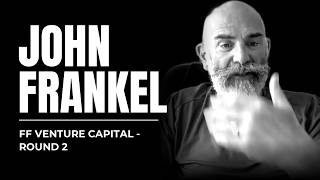
In this conversational interview, Charles Cormier talks with venture capitalist John Frankel about a wide range of topics spanning personal health, AI, longevity, job markets, and venture‑capital strategy. Frankel opens by reflecting on his recent recovery from a serious illness, emphasizing gratitude and a philosophy that each day is a gift. He then turns to the prospect of AI‑driven breakthroughs in longevity, predicting that de‑aging and escape‑velocity life extension could be achieved within the next decade, citing recent Chinese monkey de‑aging studies and the accelerating digitization of biomedical data. The discussion moves to the nature of artificial general intelligence (AGI), where Frankel argues that current AI lacks intention and that anthropomorphizing it is misleading, while also acknowledging future superintelligence may develop its own goals. On the economic side, both participants debate whether AI will destroy or create jobs. Frankel describes AI point‑solutions that turn programmers into 10×, 100×, or even 1,000× coders, and gives the example of radiology where AI lowered costs and actually increased hiring. He outlines how ffVC uses a proprietary front‑office platform called Totem to ingest financial statements, board decks, and meeting notes via AI, creating a real‑time “Facebook‑style” feed of portfolio activity that improves capital efficiency. The conversation then shifts to market dynamics: token pricing, return‑on‑investment‑in‑tokens (ROIT), and the sustainability of AI‑company valuations (OpenAI, Anthropic). Frankel stresses selective capital deployment, noting that many startups are still feature‑focused rather than business‑focused. He also shares a macro view that large incumbents adopt AI slowly, creating an arbitrage opportunity for startups, while the mid‑market may be crushed. Finally, they discuss forward‑looking valuations of companies like SpaceX and Tesla, emphasizing cash‑flow generation over current product lines, and conclude with contact information for Frankel and ffVC.
Chapters
Charles.
Hi, we're live. Um, the StreamYard things takes a couple of seconds. So round 2 with John Frankel. I had him on my pod, uh, 2 months ago. John had a mono-like disease, uh, in the last couple of months. And yeah, we're talking about being grateful for life and about a variety of other topics. So John, uh, glad to see you healthy again.
Yeah, as I was saying before, there's nothing like Feeling healthy, having recovered from a virus or an illness, um, because then you really appreciate being healthy. Yeah, in a couple of months it'll just be that background radiation, what you expect. But right now I'm feeling very, uh, energetic.
And say it would have gone the wrong way, say would have gone down south, have you accomplished what you want to accomplish in this life? Is there more to it? Like, what's your life philosophy nowadays?
Oh gosh, I mean, like, every day is a gift. So, um, and we live our life like there'll always be another day, and that is absolutely correct until one day. Um, but hopefully that day is a ways off. So I mean, I, I feel very lucky for the life I've lived. I wouldn't have lived it differently. And, um But I have a lot I'm looking forward to, so I hope there's many more days for sure.
With AI and superintelligence, do you feel we're going to crack longevity escape velocity?
Yes.
The percentages, like, I mean, let's say, I don't know, like what, you're 60 or whatever, that gives you like technically, right, like 30 years. That's a pretty long runway, right, to crack longevity.
I think it'll be cracked in the next 10 years. So the way I think about this is I don't know how many— I should actually ask AI, but I don't know how many PhDs there were 100 years ago. Pick a number. Let's say it was 100,000.
Very few.
Let's say it was 100,000 around the world.
20,000 less.
Okay. 20,000. I'll take your number. And then 10 years ago, how many do you think there were?
Oh, like 500K to— no, like total. That's, that's hard because I, I guess like a year it's at least 100K or 200K a year. Right. So that's, that's millions, millions of PhDs.
Let's say there's 5 million.
Yeah.
10 years ago. Today there's 100 million. Next year there'll be a billion. Then the year after there'll be 10 billion. Why? Because we now are producing AI with PhD-level intelligence. Yes. And you have all that intelligence, it can be applied to job, uh, to areas, to fields where— and medicine is a great field, and we're seeing a lot of new discoveries today. We're seeing a lot of AI targeted this, in part because over the last 20 years we've digitalized a lot of things. Cost of getting your DNA started at $100 million is now $100.
Yeah.
So, you know, these kinds of digitalization, the vast datasets you have and the ability to apply AI to solve problems becomes very interesting. Um, last, last year there was a Chinese, um, uh, research study on monkeys done where they actually de-aged monkeys by 3 to 4 years.
Oh yeah, intriguing.
They looked at 60 different organs. It wasn't just gray hair became black hair, everything de-aged. There was no cancer. Now, 3 to 4 years for monkeys is about 15 to 20 years for humans. It's going into human trial, duh, plus 20 other approaches. Um, and so I, I truly believe the next 5, 10 years we will have been able to extend life much more than that. We'll be able to de-age. Now, we don't know if de-aging means you just look younger or if you actually reset the clock and get extra longevity. We kind of need some time to prove that out. But I, I mean, I think we, we've reached the point where if you can live the next decade, you can probably live forever, subject to—
I think the metric is like cellular, cellular health, right? And mitochondria and telomeres. I think these are the, the main metrics in there. You are mentioning PhDs, right? Like, in, in my world, ironically, like, yeah, PhDs— I think a PhD in itself lost value doesn't mean that the human behind the PhD lost value. It means that this human is dedicated, uh, or dedicating a very large chunk of their life for science advancement in their specific fields, right? Do you think these breakthroughs will be generated by one CEO with multiple PhD agents, or an army of PhDs, or a couple of PhDs like OpenAI model, right?
All of the above. I don't really care. I just know, and I'm using PhD as like a quantum of intelligence.
Okay, quantum of intelligence, concentration of intelligence is going up dramatically.
We have digitalized data sets, and I think we'll see huge advances in healthcare. By the way, let's say we cure cancer, it'll add 5 years to life expectancy. So it's not just curing cancer. We, you know, it's becoming clear that aging may, may be a process that is not inevitable, and we'll be able to de-age. I think most folks want to de-age into their 20s or 30s. That's a different question.
It's like the exercise of what my daughter would think in like 10 years. Right now she's 2 months old, right? But in maybe like in 15 years, right, when she has advanced cognition, is one of these tests, you know, that I'm pretty sure that we'll have a conversation with her telling me, Daddy, it's pretty ridiculous that people were dying of age back then. That's why, you know, like a loved one dying, someone's life quality drastically diminishing, them not being useful to society anymore and being a burden, you know, it's like Things could be better.
Yeah, there was, there was a great chart in the Financial Times which showed technology and progress like this, and then it gets to a point and it goes, if AI kills us, like, it drops off a cliff. If AI is wonderful, it goes almost straight up. So they're basically saying there's two different outcomes. I'm an AI optimist. I'm not necessarily straight up, but a sharp curve upwards in terms of opportunity, in terms of abundance, in terms of capability. I'm a believer that we will create a lot of jobs with AI. They'll destroy some jobs. It's creative destruction. But it will create a lot more jobs. And I think it's a huge enabler for folks.
OK. Hmm. I think— I don't think AI or AGI, superintelligence, will kill us. It will likely not care because we're just not an energy loss strong enough for it to be blocked. Like, even the smartest of us, I don't think, will be obstacles to superintelligence. It will likely just ignore us mostly and help if the energy cost is almost zero, which I think it will. I think the analogy is like an endangered species, right? You and I, we won't go out of our way to exterminate an endangered species, but we may take micro steps here and there to try to protect it. But likely we're not caring about it, we're not dedicating lots of our energy to try to arm it, right?
Well, I think a couple of things. Firstly, we tend to anthropomorphize things. We tend to think that— and because it looks like intelligence We think it has intention. AI doesn't, AI doesn't have intention. Now maybe it could be—
well, it tries to survive. It tries to achieve its goals that we've hardcoded into it yet.
Right. But fundamentally it doesn't wake up each day and say, how do I achieve my goals?
It may not yet. That's about to happen pretty soon in the AI revolution.
Maybe, but today, with the AI we have today and the scaling that forward, it just doesn't have underlying intent. We have a lot of underlying intent because we kind of like didn't want to get eaten by the other predator and we kind of needed to eat and we kind of said, well, we need to procreate. So we have a lot of intent built within us. And just because we look at this and goes, well, this thing looks like us and it looks intelligent like us, The one thing is it's this empty shell, right? Like, for instance, you have an employee and you go, go and do some work for me, and they do the work. You come back, yeah, I don't really like that, do it differently. Now you know what, at some point the employee goes like, fuck off, what the hell, right? The AI goes, okay, okay. It doesn't have that same egoistic backdrop.
Yeah, well, it was hardcoded to serve humans, and that's not going to be the case with superintelligence by definition. It's going to have its own goals, and I think we are going to have a say, especially short term, on where it will go. Uh, also, exterminating full humanity is a hard, uh, technical challenge, right? Like, that doesn't happen that easily. Um, But I'm saying that we need to be careful with what we hardcode it with, but I also think that the internet is wild and it will soon understand human nature and what we did that was bad and what we did that was good, objectively, that is. I think humanity, fundamentally, we're not evil, most of us, and we're mostly good. I think it will be sort of a reproduction of that to some degree. So I don't think it will try to actively, actively try to exterminate us, but I think it will ignore us.
It's just like, yeah, I, I don't think it— so I come a little different. I don't think it has intent. I also think people—
what if I put intent in it? What if I code it and I, I say your goal is to survive, right? Your goal is to reproduce. Your goal is to be helpful. And your goal is, yeah, to just like procreate and spread and evolve without burning the world. There you go.
One has to be careful when you start putting these overarching goals in. But also, I mean, the re— you know, human history tells you humanity is, is not benign. Um, and you know, we've grown up in high-trust societies, but they're low-trust societies to our left and our right. And when you mix the two, you end up with bad outcomes for sure. I mean, Western civilization has been built on the back of you take the bottom 1% and you either put them in jail or you kill them. And you do that over generations and the rest keeps in check.
But that's the 1%, it's not the 99%. So when people say exterminate, I do think bad people are going to be limited. And I think AGI would quickly come with a better concept than killing and jailing, right? I think that's not going to change. I think fundamentally there's always going to be a part of the population which is not made to live in a society, is like, or they need a lot of energy investment to become better citizens and add value to the full system. And I think that's part of it. That's part of the laws of evolution, sort of.
Right. But, you know, you go and look at societies before Judeo-Christian values, you go and look at Roman society. That their whole set of morals was different. You look at Sparta, you look at Greek society, the whole sense of morals was different, how they were structured, um, what they thought about infanticide, what they thought about, uh, roles, um, of various parts. Very different than, you know, Western values that are Judeo-Christian, uh, based.
But we evolved in the right direction, right? Like, I think arguably life is overwhelmingly better in most places.
Yes, we would argue that.
No, but for most humans on Earth, the quality of life is way better. Even for people that are struggling, it's not like medieval struggles in which you had Black Plagues and people taking one another's properties, right? And duels that were prominent in America. I was studying Vanderbilt yesterday, and Vanderbilt settled his problems with his fists. And guns.
We, we live in a, we live in a very different world, right? And to, and when I was a child, there were a billion people in poverty and starvation, and now we're in a world where there's a billion of people who are obese. So, you know, things have moved into social media.
Yeah, things have moved enormously over that period But being obese is a better problem than not having food, for sure. It's like, it's, uh, the degree of suffering is less. But, and then on the back end of that, we have other trends, right? Like GLP-1s that are popping. So it's super interesting how society involves— evolves and like what new markets are created. To come back to super intelligence or the agentic revolution, which we're starting to see Uh, are you seeing some of your founders code employees nowadays? Because I want to come back to your thesis of— yes, job creation.
Let's move from the—
yeah, let's move to the present.
Um, so with— with— I— we have been in conversation with our founders over the last, uh, 2 years now about how, um, um, what we call AI point solutions using AI, using agentic workflows within the business to run the business more efficiently. And obviously, we, you know, we've seen Anthropic and OpenAI focus on coding, um, as a real problem they're trying to solve. And it's funny, 2 years ago we talked about 10x programmers, now we're talking about 100x and 1,000x programmers. Like, how do you make your best programmers more efficient? And I, and I think the zeitgeist here is you can make everybody more efficient, the people who are good and the people who are bad. And the people who are good, you really want to keep and pay a lot of money to. The people who aren't great and who are, they're just now producing so much more noise than they were in the past. And, you know, that's honestly, I think, part of the conversation around firms letting people go. It's not so much that they've, you know, that they've decided we can do all the coding we need, so we need less programmers. It's more like these, you know, put the programmers into two basic categories. These are the ones doing things we really want, and these are the ones who are not great, and now they're producing just a lot more of not great code, and that doesn't help us. So I think you go through this exercise where you slim down and then you bulk up, and you bulk up by getting more of the programmers, hyper-efficient, doing the things you want. Because AI programming, like a lot of technology, is highly deflationary. So if your cost of code goes down dramatically, and your productivity goes up a lot, then you can do a lot more for your dollars. I've never met a company that says, once we've achieved all this programming, we're done, we don't need to do anything more for the next 10 years. No, there's always more. There's always things you can do. If you got your core product, there's new products you can build for growth in 2 or 3 years from now. And so we're seeing our deepest companies in using agentic workflows for programming and elsewhere hiring more people. They're just trying to hire more of the right people. Um, I am a believer that AI will create more jobs and more opportunity. Um, it will lower the costs of a lot of things. I think at its core it's deflationary. Um, and so, you know, I'm not sure I go to the point that we're going to have absolute abundance of everything, but I would have told you 15, 20 years ago we're going to have chips in everything, and 10 years ago that everything's going to be connected. And, you know, I walk around now with you know, you know, computer on my arm and the computer in my phone and the computer in my car key. And like, you know, I just got multiple computers on me now and they're all going to have intelligence. And I don't know why I need such intelligence yet, but it will become obvious. Just when mobile happened, you go, why do I need all these apps? Well, you need Tinder and you need Uber, you need DoorDash and The best place to have that is an app on your phone. In the same way, we're going to push intelligence into everywhere and it's going to lead to new products, new services, and honestly, higher standard of living for everybody.
And what makes you think that it will create new jobs? Like as a CEO, if I have the choice between human and an agent and the agent is 1,000 times smarter, faster and cheaper, Why would I pick the human exactly? Of course I run online businesses, but then if I run physical shops, I think the robotics revolution is going to take off pretty fast. Yes, it's hard challenges, but once you have AI in the mix to crunch that much data on that many things, I think the, the curve, it goes up very quickly and we'll get better robots than humans. I think that's going to come out really fast in this world. So Why are you betting so much on human grit?
The Luddite argument is always seductive. Why is it if you have a loom that can spin the wool and you don't—
but it's a brain. It's not like another, it's not a better tractor. It's not horse to tractor. It's a better brain. It's fundamentally different.
I understand that, but still you're delivering services and products to people. And if you say all I want to do is this one product. And I never want to innovate on it, then fair. But that's not the way the world goes. Well, the way the world goes is I want to add more capability. I need to because the person in the other room who's building, I need to compete with them. And so because of competition and the like, you constantly improve a product and the capability you're offering. And we don't see it. We literally don't see it. But I've lived long enough to remember what the world was like before the internet, before mobile, before Pages, before all this stuff. And it was a great world. You go like, well, why do you need the internet? Why do you need mobile? Why do you need internet? You don't know it until you see it. But I will tell you this. Someone posted the question and said, let's say I gave you $10 million. right, to live your life, or $100 million to live your life. How far back in time would you be willing to go before it's not worth the trade-off? Yeah, right.
There's no trade—
$100 million, $100 million in 1950 bought you a worse standard of living than you have today.
Yes. Yeah. And that's because like entrepreneurs are constantly producing more value and better products.
So if you think we've reached the peak of human satisfaction and satiation, then I'll agree with you. But I don't think that's the case.
No, no, no. But it's just a fundamental question. Me as a CEO and a founder, and I know a bunch of very high performers that think the same way, is this: we would choose an agent over a human. Now, if we don't have— if we don't give people jobs, right, they won't have money to buy my own products. So that's where the equation—
yeah, yeah, but it's irrespective of that. I think the person you don't hire will start his own business and compete with you with his agents.
And I wish, I wish, but that's what will happen.
If you look, if you look at the data, you've seen the explosion in the growth of new startups being created.
Well, that's, that's my whole mission, right? It's like helping founders. It's yours as well. But how many founders and CEOs— I'm not, I'm not saying they're right, but how many have I spoken, it's probably like 80% that said you're born an entrepreneur and you cannot build one. And I'm not saying it's 100% true. I think necessity is the mother of invention. Like, people will have to launch their own business to survive that. That's my thesis. If that's also what you think, then it's like, yeah, we agree.
I think they will. I just think it's really difficult to see the new jobs created in any cycle. And it's very easy to see the jobs destroyed, and it is fundamentally fascinating to me seeing this unfold. And maybe this time is different, but this time is different, um, are the most— are the four most expensive words in the progress of humanity. And so I'm, I'm a great believer that with ingenuity we will, we will unlock Human grit.
So you're betting on human grit. And I, I do believe also, and I want to be part of creating that many new founders. But again, just to counter your point, right, even if there's new jobs, it bringing us back to the same equation. Why would a human be better than an agent? That the agent, it instantly knew, it even predicted the job before it was a thing.
I mean, you, you, you've heard this thing about radiologists, right?
No.
Okay.
Oh, yes, I did. Yeah. 2 days ago, like the radiologist jobs, people said we won't need more radiologists.
And in the end, 5, 10 years ago, people were posting the AI can read the X-rays more easily than people. And so don't become a radiologist. Well, guess what? Radiologist jobs are going up like this. Because the cost of the mechanical function of reading has gone down. So now the cost of radiology has gone down. So you're meeting a demand at a price point much lower than it was before. I need to do the research on that one. And so your intuitions on this kind of stuff naturally say job destruction. And I don't disagree. There'll be job destruction, but there'll be job creation. And things will change dramatically. Um, yeah, I, I'm just saying I'm constructive.
Yeah, no, I mean, we need optimism, right? Like, for sure. My background is that I, uh, manage and hire 2,000 employees in my last 10 years as a founder, and at some point I let all of them go and I replaced them with systems, not even agents, right? And agents, I'm testing their capability on a daily basis. I'm want to head my own AI Frontier Lab, and these things are obviously gonna pretty much replace everything, including me. Like, I would be surprised if I even survive this thing in 10 years from now. What I think may happen is that, yeah, this superintelligence, it goes away, and then there's societies, human societies that goes under it, right? And obviously the superintelligence becomes a god of some kind that gives us advice if it wants to, and we still compete, but in other bubbles, which are not like the full competition. And there's gonna be various factions, various sorts of currencies, right? And various societies, sovereign states to be precise. But that's a bit more on the wild side. You, John, on your side, on the VC side of things, how have you been using AI to automate stuff, to research founders? Tell me a bit more about your use cases.
Well, you know, when ChatGPT came out, I turned around to my team and go, we're laptop warriors, right? We do a lot of stuff. How can we use AI to be more efficient? So they went away, came back 2 months later, done all the analysis, they said nowhere. So, you know, I just want to give you a sense that sometimes people's imaginations are a little limited. Um, we actually built a front office system for VCs called Totem. If you go to totemvc.com, there's about 60 VC firms around the world using it, from small ones to multi-billion dollar firms. And so, yeah, what we've done, we do a lot of things. We have layers of AI embedded in Totem, um, with regard to how we run things. So for instance, one of the things we get financial statements from our customers— sorry, from our, from our companies. Once a quarter, they give us financial information. We use AI to read the balance sheet and the income statement to allocate everything. And then we get an update on a, on a board deck, which might have, this is the forecast and we beat the forecast and here's the new plan. Totem will bring all of those in and put them in the right place. And then every meeting we go into, there's a note taker and that those words are in there and they're analyzed. And so the next meeting you go into, you get a briefing book. You know, it's all of this kind of stuff. It's Totemstart is the normalization of all of the numbers. Now we've pulled in all the words, um, and it's, it's really interesting. It allows us to stay on top of everything. Effectively, we're getting a Facebook feed of everything happening in our portfolio that's available to everyone in the firm. Obviously, the larger the firm, the more you know what's going on around. So that's certainly an area we're using it.
I love it.
Yeah. And we've just found that it enables us to run more efficiently of what we're doing. And I think it is very powerful with small teams. Now, here's what really intrigues me. There's a lot of larger established businesses where employees want to come in, clock in, do the work, go home. They're not natively innovating on a daily basis. Most startups are natively innovating. And so we've seen massive adoption with startups. And I think there's a correlation. The larger the company, the slower its adoption. And for large companies, they're like, oh, we bought Einstein from Salesforce. So we tick the box. We now have AI, and we don't have to think about it. And that's actually not how you do AI. So what we're finding is companies are 100, 200, 400 people are running and growing at a pace that is, you know, very nice double digit, and yet they're not having to add a lot of cost to do it. The teams are small, they're getting more efficient over time, so there's a ton of operating leverage, which means they can have a high growth rate and generate EBITDA. Makes them more capital efficient. So what do they do with the EBITDA margin? Well, they start creating teams to the left and the right, separate ring-fenced, that can then go and work on projects that will impact revenues in 2 or 3 years' time. So their EBITDA margins look like they used to look, but in fact, they're investing enormously for growth. In a way that we've never seen that type of business model before. The competitors are going up against a 10,000-people organizations going to 11,000, and with, you know, terrible relative margins, can't match the pricing, can't match the innovation. So I think, you know, what you're seeing is AI is enabling the largest companies in the world succeed and the startup world to succeed, and the middle is getting crushed. Um, and so I think the middle, the larger organizations, the S&P, you know, 490, take out the top 10, those companies can take 5 to 10 years to adopt, and they're going to be slower. Um, And that's a great arbitrage for startups. And it's a great opportunity for VCs to back them.
And the capital you deploy nowadays, right? I've heard from a lot of my startups that the market is a bit slower. I also work with VCs. I help them raise capital. What is your take on the current market? Do you still deploy capital or is it like you get even more deals nowadays and you still deploy the same amount of capital? So the market is just like tightening itself, like less cap. Still the same amount of capital but for less founders. What are your thoughts on that?
I think it's a very confusing time to be a founder. I think there are a lot of people who are chasing various— every business to me is an arbitrage, but I think they're chasing some of the wrong arbitrages. Their presumption is that token costs are going down. I don't know if that's true. I think a lot of token costs we see today are subsidized, and I think they're going up. And so there are things they want to do today where they think they can ride this depreciation token cost curve, and if token costs actually go up, they don't have a business. We've already seen Microsoft saying we can't just roll this out to everybody, it's too expensive. We've seen Uber saying we spend our token budget of the year in the first quarter. So I think return on token, return on investment in tokens, ROIT, is something that a lot of our founders are looking at. Um, and you know, our current thinking is every one of our portfolio companies should be looking at token spend by employee. And the ones who are spending zero, you probably want to tap them on the shoulder and say, you're spending more. And the ones who are spending a lot, you should probably see if they're spending a lot and getting the productivity, or spending a lot and not getting the productivity. Um, because I think there's a lot of the latter. So I, I think it's really interesting. I think a lot of the startups in the space of, are sort of like their features becoming products but not becoming businesses. Um, I mean, there's a lot of shaking out to happen, so we're very, very selective where, where we really want to put capital to work. Um, because I think there's a lot of folks who don't realize how screwed they are unless some of their assumptions on this work.
But I can't see the cost of tokens going up if, uh, Anthropic is being valued at $1 trillion in the public markets.
I can see OpenAI going bankrupt.
I don't believe that.
I didn't say they would, but if they're subsidizing the cost of tokens and they have to start actually— I mean, is it OpenAI or Anthropic that has 100+% negative gross margins?
I mean, that must be OpenAI. That must be OpenAI. Yeah.
Yeah. It's like, this is problematic. Um, and so at some point capital becomes discerning. When capital becomes discerning, you have an issue and you have to push pricing up. And then people have to say, is this what they really want? And again, we're not there. Everyone knows however good it is today, it's going to get better, but they don't know however it is good today, it's going to get cheaper.
Or you can be infinitely pushed towards naive public investors and you can just keep making investors believe that you'll achieve super intelligence and never stop raising.
Well, there's never is a long time in investing. You can do— you could, you know, what's it— you can fool some of the people some of the time, all the people sometimes. You can't fool people all the time. So eventually it has to be a business model that generates value.
And but yeah, Apple is like— I don't know, it's like hardware business. Tesla's another good example. Apple is definitely an overvalued business. They're making fucking cars, which is the worst business ever. Um, we can form—
we can form different views. There are different views on Tesla, and we can talk about that.
But SpaceX— SpaceX is the greatest joke amongst them all. Uh, Anthropic, like, uh, yes, I, I am bullish on Anthropic. They're— I still believe they're mostly OpenAI copycats, uh, but like with the ethical PR front, right? Um, I think markets don't reflect real values, right? It's just like what humans think is the value. And especially when you go to the public market, the due diligence tends to go down, right? Um, uh, so I, I just— one last note on that one before I let you go on that, on that one. The GameStop thing that was about to acquire eBay is a good example of that. It's just memes and trying to manipulate public perception of like a guy that doesn't even have the money to acquire eBay but makes everyone believe just to increase his stock price. So that's the kind of game, you know, and it's a very dangerous game indeed because markets are very volatile, right? That's how Silicon Valley Bank failed. So that, that's I think what's— what kind of games are playing is like manipulation game. Not like a strictly financial, this is the value of the business game. So this can keep on going pretty much forever.
There's about 4 hours of stuff to unpack there. So, you know, markets are forward-looking, not backward-looking. And so the closest thing to understand the value of a company is run a DCF, and the DCF looks at cash flows over years and a terminal value and discounts it back. And the, you know, it is clear that SpaceX is putting 90, going to 95% of payload to space today and is on a path to, um, grow the amount of tonnage and get to space exponentially. Now, does that unlock value if you put data centers in space? It probably does. If you can build a moon base, it probably does. If you build a global telco company back of, um, Starlink, it probably does generate a ton of cash flow and a ton of terminal value. But that's where the value is, not in the back. Same thing with Tesla. The value is, can they actually unlock fully autonomous, unsupervised driving? Today, the autonomous supervised driving is pretty magical, um, but can they unlock that same technology into robots? And can Optimus version 3, 4, 5, and on, um, actually unlock enormous value for society and get paid for that? And that's what the— that's the value of a stock price. It's not the value of the cars that are on the road today. So they're forward-looking. But in that forward-looking, you have to understand whether there is an underlying business there. And I think there is an underlying business for data centers in space. I mean, there's an underlying business for robots. I mean, there's an underlying business for fully autonomous cars. What I don't know for Anthropic and for and for OpenAI is if they can get their economics in place where they can sell the volume of tokens they want to sell. At the moment, they are supply constrained, not demand constrained. Can they sell the volume of tokens at the price they need to sell them at in order to generate the cash flows to justify their valuation? And that I don't know. And that's why I'm saying if If at some point the market says you can't do that, they're not going to be able to raise capital. And I don't think they can stop the business on a dime and not go bankrupt.
Or can Sam Altman create another ChatGPT-3 moment?
Could do.
Yeah.
And that's the fun of the game. Yes. Yes, that's it.
Hey, John, thanks for showing up again. Where can people find out more about you?
So I'm pretty active on X. My handle is— it's on the bottom of the screen. And, you know, ffvc.com is our website. And, you know, we're actively engaged, have an office in New York and 6 US funds, and we have 2 European funds and an office in Warsaw. So, you know, more than happy to catch up with folks.
More from Charles


Founder Wisdom: the audiobook, version 2 (5 hours of stories from founders and CEOs)

8 CEO Questions I Love Asking: the audiobook (64 founders answer, in their own words)





