Jonathan Lowenhar - Founder & CEO Enjoy The Work
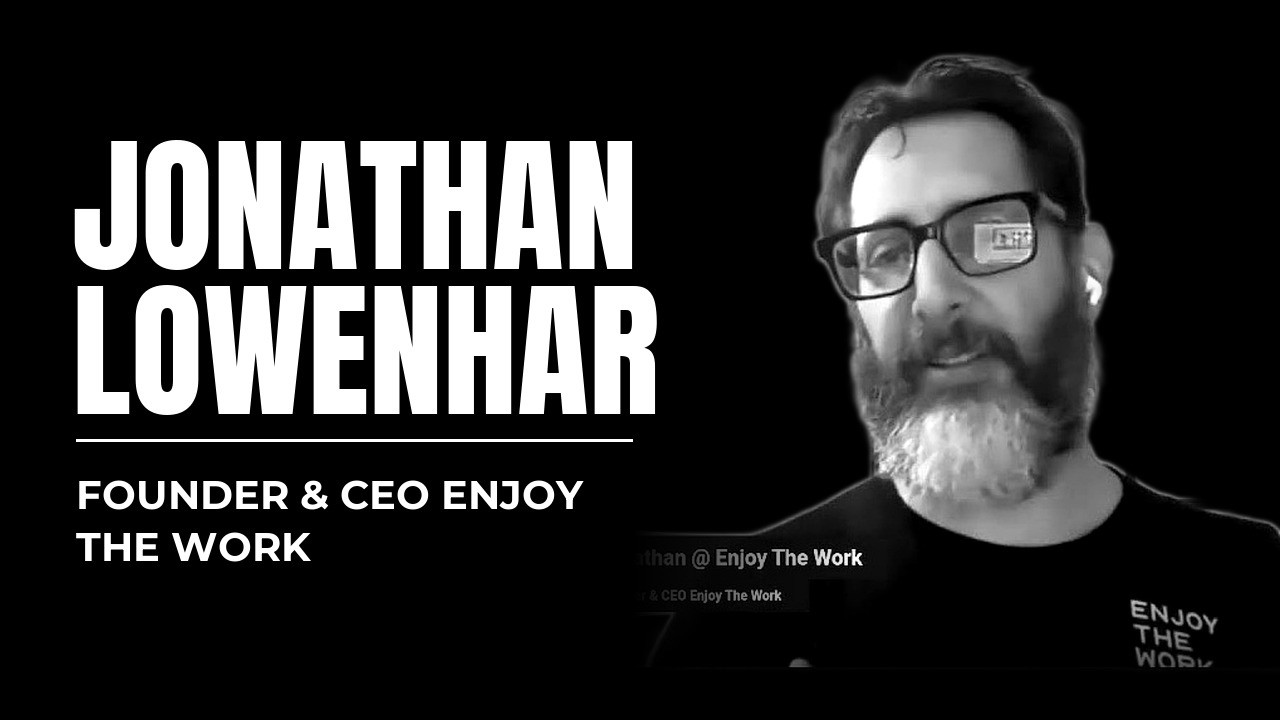
In this Founder Wisdom episode, host Charles Cormier interviews Jonathan Lowenhar, founder and CEO of Enjoy the Work, about his unconventional journey from casino and hospitality management to tech entrepreneurship and executive coaching. Jonathan recounts his first venture—a real‑time lead‑scoring analytics startup for hotels that he built, raised capital during the 2008 crisis, and sold in 2012, which opened doors to advisory roles, including serving as the first non‑founder president of a fintech company that grew to a $1 billion SAP acquisition. He discusses personal challenges, notably a costly divorce that forced him to liquidate equity and reset his finances, shaping his ethical stance against industries that exploit addiction, such as gambling. Jonathan then explains the mission of Enjoy the Work: helping founders evolve into world‑class CEOs by identifying gaps between a founder’s current capabilities and the needs of a scaling company. He outlines two founder archetypes—"starters" (idea generators who dislike repetitive execution) and "finishers" (detail‑oriented operators who struggle with vision)—and how his team tailors coaching accordingly. Using Tipalti as a case study, he illustrates how they guided a young Series‑A firm to multi‑billion valuation through metrics, friction‑point analysis, and speed‑as‑habit practices inspired by Elon Musk. The conversation also covers CEO health, self‑care, and the importance of in‑person trust‑building, as well as the community resources (subreddit, YouTube channel, website) where founders can access their framework.
Chapters
Welcome to another Founder Wisdom pod. We have Jonathan Lowenhar with us today. He helps, uh, founders become world-class CEOs, which is— I love that, uh, that tagline because very few founders are actually good CEOs, and it's a very tough thing to actually achieve, learn these skills. Uh, John advised, or Jonathan advised, 250 startups creating $13 billion in value. Uh, you're a public speaker, you're a founder at, uh, Enjoy the Work in Brisbane— not Australia, but Brisbane, California. So Jonathan, welcome to the podcast. Tell us a bit more about yourself and what you're up to.
Well, Charles, I'm well. Thank you for the invitation. What I'm up to right now is a second cup of coffee, so I'm doing reasonably well for not quite 10 AM by my time. I know you— your pacing is not something I can keep up with, but I'm doing okay on my side. I don't know, I'm happy to tell you origin story, like why I do the kind of stuff I do, why my partners and I engage in this kind of work, what my background was. I started as a casino person of all things before I moved into technology life. Where do you want me to begin?
First entrepreneurial experience.
Hmm, I guess that qualifies as 2007 into 2008.
Mm-hmm.
So I left career number one in my mid-30s. I was living in Nevada at the time and I moved to the Bay Area and I was here for roughly a year, Charles, where I was lost in the desert. I had run casinos and hotels and kind of hospitality resorts, including large companies. And now I moved to the Bay Area and I was just this strange casino guy that couldn't get a job. I kept applying for like different VP and C-level roles at startups and I kept getting to the end of the dance. And over and over again CEOs or boards would say, "Your background's fascinating, but I have this other candidate who has already done this job before." Weird casino guy. So I kind of did what is hard not to do here in the Bay Area. Like, it's an industry town, so I did my own startup. Myself and two other folks did an analytics startup targeting hospitality. I stayed in the world that I knew. And my thesis at the time was rather simple, that like if that company could get to any kind of viability, then I will have bridged careers. And this was early days, but you could think of that company as real-time lead scoring. Like you walk into a hotel or you walk into a timeshare and could you figure out in real time the likelihood of what someone could afford and whether they would buy a thing? And we did that real-time math and it worked and worked enough to raise a couple of rounds of venture and had real customers like Starwood and Marriott and Hilton. Uh, and we sold the company 4 years later in 2012, and I made like $7 in a bag of potato chips, but I had sold the venture-backed startup and bridged my career. By the way, like everything that I could have done wrong in that first startup, I did. Uh, and raising capital in 2008 was brutal. It was 120 pitches to get to the first term sheet, and I didn't take a salary for 18 months.
Man, yeah, that's crazy. I like the walk in the desert part. A lot of people don't talk about that part when they're lost, you know, and they're wandering. You took a gamble, right? Like, I think that's the expression here. Someone gave you a chance, miraculously you guys raised capital, you just had an exit, right? And that just counts because it's on the scoreboard. Doesn't matter if you made millions or not, what happened after that? You have your confidence, you have your track record, what goes after that?
It was a shocking transformation. So this was summer of 2012. And suddenly I was in demand and it made no sense to me because just a handful of years earlier, no one would hire me. And now because I had sold a venture-backed startup to your point, Charles, no one made money, but I had sold one. I built one from zero to something with my co-founders and we sold it. Suddenly I had opportunity after opportunity. Now, I wasn't a naive young kid. I had operated at a pretty senior level before I'd even run that startup. So I knew that if I was going to vet all these opportunities, I wanted to date before marriage. So I took a bunch of different advisory roles and consulting roles. And one of the companies that I started to get to know was a very young fintech business where I had known the CEO socially and we'd kind of been informally advisors or mentors to each other for a while. And it was him and 3 other co-founders, and the business had giant ambition to kind of change a corner of finance, to change the way supply chain finance works in the world. And the company at the time had evidence that the product worked, but nothing outside of the product worked. It was like 30 employees with broken culture and no repeatability of motion. And so I ended up joining that business first as an advisor for a few months and then as their first non-founder president. And I was there through from basically zero revenue, a couple hundred thousand revenue, through the first $20 million in revenue and through the first $100 million of capital raised. That business eventually went on to be acquired by SAP for just under a billion dollars. I'm enormously thankful both for that opportunity and for the success we had, and also the fact that my early startup kind of paved the way for it.
Were you set after that? Because you were president, CEO, you had shares, obviously. Were you like set, just like I can retire now?
No, uh, and for a very specific reason. So in 2011 and '12, my, my first marriage went south in all sorts of difficult ways, with addiction at the core of it— not mine— but it ended up creating a lot of burden in my life, including a lot of financial burden. So even though I had done really well in my first career and then my next startup certainly wasn't financially accretive but didn't break me. That marriage and the ending of it was not only sad and difficult but also very expensive.
Yeah.
So I ended up selling a large portion of what I had at the time when I left, um, Talia is the name of the company, the fintech business that did really well.
Yeah.
And I sold a bunch of that on secondary right in the moment, and I was really thankful for it. So I cleared all my debt and cleared all of the obligations that I had. I had some money in the bank, Charles, but I wasn't set, right?
How do you wrestle with this, right? You started your career in gambling and addiction, right? Like, what's your philosophy on gambling nowadays? Is it something that is good for society or not? Because you've seen also the firsthand destruction of addiction, right, in your marriage as well. So what's your thesis on that?
Well, I think more broadly, almost everything can be abused. And whether we're talking shopping or food or social media or drugs or gambling or coffee, um, they all can reach a point of being self-destructive. Uh, I am not going to judge the choices that anyone else makes. I'm just— no thank you. Life is too hard for all of us. We're all doing our best. I don't want to work in industries anymore that I think by definition can take advantage of those that are most susceptible to harm. And so one of the kind of guiding principles we have even in Enjoy the Work is we'll only take on companies, we'll only take on CEOs that are doing something at a minimum neutral, if not better or good for the world. That doesn't mean there isn't money to be made in all sorts of those other categories, as my former industry would tell you. Like, if you had casino executives on this call with you, as I once was, they would tell you what the hell is the difference between sitting at a blackjack table or going to a movie or going to a fine restaurant? Like, it's all entertainment.
That's— can— that's like Swiss cheese, like filled with holes, that argument.
I agree now, but I didn't then, and I would have gotten on a pedestal about it then. That yes, these are all forms of entertainment, and there are forms of entertainment that could be destructive for the folks that suffer addiction. And I just don't want to be a part of that anymore because I have witnessed it in all sorts of ways.
Yeah, well, as you probably know, I'm from Montreal, right? MindGeek is from Montreal, Pornhub, right? So, uh, these things I often think about, um, because yeah, like, yes, people have— life is hard, but pain is part of life. And I think some people can take that pain and just, you know, get out of the hole and fly by their own wings. Um, I see your advisor in like so many companies. That's very impressive. I'm guessing you take like equity in, uh, most of these. What was your home run in all the clients you've coached in the last, uh, decade plus or so?
Well, so to be clear, my firm is a firm, like it's not just me. So as a group, with me and my general partners, we've supported now, I think we're just passing 270 startups that we've done individual work for, and thousands more that have attended our workshops and our boot camps and those kind of things. We've had a few dozen that have done great things, um, and we've been fortunate enough to kind of be along for the ride. What I never want to confuse anyone with, Charles, it's like I'm not the captain in the seat I'm not the CEO. We're not even the chairperson of the board. Our founders give us a great deal of credit and I'm thankful for it. And sometimes I'll even freaking blush about it. But our role is like, there's a gap, generally speaking, between the CEO you are and the one you need to be for the stage of company that you're at. And we've had a handful of companies. I'll name one, for example, Tipalti. When I got involved in Tipalti, 2016, the company was Series A, low single-digit millions of revenue, 30-something employees, just Bay Area based. Their last public valuation was north of $8 billion. Uh, the CEO, his co-founder and investor Oren, have done an amazing job there. I still know the leadership team rather well. It has been a privilege to spend all the years that I did with that business. There have been a series of others. Sorry, go ahead, Charles.
Yeah, I've used Tipalti with corporate-ish clients, and I wish I would never have ever laid hands on Tipalti ever. But I guess that's like the opposite of my startup personality, right? Uh, it's like compliance and— but yeah, no, it's another game. What did you coach the CEO on, right? Because they were already making a couple billions back then, I believe, Tipalti, or were they just at the very single-digit millions of rev.
The company was very young when I got there. I started working with them in 2016.
Wow. Okay. What was the problem back then? The founder was still in the CEO seat, but not making the best of CEOs?
No, not that at all. So, Charles, I'll share with you the kind of two general archetypes of CEOs who come work with us. CEO number one, generally speaking, either hasn't done it before or has done it badly. And they know it and they want to get better at the job because they finally have a business in front of them that were like, this could hit escape velocity. This company could work. And there's a whole bunch of mistakes that I clearly made in hiring and management and go-to-market, whatever, and capital and raising capital. They just know that there's a gap and they could be better at the job. They don't know how. But the second archetype that we meet is the person who's a hell of an operator. And this was Chen when I met him. I, I think I have this right, but he had already run and exited 3 companies before he'd ever met me. Chen was in his mid-50s. He was a successful operator, had been married a long time, children, like this is a fully capable adult. And his curiosity with me was twofold. One was I'd come from an adjacent space. So I could relate to him quickly. And two, and more importantly, and this was language he used way back when, he only knew how to run companies the way he knew how to run companies. And he was curious to understand the gap and what the differences were between how he had been an operator, which had been hugely successful, and how the best companies do a thing, whatever that thing might be. Because all my partners and I do is obsessively study How do startups do something? And like, it could be big meta stuff, right? How to go from founder-driven sales to repeatable motion. Or it could be tiny topics. Like, I have to have a hard conversation with my co-founder. I don't know how to do that well. Or just help edit an investor update that's going to go out from one of our companies that just had a big win. And so for Hen, it was, I'm facing a layoff, a pivot, building a financial plan, hiring my first CFO. Running our first leadership offsite ever, which I helped them do. A list of these things. And then he would say to me, here's how I would do it. How would you do it? And then he would take what he'd like and he'd leave the rest. We did that for a lot of years together.
Interesting. I have so many questions. I might be a good case study for you because I think I'm very good at 0 to 1, not so good at 1 to 100, right? So Um, yeah, the first obvious thing is like being— is being a good operator like being a good robot? Is it like boring? Is it always following existing playbooks? Because, you know, like these SEALs that can't— that don't sound like humans, right? They always sound like PR fucking playbooks, right? Like, uh, or am I mistaken, right? Because there's, uh, I don't know, uh, let's separate execution from authentic. Sundar, that was great, right? Um, yeah. Even the CEO that Google promoted, Eric Schmidt. Schmidt, yeah. Yeah, he was unconventional. He was pretty good, right? So bunch of questions in there. Take it wherever you wanna start.
Well, what I was suggesting is like, let's separate authenticity from the ability to execute. And I hear you on the turnoff of the person who gets in front of the camera or the mic or on stage and suddenly like all humanity is gone and then they just seem like they're reading from a fucking teleprompter. Like I hear that, but let's separate what we def— we effectively describe as most founders sit in one of two buckets. You're either a starter or a finisher, just in life. And starters, these are folks that are really good at ideation. They're really comfortable with ambiguity, uncertainty. They can see an idea, they get excited about idea, they can mobilize others to be inspired and to go pursue it. And the idea of that exploration just turns them on. But then the moment it's like, oh, that idea is starting to work and we now need to build a repeatable process, a factory line to go deliver that again and again and again in a reliable way. The starter might be able to see the steps, but they're bored to death by them. And please don't ask them to go follow the 37 steps to get it done because they'll do that badly. Welcome to the finisher. This is a person who is the opposite of everything I just described. Generally speaking, they are not decisive. They don't like uncertainty. They like creating the workback plan of the 37 steps to get idea into execution. And they have wonderfully obsessive attention to detail to make sure that all those things actually get checked off the list. Most founders are starters. Not all of them.
I can really— and I, I wish— I mean, I'm more of a finisher than a starter, ironically, or at least that's why I want to be, because I don't want to be, I don't know, the guy with all these ideas and that never accomplish anything, which is what I look on LinkedIn, by the way. Um, but yeah, if you ask me, because I have various, uh, identities, right? Another is like ultra athlete. Ultra athletes, you need to finish a fucking thing and it's one foot in front of the other, right? You do the hard thing. And I tend to be very good at that as well. My question for you is, can both meet in the middle? I wouldn't follow a 30-step list, but I would outsource it to an agent.
Yeah.
I'm a wartime general. I think that's my personality. I wouldn't say humans because I tried humans and humans are hard. And I know it might not make sense with today's market, but I would have that idea and I would have an agent complete it and maybe guide the agent along the way. Does that make sense?
It does make sense. What I would suggest is that part of maturity, wisdom, adulthood is realizing, am I a starter or am I a finisher? And I still need enough of the other side to kind of live the life I want. I'm a starter, Charles. I, fully, fully embrace it, which means like doing my taxes or following up on my mail or the checklist to make sure that like my daughter's ready for preschool in the morning. All of that takes more activation energy for me. It's hard for me. And part of adulting, wisdom, whatever, the gray hair on my chin is knowing that I still have to do that stuff. Some of it I can outsource. Some of it I could automate. And some of it is my responsibility. The starter tasks of like, what are the most important goals next month? What are the experiments against it? That shit takes no activation energy for me. I fucking love it. So I'll lean in. It's just this recognition of which one I am and how to support myself. And that's what I want for each of our CEOs.
You think in the future most founders will become CEOs, um, managing and orchestrating an army of agents is sort of my question. Well, because ideas will lose value, right? Like, in the AI future, any AIs will be able to have good ideas. Or it feels to me having ideas is the easy part, right? Anyone can do that. But having good ideas plus having agents orchestrate it, I think that's the moat.
I hear you. I, I, I have two points of view. I think ideas have been cheap a very long time. It— a lot of the greatest success—
because there's a lot of shit ideas, right?
Like, there's also that. Well, actually, I was going to suggests is that like the notion of the first mover being the winner in a market has been debunked for a long time now. It's the one who can execute better ends up winning. Yes, there are enough companies out there, and just let's look at like the top 10 performing stocks. None of them were first. Not a single one of them was first in their industry.
The iPad, the iPhone wasn't the first smartphones that executed.
You're going to try and convince me Nvidia was the first chip company? Like None of these companies were first. So I do think execution matters more than ideas. It always has, it always will. Now, with respect to being a good CEO, I am unconvinced that the future CEO or the current CEO is that different than the past. I think so long as some humans are involved, CEO skills of what's the mountain we're climbing, who's on the team, What resources does the team need? Those all still stay true. And some of those resources now might be agents rather than additional humans. But that pyramid of stuff that still matters to be a good CEO, I don't think that's changing anytime soon.
Who are your favorite case studies? You mentioned NVIDIA. It's pretty spectacular one. What type of founders or CEOs do you study nowadays and what did you fundamentally learn from them?
Well, so long time love affair with like Sloopman from Snowflake, like did just masterful job. But I'll tell you, yeah, I'll tell you right now, and this is not a terribly popular opinion. My partners and I are on a little bit of an Elon kick, just as an operator, man.
You're not alone. That Elon's going through a revival. He got out of politics. Now founders love him again, which is what he should keep on doing.
He, he has some methodologies about how to move, how to increase company velocity. Um, there's a, there was an article in First Round Capital a bunch of years ago, um, called Speed is a Habit. And we took that article and then we operationalized it so we could teach some of our companies this. And then we upgraded it even more in the last 12 months with a bunch of tools that Elon uses very specifically that have come out. Probably not by accident, but this idea of like minimizing handoffs, meetings are his last resort, that a single mission, single metric for each of, uh, every department and organization. Like there's so many things that are just, they feel obvious now in retrospect and they are the advancing of things that have been out there in literature for decades and he's crystallized them really well. One of the ones that we've been applying regularly, Charles, is we want to get enough leverage for our CEOs through goals, metrics, leadership team that's reliable with people who are high agency so that the CEO can behave like Elon does. And look, I've never met the man, so take this all with a grain of salt, but the notion that at any given time a company is facing some sort of primary point of friction, some primary constraint getting in its, in the way of the next level of growth. And then I just want the CEO to hop from friction point to friction point, from constraint to constraint, because they are the queen of the chessboard. It can freaking do everything. But that can only be possible if you've built an organization with leverage and no blockage and no politics, right?
Which is ironic, right? Like, Elon has very few politics in his companies, but, uh, gone headfirst into politics. That was such a clumsy move. Um, Elon's the greatest. Like, I mean, there's no better entrepreneur in all, in all times, even like Rockefeller, obviously they're product of their times. But yeah, my obvious question, right? Like when we look at Elon, it's very hard to reproduce his energy, right? His genes or his flow, right? His productivity flow. And how the fuck do you manage that much stress is the obvious question, right? And these are questions you spend time pondering and answering for sure.
So I don't want any of our CEOs to be someone else. The way we operate very simply is like, what's the milestone one of our companies is working backwards from? Like, what's the next hill? Is it profitability? Is it an exit? Is it a capital raise? Once we understand that, we can set in motion the set of goals to achieve it, the set of metrics that tie up the leading and lagging indicators for course correction. We can put all those pieces in place and then a regular audit of what's happening in the business of like what's going well, what's not going well, let's attack that. And when something that Elon does well or name your company, because we have a broad set of things that we apply. Oh, here's the friction point. Great. We have seen an example from, I don't care if it's going back in time and Facebook or Zynga. Or Roche or Snowflake or Tesla, what's the example that we can pull apart that we can then contextualize to this setting and teach a framework? And then let's go attack that with speed. So I don't want the CEO to show up as someone else. Now, within the context of that, Charles, self-care means something else to every— something different to everybody. For you, it might be disappearing into a 100-mile run, but it means something different to everybody. And so what we will check in on is just what is the health of the founder in front of me? Because it's— this journey is so damn hard. And we will have a conversation around, are you taking care of yourself? Are you putting your own oxygen mask on first? Because if you're not, your team is fucked.
100%. Yeah, no. Um, how do you measure these markers that maybe they're imposing too much on themselves? Do you see, uh, bad decisions? Do you see them forgetting things? Do you see like, do you evaluate their cognitive health? Right. You're not checking their WHOOP, their WHOOP score, their sleep scores, I must guess. But you're seeing like fuck-ups here and there, right? Like that's how you know that. But obviously, hopefully you're not getting to that stage. You prevent that from happening before you start seeing the symptoms.
Yeah, I, I don't want to exaggerate our role.. And if you think about the role of the CEO as a combination of hard skills and soft skills, we, we do play in both dimensions, but we're not therapists. And so the relationship becomes intimate over time because frankly, we're the only safe source of advice they have in their life. It's not their board, it's not their investors, it's not their colleagues, it's not their spouse. There is heat or luggage or fear to every other relationship, not ours. Because we're not fiduciary. We work for them. They can fire us anytime. Great. So we will put up the mirror to say, Charles, you look like shit, like, or you've been late 3 meetings in a row, or we've had homework due that you said you would have done by Friday. You missed 3 deadlines in a row. Or I can just feel in this call, like, I can say to the CEO, you're not all the way here. And then periodically we'll make sure to see them in person. Every time we bring on a new CEO, and we take 2 months to get to know someone, generally speaking, before we'll actually say yes to them. But every time we take someone on, we also tell them, hey, a couple of times a year, no matter where you are on the planet, where I am on the planet, we're going to figure out a way to meet in person. Because that's also the best way, something that an agent can't replace yet, for me to really get a sense of how are you doing.
That's how you engineer trust, like physically meeting them, spending a lot of time. Fostering honesty, like being honest yourself, right? And just sharing a lot about yourself before they share about stuff, because if you don't, like, you can't give them feedback. You'll just hit a wall all the time.
Charles, you've experienced this. You've run a lot of companies. One of the things your people will do is they, with, with no malintent, they will lie to you.
Oh yeah, I mean, all humans, humans lie all the time.
And so we want to be the safe place because there is no threat here. I'm— my CEOs know that I'm just going to tell them the truth. And the reason they can feel confident in that is because I'm too old, wealthy, and grumpy to need their approval. Yeah, I'm just here to try and serve. And so I will be the audience that says the hard thing.
Love it. Jonathan, thanks for being on. Where can people find out more about you?
A couple of places. We have a subreddit called Founder to CEO, a YouTube channel with the same name, but most importantly, enjoythework.com. It's really easy. You can also see kind of any of the content we're putting up around the world on LinkedIn or any of those other channels from that website. Charles, this is a pleasure, man. I really appreciate it.
I love it. That was Johnathan and Charles for another Founder Wisdom Podcast.
More from Charles


Founder Wisdom: the audiobook, version 2 (5 hours of stories from founders and CEOs)

8 CEO Questions I Love Asking: the audiobook (64 founders answer, in their own words)





