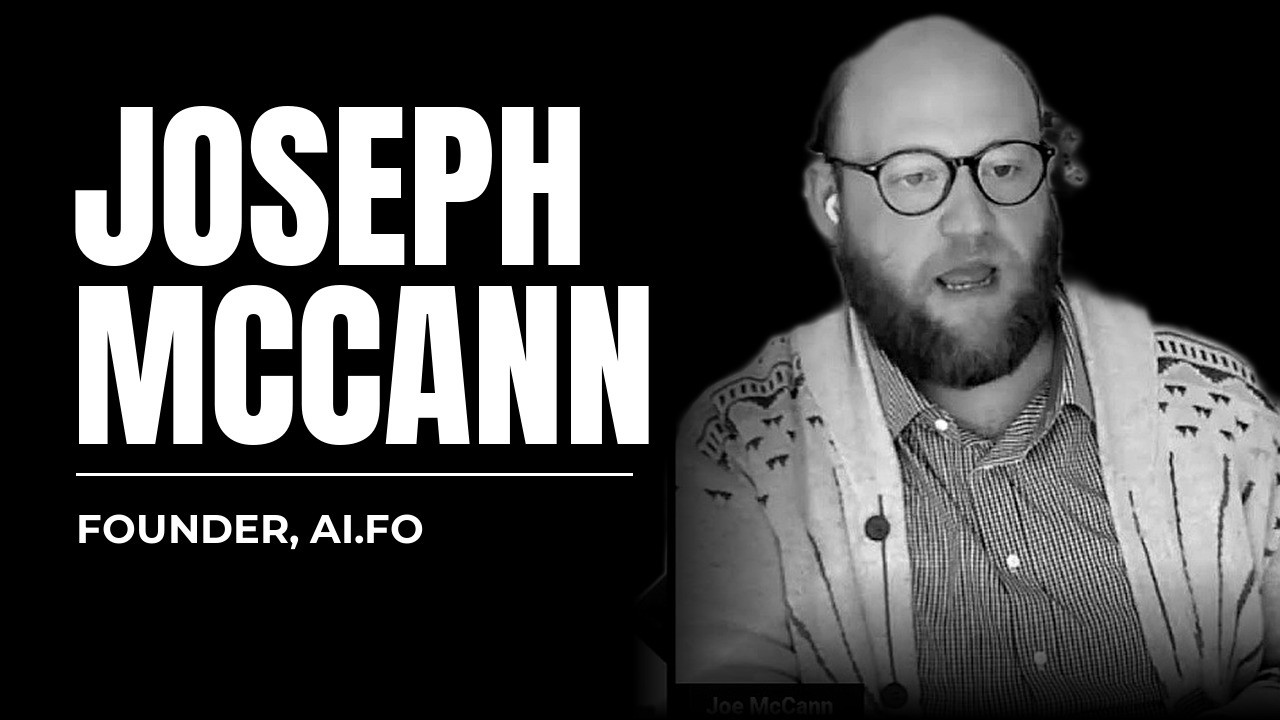
In this Founder Wisdom Podcast episode, host Charles Cormier interviews Joseph McCann, founder of AI.FO, a startup building an AI‑powered CFO reasoning layer for small, founder‑led companies. McCann explains his 20‑year finance background and the insight that businesses under $50 M in revenue often lack a CFO’s strategic reasoning even if they don’t need a full‑time CFO. AI.FO combines a deterministic financial calculation engine with a large language model that provides plain‑language explanations of the results, ensuring auditable, repeatable outputs before any probabilistic reasoning is applied. The company is about to launch two initial products—a free health‑assessment CSV upload and a “signals‑only” subscription—within two weeks, followed by additional subscription tiers. Pricing is tiered at $99, $299, and $899 per month, targeting pre‑seed and seed tech founders (ARR under $5 M) and consultancies, with industry‑specific onboarding tracks. McCann is opening a $1 M pre‑seed round and notes that raising capital has become harder, as investors now expect traction and MRR before seed funding. He discusses why he chose to remain a solo founder, leveraging AI‑native tools instead of seeking a technical co‑founder, and outlines future product ideas such as network intelligence that leverages data across client companies and a decision ledger that logs founder decisions for later CFO hand‑off. The conversation also covers differentiation from general‑purpose LLMs like Claude, emphasizing deterministic calculations, and why a fractional CFO model is less valuable compared to AI.FO’s software‑only solution.
Chapters
Welcome to another Founder Wisdom Podcast. We have Joseph McCann with us today. He's the founder at ai.fo. He's building an AI system for reasoning in finance. He's a former CFO, CEO in the SF Bay Area. Joe, welcome to the pod. Tell us a bit more about what you're building there.
Hey, I'm Joe McCann. I'm the founder of ai.fo. We are a CFO reasoning layer for small and founder-led businesses. I've got 20 years of experience in finance and operations, and a common theme that I've learned throughout that is that most companies under $50 million a year in revenue don't necessarily need a CFO, but they do need the reasoning and the logic that comes with that. So I've pulled on 20 years of experience in that, and then as well, living in the Bay Area, AI is everywhere, and how do I best pull those 2 experiences together and build the best product available.
And why decide to throw yourself in the arena after so many years in a comfortable corporate job?
So I guess the biggest reason is this past January, I laid myself off as part of a reduction in force, and it became clear that more and more organizations, as they grow, Or even startups that don't need a CFO, but they need the reasoning and the logic that comes with that. And being in the Bay Area in general, you can throw a rock and hit 100 people in AI. And what better place to learn how to work with it than here?
Right. Are you raising capital for that one? What's your day-to-day like nowadays?
Yeah. So we're actually about to launch our first 2 products in the next 2 weeks or so, and we're about to open up our pre-seed round, raising $1 million on that.
Interesting. And why shouldn't I just prompt my Claude with a very CFO fancy prompt and use that instead of AIFO?
That's a great question. And I think the very clear answer is, do you really want to unleash AI on your general ledger? The way we have it built out currently is that our system is separated by an architecture. So all of the financial reasoning that happens happens on a deterministic layer. So all of the calculations, formulas, and equations that we build, all the scenario planning and modeling and decision-making matrix that we build is deterministically. At that point, we take a snapshot, a snapshot.
Okay.
of everything that's happening. And only at that point do we have an LLM come in that then adds plain language explanation to what's happening in your business and how to work with that and what you should be thinking about based on these numbers that have already been calculated.
Got it. Um, hmm, I mean, I think people have more trust in Claude than like a brand new, uh, startup like yours, generally speaking, to answer your last question. And I'm already feeding Claude like shitloads of data, right? Like Stripe and direct data from the source. I guess a bunch of people are also doing that. Another better question is probably if they should trust like Claude or Anthropic and OpenAI with all of their data, if that may be breached, right? Is there like real danger if it's ever breached? But Um, what specific features can you offer me that would be different from that? Sort of the question.
Yeah, so I guess the biggest part of it is that the way all AI, whether it's Claude or OpenAI, it's all probabilistic. So when you're asking an LLM to start to do the calculations, the reason, the calculations and the formulas, you're not always going to get the same answer because As you know, AI has this wonderful habit of anchoring itself to one specific piece of information, whether it's correct or incorrect. And once it starts to do that, you're never going to be able to get that right answer that you need to get out of it. Whereas everything that we've built at this point is actually based on a deterministic layer. So everything is being done in an auditable, trackable way. So that everything that we calculate on that can be repeated and be repeated and get the same answer every single time when you're using the same numbers. You're not going to get caught up on the wrong piece of information or carry it and have that carried through throughout everything. So it's being able to verify the information first and then proceed with the reasoning and the logic that comes with it. And then you're also—
I don't believe AIs have these problems, no? Like if I use Google Sheets, for example, and I have Gemini on another tab, or I believe Copilot, Microsoft Copilot, they have AI and the AI is pretty accurate and doesn't make mistakes. I believe we're way past that.
But it's yes for the formulas, but then once you take the formulas and then start asking it to extrapolate based On what's there already. There's not— you're not taking a locked presentation at that point on what's happening.
Hmm, I'm not sure. And I'm not sure even why these companies would let that go. I'm pretty sure by now it's fixed. But, um, I guess if, if it's, if it's a CFO that has agentic power and can do stuff for me, I think that would be an interesting fit point, right? Like if it's more than a CFO just telling me like, do this or do that, it's like a CFO that takes action, right? Like that would be pretty cool. Like a CFO that goes out and fetches that grant or that outreaches to this investor that renegotiates that deal. Have you thought of adding these features in your later deployment?
Yeah, we've— we actually have a couple of interesting things that are gonna be happening as we continue to scale. And one of them is network intelligence. As, you know, as you— as we grow, the more companies that we have working with each other in our network, we're able to get the scale of those companies and have that pattern recognition from company to company and being able to see a larger swath of what's happening there.
You're solo founders? Well, why not have a co-founder that can either build or sell?
I started out, I've probably had about 150 conversations with potential technical co-founders and other founders who have had startups that just kind of fell apart. And I had a really interesting conversation with a VC, and the first thing that he was talking about was finding a technical co-founder. One of 3 things can happen. One is you know them and it's going to be great and you're going to hit it out of the park. The second thing is, is you can either find a technical co-founder and 6 months later it falls apart. Or number 3, being that it's 2026, having AI-native tools, building it yourself and then bringing it to market yourself is going to be probably the best solution for what I have. And that has been so far the most success that I've had. And the second part is, is that I feel that having had these conversations that I've had, I'm having the 20 years of experience that I have. I don't think that anybody else would be able to craft the product in the way that it's needed to be able to provide the insight that is needed for it to be as successful as it is.
Yeah, I agree with the AI co-founder part. Very true. What part is— are you struggling the most right now as a founder? Is it getting clients? Is it raising capital? What's hard nowadays?
Right now, I would say that the hardest part for myself and for anybody is raising capital. The game has changed across the board. With the growth of AI-native tools, it's really, really easy to build a product and bring it to market. But the more important part is what type of traction do you get and how do you raise on that? The idea of a pre-seed has changed over the last 8 months than what it was even over the last 2 years. And so you're expected to have traction and MRR before you even raise a real pre-seed round at this, at this day and age.
The beta product, like, is it ready? Where can we try it out?
Yeah, so the demo is available on our website at getai.fo— excuse me, getaifo.com. And we're going to be launching our first 2 products in the next 2 weeks. The first product is a free health assessment for anybody who wants to try it out. It's just a CSV upload, and the second is going to be a signals-only subscription. Over the following month or so, we're going to be launching the next 2 subscription layers that we have available as well.
And what will be the pricing?
The signals-only layer is $99 a month. Our base subscription is going to be $299 a month, and our premium is $899 a month.
And who should be the ICP to that? Do you also appeal to CFOs themselves?
Yeah, I think that the idea of the— the idea will be there that for the CFO, our first ICP is the founder-led business. So the founder who's maybe got, you know, sub-$5 million a year in ARR or, you know, $50,000 to $100,000 MRR. And they don't know what to do next. And there's— maybe they raise a little bit of money, maybe they haven't. And the idea is we're going to start being able to provide that guidance and the reasoning for what you should be doing next, what you should be looking at, and help you with the important scenarios that come up as you go. Do I have enough runway to hire an engineer? Do I have enough burn? What does that do to my burn? How does that all trickle down? And then as we continue to scale and grow, yeah, I think the idea is that We become a trusted partner for companies that when they bring on a CFO, in the way that we've built in a decision ledger. So as founders who start with this, they start making decisions and they go and see what happens. We're able to log those decisions and then proceed throughout that and see what happens and track the outcomes so that when they do bring on a head of finance or CFO or whatever that title happens to be, That person can then see what happened, why this decision was made, instead of having to hunt it all down from the founder themselves. And then we become that trusted copilot for the CFO who's in that seat because we become that first layer of analysis that's already happening. We know it's there and we can really begin to scale together.
And how much from the pricing plan— is there a plan in which you would be involved or it's pure software?
It's pure software.
Okay. Would there be a plan also in which they can pay you, I don't know, monthly basis for fractional CFO stuff and you could re-inject that money in the business?
You know, that's, it's been an idea that I've kind of kicked around with, but I haven't really committed to that yet because part of the reasoning for this whole company as well is that I'm sure you've seen it everywhere online is you see people who might have 3, 4, or 5 years of experience in accounting, and they take an online branding course and they become a fractional CFO and they start charging all of this money for it. And at this point, that's— what value is there really for that? So I think that everything that you would be getting at that small stage from a fractional CFO, we're able to provide them. And we are looking to save companies money as they scale so they can reinvest into the business.
Your ICP precisely for that, would there be some specific industries that would better use you, like other AI companies in the Bay Area? Would that be the main ICP, the founders themselves, pre-seed and seed?
Pre-seed, seed tech founders. We've done some design work with consultancies, and that's been very successful as well. And then, you know, we have 13 different onboarding tracks depending on your industry, actually. So we're ready to be able to grow with that. But the most success that we've had so far with our design partners has been with consultancies and other tech B2B SaaS tech startups.
Nice. Joe, where can people find out more about you?
They can find more about, more about me at our web— from my website at getaifo.com, or they can find me on LinkedIn, Joseph McCann.