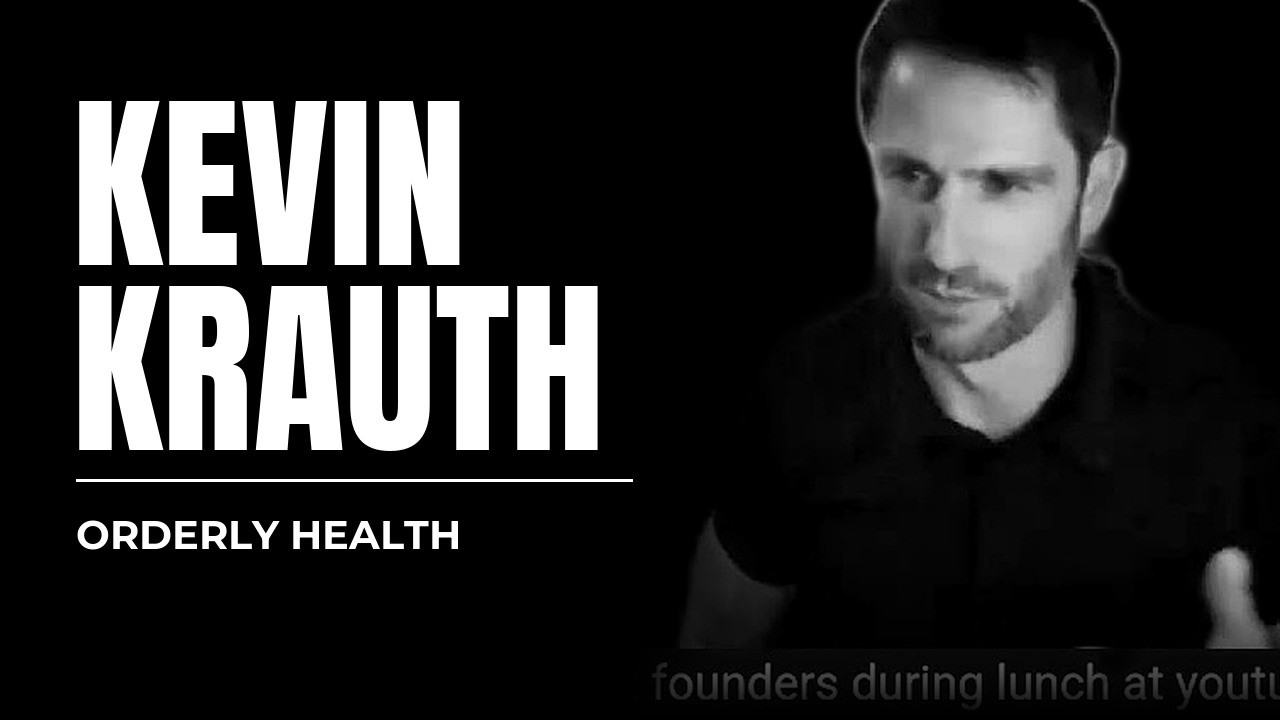
Kevin Krauth co-founded Orderly Health after working in investment banking and renewable energy, starting as a consumer navigation platform in 2015 before pivoting to provider data management for insurers and health systems. The company was acquired by First Choice Health, where Orderly now operates as an independent unit. Krauth defines success by team health and product impact rather than valuation.
Chapters
Welcome to another Founder Wisdom podcast. We have Kevin Krauth with us today. Kevin is a co-founder, president, CEO, everything at Orderly Health for 11 years now, but he's exited, I believe, that same company, or is on his way to exit for that one. Strategic product leader, has deep expertise in healthcare, SaaS, data infrastructure, energy tech, um, cool guy altogether, living in Denver, Colorado. So Kev, welcome to the podcast. Tell us a bit more about yourself and what you're up to.
Yeah, thanks so much for that introduction. Uh, well, like you said, I'm the co-founder and now president, used to be the CEO of Orderly, Orderly Health. We exited last year. Our— one of our largest customers bought us, and I now operate Orderly as an independent business unit. So we're We are very well integrated into the company that bought us. It's a third-party administrator and network services provider called First Choice Health. But while we're independent, we still serve most of their needs. And then we also serve our existing customers and we're expanding our product base as well. So not that much has changed other than my stress level and the longevity of the company, which has been really great and happy to dive into more about personal life or Orderly.
Yeah. Interesting. Before Orderly, what were you doing? What was your career before that?
Well, I have a bit of a journeyman's career. I actually started my career in investment banking with Blackstone in New York. Uh, through various twists and turns, I ended up working for a data analytics startup in San Francisco after a stint of working in the renewable energy space. Uh, that data analytics startup, it was called Upsight. Uh, they had previously been very big in the gaming space, but they wanted to move into other verticals And I had a little bit of a background in healthcare, uh, grew up around a healthcare family. My dad was a physician, my mom was a nurse. Uh, so I became the product manager that helped expand our platform into the healthcare vertical. And that's what led me to the initial idea that then became Orderly. So I never expected to found a company on my own. I was more forced into it by what was first a curiosity that became an obsession. And then that became a company.
Yeah, that's intriguing when I hear that entrepreneurs were like not meant for this, 'cause me, it's been engineered, right? My dad was an entrepreneur, and frankly, like, I'm not a hireable, right? Like, I'm too good for most companies. I would replace the manager almost immediately, and it never made sense for me to work for someone else. I dropped out of school because I was making more than my teacher, I was making, what, like $50 grand at 17 or 18, right? Like a year. And I always thought I would be an entrepreneur. And with all the books that I read, right, it's impossible to become super wealthy without being an entrepreneur, right? So why? I don't buy that. Like, why did you become an entrepreneur and stuck in there? Because if— If it was by a mistake or by luck, you would've probably been out. There must have been like something that really kept you in.
Yeah, I think that's fair. And I think probably with a lot of founders or entrepreneurs, there's either a very clear investment in formulating and cultivating that identity as a founder and a builder, or there might be also a little bit of self-denial until you can't deny it anymore, right? And I think that I was more the latter. In looking back, Steve Jobs said in that— his famous convocation speech at Stanford that you can only connect dots looking backwards. Well, I say that I never expected to be an entrepreneur, but I think all the signs were there. Like you, I don't think that I'm unhireable. I hope I'm not unhireable because I actually have a job. However, I've always struggled when being in a traditional role because my attention is always toward building, improving, innovating, changing things to make them better. I did it in high school. I did it in college on various different side projects. And even now, I sometimes say that the only time I hear serial applied to someone as an adjective is for a serial killer and a serial entrepreneur. So I think that there's a similar pathology in both where you have to be a little bit crazy to try again. And when someone said, hey, would you ever start a company again after all I went through with Orderly trying to keep it alive for a number of years, near-death experiences, pivots, all the challenges that you face— we really did go through it all— I would have told you that no chance, I would never do it again. And already I'm seeing that there are opportunities. I'm advising other startups. I'm working on a side project on my own. I don't know that I have any plans to leave my current job anytime soon, but I do think that that is something that is just encoded into your DNA. I don't want to say that you can't learn to be an entrepreneur, because you certainly can, but for me, it's been more of a discovery process than something that I was pursuing my whole life like you.
Right, and health is no coincidence as well, right? Like, if your dad was a doctor, it's like, uh, you just took some of his problems and brought a solution to it, right? What was the discovery of the problem for you?
Well, I think it's, uh, like a lot of other founders, it's, uh, it's scratching your own itch. Uh, for one, there's a— it's actually a well-known trend, particularly in the United States, where a lot of doctors' kids go on to work in sort of healthcare adjacent or healthcare industries, but don't become doctors. And I actually think that there's a number of reports that show it's a bit of a problem because we are running into a long-term shortage of physicians and providers. So for me, it was, I actually went into my undergraduate studies thinking that I might become a doctor. And after 1 or 2 semesters, I had a kind of come-to-Jesus conversation with my dad who basically told me, don't be a doctor if you don't love everything about it, including all the tedium, because it's not, it's not what it used to be. Most people go into medicine to practice medicine, and what they find is that they're very often hamstrung by the bureaucracy of the business of healthcare. So I always had an interest in it. I read a lot about it, and because of that, I sort of understood at a high level some of the challenges. Again, though, it wasn't something that I thought I was going to devote my career to until I had my own issue. I felt, as somebody who spent a lot of time in and around healthcare, who was very healthcare literate, I had very close friends in college who both had long-term diseases. One had type 1 diabetes, another had Crohn's disease, and I felt guilty for being healthy. Right? Here I was as a healthy individual who, uh, fairly healthcare literate. I could navigate the healthcare space well, and I'm watching my friends really struggle with it. Then I just needed a doctor for something that was a nagging ear issue that I was having, and when I couldn't find a doctor, it wasn't easy for me. I thought, how much harder must this be for other people who don't have the same kind of literacy or exposure into the healthcare industry? And that just led me to pull on a thread that you find yourself going deeper and deeper where you say this problem must be solvable. And truly, after 10 years, I don't want to say it's impossible to solve, but after 10 years of working on it, it has been both surprising and at times frustrating to work so hard on something and not feel like you've totally upended, right? The conventional wisdom or the aphorisms that people use when it comes to being a founder is, oh, we're gonna disrupt or we're going to revolutionize or replace this industry. And that's a pretty rare occurrence. Normally you get step changes and you make things better through constant iteration. It's very rare that you see an organization that just completely upends an industry. They exist. But I think that you have to be satisfied with making step changes because that, that's how progress is made.
Ultimately, what does Orderly do?
Yeah, I mean, the easiest way, the short end is we're a provider data management platform, which is a bit of a jargony way to describe what we do. What we do is we manage doctor and provider entity information for enterprises. And if you don't understand what that means, then you probably have experienced the problem. Most people who listen have probably experienced the problem. Basically, that for any number of reasons that we could spend the rest of the time talking together, there's a lot of issues with provider data. Providers are credentialed where they're sort of certified to be allowed to practice medicine. And they have to do that on a 3-year basis or quarterly basis, depending on, on what they have to do. But that data changes pretty rapidly because a provider can leave a hospital system, they can change states, they can move locations, they can actually become better or different in terms of their specialty. For example, not all orthopedic surgeons are created equal, but that data stays either static or it's, it's stored in a lot of different places, which creates a lot of noise and inaccuracy in the data. So what Orderly does is we aggregate a lot of different sources of that provider data. Everything from their phone number, fax number, location, address, practice, uh, specialty, primary specialty, subspecialty, etc. And we aggregate it into one unified cloud-hosted system that can then be subscribed to, and applications can be built on top of that data. So we sell to insurance companies, health systems, and digital health. Uh, one other shorthand that might make this all a lot easier to understand is Most people are probably familiar with Google Maps. They might understand it as an application, but it's also a platform. A number of different organizations use Google Maps data on a regular basis. Everybody from Uber to Waze to, to Yelp can tap into Google Maps, pay for their data that's constantly updated and giving real-time traffic information, etc. And that, that data can always be updated and online. So then an organization doesn't have to build that from scratch. That's a really good metaphor for what Orderly does, but we do it for doctors, nurses, physical therapists, as well as the locations where they practice.
Nice. And you've spent 10 years at that company. How did you last that long? And what's been the progress with the company from 2015 to today?
Yeah, it's a good question on how we lasted so long or how I lasted so long. I think that the best answer is probably that it was always changing. When we first start— or when I first started Orderly, uh, the idea wasn't to create a provider data management platform. It was actually to create a navigation platform for consumers so somebody could go in and find the best doctor, find an online medication order that could be shipped to their house instead of going to their local pharmacy, get a second opinion, connect with the telemedicine platform, find out how much was left on their HSA or on their deductible. There were a lot of different organizations and partners that we worked with to stitch that data together. And as often happens, as we were building this platform, we discovered a much bigger problem, or we discovered our capabilities were really strong in this particular area. So it was actually around 2019, about 4 or 5 years in, that we pivoted into the Provider Data Management platform, and that opened up a whole new world of opportunities. So We stayed small for a long time, didn't have the kind of rocket ship growth that a lot of startups experience, but we always had enough to keep going. And that was really motivating because we just, we just were always making progress. And then when we pivoted, we found this whole new seam of opportunity. We very quickly got a number of enterprise customers, got a few million dollars in revenue. And as the team started to grow, that, that reinvigorated my motivation to stay with it. Uh, and I think for me it was always seeing that we were making a real difference with our customers, that they really liked the products that we were building. We could genuinely see how processes were changing within an organization, how they were saving money, how they had better experiences using our tools. That all was really motivating. And then of course the team that we worked with also kept me with it. So that's really why I'm still here. Even post-acquisition, we only had one person who didn't make the transition to our new company. And we're still operating, as I said, largely the same, but we have a lot more freedom to explore new things, take more risks, and all of that I think is motivating.
Interesting. And you've exited that not so long ago, or?
Yeah, so we exited, we are now part of First Choice Health out of Washington State, which is a third-party administrator. We, uh, the way I describe what we're doing now is it's a little bit like a restaurant having a test kitchen built in. So for us, it's great because we can now develop products specifically with First Choice in mind, and if they like what we build, they, they can help us get feedback and we can iterate on it quickly, and then we can make that product more generalizable to the overall market, which is great.
And how's that been for you? Was it a confirmation of your efforts in the last couple years?
Yeah, so, you know, exits come in all sorts of shapes and sizes, right? The, again, the conventional wisdom is that most startups fail, and that, that's true. Um, and then there's also the case where a lot of founders don't tell the real story. They always want to make everything seem like a smashing success. Now we had a bit of a middling outcome. We did raise some venture money, but not very much. And we were really, really close to becoming profitable when one of our largest customers went out of business as a result of losing a government contract. Had nothing to do with us, but we were so close to becoming profitable that we were somewhat scrambling to, to find an outcome that would allow us to continue to operate. So it was a great fit for us from a strategic standpoint, from a culture standpoint. We really lucked out in finding such a great place to land. Um, all, all of our team has been thrilled with the outcome. So, you know, I'm not retired, I can't put my feet up, and I don't have a family office that I can use to invest in other startups yet. But we, we still think that there's a lot of room to run, that there's a lot of great opportunity within this new structure. And for that, in that sense, I'm really proud of what we built Another outcome that can often happen is you sort of find the bigger fool, right? Startups can often be, especially venture-backed startups, can sometimes be just one really protracted Ponzi scheme where the investors are passing off to other investors, other investors until there's either an IPO or an acquisition or something. And then the value that's created, the emperor's clothes come off. And the value that's created, uh, gets completely destroyed, right? You see this all the time where a company goes public and then 90% of their share value goes away once the retail investors get a hold of it. For us, what's been really great is that our product is still functioning. We have great customers. We haven't had to, to disassemble the team or our product in the acquisition, which is often an outcome. People find there's not a good fit or that the the product isn't what they were expecting. So again, I'm really proud that we created something from nothing. We're still going, we're still building, we still have a lot more opportunity ahead of us.
Interesting. Yeah, what's next for you? You— will you stay part of that group for quite some time? What's your role? How do you integrate to the organization?
Yeah, so a plug for, for my team and for the, the combined entity, uh, First Choice has been an incredible organization, uh, I never thought that I would work for an insurance company. That sounds anathema to anybody who's a venture-backed startup founder. However, what I've found is that particularly at the, at the top, we have great leadership. We have a really innovative, risk-taking team when it comes to a healthcare insurance company. So I'm really happy with that outcome. When it comes to what's next, I don't have plans to leave imminently. I really like what I'm doing. I keep saying it, I think we have a lot of opportunity ahead of us. And frankly, for anybody who's experienced the healthcare industry in America, health insurers are not exactly a beloved group of organizations. However, being on the other side of the looking glass, now being a part of one, I can now see how innovative and risk-taking and bold our team is. They're really smart, really hardworking. So we are really trying to focus on the member experience, not just minimizing the amount that we spend on claims, but actually improving the member experience and improving their health. We integrate with mental health providers. We have a lot of benefits to our members, and we're— as Orly is now the kind of innovation arm, the tech-enabled services that is driving a lot of the future growth when it comes to what our members, how our members can benefit. Everything from improved provider searching. I know it seems so silly, but one of the biggest challenges with healthcare is finding a good doctor that is covered under your plan. Well, we're rolling out next-generation search that's powered by AI so that you can go to First Choice's platform and you don't have to know what specialty you're looking for. You can just say, hey, my foot hurts, and it'll come up with all the doctors that are covered under your plan with specialists for podiatry or maybe even a primary care physician, maybe a physical therapist, all that information. These are the kinds of things that we're building. So for us, I'm— as long as we continue to build, as long as we continue to serve our customers and our members well, then I stay inspired to continue to work here. And I don't, I don't have plans to change that anytime soon, notwithstanding some of the, the side projects that I'm working on because AI makes things so easy to build.
And isn't, um, that the default nowadays, like health companies being acquired by insurance companies, like, which have become banks literally?
Yeah, I mean, I think that there's a number of organizations that are basically just shell companies or holding companies, right? But going back to what I was saying earlier, I've seen a lot of companies that have, uh, their, their tech or their team has been bought and then the tech is immediately unwound and they cease to exist. That happens in fintech and in healthtech pretty commonly. We're, I think, more the exception than the rule. But if you're a first-time founder or even if you're a serial entrepreneur, I would say that in the healthcare space, the goal shouldn't be to try to position yourself for acquisition. The goal should be to make a great product with customers that love your product and love using it. Build a really good business because then good things will happen.
We were—
Orderly was just so close to becoming profitable. In fact, as a business unit, we should be operating profitably this year. And, you know, as time goes on, we hope to expand on those margins and improve that. And doing so will only help our partnership and our engine being the engine of growth for First Choice.
How does it feel to be acquired when like most of your competitors like struggle to be acquired? Do you feel um, like a golden child? And, uh, or was it like on purpose, right? Like, did you engineer your own company to, to be acquired?
Uh, well, so I, I don't think that we ever engineered the company positioning ourselves for exit. Our, our goal was always, as I said earlier, our goal was always to build a good company and to become profitable. There were a lot of challenges and macro-level circumstances that helped us consider our paths, right? We, we banked with Silicon Valley Bank and then Silicon Valley went under. We went through a pivot, we went through a riff, uh, we had customers go out of business, we had customers churn. It's just every new day is a new challenge, uh, but you have to roll with the punches and sort of reinvent yourself constantly, uh, and, and again, focus on what is important in the right now in order to build a good business and good things will happen. As far as how it feels to be acquired, you know, I've shared with this— I think a lot of founders, and probably a lot of people you've interviewed, Charles, have shared similar thoughts— but one of the hardest things about being a founder is when a lot of people around you are congratulating you for success, for your success, when you feel internally like you've somehow failed. And I think a lot of being a founder is just constantly wrestling with that fear of failure or constantly feeling like you're failing in the micro. You know, you have— you, you miss on an RFP, or a customer leaves, or you, you don't get the recruiter, you have to fire somebody, or, or an employee departs. Any of those situations can make you feel like you've done something wrong or that you're failing, and you're, you're constantly fighting against that. And when we got acquired, my goal was always to have some massive exit and to pay our investors and, you know, to be popping bottles and potentially ringing the opening bell in the NYSE. That didn't happen, obviously. But we, as you said, we are a part of an elite group of people where we started from nothing, we built something that didn't previously exist, and we got acquired by a company that saw real value in what we're doing. So I'm really proud of our accomplishment and the work isn't done. Now, if I ever go out and off on my own again and start something again, which I don't know that I will, but I might. If I do it again, there's a lot that I will learn from, but I think I will also temper my expectations for what it means to be successful because you don't need to ring the opening bell at the New York Stock Exchange in order to be considered a successful founder. Really the main thing to be considered a successful founder is understanding what your definition of success is. And one of the greatest things that I could say, one of the things I'm most proud of about Orderly is the employees that we've hired really like working here. I don't obsess about Glassdoor or reviews or anything like that. I really just care that our employees have a job, that they're not anxious about where their paycheck is gonna come from. And that they respect one another, like working together, and are aligned around our shared mission. And I think we've accomplished that. So I feel really good about that.
Yeah, I love it, dude. It's quite impressive what you've built. Where can people find out more about you, Kev?
Well, I'm on LinkedIn. My last name is— you said you're one of the few people who can pronounce it correctly. It's Kevin, K-E-V-I-N K-R-A-U-T-H. If you want to find out more about Orderly, you can go to Orderly's website. We're just OrderlyHealth.com. And you can find me pretty easily anywhere online. I'm not super involved in social media, but my name is pretty unique. So I'm Kevin@orderlyhealth. And if you look for Kevin Kraut, there aren't that many in the world. So I'm always here to— I'm always willing to listen to people and take advice. I love hearing other founders' stories. So please reach out and try to find me anywhere online.
Love it. That was Kevin. Charles,
More from Charles


Founder Wisdom: the audiobook, version 2 (5 hours of stories from founders and CEOs)

8 CEO Questions I Love Asking: the audiobook (64 founders answer, in their own words)





