Mark Kleyner - Co-CEO @ Dream VC
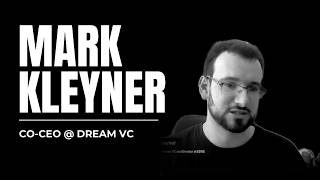
Mark Kleiner, co-CEO of DreamVC, invests in early-stage African companies and runs the continent's largest VC training program. Africa gets only 1% of global venture capital despite a young, urbanizing population with high entrepreneurship. His firm backed Member Money, a fintech serving under-banked women in Nigeria through point-of-sale systems.
Chapters
Welcome to another VC Wisdom podcast. We have Mark Kleiner with us today. Mark is a co-CEO at DreamVC, so, uh, he also does, uh, CVC support at, um, Edge by DreamVC. We're gonna talk about more about that one, uh, today. He's in London, uh, spends a lot of time on a plane as we've talked last time, so Remember seeing that you did your world tour, Marc, in Canada, Morocco, etc., etc. Tell us a bit more about yourself, Marc, and what you're up to.
Awesome. Thanks for having me on, Charles, and great to move from fan to guest for today. So yeah, about myself in a blurb. Well, I'm based out of the UK. I'm currently a venture ecosystem enabler as well as a practitioner. So I both invest in companies, but I also try to build the ecosystem while we do it. I currently run a firm where a big part of our mission is really creating more space for other people to become venture capitalists, and we actually run an institute which we are very glad has grown to become one of the largest around the world, teaching young professionals and experienced professionals alike how to move into becoming early-stage investors, specifically in markets across Africa, the Middle East, and some of the developing markets as well. Outside of that, I'm usually a pretty, I would say, happy guy. I tend to try to make the most of life. As you said, I find way too much time on a plane, so I try to find something to do in the meantime. I think I've gotten very comfortable in plane lobbies, airport lobbies, and hotels and whatnot. But I'm also a big sports enthusiast, and I think it's something that I like to do in the meantime. And you might see it in the background. Sitting in my home office as well. Somehow in all this last decade or so working in African markets, I've come to have a weird fascination with hippos. So there you go, you know, you travel enough times and you start picking up something. For me, maybe not postmarks, but I think it's nearing on something like a few hundred in the office by now from all over the world.
That's intriguing. Yeah, we talked about your hippo obsession. What's your trick in planes not to get bored? Uh, do you stay productive or do you just watch movie or Have you found a strategy to actually doze and sleep?
So I think there's a few things. Firstly, I found that I don't tend to do well with sleeping a short period of time. I haven't quite figured out this life hack approach like I've seen a couple of other famous VCs have of sleep 20 minutes, wake up refreshed. I'm certainly not into any of these patterns. If anything, I'm always been someone who does better at night and I'm perfectly fine when most people are asleep, there's no noise. In fact, that makes me study or work harder. So on a plane, when most people are passed out or in their headphones, I actually find that a great place without distractions to work. And, you know, recently, I don't know, now close to 50 airlines have Starlink enabled. So you can actually work. It's not just terrible Wi-Fi and you're waiting for an email to load for 20 minutes. You can actually get some good work done. So I think that certainly accounts for a bit of it. Beyond that, I think some movies are good. I almost never think too much when I watch movies on a plane. So I always assume it's kind of some movie, it goes in one ear, it comes out another. But something that tends to lock the mind well is alternating. So whenever I'm on a plane, I go through sequences. I think I'm coming into the plane, am I feeling tired? Okay, I'm gonna start with maybe a movie or something else just to rest. Then I'm gonna go into work. Or am I feeling productive? I'll start with work and then sequence it. And because of that sequencing, sometimes I, almost end up with the equivalent of like shower thoughts, but I call them plane thoughts of something that, oh, why don't we do this? Which could be a great GTM hack that we haven't tried, or why don't we try and partner with these guys? And sometimes it's the best ideas that come while in a long flight over the Atlantic or flying over the desert or anything else.
And do you still find an ROI in actually meeting people physically?
Yeah, I'd say so. So what's interesting is actually we went, let's say, remote first before COVID So DreamVC as a business really sprung up during COVID but even prior to COVID, I was quite used to working remotely. So it was a very easy transition to move into, for example, on our institute side, doing all the training remotely, doing all the sessions remotely, and on the investment side, doing a lot of the due diligence calls remotely, founder calls and whatnot. But I think some things aren't fully replaceable. And a bit like everybody else around the world, I think I found during COVID even though I was still traveling, but less so perhaps than my typical average, there was some connections, some relationships which just didn't feel quite as strong unless we were meeting. So even if it was just as simple as let's meet for 30 minutes when I'm in town, or if you pass by any of our offices, let's meet for 30 minutes. Those types of relationships, I think, have stood the test of time, and the ones which were mostly, okay, yeah, we'll keep in touch online and we have a call once every 6 months, I don't think those actually survived or tended to yield any particular value, whether investment-wise, deal sourcing-wise, or on the educational side either.
And you said you teach the art of VCs to newcomers. Do you feel that the market is still promising to them? Do you feel that there's, uh, uh, too much VCs nowadays and the market is getting saturated, or it's still promising?
I think that's obviously subjective, depends who you ask. I mean, for me, I think it's promising, but I have a bias. I would say I think it's more promising in markets where there are bigger macroeconomic opportunities for the economy to grow a lot. And so as a derivative, there's a lot of space for private equity and venture capital to exist. In markets where the economy is somewhat in stagnation, or there isn't that much economic growth that's possible, I'm not sure there's much more room for VC. So when I talk about this, even in our programs, I often use the examples of a market like Nigeria and compare that to a market like Japan. I think for most people, we are maybe in the Western world, we think about the UK or the US or France. These markets still have some areas of growth but a lot of areas of development. But if you look at a market like Japan, population demographic is going down, their economy is more or less stagnant, it's a super competitive industry, industrialized economy, every region of Japan is industrialized, everything from the 9th biggest train company in the region to the 15th biggest utility company might already have a corporate VC fund. So at that point, what is the additive value that another VC or incubator accelerator adds? Potentially not as much unless it really beats that bar. But then you bring that over to the Nigerian context and you have 200 million people, an economy that's growing 5 to 10% every year. You have a lot of areas of growth on the industrial level. And arguably only now in these last 10 years are people starting to get to the point of becoming billionaires or multimillionaires. So there's a lot of room at the macro level to say, okay, this economy can be 10 times bigger, 20 times bigger. So I believe then there's space for VC and you look historically and, you know, African VC in particular has been probably the last to get around to making venture capital or private equity style investments. And yet it acts as if it's been around for a very long time. So it still has the same barriers, the same expectations, the same stereotypes of, you know, to become a good venture capitalist, you should have maybe built and sold a company or, worked at McKinsey, BCG, Bain, or came out of Goldman or JP Morgan. But those assumptions are a little bit more westernized. And obviously, if you apply that to African context, you'll have a very small pool of people in a very, very large labor economy. So a big part of what we do is kind of turn that on its head and say a lot of people can be VCs, and there's a lot of space for VCs to exist. But ABCD needs to happen for all of that to be sustainable. And that's where the institute comes in.
And what's your story? How did you get into VC?
So it's an interesting one. I think the start, not so interesting perhaps. So I'm originally from Eastern Europe and my family moved over to the UK. I moved here to finish schooling and I studied up in Edinburgh in Scotland, which was a bit of a difference climate-wise to what we find day to day in Africa, India, Middle East, and everywhere else we work. As I used to joke, we used to have rain that would go sideways, upside down, and any direction, but you'd be guaranteed to get wet if you lived in Scotland. But, um, now coming back to work from Edinburgh, I moved into consulting. So I moved initially into strategy and management consulting, from there quickly on into digital consultancy. And in digital consulting, even prior to COVID and this recent, let's say, spell of AI focus and everything else, there was a lot of conversation on how can businesses to explore digitization and transformation and explore being a little bit more like a startup. So that was kind of what exposed me to the world of startups. I already had had an opportunity to do a bit of internships and that type of stuff in a couple of food tech startups. So I realized that consumer startups in particular were interesting to me. So as soon as I found an opportunity, I moved on to work into one of our clients, which was a consumer-based startup. And from there it was client to bigger client, bigger client to Venture Studio and Venture Studio eventually into the VC space.
Interesting. And do you feel this is lacking in Africa? Is there an actual opportunity in Africa?
I think so. So I think just the big picture, if you look at the top 20 countries for rates of natural entrepreneurship, so who's actually building a new business, let's say business in general, not just startup, startup or SME. Out of these top 20 countries, about 15 to 17 by most rankings will be African countries. So there's just a very, very, very high rate of natural propensity to entrepreneurship, which is one of the best things you can imagine for venture capital. But then you look at the other side, and even though the continent accounts for almost 20% of the world population right now, it accounts for less than 1% of venture capital and private equity funding, right? So if you were an economist or a geographer or, you know, a global politician, you'd say, oh, well, I can still do maths, 20 minus 1, there's a 19% economic dividend or gap between the social base, this growing population, which I think on average is about 20 years old across the continent, and the fact that the economy is simply not there. Now, the economy is a bit bigger than 1% of the world, but it still has a lot of room to grow. So again, if the economy has lots of room to grow, then there needs to be someone investing in making that growth happen, and it can't just be governments. Private sector has always powered a lot of the global growth, and I think venture capital and private equity are especially well poised to do that in a world where technology is becoming commonplace.
Right. What are some of your investments that panned out in the last couple of years? Any case studies?
Yeah, I mean, there's been a couple. So I was quite happy with the fintech investment we did in the last let's say— I'm trying to find the best way to explain this to a non-Nigerian audience. Essentially, it's a network of fintech providers all connected through the actual point-of-sale devices who enable individuals outside of the traditional banking world to be banked. The conventional version of banking the unbanked, but not doing so by offering them some kind of microfinance bank or going out and giving loans to SMEs, but rather by actually having a network of individuals who can go into rural areas, who can work out of markets, work out of shops, and who alongside their typical card payment machine actually end up being a walking human version of a bank account. They are armed with these POS devices and they enable anyone to open up a bank account literally in seconds, saving them potentially hours of wait time in a bank. Days of wait time on verification to get through the process of one, either becoming a, let's say, bank distributor of sort, which we call POS agents in Nigerian markets, or becoming actually a banked individual with a virtual account, a card, and an ability to pay for bills or make international payments through that bank. Now, this particular company is called Member Money, and their whole idea is focusing on the underbanked female audience in Nigeria. As in any market, about 50% of the Nigerian demographic are women. But the rate of people being unbanked is much higher among women than men, even though a much higher portion of women than men run businesses. It comes back to a bit of a socioeconomic issue. If they are running businesses, they're too busy to go and open up a bank account. And most banks are not going to go into these sprawling markets and rural communities to try and open up bank accounts at a time. And this is where these POS-driven fintech payment agent networks have been very successful. So Mama Money, I'm very happy with that one because it's gotten perhaps to be one of the biggest in this particular niche. But it's a good example of a model that works at large. And actually, two of their biggest competitors already count among some of Africa's first unicorns. So one of their competitors is a company called OPay and another called MoneyPoint. And both of these have now surpassed 500,000 of these individual working bank accounts, if if you want to call them that, who now power several billion dollars of transaction volume a year and sit within a broader billion-dollar company framework.
Interesting. Africa, like, what do you expect in the next 5 to 10 years? And what has happened in the last couple of decades?
Long story, a lot to explain, but I think at a really synchronized level, Number one, generally speaking, across the entire continent, we have seen a much greater increase in both the socioeconomic welfare of the average individual. We've seen a greater penetration of ICT systems, so the accessibility to internet and the access actual of internet has risen. Mobile penetration has gone from under 20% to now almost 80% in most regions of African markets. We've started to see satellite internet penetration, not just through Starlink, but through a number of other providers. But what's also quite interesting is that all of this has happened, everything I'm describing, in really the last 10 years, not even 20. So the speed of transformation of society is very, very, very fast. So it's a bit hard to say where we're going to be 10 years from now, because 10 years ago, most of what has happened would be hard to predict and hard to imagine. What I would say is most likely going to happen, just based on parallels to what I see to the Indian market— we also work across India as well, and we do see these parallels— is there's definitely an ongoing and an ever-increasing urbanization. I think the majority of the world cities with 20 million or more people will be African in the next 20 years. Already a number of them are, like Cairo in Egypt and Dar es Salaam in Tanzania and Lagos in Nigeria. Enormous sprawling metropolises which I believe will continuously continue to resemble cities like Jakarta and Mumbai in India, less so perhaps New York or something that we are more used to in the US context. So very, very large sprawling ecosystems and obviously that will create a lot of opportunity for, I believe, new industries. So at the moment the typical investor mindset when they think about African markets is, am I looking at the minority urban population who can actually consume digital products or consume more expensive products, who might have some disposable income, or the majority rural community who does not have disposable income and also is not fully penetrated by banks and internet services. I think that's going to change. That narrative is most likely going to remain with only the less economically developed countries in Africa 20 years from now. And those will be a smaller number, maybe 10 to 15. But broadly across 54 markets, I think a existence of a middle class is starting to form. It's still not quite there, it's starting to get there. I think things will get normalized like e-commerce and last mile delivery. It's already getting there now, but it certainly wasn't at that point 10 years ago. And I think, well, the biggest thing that will probably change is some people who are philanthropists and in the impact business might need to decide where else to put their money, because I think at some point it's going to just become obvious that it's a commercially viable continent to invest in, not a save-a-kid-for-a-dollar type of narrative.
Right, and you adopt a venture model. Why is that? Venture Studio?
Yeah, I think in general for us or in general when people invest in African markets?
Uh, for you?
For us, I think we believe that firstly, first and foremost, we are more biased to the model. So everyone on my team are former venture capitalists or venture builders. So we're quite familiar with both the process of controlled simulations that enable you to build companies through processes of iteration and cyclical learning. But we also believe strongly in the idea of exponential and potentially outsized returns through a structured investment strategy, investing somewhere where most people underprice. Now, I think broadly speaking, Africa remains underpriced pretty much in every sector if you look at the global level. There are some sectors that see more concentration, there are some areas in particular that see more focus, maybe like fintech in Nigeria or fintech in South Africa, but broadly speaking, still underpriced, underfocused. So in that context, I think we believe both we can be more competitive, both individually, institutionally, and through these corporate venture funds that we co-manage, but also I think there's just so much more room for building a market almost from scratch. What I mean by that is I've previously sat in and worked in funds based out of Chicago, based out of San Francisco, and out of New York. And while the funds were great and I feel like I learned quite a bit working in those, it was very difficult to say, can we ever get to being a tier 1, you know, top 5 fund in this region? Just because there's so many fantastic competitors who are coming with a 30, 40-year head start to what you're doing. If you're looking at VC in Africa, specifically VC. Private equity has been there, but VC in Africa, the oldest funds are barely above an 18-year vintage. So the oldest funds haven't even had 2, 3 full fund cycles. They might have just finished one or two. That means that there is an open field for almost anyone to be a tier 1 player, pre-seed, seed, Series A, Series B, all the way through to IPO markets. Interesting.
Your colleagues, I saw like co-CEO, right? Like, how does that work? How did you meet your co-founders? And is the co-CEO model scalable?
Hmm, it's funny because we actually teach people to say always look out for co-CEOs. It potentially could be a governance risk, who handles what, what happens in a particular scenario, maybe better a little bit than a solo founder risk, you know, the typical key person risk that arises with one person, I call this a hit-by-a-bus risk. But if you get hit by a bus tomorrow and you're running a startup and you're the one CEO or the running a fund and you're the one general partner, what happens to the fund or what happens to the startup? A little bit better when you have another CEO next to you, but at the same time, it does require a little bit of a delineation of duties. So I think most formats that we see, and it's the same format we emulate, is that across a business, if you have separate business lines, separate ops, you end up with someone having some COO duties and being realistically an operating officer or maybe a sales officer, and someone else being an executive officer for one part of the business and then swapping roles for another. So for example, in our case, I have one co-CEO. We have two co-founders in the business and we both took on executive duties from the beginning. But then we ended up finding out mostly through again this kind of process of experimentation that there are some areas we're simply better at. So in that sense, for instance, I will often be seen more often as the CEO presented when it comes to conversations on the corporate venture capital side, for instance. And then Cindy, my co-founder, will more often be speaking as the CEO on the institute side and on the core business, which is the one that generates, let's say, more renewable revenue into the business and actually tops up our balance sheet and enables us to make those off-balance sheet investments as well.
The $10 billion under management right now, how do you project it growing? Like, that's been the last 5 years, right? Isn't— doesn't that make you like the biggest VC fund in Africa?
Like, I think people often see the number and they get very excited, but it's a bit of a misnomer because our own assets under management undisclosed as a holding company, we aren't set up as an alternative investment investment fund. What's different though is that we have alumni, individuals who work through our programs on the institute side, who often come from a background of tech, operations, consultants, economists, or anyone else who've come to us and then through our programs being catapulted into either setting up their own funds, running their own funds, and overseeing those. And so when people look at the $10 billion figure, they think, oh, that must be the money that DreamVC manages. We have 2% of $10 billion a year. That's not the case at all. $10 billion, the figure that you'll see often mentioned online, especially in tech publications about us, is the assets under management in all of the funds run by those alumni. So if you then look at it like that, considering our alumni account for a substantial minority of Africa's investment space, it's really $10 billion under management by that substantial minority of Africa's investment space. Now, The overall assets under management of the African continent is not that much larger, probably under $50 billion, which by global standards is still very, very little. But for us, we see ourselves as the small piece that we are as DreamVC and Edge by DreamVC, and then the much bigger network layer that exists above us of all of these funds that have been formed, enabled, accelerated, built by alumni who are now managing a bigger piece of money. So in that sense, can I see that grow? I can, as long as I can imagine that all of the existing funds that have been set up by these alumni will raise more capital and will hire more people. And as long as I believe there will be more funds that will open up an Africa desk or an African-focused strategy and potentially hire alumni from our institute and in some way come back to be part of that network. So is the overall amount of funding going to Africa going to grow? Almost certainly. Is our part of that going to grow? I hope so as well.
Interesting. Tell me a bit more about EDGE and why did you get exactly in CVC and what's the state of CVC in Africa?
That's really interesting. So EDGE came a little bit, I would say, opportunistically for us. So on our side, we've had the Dream BC core business and the institute running for now more than 5 years. We recently celebrated our 5-year anniversary as a business and we're quite happy with where that's going. Edge came more recently, really in the last 24 months or so, where into our institute, we would see an increasing number of experienced or executive corporate professionals coming to us and saying, I want to learn to be a VC and to build a fund, but I want to use the corporate's resources to do that. Now, what does that actually mean when the money is coming from a corporate and when you're building a fund inside a corporate? You're either talking about a fund which is being anchored by a corporate, which is a neo-CVC, or you're talking about a direct CVC where the corporate's investing off its balance sheet. Now, both of these formats are not very well established in African markets. There are less than 100 active corporate venture capital units across the entire continent, which again makes it pretty much an open market for almost any new corporate venture to exist and succeed. Out of the 100 that exist, a number of them are tied to international corporations, So we see a number of French businesses in particular and a number of Japanese businesses being quite active. If you eliminated just the French and the Japanese, the total number of the CVCs in Africa falls to under 70. There's close to 30 that have some tie to those two markets in particular. But broadly speaking, what I see there is we have a continent broken up into 54 countries. Each of these 54 countries has a dormant corporate base. A base that predominantly has been servicing the domestic customer. Most African businesses are not Pan-African. The majority even that extended beyond one country cover just 2, 3, 4, or 5. So in the analogy to the US, it's like imagining a multi-state business, but very few that are really federalized. With the exception of a few reinsurers and a few banks, almost nobody covers across Africa as a whole. Now, expanding across Africa at the moment is super expensive. Inconsistent regulation, lack of knowledge, lack of market awareness, the ease of doing business— well, there's no ease of doing business, it's difficult almost in every market. So usually big business has always expanded through M&A, and because most African businesses are not as big as businesses internationally— one of the biggest African businesses, Naspers, is under $50 billion in market capitalization, and it's much larger than many of its peers— in that world, there is a lot of space for someone to say, there are other ways for corporates to expand. So realistically, both for African businesses to expand across Africa and for international businesses to expand across Africa still remains an opportunity. And what most of them only know is M&A. So our whole narrative is that in today's world, with that birth of SMEs, with the birth of startups at record levels, with the ease of building a new startup lower than ever before, you can open up a laptop and a few hours later you've built a startup with corporates facing more pressure than ever before because of the technological disruption and now the AI-driven technological disruption as well. It's actually an interesting, you know, overlap of factors that actually make the perfect porridge within which CVC can be born as a solution to an existing problem. So I think what's very interesting for anyone else who looks at the CVC market and for anyone who might be listening in and might be thinking, look, I'm interested in this market or maybe even collaborating with us, one of the biggest things we say is traditional corporates actually now have the opportunity to do that same leapfrogging which startups have been doing in Africa for the last 20 years. People have always been saying that startups can leapfrog from 1G to 5G, can leapfrog from no Wi-Fi to amazing Wi-Fi, can leapfrog from no payments to neobank. Well, the same can work with corporates because they are the only ones who actually have that strong of an asset base. To build, for example, very well-trained agentic models. If you're talking about applying AI to the oil and gas industry, AI to the construction space, that's not gonna be international corporates, that will be domestic African conglomerates potentially changing a 100-year-old business to actually look a little bit more internationally competitive and a bit more digitized. And because we think that's going to happen, we set up EDGE as an entity which essentially trains corporate executives and board members and explains exposes them to that mindset of how do I take calculated risks, how do I expose my business, not necessarily always starting from investments, but at least from procurement, partnerships, venture clienting models, then how do I structure the corporate venture capital models, and then how do I succeed. And because we already had a track record of investments, and we have now the largest venture capital institute in emerging markets training individuals, when we come to those corporates, we basically say, look, If you want to build a VC team, you don't need to go to San Francisco, learn for 10 years, and then come back to Nigeria or Kenya or Congo to do so. You can actually build one understanding the sectors that you invest in, integrate our teams and learn from those teams and co-invest with those teams through a co-GP setup, which is something we already do in Nigeria, Kenya, India, and a few other markets with co-managed funds. And if you want to hire teams, hire those same African professionals who are now entering the VC space through the institute. So for us, it's kind of a win-win for the ecosystem. And as we see it, it's only going to get bigger as a business.
Very interesting. What, what has been challenging about running this fund in Africa? And is there like more choppy waters ahead?
I think the biggest challenge has always been liquidity. So the challenge comes back to, okay, if it's not that difficult to find a company or it's not that difficult to invest in a company or it's not that difficult to support that company, That's fine, assuming you pass barrier 1, barrier 2, barrier 3. And I'm not saying it's not difficult, it might be, for some it's very. So getting through those 3 barriers is okay. But what happens when you have an investment? I think this is something that any international listener will find equally familiar. What happens when you're in year 7 or year 8 or year 9 of your fund and your entire portfolio is illiquid because no one has been acquired, there is no IPO in sight and there is no opportunity for an easy trade sell. That's the world that many African funds find themselves in. It's a bit of a chicken and egg issue. You have to create a buyer's market and you have to create the VC market at the same time. So what that's actually meant is that some of the very, very, very first VCs who were investing in the early 2010s in African markets— and this is the start really of African VC, late 2000s, early 2010s— they basically have no one to sell to sell their portfolio to, except international private equity buyers, except international secondaries funds who might want to come in late stage and buy underneath market value. For the new funds that are in market now, I think they are facing the same problems that I've seen even from some of my own investments, and that really comes down to who do we sell to later, and are we comfortable with secondary sales as the primary form of exit? Interestingly, there was an interesting study recently that basically just validated what we've seen in the market. A fund and one of Africa's biggest tech publications came together, documented several hundred exits, and discovered that pretty much all of the exit landscape in Africa today is either M&A or secondaries. So IPOs are very, very rare, and any other type of buyout is also very rare. So really, these are the two exits you have to optimize for, which means if you haven't, you haven't got a buyer universe of later-stage investors to sell your secondaries to, you haven't got to buy a universe of corporates to buy your assets, well, not to put it lightly, you're screwed, right? So we're working to make sure that we are not screwed, and we hope that many other investors will take the same. And, uh, to some extent, that's why I guess some of them send their teams to us for training, is to even understand, oh, okay, investing is not just about spending money, it's about returning that money to LPs as well. And that's a harsh reality that I think many funds are going to face as they reach the end of that 10, 12, 15-year vintage that they've had now running into early to late 2020s.
Mark, thanks for being on today. Very insightful. Where can people find out more about you?
Yeah, I'm very easy to reach online. So firstly, if anybody ever wants to reach out and connect, I'm very happy to connect with anyone on LinkedIn. I am just @MarkKleiner, my full name. But otherwise, if you're interested in DreamVC or Edge by DreamVC, you can find a lot of information on our websites. On www.dream-vc.com, and our Edge website is directly linked there as well. Now, I'm always easy to reach, and I think there's so much more work to be done in emerging markets investing. So if anyone is thinking that you're just curious about the space, you want to have a chat to take that conversation further, I'm always— reach out anytime.
So that was Marc and Charles Cormier for another VC Wisdom Podcast.
More from Charles


Founder Wisdom: the audiobook, version 2 (5 hours of stories from founders and CEOs)

8 CEO Questions I Love Asking: the audiobook (64 founders answer, in their own words)





