Matt Blumberg - CEO of Markup AI
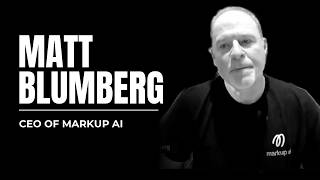
In this June 2026 episode of the CEO Wisdom Podcast, host Charles Cormier interviews Matt Blumberg, a serial entrepreneur and current CEO of Markup.ai. Blumberg recounts his unconventional journey from a Princeton urban‑planning degree to founding and leading multiple tech companies, beginning with his early role at Moviefone and then launching Return Path in 1999, which he grew for two decades into a 4,000‑customer SaaS business renowned for its people‑first culture and universal employee equity. He discusses the challenges and near‑deaths the company survived, emphasizing how a strong culture and trust helped navigate crises. After selling Return Path in 2019, Blumberg co‑founded Bolster, a platform‑focused search firm that ultimately wound down due to scalability limits. In 2024 he was head‑hunted to revive a legacy natural‑language‑processing company, rebranding it as Markup.ai. The firm is pivoting to an agentic AI platform that acts as a control layer for enterprise content, ensuring brand consistency, regulatory compliance, factual accuracy, and readiness for AI‑driven search. Blumberg outlines the product’s agent architecture, integration points (APIs, Chrome extension), and the go‑to‑market strategy of migrating legacy clients while acquiring new early adopters, with a product launch slated for June 23, 2026. Throughout, he shares leadership philosophies—people‑first, trust, giving equity to all employees, and the importance of “lieutenants” and cultural integration when steering turnarounds.
Chapters
Welcome to another CEO Wisdom Podcast. We have Matt Blumberg with us today. He's CEO of Markup.ai. It's content guardian agent. So we're gonna double-click, triple-click on that, what that means nowadays. He's a multi-time founder, CEO of tech companies from $0 to $100 million, the author of Startup CEO, Startup CXO, and Startup Boards. He also hosts a podcast called the Daily Foster. And Country Over Self. Uh, intriguing. Matt, welcome to the podcast. Tell us a bit more about yourself and what you've been up to.
Yeah, thanks, Charles. Uh, happy to be here. Uh, yeah, so look, I've been running, uh, tech businesses, uh, going back to 1995, sort of the beginning of the internet. Um, businesses in lots of different spaces, uh, the movie business, the email business, uh, the, the recruiting business, and now the, um, sort of content production AI business. So lots of different experiences— public, private, venture-backed, private equity-owned, um, you know, kind of full range of things. And then, as you mentioned, some good extracurriculars. Uh, I've written a few books, I sit on some boards, I've done a couple podcasts, some business-focused and then some American history-focused stuff too.
Interesting. Let's start with, uh, your education. Yeah, Princeton, but urban planning. Like, what? Graduated from urban planning and ended up being a tech CEO, a very Wenzel. Tell me a bit more about that early life of yours.
Yeah, you know, my parents always said, like, doesn't matter what you study in college, study something you want to study.
As long as it's Princeton.
Study what you want to study, learn how to be a critical thinker, learn how to learn, learn people, and you can do anything you want with it. And urban planning for me was a mixture of a couple different disciplines that I really liked. One was civil engineering. And kind of architecture, so the building, which I guess translates into entrepreneurship. The other was public policy, so that major combined them. And, um, you know, interdisciplinary— my whole life it feels like it's been interdisciplinary, so I guess that started in college.
And what was your first company? What was your first stint in the startup and tech world?
Yeah, I joined an existing company called Movifone, uh, 777 Film. In 1995. The company had been around for 6 years, so I didn't found it. It was an interactive telephone business and it was pre-internet, and I was hired to figure out what the internet was and ended up being the kind of product manager and then general manager of moviefone.com, which in 1995 at some point was like a top 50 web property. First place you could buy a movie ticket online, first place you could get customized movie listings and e-commerce through email. Lots of firsts in the very early days of the internet, a very, very disruptive business to old media, to newspapers and television at the time.
And you exited just on time for half a billion, uh, right before the, the bust.
Just on time, yeah. And I, again, I not— it wasn't, wasn't my business. I was a happy member of the executive team, uh, but it was great experience. And kind of a good, uh, sort of first, uh, entrepreneurship experience of building a business inside of another company before I started my first company.
And why didn't the CEO/founder give you any shares back then?
Oh no, no, I mean, I, I had options just like other employees and did very well for a 20-something-year-old at the time. But, uh, it was a big headline number and it was not my headline number.
Yeah, yeah. How did that change your mentality? You were like, oh shit, that guy just exited and he's probably worth tens of millions now. How did that influence your mindset?
You know, it was, it was never about the exit and the money. Quite frankly, the thing that I really took away from that experience was wanting to start my own business more because I had a lot of interest in building a different kind of workplace and a different kind of culture than anything else. And that's really what influenced me to go do my own thing, that and my entrepreneurial role model in life is my dad, who was also a founder, really gave me the bug to go do something on my own more than it was like starry-eyed IPO exit thinking.
And why did it take you so long to launch your first stuff? Because my dad was an entrepreneur too, and off the gate, I've started something. Um, seems like you, you followed more like the traditional path, right? Like getting high-paid job. Uh, did you, did your dad push security on you, or did he sort of push you to also take risks?
No, no, he didn't. He didn't actually— he never had an agenda with me. Um, it was, uh, uh, quite frankly, starting a business at 29, which is when I started Return Path in 1999, was still considered early at the time. Now it's not. But, you know, that was before everything. I mean, it wasn't quite before the internet, but it was— let's put it this way— it was before the cloud. Like, when you started a tech company, the first thing you did was get a data center and buy servers and physical servers. You know, you had to raise more money to get started. And so the barriers were higher.
Yes.
And yeah, I had had a few jobs, but I wouldn't describe any of them as— I wouldn't describe what I had as a long career in high-paying jobs.
Right, yeah. Um, maybe I read a couple ones on your LinkedIn as associate and consultant for Mercer, but your first official one was ReturnPath, right?
That was the first company I started, correct?
Yes, yeah, the— and quite successful. Tell us a bit more about that one.
Yeah, that was a great journey. Um, I started the business in 1999, sold it in 2019, so it was a 20-year run. We were kind of pioneers in a couple of, of corners of the email infrastructure sector. We built some really unique data and analytics assets, and we had an enterprise, global enterprise SaaS business at the end that had about 4,000 customers. We had about 500 employees. We were in 12 places around the world and a really well-known brand and a really, really great place to work. Which was part of what I wanted to do from the beginning. So, you know, we won a lot of awards for our culture and being a great place to work. And that part of the success was just as important to me as building a large business and a scaled business.
Tell us more about the culture. You seem pretty fixated on it for a reason, right? Because that was like— Yes, it's been instrumental to your success so far. So double-click on that in like systems that you've built to attract very aligned humans in your company.
Yeah, the philosophy we had at Return Path and the way it was articulated there, maybe a little different than I've articulated it in subsequent companies, but it's the same general gist of things, is what I call people first. It's very simple. You have a lot of stakeholders in a business. There are a lot of companies that are shareholder first. There are a lot of companies that are customer first. And the business was people first, with the theory that if you put people at the center, if you hired the best people, if you developed them and grew their careers and gave them just a great environment, a place they wanted to come in every day and connected them to the mission and connected their work to meaning, that you would, by definition, do the best job for customers. You would build the best products, you would have the best customer service. And then if you got this, if you got that right for stakeholder number 2, it would work out for shareholders. So I think that philosophy has been really important to me in my career as a leader.
And you lasted 20 years in Return Path. I'm, I'm saying lasted because that's an exceptional one. 20 years. Uh, what did you survive? Uh, what challenges came to you? And yeah, like, how much near-death in the 20-year span?
I mean, let's start with, uh, let's start with 9/11, the dot-com meltdown, the global financial crisis— take your pick. Um, but lots of, you know, lots of near-death experiences. It was not a linear journey of 20 years, you know, smooth and up and to the right. And there were Yeah, there were a number of times where I feel like we looked death in the face. And quite frankly, I'll bring the point back to culture a little bit, which is I think there were probably a bunch of points where the business might have died except that the company was really strong.
Yeah, that's fascinating, right? Like employees are still there, like holding each other up. Um, the counterargument is like, do they have other options?
Um, but But we had really good retention and tenure of really strong employees because people wanted to be there and they wanted the company to be successful and they could get on board with a pivot. Pivots were not scary.
But what did you do when there was almost no cash in the coffers and not going to meet payroll? I guess you're a nice guy, nice boss to have, I guess. People built shared values and have fun working there. So it's like, oh, let's just wait, we trust Matt, he's gonna figure it out. And 2, 3 weeks later, it was figured out. Or what were these moments like?
Probably the right way to describe it. I mean, the moments were, you know, harder than, you know, behind the scenes than, you know, than maybe were on my face every day. But, you know, cultures like that have a lot of shared trust. The same way, like, I'm not an engineer, and I trust that the engineers are going to do a good job. Um, you know, I trust that they're making smart architectural decisions and writing efficient code and making good decisions about technical debt. You know, I could say the same thing about almost any role in the company, and I think people felt that way about me. Like, you know, I mean, that's one of the things Matt handles, and that'll work.
Did you give them equity?
Every single employee.
There you go. Yeah, I love that. I, I wish like all—
that's been true. That's been true of every company of mine. Um, including the current one.
No one was doing that back in your days. Like, very few people gave equity to, uh, pretty much everyone.
It was less normal then, for sure.
Yeah, and it's complicated also to give them equity, right? Like, financially, you need to pay for the lawyer papers and all of that, and the complexity, the compliance. Um, how did that one ended up? How did the run ended?
Uh, it was great. We, uh, sold the business in 2019 to a company called Validity. Uh, which was a private equity-backed roll-up in the marketing data space. Um, they bought Return Path basically to be their anchor platform. They've done a tremendous number of bolt-on acquisitions since then. I think they've done a great job of continuing the journey. Uh, we handed them the baton and they've continued to scale it really nicely.
Uh, Foundry invested in you, so Seth Levine, one of the guys that I had on my podcast many times. Good guy.
Yeah, never on my board, but he and I actually were on another board together. Uh, Brad Feld the partner from Foundry, Seth's partner. Fred Wilson was my, one of my anchor tenant investors from Union Square Ventures, and Greg Sands from Costa Nova Venture Capital. Uh, those three were at Return Path. They were also on my cap table at Bolster, uh, the business afterwards, along with Scott Dorsey from High Alpha. Uh, and, uh, yeah, great, great group of venture investors.
And SoftBank, did you speak to them?
No, no, not quite. It was SoftBank Venture Capital, which was Brad Feld, which became Foundry. Basically.
Oh, okay, got it. That's SoftBank. Um, what happened after? Uh, that brings us to 2020, which is like not so long ago. What's, uh, Bolster, I guess, right?
Yeah, 2020, a group of us left Return Path after the acquisition, and we started another company together called Bolster. Um, the premise of Bolster was helping other founders scale themselves, scale their teams, and scale their boards. So the idea was to basically create a different kind of new kind of search firm, uh, that was, um, designed really to be a platform, not a high services, high touch search firm. Um, and we did that for about 4 years. There were a lot of aspects of it that worked really, really well. We placed about 500 people at startups, uh, all across the country and even some internationally. Uh, about 100 of those were independent board members. We did a lot of great intellectual property development, but we had a really hard time building it into a scalable platform, a scalable technology business. The gravitational pull was much more to being a services business like everybody else in the search space. And we just didn't— we weren't into that. That wasn't what our DNA was. That was a lot harder to do. There are a lot of entrenched relationships in search. So we decided to wind that business down in 2024, 2025. It just wasn't going to produce the kind of return that our venture investors wanted or that we, that we wanted. So we returned some capital to shareholders and there's still some remnants of it out there. There are a couple of my co-founders that do some of that, some of that work freelance. So you still see the brand on the website, but the business doesn't really operate anymore.
But now you're all in full time in Markup, right? Like, why did you make that decision?
I am all in full time on Markup. Pickup.ai. Um, this was a really interesting opportunity. This is a business that I didn't start, but it's a business that I'm restarting. So I was recruited in and was able to bring a management team in with me, a number of people that I've worked with at my prior companies. Um, and, uh, we were brought in to, to basically pivot a company that had a legacy software product in natural language processing and a lot of business from Fortune 500 customers that had been with them for 10, 15, 20 years and pivot that into an agentic AI business. So on the one hand, we're building a native AI startup, which is a lot of fun and puts us kind of right in the, in the middle of the most exciting part of tech right now. But we have the sort of the strength of a legacy business behind us. We're about to launch our platform in less than 2 weeks, and first order of business is to migrate our clients from our old stack to our new stack. And then, uh, co-equal, uh, first order of business is to get new clients in the door. Uh, we've already got about 200 customers on the early access list, uh, and we're really excited about it. The premise behind the business is basically, um, you know, job one for large language models was code, uh, and there's a, uh, you know, a well-known and rich ecosystem of, uh, vendors and platforms that serve the coding assistant world. We think job 2 is going to be content. And, um, you know, companies are increasingly turning to LLMs to produce enterprise content. Um, and what that means is that they're getting more content at lower quality, um, in an environment of, of changing— rapidly changing standards. So anyone I talk to that touches content in an enterprise says, oh yeah, my job is now editor because anything I get out of a model isn't quite right. And the Agentic platform that we're bringing to market is basically a control layer for content. So it's agents that help companies keep their content on brand, compliant with laws and regulations, accurate and fact-checked, and ready to go for AI search and AI discovery.
So who recruited you in the CEO role, and were you dropped on the battlefield? I could maybe kill from an helicopter.
I got headhunted by a headhunter, uh, the, the same way that we had kind of been doing at Bolster. We got captured.
Why did they pick you? Like, I mean, you have a very strong track record, right? Like, why were you the right fit for that company?
I think the board knew that they needed someone that was not only able to scale an existing business, because the business wasn't scaling anymore, the business was in decline. And I think they preferred someone who was a business builder and had seen 0 to 50 as much as they had seen 50 to 100. I'm not necessarily a turnaround person, although the business is a little bit of a turnaround because it's not a, it's not a stable, mature space, which is where you think of turnaround. This really needed to be a restart. The company was also originally based in Germany, and the private equity owners who are German wanted a US-based CEO. Company had some US employees, had most of its clients in the US,, but really wasn't part of the US tech ecosystem. Um, and so part of pivoting the business was also pivoting it to, uh, to the US into kind of the startup and growth environment.
It's pretty interesting though, like how they caught you at the right place, right time, because—
right place, right time. Yeah, I mean, the real attraction for me was, was less doing a turnaround, although that's been really interesting, was more the opportunity to work in the AI space, but to do it from a position of having you know, 100 to 150, you know, Global 2000 enterprise customers. So, you know, you can start an AI business from scratch and you can do well with, you know, getting small early adopters. But I think what we're going to have here at the end of the turnaround journey is a native Agentic AI business with Fortune 500 clients on it. And that's a great foundation for us to build on.
So what's your GTM playbook to get these guys to try you and use you?
Well, the existing clients, the playbook is less GTM and more about product and functionality. Basically, we replicated the functionality of the old system in the new system as a series of agents. And the migration path for them is going to be very straightforward because it's the same in some respects, the same system that they're used to using, but it's housed in a much better, much more contemporary body. So that's a little different than the go-to-market playbook for new, which is going to look much more like you would expect, um, a new, uh, native AI company to do. Free trial, you know, start with early adopters and disruptors, start with an atomic unit of one or a small team, land and expand, forward deploy engineers, and the like.
So when you say agents, the agents would go and correct the uncorrect content of my brand?
Correct. Yeah, the agents can be deployed, uh, through a few different surfaces. And there's a little bit of configuration up front, although that only takes a few minutes. You have to inform the agents, like, what is your brand? You know, what's your brand guidelines? You know, you can upload documents that do that or point us to web pages. Do you have a terminology dictionary or glossary? What laws do you want us to check in terms of compliance for accuracy and fact-checking? What's the source of truth? What content repositories do you want to tag for which issues as a source of truth? So there's a little bit of setup, but that, that is trivial. It takes minutes. And then the way you interact with the agents, we, we're very surface agnostic. So quite frankly, MCP server and APIs are the way that a lot of people are going to interact with the agents because we'll plug in as a tool call during the moment of content creation or do batch checking of whole repositories. But we also integrate with, with content applications through a Chrome extension. A couple times we have a bespoke integration to some systems that are a little quirky or are still desktop-based, but for the most part, the Chrome extension is going to do the work so that an author can use us at any point in the lifecycle: content ideation, content creation and editing, batch checking.
And for a guy like you that loves building teams from the ground up, was it a trauma slash a shock to be dropped in a battlefield and probably have to let go of some people and restructure some stuff?
Yeah, there were some really difficult moments, um, and I dropped onto the battlefield is not a bad way of describing it at all. Um, I will say, you know, this is about— this is about founders. So there are a couple lessons that I kind of take away that I think are interesting for founders. One is I think every founder should have to do a turnaround because it makes you sharper. You do not have the luxury of, of dithering that you do sometimes, you know, as a startup. Um, but, um, one of the other things that's been interesting for me, just kind of mentally or psychologically, is when it's your own company, when you're the founder, everything's personal. And when you're dropped in to fix something, nothing is personal. Um, and that's made a huge difference. Now, that doesn't mean it's hard to, uh, to say goodbye to employees. Even the ones you don't know. You understand emotionally what you're doing to someone, but you also understand that if you don't do it, the company is going to die. So definitely challenging, a whole new set of challenges. I think if I ever am a founder founder again, which who knows, I think I'll be a much better one for having done this work. But yeah, I mean, it's tough to be a builder and the first thing you have to do is throw the gear into reverse. And, you know, we've taken a lot of lessons out of the playbook that our team has developed over the years for scaling up and literally done the opposite. Now, fortunately, the business is stable. We're cash flow positive. We're about to launch our new product, and hopefully we'll put the gear back into drive and accelerate forward.
The first— I mean, I've been— I've never been dropped in a company like that. Not something that would be interesting to me as well. But I had various fires and wars I fought in my own businesses for sure. Some instances which I had to sort of take teams, and the first thing I would do is find lieutenants, right? Like find lieutenants that can be trusted and can be like directly under me and start executing stuff. What do you have to say about this?
Yeah, for sure. I mean, I think one of the things we've done well here is we've blended new team with old team. So I did bring some people in with me, because there were some open roles and some part of the nature of turnaround and moving to the US was we had to move some stuff around. But there are some critical people in the organization, probably about half and half, that have been here for a long time, that have the value of institutional knowledge, of client knowledge, and who have been essential to the success of the business and of the turnaround. And I think the team has done a nice job of coming together around shared goals and shared values to move forward. And it does— there's never been a moment where it feels like, oh, it's the new people and the old people.
How do you manage culture clash? Like, German culture, American culture, quite different, right?
There were so many different points of culture clash— front of the house, back of the house, German, US, although we've got people in other countries too, um, old people, new people.
At some point, you—
exactly, at some point you have so many different vectors that it's not— you're not focused on one, and you just have to get keep everybody focused on the task at hand. Um, as I always like to say, the business is the boss. So we spend time getting to know each other and getting to trust each other as humans, but everyone's focused on pulling in the same direction. And we kind of— we try to just set all of that stuff aside. It doesn't matter. It doesn't matter if you're German or U.S. Doesn't matter if you're an engineer or in sales. Everybody's got to pull together to make this thing a success.
Yeah, you gotta be an M badge or an AMG badge to be recruited. That's how I would put it. Um, what's next for you? What— this year, what's your focus?
Uh, launch is June 23rd as we're recording this on June 9th. Uh, so all hands on deck to get this product launched and get adoption, and nothing else matters until the end of the year. We got to get adoption by legacy clients and adoption by new clients. We want to finish the year having moved or planned the move of every legacy client. That's about 120 large enterprises. Um, and we want to get another, you know, equal number of new clients in the door. Um, you know, prove the thesis and, uh, you know, and start the journey forward instead of the journey backward.
Matt, where can, uh, people find out more about you?
Uh, lots of places. Um, my blog is startupceo.com. Um, that's not really about Markup AI, it's about management, leadership. I've been posting a lot about AI recently, but but not so much about this company. Um, my email address is matt@markup.ai for anyone that's interested in what we're doing. Uh, we're still looking for early adopters. Um, product is free at the moment and excited to have people try it and give us feedback.
As Matt and Charles
More from Charles


Founder Wisdom: the audiobook, version 2 (5 hours of stories from founders and CEOs)

8 CEO Questions I Love Asking: the audiobook (64 founders answer, in their own words)





