Mike Muhney - Co-Inventor at Contatta!
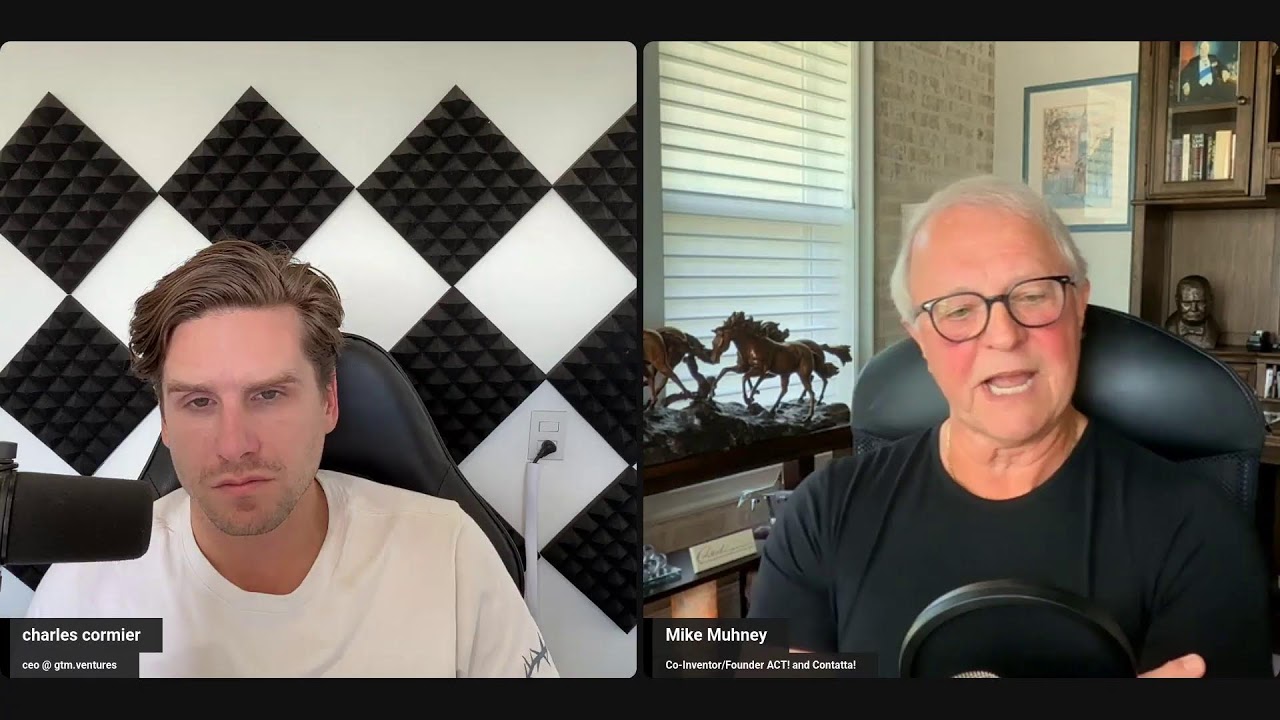
In this Founder Wisdom Podcast episode, host Charles Cormier interviews Mike Muhney, co‑inventor of ACT and co‑founder of the new relationship‑first platform Contatta. Mike recounts his early career at IBM, the serendipitous partnership with Pat Sullivan, and the near‑failure of their first product that led to a July 4th brainstorming session which birthed ACT – the first CRM focused on relationships rather than data. He describes how mentorship from industry influencer John Pertell helped secure a $400,000 seed round, the rapid market launch in 1987, and the eventual 1993 sale of ACT, which yielded a 25‑times return for the original angel investor. Mike critiques modern CRM systems for being data‑centric, non‑collaborative, and neglecting personal relationships, arguing for a broader “people‑matter” approach. He introduces Contatta, explains its naming (Italian for “make contact”), the trademark‑driven exclamation point, a nostalgic $19.87 monthly price, and the role of AI as an assistant that never replaces human connection. The conversation also covers Mike’s post‑ACT career – ventures with Michael Jordan and Charles Barkley, leadership at SalesLogix, and a senior role at Deloitte – before returning to entrepreneurship with Pat. He outlines their complementary skill sets (Pat as the inside/operations lead, Mike as the outside/sales storyteller) and shares personal philosophies from IBM sales school about self‑management and the importance of remembering people. The episode ends with contact details (mike@contatta.com, contatta.com) and a teaser for the upcoming product launch.
Chapters
Welcome to another Founder Wisdom Podcast. We have Mike Mooney with us today. He's the co-inventor of Contata and ACT. He's an author, a speaker, he's a CRM OG, the godfather of CRM. Mike, welcome to the pod. Tell us a bit more about yourself and what you're up to.
Charles, thanks for having me. Well, despite being older since the original invention of ACT back in 1986, '87, I'm back in the startup software entrepreneur realm. My ACT business partner and I, Pat Sullivan, decided to start another company and create an even higher standard of contact management or relationship management software than currently exists on the market. In contrast to the CRM industry, which is really no longer about relationships, it's more about the data. We're grabbing the bull by the horns and taking the relationship ownership back.
Interesting. Okay, tell me about your story, right? Like, how did ACT, uh, got started back then, and how did, uh, Contata saw the light?
Okay, yeah, so, uh, Pat Sullivan and I serendipitously met after graduating from college. We moved into an apartment complex 2 doors down from each other. We became great friends. We both started our careers in sales. I started my career with IBM back in the mainframe era, so I'm a classically trained mainframe sales guy, and IBM taught us in sales school, interestingly enough, on how to connect with people much more than how to sell. Although they did teach us how to sell and all that, you know, selling techniques, but it was always about the connections and also about how you carried yourself. So principle-oriented. Those principles, 10 years later, when Pat and I decided to start a company as the emerging PC industry was happening, is what caused us to ultimately create ACT. But how ACT came together is not what people think. ACT was really a Hail Mary pass. Our first product was a configuration product for a very specific industry segment. We raised $100,000 from an angel out of Boston. We were in the Dallas-Fort Worth area at the time, and $85,000 later, With only $15,000 left, Pat and I literally said to each other, this dog ain't gonna hunt. We're dead. It's over. We failed. And we were willing to give the $15,000 we had left back to the angel who was coming down to see us in about a month. But as fate would have it, one of the people that I was trying to sell the configurator product to, a CEO of a company— IBM always taught us to call at the very top. and you might get delegated down, but call at the top. Well, I applied that principle from all those years of being an IBMer, and he took a liking to me. He never bought the product, the original product, but he did invite me to stay in touch with them. Well, the week that Pat and I realized that our product had failed, there was an annual edition in the PC industry called Consumer Reseller News, and on the COVID of the, of the annual edition of the top 25 most influential people in the entire PC industry. I'm call— I'm talking about people like Bill Gates. Uh, this guy, his name was John Pertell, was one of them. So I called up John and said, John, can we come and talk to you and get some advice? So Pat and I went and talked to him, told him why our product had failed. We were willing to give $15,000 remaining back to the angel. And this is what he said. He said, look, you 2 guys are smart guys. Next week It is July 4th, a holiday in America, obviously, 1986. Why don't you go have an 8 until noon brainstorm breakfast and see if you can come up with another idea before you throw in the towel? Well, we could still afford coffee and toast, so we were in a booth in a restaurant hotel at a Holiday Inn. And we said, we are sitting here no matter what for 4 hours, and we've got to try to come up with another idea. And we We decided to set some boundaries. Whatever we created, we wanted to have what we called useful use. But we started with this question: if we wanted something that we could use ourselves, what would it be that doesn't exist? In other words, what do we need? Forget about the market. What do we need? And so we began a discussion, and at the time we had our paper day timer system, Filofax. Calendar system, whatever you want to call it. And as we looked at it, we said, you know, that's all about activities, but all of those activities spread all over time across many days, weeks, months, and years of Daytimer, you know, folders. It all points back to the person. So why don't we flip the coin and focus on the relationship and attach everything to the relationship rather than the activities? And so we began that discussion and I'm going to show you right here is the original quote unquote napkin. This is the original menu design of what 9 months later became ACT in the market. And not only did we create a product, ACT, we had to create the category for it as well because there was no category for it. Let me take a step back as well and tell you the finish of the story. After that breakfast on July 4th, for the next month, Pat and I architected the product. I hadn't yet come up with the name ACT. I code-named it YES, and YES was an acronym that stood for Yes, Everybody Sells. I don't care if you're an engineer, doctor, lawyer, accountant, pastor of a church, a clown in a circus. Everybody has competition because all of us are replaceable. So the fact that this was designed for people who deal with people and wanted to distinguish themselves from competition is basically what it was about. And so I— we architected the product. The angel came down a month later. We picked him up at the airport. We went out to lunch, and at the end of lunch, we said to him— his name was John McNair— John, we have bad news for you, and we have good news. And thank God he was a very patient man. He said, well, what's the bad news? We told him why the product had failed. We answered all his questions, and he said, well, okay, so what's the good news? And we told them all about YES, what it was going to do, its value proposition, who it was for. And this is— and then we had to shut up our mouths because we did say to him, we're happy to give the $15,000 we have left back to you if that's what you want. And he looked at both of us and he said, I didn't invest in that product, which was called Margin Maker. I invested in the 2 of you guys, and I actually like this idea better than that. Do you need any more money? We were totally not expecting that, Charles, you know. And so spontaneously, Pat and I said, with no premonition that that would be a question or, or an opportunity, we said $50,000. Why didn't we say more? Well, we'd asked for $100,000 to begin with, and we lost $85,000 of it. We said $50,000, and without a word, he opened up his sport coat, took out his checkbook, and wrote us a $50,000 check on that table. He left back to Boston the next day, and I then called John Pertell, who I hadn't spoken to in about 5 or 6 weeks now, who suggested the breakfast. And I said, John, you're not going to believe it. We, we took your idea. We had the breakfast. We came up with an idea. The angel came down and he liked it so much he invested another $50,000. And here's what John Pertell said. He said, You know what? I like that idea too. Why don't you and Pat come to my house later in the week in the evening? And I'm going to also have 2 other guys, friends of mine, who might be interested in taking a look at this too. Pat and I went there later in the week. We did our pitch, and we left that house that evening with $400,000 in checks. And now we had life. And we continued to develop ACT, and it came on the market April 1st, April Fool's Day. Easy day to remember, 1987, 39 years ago. And Charles, it is still on the market today, tens of millions of users. It established what became and evolved into what is known as the CRM industry. And decades ago, the industry dubbed Pat and me as the godfathers of CRM.
Got it. And what was the return on these checks? Like, did the company pass various hands? What was the exit of that original investor?
Yeah, the original investor, he did very well. He made about— let me think here, calculate this— he made about a 25-time return on his investment.
Okay, nice. So that would be what, like $4 million?
Yeah, he made a lot of money. $150,000 to about $4 million. Yep. Okay, and when did you and your partner exit that We sold the company to a firm in Silicon Valley 7 years later, June of 1993. I will say that upon reflection back, we wish we hadn't sold it. We would have gone public had we stayed the course for another year or 2, but, you know, it was lightning in a bottle. But at the time, Microsoft was beginning to make inroads in the press that they were going to come out with an apt killer. And so a bird in the hand is worth 2 in the bush. So we sold the company. Having said that though, the product that Microsoft came out with was Outlook, which is not a relationship management product.
Yeah, well, I guess it was Salesforce, right? That was a pretty big competitor. Tell me a bit more about that.
Well, Salesforce didn't come on the market till 1995, I believe. So, you know, a couple years after we had sold that. But again, ACT! is recognized as the catalyst that started the CRM industry. You know, as funny as it may sound that Pat and I are the godfathers of CRM, Charles, we also have a little bit of an anti-CRM attitude for a number of reasons. First of all, CRM is only about customers and prospects. What about the 98% of all the other people you meet in your life, both business and personal? Are they not important to, to remember things about? Sure they are. Because you never know how you may encounter them again, or they may go talk to other people who lead those people back to you as a customer or prospect. So you've got to take care of everybody. CRM does not allow that. Number 2, CRM is not collaborative. They will never share their database with an outside entity. Well, that's not the real world. What if I need to collaborate? Let's say I'm a wedding planner and I need to collaborate with the photographer and the cake maker and the venue owner. I've got to collaborate for this wedding party on this very important date for the bride and groom. All of us working together in unison and sharing common contacts and who's doing what with whom. So there is outside collaboration that is necessary in a vast part of the world. Number 3, CRM is, like I said, only about business people, so it totally negates personal relationships. But In today's world, as we know, a friend can become a customer, a customer can become a friend. So it doesn't make any sense to limit it only to one very small segment. So there's a lot of things that are lacking in CRM, and it really ought to be called CDM, customer data management. It's about the opportunity— who's going to close, when, and for how much. Well, that has nothing to do with the relationship. You know, I kind of liken it to the movie The Godfather, where Clemenza— for those of you that saw The Godfather— took Paulie out into the field to kill him, right? And Clemenza gets out of the car and he said, you know, leave the gun, take the cannoli. Well, in today's world, companies are laying people off, or people quit, you know, all sorts of things. There's a huge gig economy today. People that are on their own, they, they are the ones establishing the relationship. They're the ones that could have that relationship for life as long as they maintain it. So, if they leave a company or are downsized or fired, The company has the data, but they're not the ones that nurtured the relationship. And a salesperson— and again, remember, our belief is everybody sells— nobody is going to say all those little personal details that they've learned and put it into a CRM system. The CRM system doesn't care that your little daughter Susie, you know, just won the ballerina contest, or that your son has aspirations to go to Harvard, or whatever. The CRM system doesn't care about that. The person establishing the relationship does to make a deeper, stronger connection. That's what we're about. So that's why Pat and I, we got disillusioned with the CRM industry, how it took the relationship away. And we said, let's create a product using today's technology and standards and create an even higher standard of relationship management than we did once a long time ago with ACT.
And that's Contatta.
And that is Contatta, C-O-N-T-A-T-T-A. It's an Italian word, oddly enough, interestingly enough, that means make contact. So our byline is going to be Contatta from the Godfathers of CRM.
And why the exclamation point? I don't think you can put that in a domain name, right?
You cannot. The reason it kind of goes back to ACT. You cannot trademark a common language word, right? So with the exclamation mark back in the ACT era, We were able to trademark it. That's number one. Number two, it just shows our enthusiasm, the passion, kind of be dynamic, you know, just do something, be in motion. And that exclamation mark is that level of excitement.
And what did you do after ACTS? You know, like I saw your LinkedIn, you were speaking and all of that. Like what did you do during these couple of decades and what brought you back to like building some stuff ultimately?
Yeah, well, I was, I was only 42 years old when I retired, and although I enjoyed that for a brief period of time, I found that retirement was quite boring after all. I mean, you can only play golf so many days in a row. I had done world travel. I'd lived in Europe for 4 years. I'd been to 27 countries, you know, so traveling wasn't, you know, anything exciting to me anymore. So I got my fingers involved in a number of things. I started a company that lasted for a while with Michael Jordan. the basketball player who was still playing basketball at the time, and Charles Barkley. I later went on to be the executive vice president and general manager of international operations for SalesLogix, a publicly traded company that Pat himself had started. And I also was a senior manager at Deloitte Consulting as one of their 3 global spokesmen for their CRM practice. Because of my credential. So I did things, but none of them ever realized the level of excitement that I had tasted with ACT. I mean, there's nothing like starting with an idea and seeing it through to a destination you never could have imagined in your life. But more importantly, the impact that we got feedback on from our customers on how it changed their lives, Charles. I mean, When you tell people that their, you know, their lives were completely different than they ever thought they could achieve, that just touches your heart. And so, you know, as time went on, there was— there's always an affinity toward what I call our child, Pat's and my child, ACT. But ACT grew up and presently it's on its 5th owner. And the soul of ACT went out with it when Pat and I sold the company. Quite honestly, it just became a transactional software product. People are still using it today, don't get me wrong. It's a Windows-based product. Now it's cloud-based, but it for the most part was a Windows-only product. They didn't even have a mobile version for quite a long time. That didn't even reflect reality. And so 39 years of upgrades is kind of an overburdened software product, if you will. We're proud of our child, but it's on its 5th husband, if you will, and it's been abused. So, you know, Pat and I are just raising it, raising a new kid, if you will.
How are you and Pat complementary? What, like, skills, uh, do you have that one may not have in the relationship?
That's a very good question. So here's 2 sales guys. So, you know, how do you distinguish your, your, uh, responsibilities? And we made it very simple going back to the ACT era. Obviously, we both designed and collaborated on, uh, the functionality of what ACT became. Once it was out in the market, we split our responsibilities where he was the inside guy and I was the outside guy. So operations, working with the developers, etc., is Pat's strength and interest and passion. Mine was more the sales and marketing and the ability to go out and tell the story and present the value proposition. So it, that's what we're employing today with Contata.
Aren't podcasts the greatest relationship accelerator of all times?
Aren't what? Say that again.
Podcasts, the greatest relationship accelerators of all time.
They definitely can be. I mean, keep in mind, back in the ACT era, there wasn't even email to begin with. Imagine that. And people were using things like fax machines. So the eras, the cultural themes have changed greatly in the last 39 years since ACT came on the market. Definitely podcasts, social media clearly is a way to help promote and create a viral awareness of any type of a product. 100%.
Well, it's just you give people an excuse that wouldn't talk to you to talk to you, right? Like, think about it, Mike. If I would have outreached you with like a sales pitch, you would have never talked to me, right? If I give you the stage, if I give value before I ask them, you're gonna say hell yes, right?
I did.
You can refer me some of your colleagues, I can refer you some people, and this grows exponentially.
Yeah, 100%. And that's how I actually did respond to you, because that was the opening line in your email, that you're a podcaster and, you know, you had learned a little bit about me and wondered if I'd be interested in joining you on your podcast. Well, how can you say no to something so seductive?
Yes. So maybe we'll, we'll help you start yours. I want to know though, CRMs, right? Like I use a bunch of CRMs or tried a bunch at least. Salesforce, I've never stuck to it. HubSpot, too expensive, too jack of all trades. In the last year or so, I've stuck to CRM called Adio, Adio with 2 Ts.
Why?
Because it's AI, right? It records pretty much everything. It's data like you said. Obviously I add the relationship part of it. So I give out good offers to my prospects and build the relationships and care about them. And I view it as a win-win ecosystem. But these guys are doing it very well. And also, how can you compete against these new guys that are tech-forward first? Like, double-click on the relationship aspect that you were telling me about.
Yeah, obviously there's always a lot of competition. In fact, I'm going to go back about 15 years ago, the last time I read a Gartner report, their annual report on the status of the CRM industry. And at that time, it's It's got to be a lot more today. There were over 1,500 CRM companies, and so competition is just everywhere. And obviously we're going to face competition. That doesn't discourage us because we think we have a cleaner approach and a bit of a deeper understanding. I mean, when you think about it, Charles, between Pat and me, we've got 80 man-years of understanding relationship management. We created the category. Now, does that make us, you know, a shoo-in for people to select? Absolutely not. Like anything, we've got to earn the right, but our credential gives us a little bit of a hedge in, in having that useful use concept that we originally employed in ACT. And so that's partly why we're having the Godfathers of CRM as a tagline, because for people 40 and above, many of them will have one— will have had at one time used ACT, or know somebody that used ACT, I mean, including their parents. I can't tell you how many people that I meet today that are around your age that said, yeah, my dad used to use it and he swore by it. I mean, I literally had one guy tell me, if my dad was here and met you, he would bow down to you. I kid you not, that's what he said to me because of how much you changed his life. Okay, so our OC credential kind of— OG credential, sorry— gives us an open door that we hope to take advantage of. But like anything, you're going to have to evaluate our product against others. Our price point is very attractive. As a throwback to ACT, which I said came out in 1987, the monthly subscription is going to be $19.87. Very affordable for all that you're going to get with it. Regarding AI, of course, there's going to be some AI component to it. And it will continue to increase in value and functionality. But I will tell you, Charles, that we will never— and I know you should never say never, but at this point I'm going to say we will never let the AI take over the relationship. It will be an assistant toward deepening the connection and strengthening the connection. But it's up to you and me, the individual, to, you know, better connect and construct and cultivate the relationship. And I want to say this too. I really don't even like the word relationship management.
Why?
Because I can't manage a relationship. I can barely manage my own kids. What makes me think I can manage you, right? Or any, any connection that I have in my database. The only thing that each one of us can truly manage is ourselves. The better I manage myself is the means by which you better perceive me. How you perceive me is how you talk about me. How you talk about me to others basically is my reputation that will either lead people toward me or away from me. And so my job really is to manage myself better, and I want a tool that helps me accomplish that. And that's what Contata is in the final analysis. Fundamentally, it's about 2 simple words that are powerful: people matter. That's it. People matter. And I therefore want to do everything I can to demonstrate how much the people that I encounter matter to me. Some are transactional, some are frequent, some are extremely close. But in my layers of relationships that we all have, and I'm talking tens of thousands over the years, as you can imagine, that I've met, you know, some of them I've obviously collected information on there. They give me their business card. For whatever reason I chose, I wanted to remember them. Some of them I haven't talked to in my own current database today, haven't talked to in 10, 20 years, but they might come around again. As a matter of fact, 2 weeks ago I got a text from a friend who I haven't seen since 1993, who was one of our original beta testers of ACT, who learned I was going to be in his town speaking And he said, hey, can we get together? And he picked me up, we went to breakfast, and we picked up right where we left off 20— what is that? I can't remember it now. 31 years ago. 32 years ago. 32 years ago. Yeah. And so that's what I'm talking about, Charles. And I remembered all those details, and people— that impresses people. Here's another principle IBM taught us in sales school to give you an example of why it's important to understand the things you're really managing is truly just yourself. So, on the first day of our class, our national class physically being together, in the first 15 minutes, they changed my life. And I kid you not. And here's how they did it. So, we were all eager. This was the first day of sales school. And, you know, they said, we only have— there's only 2 kinds of salespeople in the entire world. And they said, the first kind we call jackasses. They can carry a heavy workload, but you constantly have to kick their butt to get them to work. None of you are jackasses. Now, that was nice to know for a moment that they didn't consider us jackasses. But this is what he said. We only hire wild stallions, and all of you are wild stallions. Now think about it. If you're sitting in class and somebody says you're a wild stallion, in my own mind immediately, and you look at my bronze wild stallions in my office here, which is kind of a throwback to my IBM. launch of my career. Uh, the fierceness, the independence, the power, the determination— that's a wild stallion. But here's what they said: but by the time we're done with you in 6 months, you're no longer going to be wild stallions. You're going to be thoroughbred racehorses. Holy cow, they took us from here to being a wild stallion to saying, no, you've got to see yourself at an even higher level a thoroughbred racehorse, a Kentucky Derby winner, whatever. So the whole point that they knew was the fundamental cornerstone to our future success as an IBMer and life itself was how we saw ourselves. Well, how you see yourself is how you carry yourself, right? And so that's why the principles that IBM taught really were embedded in the design of what became ACT and are embedded today still in the design of Cantata. It's really a philosophy of life more than a functional software product, although it is that, obviously.
Thanks for being on, Mike. Where can people find out more about you?
Well, thanks very much for the opportunity. Mike, real easy, mike@contatta.com. C-O-N-T-A-T-T-A. We're anticipating launching our product to the market in, let's say, a month's timeframe or thereabouts, maybe a month and a half. You can go to our landing page, cantata.com, and leave your email address so that you can be notified as to our progress and launch. And to those that do go there and join us, we look forward to having you as a customer at that time. And Charles, again, I appreciate the invitation and the opportunity to speak to your audience as well, and for them to know about you.
Was Mike and Charles
More from Charles


Founder Wisdom: the audiobook, version 2 (5 hours of stories from founders and CEOs)

8 CEO Questions I Love Asking: the audiobook (64 founders answer, in their own words)





