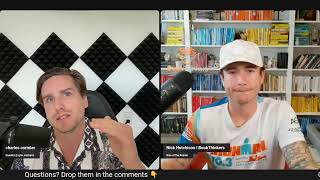
Nick Hutchison, CEO of BookThinkers, talks about how endurance athletes use documentaries and audiobooks to push through pain, why authors like David Goggins work with publishers like Scribe to keep their IP, and how his 15-person agency markets books. He also covers bio-hacking rituals, learning tools like NotebookLM, and why re-reading books changes what you get from them.
Chapters
Welcome to another Founder Wisdom pod. We have, uh, Nick Hutchinson with us today. Uh, he's the CEO and founder at BookThinkers, a bestselling author, keynote speaker, top-rated podcast host, in full Ironman suit today. Uh, my man did the 70.3 last weekend, about to do a full 140.6 soon. So Nick, uh, how's it feeling?
I'm just trying to be like you. That's what I'm trying to do.
I, I need to do another Ironman. I'm prepping for 125K. Um, yesterday I had a pretty good session on the treadmill, the 14 kilometers an hour sustained for, uh, 10 minutes. It's pretty fun while watching an Ultra. That's a big hack, you know, like you run and you, you're in deep in the pain cave while watching an Ultra documentary. Have you use some of these hacks yourself?
Absolutely. I do that when I'm on the indoor bike trainer all the time. I'll watch like the Iron Cowboy documentaries, or I'll— if I'm on a long run and I just have headphones, I'll listen to David Goggins and Can't Hurt Me or something like that.
Yeah, Lionel Sanders, um, this is another good one, right, on YouTube. Have you find out?
No, I haven't checked that out. No.
That's like the, the pain cave godfather. I mean, technically, uh, I think it was Courtney DeWalter or Sally McRae that coined the pain cave, uh, as a term. But, uh, yeah, the, the number one representative of the pain cave in the triathlon world is Lionel Sanders, fellow Canadian. Uh, love this guy. And by the way, um, I was about to refer that book to the last guest of the podcast. Your book guy, right? Uh, yes, Ken Rideout. Uh, you've heard about Ken? Maybe. I'll have to check. Ken is like this, um, Irish guy in New York. Uh, he won a bunch of marathons. Very tough, tough as nails, this guy. Really good book, uh, if you want to listen to that one.
Is it The Other Side of Hard? Is that the book you're talking about?
Yes, yes, yes, yes. Another good one, um, sort of traumatic one but good to listen on the, the run, uh, because Ken also had a tough childhood, but Sally McRae. She recently launched a book, was a bit weirder book because it was like a two-part and the second part is not released yet. Is like the first covered her past and the second book is going to cover her present, which is her runs. What do you think about that book strategy? Is it the first time I've seen that one?
Yeah, I don't think I've seen that strategy before. That's interesting.
What other ultra books? I mean, Goggins is like a masterpiece, right? Like Can't Hurt Me. 1 and 2. I know that the second one is not called Can't Hurt Me. Yeah, it's called Never Finished. Yeah, both of these are masterpieces. Why do you think these are so good? Because I mean, I read 1,000 books. You also did read a whole bunch of books. This one is one that I constantly repeat. I never get rid of it. And it's one of the 5 books, right? So why do you think it's so good?
I have a lot of thoughts on that. David, David was in such a bad position in terms of growing up in an abusive household and then going to school in racist communities and then ending up unfulfilled and overweight. You know, in the United States today, 40% of people are obese. So I think it just It strikes a chord with a huge population. And then his turnaround was so incredibly dramatic that I think it gives everybody hope. Now, there's a funny saying about David Goggins, Charles, which is like, even David Goggins doesn't want to be David Goggins. Oh yeah, I think willpower can only bring the average person so far. I don't have a broken upbringing like David, and so while I get motivated by it and I can relate to parts of the story. I more admire him than can relate to him. And so I focus a little bit more on strategy than pure willpower, and I think that's a little bit more of a sustainable approach. But I've listened to that book Can't Hurt Me like 5 times, and I just love how imperfect David is.
Yeah, but 2 things, right? You and I, we don't have broken passes— we had pasts. Uh, we had the happy childhood, but we can still relate to the guy like crazy. Uh, that's one thing. And second, you mentioned systems, right? Well, David is part of our system. I'm very systematic like you do. I hack the shit out of my ultras, my triathlons. Like, people ask me, oh, Charles, did you train like 30 hours a week? No, dude. Do you think— do you train 20 hours a week? No. You train 10 hours? No. I train like 4 hours a week or something like that. And I still do these, do these training, right? But I supplement like crazy. I invest tons in my health. Like, I invest like at least a couple of grand in my health per month. And I've been doing that since 10 years, right? So, but yeah, no good comments on Goggins. I think he went to that company you told me about, Scribe, right? Scribe Media and JM, I feel McCormack or whatever his name is. You run a similar company, right? I do feel that Goggins was sort of luck for them, right? Because like, oh, this military dude, like, who is he, right? Why do you feel they took a bet on him? And how predictable would be the book success? Because I'm pretty sure you, you filter your client and you estimate their probabilities of success when they come to you.
Yeah, so my company BookThinkers, we're just on the book promotion side of things. So we don't do the actual publishing. In fact, we work with Scribe and a whole bunch of other publishing companies. And then we just help take a book that already has some success and bring even more exposure to it. But I think a book like David's, you know, a little bit about his process— he had a few different publishers that were bidding on that book originally. But what happens in the traditional publishing space today is you forfeit your IP. You're selling your intellectual property to the publisher for some money up front and you get almost nothing on the back end. And I think a lot of those publishers wanted to moderate his content a little bit. I mean, it's pretty, it's pretty out there. He's pretty straightforward with his language and transparent about the things that he went through. So going with Scribe, and then they have this imprint Lion Crest Publishing, going with them gave him the ability to retain his IP so that he could go out there and speak and build other products and services related to it without having to pay them royalties. I think I think that was a good move, but really he just wanted to retain the real raw aspects of the book at the time, you know, Navy SEAL, um, Army Ranger, you know, triathlete, long-distance runner, endurance athlete. Like, he was just gaining so much momentum, and there really was, you know, all of those things were becoming more popular at the same time. And I, I just think he placed a bet on himself. Really by going with them. And then, yeah, the book caught fire. He was also one of the first people ever to do the audiobook in that style where— which is weird— the reader reads the chapter and then he does like a mini podcast interview after each chapter to share behind-the-scenes stuff. So I know that when I refer that book to people, I go, don't read the physical book because you're missing some of the best stories. They're only in the audiobook. And that fear of missing out just kind of caught fire.
Right, right. Yeah, Adam, the guy is a bit odd, right? Is like a bit on the better side of things when you read the book. It's like, Adam, dude, just shut up. But Goggins is, um, yeah, it's very gracious in the, in the book, the Slash Podcast they call it, right? Listen to the book so many times, I can tell you about the micro details, but it's crazy. Question is, did he had the Joe Rogan appearance when he came to them? If so, it's like a no-brainer, right? Because Joe Rogan, or anytime someone goes on Tim Ferriss' show back in the days, that was like a hockey stick, right? And it's just the right time to, to sign these clients. I'm not sure if he had that back then.
I know that the interview with Jesse Itzler on Joe Rogan about Living with a SEAL— oh yeah, yeah, yeah— I know that was definitely before everything, and that was probably like a little bit of a market test. Like, that book did so well and everybody said, who's the seal in this story? And at first David wanted to be anonymous and then that book took off. Yeah, the stories kind of took off. So that was probably like some proof in the pudding that it was going to be a successful story.
I was like Goggins with zero EQ back in the day, zero. And then he progressively like learned how to interact with humans, which is pretty hilarious. Today's version of Goggins is better, right? I would have not want to go out on a run with Goggins back then, but nowadays, like, oh, maybe he's a bit more human and you can have, like, interactions with the dude, right? It's not like a fucking gorilla that just, like, growls at you. Um, how did you first get into books? How did you first get into triathlons? And what's the magic in merging the two, aka listening to audiobooks while you're on your bike or running?
Yeah, well, I'll take the floor for a couple of minutes, but I think you'll find this story interesting. So I was not much of a student growing up. I was more of the athlete, not really the academic. So I played American football and I also wrestled, and I loved playing sports. I did not love the classroom. I was one of those kids that was always capable, like I was famous for having a 0% homework average in my AP Calculus class. So I could do the work, but I was just sort of choosing not to. School didn't excite me. But when I was in college, something flipped. I took an internship going into my senior year of college at a local software company. It was a sales internship, and my boss Kyle brought me on a couple of local sales trips. And Kyle was a cool guy. He drove a new white BMW. Kyle was making good money. He was the director of sales. He would like to go out and have fun and party. And so I said, I want to be like Kyle. If he listens to podcasts I should too. And so I started listening to some shows. This was back in like 2015, 2016. One of those was the Tim Ferriss Show, and I listened to all these successful people talk about how they became successful. And so many of them were giving at least some credit for their success to the books that they had read. And a lot of the personal development classics were popping up, right? Books like Think and Grow Rich or How to Win Friends and Influence People. So I realized if I am not reading because books aren't cool, then I'm also forfeiting a better future. I'm going to make less money, I'll be less healthy, I'll have worse relationships. And so I just put the ego aside for a minute. I went to my local Barnes Noble, I grabbed a stack of 10 books, and the rest is history, man. I fell in love with reading as a way to solve problems and build skills and satisfy curiosities. So I started sharing the books I was reading on social media because my friends and family were sick and tired of hearing me talk about the books. And I built a following of other young professionals interested in a better life and achieving it by reading and implementing books. And as my audience got big and big, or bigger and bigger, I had authors reaching out to me asking, asking if I could help promote and market their books. And I built that into a full marketing company. I mean, today we've got 15 people on the team. We serve hundreds of authors a year. We help them promote and market their books in a variety of different ways. And you know what, Charles? Along the way, I met a bunch of triathletes. You know, these successful business people that—
Savages.
Yeah, they exit a business or they retire and they have all this money and all this time. You know, it's an expensive sport, or it can be. And they all get into endurance sports because it's a way to keep that same business endurance type vibe, but then they apply it to their bodies, which usually they've been neglecting for a long time. And so, yeah, I just, you know, I started working with all these crazy clients who were like, hey, you should get into this sport, you should get into this sport. And so I thought, the business brain of me said, if I get into this sport I'll be able to build better rapport with these people and close more business. And so that's why I got into it. And then of course, you know, it becomes addicting for its own reasons.
So funny, like how you got into these things. Me, like books, my mom got me into books like early and words. I was always good with words. I had a very vivid imagination, right? So I can play out a better movie reading stuff than watching an actual movie. Movies are a bit more boring. For me, except if it's a masterpiece like Blade Runner 2049. Shout out to Denis Villeneuve from Montreal. Um, and triathlons— it was my, uh, business partner's stepdad. He was like a 50x Ironman. I was like, dude, I'm running 10Ks and it's already fucking hard. How can— can I be like this guy? This guy's like a fucking legend. 'Can I be like this guy?' And that sounded impossible back then. And look at me now, you know? And I started as an asthmatic in this world, right? I was born asthmatic. So it's like, fuck you, you know? Like, I'm not asthmatic. The school system was sort of against me also back then. Look at me now, I'm serial founder, extremely successful. So there's also like a middle finger component to it. Oh yeah, for sure. It's like what Goggins says, right? Well, you go to your grave as the best version of yourself, or will you be like the loser that society built, you know?
Yeah, those deathbed metaphors and, and like brain exercises— I spent a lot of time thinking about death. In fact, I have a tattoo on my neck that says Memento Mori.
Of course you do.
Remember, you're going to die. And, uh, one of the books that had the biggest impact on me early on was a book called The Top 5 Regrets of the Dying by Bronnie Ware. Oof, it gives me goosebumps every time I talk about it. She— for the audience that doesn't know about the book, she spent the last couple of days, weeks, or months with people as they would die. She was a palliative care nurse, and she would just talk to these people, and they all had the same regrets. And the number one regret is something like, I wish I would have lived a life based on what interested me instead of live a life based on what interested everybody, you know, everybody else. And so early on, it was just, hey, I'm gonna go for it. I'm gonna live a life where I minimize regrets instead of maximize regrets, like the default programming that our society tries to put on us, right? Overweight, broke, unhappy, unfulfilled, divorced. I don't want those things. I want a different life. And by the way, becoming an Ironman, I mean, that just defies all odds. And you're right, it's like a middle finger to what society tries to get us to like anything is possible, right?
It still is, I think.
Yeah, yeah. And it's so very true.
It really is, right? Podcast. I also— yeah, John Lee Dumas. Shout out to John Lee Dumas, right? Back in our days, uh, I got like into that, that rabbit hole. Makes me think of a guy that we talked about, I think, last time that we spoke, David Senra. Deeply obsessed with books, that guy. Uh, I, I love studying his story. He was like a, a sales rep or something, hitting like 35 years old, and then he got obsessed with one book. Was it Esther Lauder? Was it Warren Buffett? Was it Steve Jobs? But then his obsession never stopped from there. What is so addictive about self-improvement, right? Because I've gone through that phase. I think I'm sort of out of it. I'm getting back into you know, the podcast train with Founders Podcast, but even Founders Podcast, I'm getting bored. Um, I'm getting to— I'm getting to the question of your learning stack nowadays. I've gone through the phase of doing deep researches with AIs because audiobooks were a bit too boring for my brain or not advanced enough. I feel books— a lot of books have agendas also, and they're trying to sell me something, and I just want like the pure information. So at what phase are you right now in your learning stack and how has it changed since the advent of AI? Give me like your, your learning routine.
Yeah, it's, it's a great question. And I'll tell you what, I'm still, I would say the primary learning mechanism for me is still long-form physical paper books. And I have, we could dive into why, but I, I love everything. I love audiobooks. I use a couple of different AI platforms that are specifically for books. Of course, I use the general AI platforms to do deep research as well. I'm a business owner. We're a scaling business, so, you know, we're implementing all sorts of systems and measuring data. And I also have a bunch of different mentors, like people who have done what I want to do times 100x, and they're working with me to jump over the milestones that I'm at in my career. You know, I'm a young guy, I'm 32 years old. I'm going to be in this space for another 50 years. And so I think the learning will be endless. I'm just genuinely curious about the world. And what's interesting about learning, whether it's books or AI or anything in between, is that the more you learn, the more you realize you don't know. I mean, there's an infinite amount of information out there. You read one book on fasting and autophagy and you realize there's an entire— like, you can spend the rest of your life researching just that subject. So, I mean, today I use all of the tools, but still, long-form physical paper books, that's my go-to.
Yeah, or talking to Jason Fung, I guess, right? Like, having them on your podcast is definitely like a good part of the learning stack. You need to talk with the guy and ask the questions that you have. If you talk to so many smart people and you've already researched the topics with books, audiobooks, podcasts, and you supplemented with AI research, then your quality of questions will be even greater on the podcast with this guy. How do you get this guy on your pod? What's your strategy to have him allocate a bit of his attention span to you?
Yeah, well, you know what's beautiful? I found a great hack for this, Charles. So my podcast, every episode features an author and we do a deep dive into their book. So I get to ask my follow-up questions after reading it. And every author is a little insecure when they're about to launch a book. They're insecure about the number of copies that they're going to sell and how people are going to think about it. The more successful you become, generally speaking, if you don't do the inner work, the more insecure you become as well, because there's a bigger risk. And so, look, my first podcast interviews were with authors like Jim Kwik, who wrote Limitless, and we dove into the brain. Or Grant Cardone, who wrote The 10X Rule, and we dove into thinking big. Robert Greene who wrote The 48 Laws of Power, and we talked about power dynamics. Or Ryan Holiday— I love stoicism— and we jumped into stoicism. And so I've interviewed all of these people— Alex Hormozi, and the list goes on and on. And I— the reason that they choose to work with me is because I'm helping them sell a book they're about to launch. And that's the cheat code.
It really is, right? Okay, I'm skeptical on books, right? Like I said, I don't read books almost nowadays because I find their value to not be as good with on par next to deep cloud research with Fable, for example. It's like humongous. It just scrapes everything, right? Or NotebookLM, right? Like you just ask NotebookLM to scrape everything about one person, make a video. Like my brain will digest that stuff like way quicker and just go on a very long run and listen to all of these NotebookLMs while I run, right? Which is great for, I'm from an neurobiological perspective. Um, so granted that, what do you think about the, the last elements that I just mentioned?
Here's what I have to say about that.
Yeah, let me just formulate the question. Do you think that book will stay alive for that long? And then tell me, if I would launch my book, right, because I've thought about it many times, I did have micro versions of my books, how could you help me to commercialize it and make it like a perennial book?
Sure, great questions. So depending on where— depending on the research, depending on the study, somewhere between 60 to 80% of the inputs to our brain are visual. And so by default, if you're only listening to something and the visual input is taken up by the scenery while you're running, or by the road while you're driving a car, or by your house while you're doing chores, or by weights if you're in the gym, you're at a disadvantage from an input perspective. So I like physical paper books because I know that I have a better chance at retaining the content and then allowing my subconscious to identify opportunities to implement it in real life and actually run the program that I just installed if I'm reading a physical paper book. I like audiobooks better, so my preference is to consume just audio information But I know that from a science perspective, at least the data that I've studied, adding the visual element, which can be taken up by a video that an AI creates for you, that strengthens my information. I also like the structure of a good non-fiction book, not a book that's just trying to sell you something, but a proper non-fiction business book where the author states maybe a hypothesis, then they go into all of the supporting evidence and you're building this argument with the author. Then you go through all the case studies, which summary apps usually toss out— they're boring— but they just help you retain the information because they're a form of repetition and then a diversified experience. And then as you get closer to the point that the author makes, you have a better foundation to attach the point to. And then therefore, I think the program gets installed a little bit deeper. One of my favorite books is called The Art of Learning by Joshua Waitzkin, and he's a multi-time chess champion and mixed martial arts champion— one physical domain, one intellectual domain. And he talks about studying subjects so intensely, so deeply, that your subconscious can identify opportunities to implement them. It's like knowing a chess move without having to individually map out every opportunity. You just see it. Or in a mixed martial arts match of some sort, Brazilian jiu-jitsu or whatever, you could just do the switch or do the move. You don't have to think consciously about every single opportunity. And you can achieve some of those same things by going really, really deep in one continuous lane of thinking for a long time inside of an AI tool. Most of us aren't as disciplined as you are, Charles, because we get distracted. We just look for the summary, we go, oh yeah, that scratches my itch. I get hit with the dopamine. I can I visualize myself implementing the solution. It's so obvious. And then you move on and you never do anything with it. And Napoleon Hill, author of Think and Grow Rich and Outwitting the Devil, he says, "Action is the real measure of intelligence." And I just feel like today AI doesn't get us to action often enough. It just scratches the surface level itch and it makes us feel like we're smart. There are some AI tools. There's one coming out that I'm actually an advisor for. Called Sinai.ai. Sinai as a reference to Mount Sinai, where God hands Moses the Ten Commandments. In this platform, it has legal access to all of the great, amazing books. So it's trained just on that container of information, and then it creates a custom version of the book for you. So instead of reading Think and Grow Rich—
I love that—
you can read Think and Grow Rich for 32-year-old Nick Hutchison and it's trained on my entire backend. I'm sold. Yeah. So working on this. That's coming out soon. I'm excited for that one.
Yeah, I'll check him out. Shout out to my mom again. She got me out of my young party alcoholic phase of my life with Think and Grow Rich. Just connect the last two episodes because I had another guy that would be great on your podcast. You could come on his podcast too, and we discuss about that. My mom keeps coming up, so shout out to mom. She doesn't get enough recognition.
Shout out to my mom too. Yeah.
Shout out to all the moms out there. Shout out to Nick's mom too. Two book routines and learning routines I'm going to throw at you, one that I stopped and one that is recent, which is pretty hilarious. Back then, I would read books before bed. You talked about paper books, right? I'm not bullish on paper books because I would have literally a stack of 10 next to my bed, and then I would read, and that's really much— that reflects my brain, right? I have a not brain, um, and you make me think, you're like, oh, imagery. But you know, when I, when I listen to audiobooks, I can imagine everything in greater details. I have great connection with this body. I'm a very physical person, so I'm not sure how you call that, but like moving your body, and I think it's like kidney, uh, cognitive or something like that. So audiobooks are good for me. But before Ben, I used to have a stack of 10, so I was like not useful And then I would dream about business when I would go to bed. And the bed was like the greatest moment to read books because I would do business full day, and then the thesis was to stimulate my, uh, my subconscious with like all that info, right? But it affected the quality of my sleep, so I stopped that. Now, nowadays, I took all of these books. I had a hiatus period, but I have a sauna session every day, and I have these physical books, a stack of books in my sauna. And that strategy is pretty funny because I'm about to pass out and I'm still reading something, uh, and I'm not sure what the fuck is my circle scientific thesis about. That's like shutting off the conscious, and I'm reading like Tools of Titans by Tim Ferriss, which is one of my favorite. What do you think about, uh, these two, uh, types of learning routines? Just to close off the pod.
Yeah, I love reading before bed for a couple of reasons. One, you talked about subconscious priming. It's interesting that it lowered the quality of your sleep. Uh, that has never happened for me, but just like you, my brain will work to solve problems while I'm sleeping if I subconsciously prime it. And getting the blue light out of the room and reading a physical paper book can help put you to sleep a little more.
You still need a light too. That was also like a concern of mine. You still need a light to read a physical book. Even Kindle has some kind of background light.
Yes, yes, it's true, but it's not— it's not, um, both the Kindle and the light that you can have next to your bed can be less disruptive than the blue light on your phone, which is nice. Uh, the other one that you talked about— so yesterday I was in— I have a sauna in my garage. I know we're both biohacking in a lot of the same ways. We love the same stuff. And I was doing the Wim Hof breathing, like 3 rounds of Wim Hof breathing in the sauna. Yeah, that'll do it. I was like half alive by the end of 3 rounds of that, and, uh, it skyrocketed my heart rate even more than normal. I was— so I recommend that for people. And then I also read in the sauna, just like you do. Um, yeah, so it feels like the information flows into your brain more effectively when you're less conscious and therefore less distracted.
Just one last comment while I read tools of Titans, which have been favorite book of mine. I reread it nowadays and it didn't age that well, you know, either the information in there or the fact that I'm like 10x as successful when I first picked it up. What do you think that is? You know, like, again, it's— is it books as a medium that's falling down, or is it just me growing? Do you get that sometimes? You reread a book and you're like, oh, I'm different, definitely at a stage of my career which this guy doesn't have any value to add to me.
Yeah, well, just like you can never step in the same river twice because the river has changed and so have you, I'd argue you can never read the same book twice because you've grown and you've changed. And so the lens through which you're consuming the information is different. Some books stand up to that newer elevated version of you and you can get a deeper, different version of it. And then some books, yeah, you outgrow. I The, the reason that I continue to read books that I've outgrown is because I do like to refresh the fundamentals. I think there's some value in that. But at the same time, yeah, life is too short to read a bad book that's not serving you. So I'm a big advocate of putting down books that are not going to solve the problems you're dealing with today.
Yeah. And last hack, shout out to listening to Art of War while being at a war phase in your business while playing Call of Duty. That's habit stacking right there. Yes. Nick, where can people find out more about you?
You can go to Instagram and check out Book Thinkers. That's my biggest and most vibrant community. You've got hundreds of thousands of other nerds like me and Charles in there.
All right, so that's Nick and Charles for another Founder with
More from Charles


Founder Wisdom: the audiobook, version 2 (5 hours of stories from founders and CEOs)

8 CEO Questions I Love Asking: the audiobook (64 founders answer, in their own words)





