Nina Horowitz - CEO of ImmuneBridge
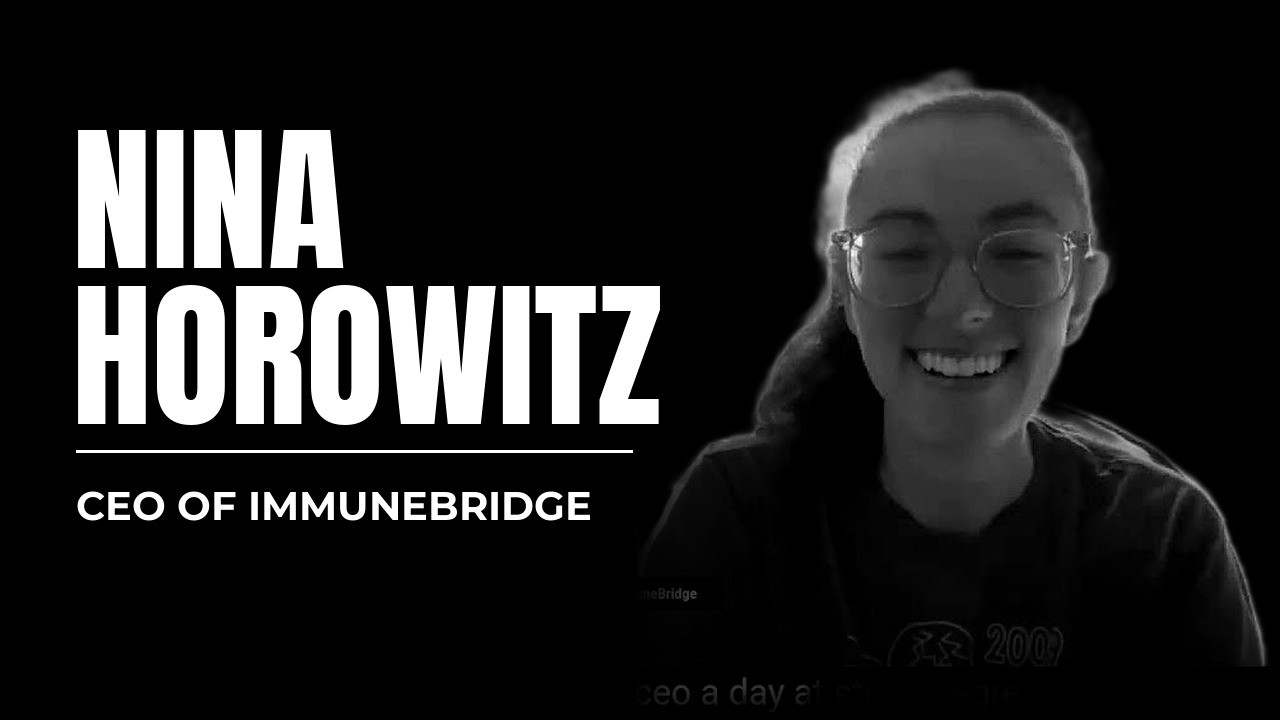
In this Founder Wisdom podcast episode, Charles Cormier interviews Nina Horowitz, CEO of ImmuneBridge. Nina describes her journey from a Stanford PhD student to head of research and then CEO, emphasizing the steep learning curve of moving from academia to business and the mentorship she received. She outlines ImmuneBridge’s fundraising history—pre‑seed and seed rounds focused on discovering small‑molecule HSC expansion, and a planned $35 million Series A to advance a triple‑negative breast‑cancer cell‑therapy candidate into the clinic. The core technology is a proprietary hematopoietic stem‑cell (HSC) expansion platform that uses a small‑molecule cocktail and AI‑driven donor‑selection models to scale manufacturing of NK, T, macrophage, neutrophil and mitochondrial immune cells from umbilical‑cord blood. The business model includes B2C (direct patient therapies) and B2B (partnering with other cell‑therapy companies for donor screening and manufacturing). Nina explains the scientific workflow: sampling cord‑blood segments, expanding HSCs, differentiating them in bioreactors, high‑throughput functional assays, and iterative machine‑learning pruning to select optimal units. She discusses competitive positioning—no other startup uses HSC expansion at this scale, and their NK cells show slight cytotoxic advantage over existing clinical products. Ethical and economic aspects of cord‑blood donation are explored, including the fact that most donated units are unused and donors receive no compensation, with Nina expressing openness to royalty‑sharing models. The conversation also touches on the broader cell‑therapy market, the evolution of T‑cell and NK‑cell therapies, and Nina’s philosophical view that cancer is an inevitable by‑product of evolution, unlikely to be eradicated within a decade but progressively becoming more treatable. Finally, Nina shares how to follow her work (LinkedIn, ImmuneBridge website).
Chapters
Welcome to another CEO Wisdom Podcast. We have Nina Horowitz with us today. She's the CEO of ImmuneBridge. She types really fast and she's addicted to Cinnabons. And apart from that, she's also CEO from ImmuneBridge since 4 years from now, doctoral student at Stanford previously to that. So Nina, welcome to the pod. Tell us a bit more about yourself and what you're up to.
Thank you so much. Yeah, it's really great to be here today. I do think that is me in a nutshell. Speed typer, sugar addict. I am a scientist by heart, but a CEO by job title right now. So I actually joined ImmuneBridge originally as head of research and then climbed my way up the ranks to CEO. But I think where the company is right now is really incredible, and I'm super excited about everything that we're working on.
Right. And most of your peers didn't transfer from academics to the business world and becoming founders. Why were you that way?
Yeah, it's a good question. I think actually more now than ever before, we are seeing a shift from academia to industry, especially as grants become harder to come by and sort of the academic future of research is very uncertain. But I do think part of it is because a good training as a scientist does not really prepare you at all to run a company. And that was a really hard thing for me to learn. I thought if I knew the science, then anything would follow from that, but It's almost a completely orthogonal set of skills to be able to run a company, and it's not something that a PhD trains you for at all.
Right. Uh, so what happened in your case? Uh, you were a PhD student in 2022, you started at ImmuneBridge as head of research. How did you get promoted to CEO?
Yeah, I think it was a few things combined. I am a very enthusiastic speaker. I do know the science well enough to pitch investors and things of that nature. So That helped as the company was looking around for some new leadership. And I also had a really incredible mentor. His name was Alex Jacobson and he served as interim CEO while he was training me up for the job. And he taught me everything I could possibly need to know. Pre-money SAFE, post-money SAFE, how to give a pitch, how to make a pitch deck. My slides for pitch decks used to be horrible. Like it was just graph, graph, graph, graph. There was no splashy takeaway or arrows to what you should be looking for. So he really gave me a kind of a speed run in how to be a CEO. And also thankfully I work with some amazing coaches like Jonathan Lohenhart, Enjoy the Work. So I've sponged up as much knowledge as I can, but I won't say I'm amazing at it yet. I'm definitely still learning.
What are you learning nowadays?
Ooh, so many things. I'm learning how to communicate strategy, company needs, both towards the scientists and towards the board. I'm learning how to develop partnerships in a rigorous manner, how to hold your collaborators accountable, how to manage my time better between all of the different lanes that I'm working on, and also the finances behind all of this and how to structure around and when you need to fundraise and what you should be fundraising for. So I guess the shorter answer is everything still.
Are you guys fundraising right now, or?
We are going out to raise a $35 million Series A. Yeah. Starting next week when everyone's back from Burning Man. Nice.
Yeah, Burning Man's happening right now. Yeah, tell me a bit more about, yeah, what was the pre-seed and seed about? How have you guys met investor expectations so far? And what are you hoping to build with Series A?
Yeah, that's a great question. So the original rounds that we raised were to explore the chemical space and find any molecules we could that would grow hematopoietic stem cells, which are immune stem cells. And so it really was just this exploratory question of, is this even possible? And once we found those, then it became, okay, now we have a lead molecule. Can we actually grow hematopoietic stem cells at scale? Originally, potentially as a longevity play. But once we realized this was really working and working consistently across donors and across process methods and scales, we sort of had this mindset shift where we realized this could actually enable the entire cell therapy industry. To do a better job, make better products, make them more affordable, larger scale, lower cost, and higher quality. And so then the seed round that we raised was to show that from these expanded stem cells, we can make natural killer cells, T cells, macrophages, neutrophils, mitochondria, et cetera, both internally and with our partners, and that the cell therapy qualities that we make are actually high-quality products. And so what the Series A will be for is to actually take our product and some of our partners' products into the clinic. And really validate where it matters that what we're doing is driving good clinical outcomes.
All right. So you're making cells cheaper?
Cheaper, better, and more of them all at the same time.
Okay. Interesting. And what does the company look like? Do you have like a lab? How many employees? What is proprietary as well? Do you have like an AI algorithm or is it software?
Of course we have an AI algorithm. Everybody in 2026 has to have an AI algorithm. So most of our team are lab scientists. We do have data scientist as well. Predominantly, we are in the lab working on scaling up manufacturing, but what we've noticed is every donor is either a little bit or a lot different from the next. And so what our machine learning algorithm does is help us very efficiently parse the experimental space to find those good donors without needing to screen every single donor out of 100 potential donors to figure out which ones should go to the clinic. So we have the scientists in the lab. doing some of the screening data, validating these models, and then these models are continuously improving the more data we generate to help us identify these optimal clinical candidates.
Interesting. So who are your clients at the end of the day? Who do you work with?
Yeah, we have 2. So we have, in conventional tech lingo, B2B and B2C. B2C would be we make therapies for human patients. And so the patients there are the customers. The doctors would be the people prescribing them. That's our lead asset, which we are going to take through clinical trials to validate that this is a good option for patients. But we're also B2B. So some of our other customers are other cell therapy companies who either need help with donor variability, poor scalability, insufficient product quality, et cetera. And they come to us and say, can you help with either our donor screening or our manufacturing? So we have both the partnership model and the direct lead asset model.
Okay. And what products do you have out there? Let's start with the B2C aspect. What did you deploy yet, or what are you hoping to bring to market?
Yeah, so we're not in the clinic yet. That's what our Series A is going to fund, but we are developing what we think could be a really game-changing asset for women with triple negative breast cancer. So triple negative breast cancer is the worst kind of breast cancer you can get. There's not a lot of good therapies out there. There are several that are approved, but triple negative is called triple negative because it lacks These three key receptors that most breast cancer therapies previously have targeted, like HER2, estrogen receptor, progesterone receptor. This has very low or none of those, so that whole category of therapies is invalid. And then you need to use other therapies like chemotherapy, which sucks for the patients; antibody drug conjugates, which also kind of suck for the patients; checkpoint inhibitors, which like modulate the immune system. They work a little bit, but they're not astounding improvements there. So it's a really aggressive disease. A lot of these women are unfortunately dying from this disease, and we have a new therapy that we think. And can really help in that space.
Interesting. And that's the only one that you're focusing right now. That's your one focus, or do you have others in the pipeline?
So we have the ability to make others. And I will say we're very closely watching the autoimmune space and K cells have proven to be very useful there. T cells have shown to be a little bit too very toxic in that space. So if we were going to make another play, I think it might be there, but this is really our predominant focus right now. This is the only one we are planning to take to the clinic in the short term. But of course, we're also working with our partners who will also be taking a lot of their own therapies to the clinic very shortly.
And your source material is umbilical cord. Is that for— you start with stem cells or what?
Exactly. Yeah. So umbilical cord blood is young. It's healthy. These babies are not obese. They've never smoked a cigarette, right? It's a, it's liquid gold is what we refer to it as. It's a great starting material. And it is full of hematopoietic stem cells that have this massive expansion potential. They have long telomeres. They're just, yeah, it's an amazing source of cells to work with, and these women who are giving birth, they donate their units for research or commercial purposes. So they're just sitting there in liquid nitrogen. The vast majority of them are not getting used right now. So we have a way to really transform the use of umbilical cord blood, we think.
Do women make money out of this?
It's a, it's a pure donation. It's out of the goodness of their heart. I think the original use for this and the reason most women donate is that these are often used as a stem cell transplant. So when someone has AML or other kinds of blood cancers, one of the options that they do is they undergo either a stem cell or a bone marrow transplant. So that can be bone marrow from a matched related donor, from a mismatched related or unrelated donor, or from an umbilical cord blood unit. And so there's data showing that umbilical cord blood can be a little bit less toxic to these patients. We have all these units sitting. So these women donate originally because of this use case, and there are still units today being used for that. But if I had to do the math on the back of my head, I would say 100 to 1,000 times more women donate than units are used. And so they're sitting in these cord blood banks and most of them are untouched. And so I think it'll be really cool when we have clinical data showing now there's a whole new use case for these units that these women are donating. But yeah, they don't get paid for it. It's just out of the goodness of their heart.
I think that's a problem. It's an economical, economical problem. Women don't make money when they're pregnant and they should because Else the taxpayers are paying for them. So why not donate this breast milk, extra breast milk, right? That would cost everyone less and would make everyone more happy. What do you think of that?
Yes, I do think because you would have to pay for them. So it's like, well, that's a good question, right? I think you have to examine both. I, I would be honest, like the U.S. government's responsibility to take care of women in this country and newborns in this country. I do think that women Deserve more financial and societal structural support, both when they are pregnant and when they have newborns. I think healthcare should be free. Daycare should be free, right? If we want women to have babies and for those babies to grow up healthy and happy in society, they do need resources. But I don't think that the way cord blood unit donation currently works could be structured to incentivize those women. Properly. Am I open to a new kind of system where if their unit gets screened, selected, run through the clinic, and then approved, they get a slice of royalties off of the product? Totally. But we would not be able to afford to pay every woman who donated upfront because we end up using less than 1% of these units, right? So then it's kind of either a lottery system or everyone who donates gets an evenly divided slice rather than the one woman who donated the best unit getting all of that. I'd be open to either. But I do think there's a lot more that needs to change than just us paying them for their umbilical cord blood.
And why do 99% get refused?
It's not that they get refused. It's just that they aren't used. They are donating in such excess of the amount that we actually need that there's simply no way to use it all. And part of that is because of our scalable manufacturing. So we can make thousands of doses of therapies from a single cord blood unit. So we would need a disease market that had millions of patients to be able to go through even thousands of units. And there's hundreds of thousands of units sitting in these banks right now. So it's, we're sort of helping that problem in a way by figuring out how to get as much as possible from every optimal unit.
Okay. And when you have the unit arrive, you cut it, you isolate this. How do you, what's the full process? What is this full scientific process of Isolating and cultivating, I guess, these stem cells.
Yeah, exactly. So a unit is actually broken down into a couple of different components. There's the full cord blood unit, which has 20% and 80% heat sealed off from each other. And then there's these little segments attached to the end. These ones are only 100 to 300 microliters and they look kind of like sausage links. Each one is heat sealed from the next. We actually do not purchase the whole unit. And this is something that gives us a huge advantage of our competitors because we have this stem cell expansion technology. We only purchase the little segments attached to the unit, but we reserve the right to purchase the unit if it's one that we like. So we take these little segments, we purchase them from a cord blood bank who we love working with. That's Bloodworks Northwest. They send us samples of 100 units. Then we take the stem cells in those samples, expand them with our proprietary small molecule, freeze them, thaw them, differentiate them into immune cells, and run those immune cells through multiplexed assays at high throughput. This is Cytotoxicity, cytokine production, degranulation, everything that predicts therapeutic response. And of course, our machine learning models help us get through that process much faster because we don't actually need to take all 100 end-to-end. We can use our in-process measurements, put those into the model, and the model will tell us which ones are worth continuing. So we really narrow— we kind of prune our outcome set as we go. Only once we know a unit is top 5 to 10%, Do we then go back to the cord blood bank and say, we would like to purchase this entire unit? And then that unit runs through the same process we just ran at small scale, at large scale, to produce immune cells for clinical use.
Interesting. And what's the process? Yeah, can you repeat the process from stem cell to T-cell? Like, that's an existing technology that is not yours, right? Like, you, you're already using that, you're just scaling it. What, what is the proprietary process On your end?
That's a good question. So the HSC expansion process is entirely ours and entirely proprietary. Now, there are commercially available reagent kits that you can use for NK differentiation, T-cell differentiation, et cetera, but they're not designed for large-scale manufacturing either. That's very much like in a well plate. You could take some HSCs and turn them into immune cells. What we have done is develop, I would say, trade secret protected methods to do that same thing at large scale in bioreactors. So we're not using these commercially available kits. We have our own cytokine combinations, other ligands, things like that that these cells are exposed to. So 3 weeks of HSC expansion and then 4 weeks of NK cell differentiation and expansion.
And are you the best at it? Uh, like, can you compare your numbers compared to other startups that are doing the same?
So no other startup is manufacturing the way we are manufacturing. There are sort of 2 worlds of cell manufacturing. One uses induced pluripotent stem cells, which are not umbilical cord blood HSCs. And the other just takes the actual immune cells. So they would just take natural killer cells from cord blood or adult blood and use those as the therapy. So there really aren't any companies doing it the way we do it, which is expand HSCs to become comparable to iPSCs, but still get the quality of these real immune cells. That being said, we have benchmarked our internal products against products that are in the clinic right now, and they are Just as, if not more cytotoxic.
So at the end of the day, you sell T cells. Is that what you're selling to laboratories? And could you do that? Could that be a channel?
Um, it could be a channel. The thing is T cells are very easy to get from blood. So nobody has an unmet need for T cells. What we sell is the HSC expansion technology. That's the part that's only ours. It's the ability to grow these immune stem cells. So we are working with reagent vendors, mouse vendors, and other cell therapy startups. to turn their entire process into one that uses this new system. Take stem cells, expand them, differentiate them into whatever you want, screen them, find the best one, and then have this matched larger scale material to use for your clinical purposes.
And what do you charge them for that?
That's a good question. Just for the small molecule is, you know, on the order of hundreds of dollars. If they really want to work with us as a co-development partner, then that's a deal that comes with upfront milestone payments, royalties on the back end. So it really depends how much is involved there. And then for the customers who want to do the screening with us, it's a similar thing. We can offer a price per screen, or we can say we will be your screening provider for the clinical lifetime of this therapy. That's then another deal with upfront milestones and royalties.
Okay, so you would offer the full therapy, or— I mean, you're not ready to do that yet, but technically, like, in 2, 3, 4, 5 years from now, you'd be ready to offer a full therapy and it's like more potent T cells. It's more of them. It's more reliable rather than what's existing, which I guess it's non-existing in this current market. Is that correct? Or—
So there are cell therapies on the market today, some of which are approved, including T cell therapies. There are a lot of NK cell therapies, macrophage therapies in clinical trials, mitochondria, exosomes, etc. Those are all being tested. It's just that nobody is manufacturing theirs the way we are manufacturing ours. And so we are ready right now to help customers with their manufacturing. Our first clinical asset is a few years away from the clinic, as are most of our partners, but we are ready right now to work with partners to start scaling up and improving their processes.
And you have proved that your T cells are more potent than the competition, or?
NK cells we have benchmarked against a clinical product. Our T cells we have not yet benchmarked against a clinical product.
Okay. By how much percent was it better? And how— so this was the hope of this study?
Just a slight advantage. We did one of our donors versus one of their donors head-to-head, and we did see that ours were slightly more cytotoxic. But again, that's unmodified. We are then planning to engineer these cells, which will further boost their cytotoxicity. So this was just a first pass to make sure we were really on the right track. Like, we can say all day long our cells are high quality, but it's really only once you put them head-to-head versus something that's in the clinic and showing efficacy in the clinic that you can really feel confident in that claim.
And when would you say that T cells picked up traction for cancer treatment? Was it like 5 years ago officially? And nowadays it's like crazy.
More than that. So Emily Whitehead was really the watershed moment for T cell therapy. That was just over 10 years ago now. The first data started coming out showing that CAR-T could cure people who were going to die from their diseases. There's some people that I've spoken to who had failed 6 or 7 other lines of therapy and then received a single dose of a CAR T-cell therapy and then were cured. No relapse, never had to have another therapy ever since then. And then 2019 is really when CAR NK cells started to be used in the clinic. Katie Razvani published a paper in New England Journal of Medicine that shifted the Overton window entirely, showed you could use off-the-shelf non-matched natural killer cells. And so that was 7 years ago now at this point. Kite was acquired, which was the early CAR T company for $12 billion. Arcelex recently, another T-cell company, was acquired for $7.8 billion. So I would say the T-cell field is still really hot. Interestingly, the manufacturing's shifting from ex vivo to in vivo, but there has yet to be a major acquisition in the NK cell space. The biggest NK cell companies have IPO'd, and, you know, Arteva's stock price has tripled this year. So the market's definitely good for NKs as well, but It is smaller than the T-cell market.
Do you believe we'll fully solve cancer in the next decade?
In the next decade or in the next, like, whenever?
10 years?
Decade? No, I do not think that we will fully solve cancer in the next decade. I do think one by one we are taking cancers from you will die in 3 years to you will die in 10 years to you probably won't die. So like, you know, melanoma with checkpoint inhibitors, game changer, right? Leukemia with CAR T-cells, absolute game changer. I do think I think one by one by one, we are taking cancers off the scary list and into the treatable list, and some even into the curable list. But there are some— I mean, like brain cancer is still a really devastating disease, late-stage gastric cancer, late-stage ovarian cancer. These are really, really challenging. This is going to be a combination of better treatments, but also better early-stage diagnostics. If you can diagnose earlier, then most cancer actually is treatable and potentially even curable. I do think, let's say 25 years, but 10 years is a little rushed. I mean, most of these clinical trials alone take 7 years.
And what is cancer from a philosophical, scientific perspective? Like, why does it exist?
Yeah, great question. So it exists because evolution is important, and this is sort of the problem. So evolution is the reason we have humans and bacteria and everything in between. And the reason that we are better at some things than bacteria are, and the reason that fish exist and we can't swim underwater without needing oxygen, right? Like evolution's important. Evolution lets species adapt over time. And evolution is driven by mutations, which are the accumulation of small DNA changes until something important happens. All of a sudden you have a tail or gills, or actually now you can walk on land. Now you can breathe air. So that matters, but any species that does acquire mutations then becomes at risk of getting cancer because cancer is when you get a couple mutations too many and now your cells are dividing too often or dividing too close together to each other or using more nutrients that they should. And all of a sudden a tumor starts to grow. And so I don't know if we will ever be able to prevent cancer from appearing in the first place unless we as a human race decide that everyone should get a higher fidelity DNA polymerase that will never induce mutations. But then of course that slows down the rate of DNA replication. So I don't know if that would even be biologically compatible with the way our bodies and gestation and growth work. So I do think we will always have mutations, which is good because otherwise we wouldn't be here in the first place. But because we will always have mutations, we will always have some amount of precancerous or cancerous cells arising in our body. And then we need good diagnostics and good treatments to be able to address that.
So, is that Mother Nature's way to weed some of us out of the gene pool to make sure we survive more long-term? And is Mother Nature, like, very much not friendly towards living forever and longevity? It's a good question.
No, I actually think we are weeding ourselves out of the gene pool, right? Eating smoked foods, processed foods, Cinnabon, right? Smoking cigarettes, things like that, sitting out, going to the tanning salon. All of these things are things that we are doing to ourselves to cause mutations, to give us cancer. There are, of course, many kinds of cancer that have no direct behavioral cause, right? Pediatric cancers, things like that. There will still be some amount that we get, but I think it's us ourselves who are weeding ourselves out of the gene pool. And Mother Nature actually loves longevity. There are species of animals, plants, et cetera, that can live well over 100 years, some even thousands of years. I do think that Mother Nature actually does like longevity.
But.
It is just this double-edged sword of if you want to continue evolving, you have to accept that some mutations will be good and some mutations will be bad. Yeah.
Or the fact that the human race accelerated evolution so fast. We created cities, we created stress, pollution, right?
And, and we're no longer under natural selection. Like there is no survival of the fittest in the human race anymore.
Well, I mean, technically there are, right? But it's mostly social cues, right? It's like who has the most money, who has the most power. But yeah, you're right.
Those people all marry each other, but there's also other people who also will all marry each other, right? It's not like everyone in the world wants to be with the richest alpha male guy. I think there are certain people for whom they love that, and there are others for whom they just want someone funny and they don't care if they're really muscular or like how rich their spouse is.
Less stress.
Does it? I actually feel like some people who grow up really stressed have a wicked sense of humor because that's how they learned to deal with that stress.
But that's what I'm saying. They, they, they do it as a survival mechanism and they find a partner to relax them out because if there's less stress, there's more survival.
Yes, but this is no longer single axis survival of the fittest, right? Like for giraffes, the metric is who is the tallest. That's it. Because they can reach the highest things on the tree. For us now, we have completely divergent survival of the most attractive. Sure. But it's not necessarily single axis. biological fitness, which is why now mutations can continue to compile, I guess, in, in the human race that actually do negatively impact our physical fitness.
Yeah, I think nowadays it's like really we've 100x down on our main weapon, which is our brain. If you look at the alphas nowadays, it's all tech billionaires, nerds that are skinny and look like aliens, right? Like, am I right about this? I think that's, that's pretty much right.
I do think humanity, since well before, you know, the tech evolution, yes, the difference between us and monkeys was we lost physical strength and gained the ability to manipulate our environment through intelligence. For sure.
Yeah. Palmer Luckey will just send his drones on you. Um, thank you for being here, Nina. Where can people find out more about you?
More about me? I post on LinkedIn relatively frequently. I'm not so good at X. I think I need to make a new X account. My old one was hacked, but LinkedIn works great. You can also read about ImmuneBridge at immunebridge.com.
There you go. That was Nina and Charles for another Founder Wisdom.
More from Charles


Founder Wisdom: the audiobook, version 2 (5 hours of stories from founders and CEOs)

8 CEO Questions I Love Asking: the audiobook (64 founders answer, in their own words)





