Peter Gelardi Mikkelsen - COO & Co-founder Dial
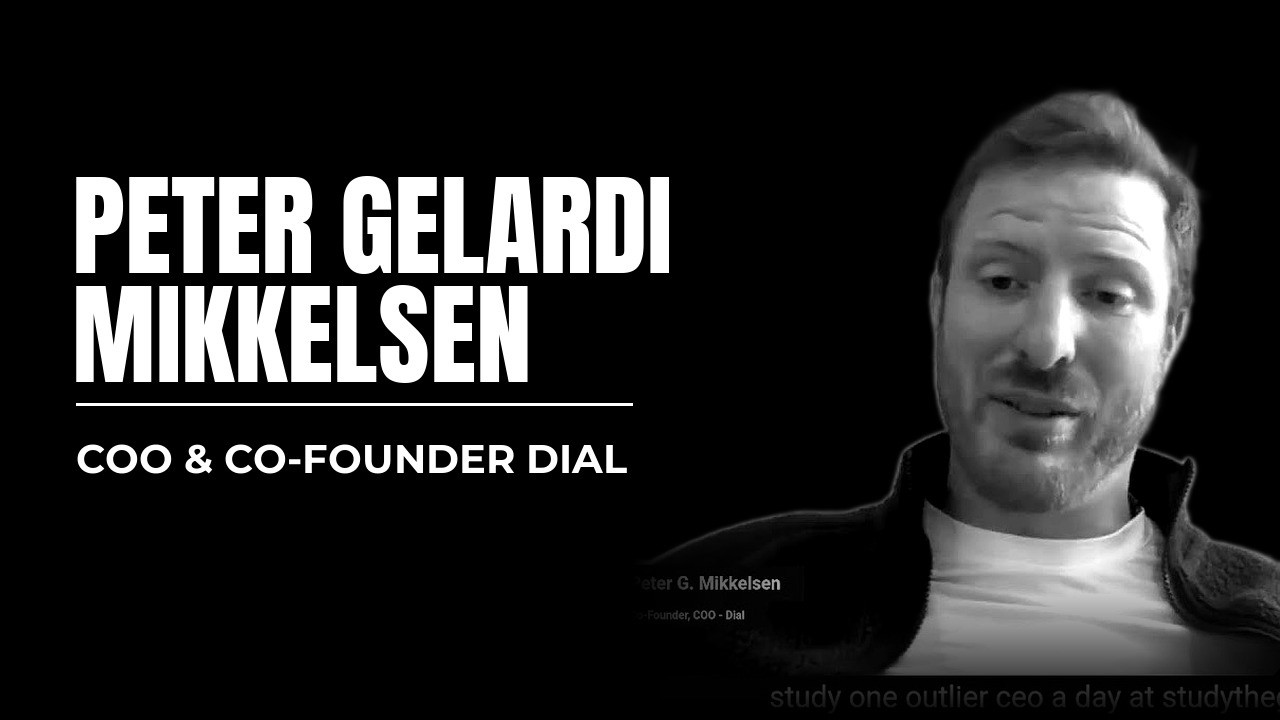
Peter Gelardi Mikkelsen, COO of Dial.wtf, explains how Bitcoin's proof-of-work consensus solved the double-spend problem without human auditors. Dial turns crypto wallets into phone numbers for secure, fraud-resistant calling. The company raised $500k pre-seed and is heading into a seed round before launching a token.
Chapters
Welcome to Founder Wisdom Podcast. We have Peter Gelardi Mikkelsen with us today. Peter's a co-founder and CEO at dial.wtf, a company I was put in touch with, what, a year ago through Sunny and Kyle. I love the company but didn't know that Peter was head of it. And Peter reached out and I saw that guys was in crypto for what, 13 years now, writing books, speaking and doing all kinds of things. I thought I should have on the pod. Peter is also a co-founder of Greenland Blockchain Crypto Association and a co-founder of Dunks Bitcoin, uh, politisk initiative. How was my Finnish accent there? Or, uh, Nordic accent? Um, yeah, Peter, welcome to the pod, dude. Uh, tell us a bit more about yourself.
Yeah, thanks, Charles. It's hard to come after that intro. You're very, very kind. I mean, I'm deeply inspired by you as well and all the work that you've been doing and what you do in our community of founders. I think it deserves to get out there. You're truly a community leader. So honored to be here.
Thanks. Pleasure, dude. What's your background like? Maybe we can start with like first time you ever were put in touch with Bitcoin when you read the Satoshi paper.
Oh yeah, absolutely. I mean, whoa, that's a while back. I was working for a super inspiring man at that time. His name is Nick Spanos. A lot of you that's listening probably know him, and he started and founded the New York City Bitcoin Center back in 2013. And he basically just— I was working for him at the time, so when he said, This is what we're doing. We had just come out of the Ron Paul campaign and, you know, had been in the trenches there. And so, we were all eager to find something that could help us be the next chapter in the libertarian movement. So, that's how I came into it, was actually through the philosophy and idealism of libertarianism, and then got sucked into the world of Bitcoin. And I remember I was on my first semester at the Copenhagen Business School and got a call from Nik, who was like, you know, drop everything you're doing for 6 months and read the white paper. And for all of you who worked in Manhattan, you know, when a Manhattaner gives you a 6-month timeline, then it's complicated. And since I came from a non-tech background, I must admit it was quite a steep learning curve, but I just dove through it paper by paper. And, you know, it's a 10-page document, learned the core concepts and And then, yeah, learned the technology and now we're here. So that's how I got into it.
And how did it change your life?
I think it gave me a lot of hope that, you know, we finally, I think it's one of the biggest things in human history that we have a system that self-audits. Like we have a system that basically is completely reliable, autonomous. And that no one can shut down. So, I think that was a big piece we were missing in the age of money. You know, we had sound money for millennia, and now we're living in the briefest financial experiment in human history since we only run on fiat now. And so, I think that that's a monumental thing. And yeah, besides that, I met the most incredible people throughout this journey. I met the craziest people, most amazing people. So, Yeah, it's been, it's been a fun ride.
Because I'm asking that question because around the same time, right, at which you started, uh, working at Bitcoin Center, I was in Hong Kong and, uh, there was a Bitcoin group with like pretty decent traction. Virgilio was one of my friends, uh, there and he tried to onboard me or I don't know, sell me on the idea. I was an exchange student back then. I already was running a couple of companies and I don't know. I didn't get it right. I'd read the paper, but I was more always more obsessed on artificial intelligence, right, and its potential. And it's like I think a bunch of people on Bitcoin is that they've been like kicked out of their banking institution or they were fucked by the government. And I really was never effed to some degree by that. Obviously, I'm a libertarian and. I don't believe in the idea of governments. I think most banking is broken, but not enough to be like a Bitcoin evangelist, right? And the obvious factor, I think the most important one back then, I didn't have the money to invest in, uh, in Bitcoin, right? So I couldn't like really see it grow. And even that, you know, like having the investor mindset is weird. Uh, even the Bitcoin growth wouldn't be enough to satisfied my— the addict in me, right? Like, I'd rather do like a couple thousands of dollars per day focusing on my agencies and my own business than to watch a fucking plant grow on a daily basis. So do you say when I— do you need— do you know what I'm saying here? Like, I never got the bug, right? I mean, I'm for it. I'm definitely for it, but I'm not an evangelist. Why is that?
I think you're— well, thanks for sharing, man. I think it's a very common thing. So it's not just you, it's millions and millions who feel the same way. And my answer is that there are 2 kinds of people in Bitcoin. There are those that understand the philosophical aspects of it and that context. And then there are those that just look at it from the outside within the context of the world we're already living in. And I could understand, 'cause I, you know, I'm, I was born in 1990. So I grew up in this, I've only ever seen the fiat world. So I had to go back to history. I had to go back and realize that sound money was the norm, like up until recent history, you know, up until we, we transitioned in the 20th century to the pure fiat system. So I think that's the difference. The people who get the bug are those that realize that This is actually a timeless concept in a digital format. And once you start to realize the depth of that, that's when people start to catch the bug. I mean, one aspect is Draper, who said that he had his second youth after he discovered Bitcoin, because he's just so extremely encouraged by what this is and how revolutionary this invention is. So, the people that are thinking a bit deeper are those that tend to get the bug, whereas those that just see it as another speculation object, another investment object, I can understand why it's lost on them, why this is so significant. And maybe it's a little bit puzzling why it just keeps going forward and forward and forward and taking all the victory laps around the world. And I'm saying this now on August 26th, when Bitcoin has taken a dip. And I'm proud to say it because I know that either it's going to be worth everything or it's going to be worth nothing. Like I tell everyone, that's my standard answer when people ask me, what is Bitcoin going to be at? It's going to be absolutely everything, or it's going to be worth nothing. It's too revolutionary to fall in between.
Yeah, that's kind of risky, right? If you say that to an investor, everything or nothing is like—
It is, it is. And, and, but, but that is what it is. And people have to understand this is a political instrument. Like, it's, it's, it's not just a normal investment asset. And that's, that's why people love it and it's why people hate it. And, uh, yeah.
Okay. To my defense, right? Um, and I'm, I love that. I mean, I'm, I'm for that. I'm a very deep thinker. I study history, I study fiat, I understand Bitcoin more than most Bitcoiners, I would say, uh, with like all the mental models that I've created and the full world knowledge that I have. Um, I'm way more excited about artificial intelligence. Artificial intelligence could create its own Bitcoin but better, and it could also hack Bitcoin and make it worthless eventually. I don't think that everything lasts forever as well, and we've seen with the latest hack of whatever that fucking hard wallet company was called, right? Like, nothing is really safe. Everything is sort of hackable. So, what am I missing out on here?
It's such a good point. I think, and first of all, Charles, I love you because I know you are a deep thinker. That's why I was so excited to come here and talk to you today. And basically I think what I would say, and now I'm actually quoting a really cool thing, like back, I've always been a true seeker. I always like been curious to find out what's going on. Right. And when I was very young, I studied the debates around atheists versus Christians. Right. I ended up becoming a believer. Thank you.
That's a challenging one.
Yeah, it was.
That's a heated one.
It was, it was to me, that was the philosophical UFC, right? You had all these people. But I actually want to quote one of our local gems, and that is a woman called Lone Frank. And Lone, if you're hearing this, please reach out. I always love to meet you because I think you're a super great mind and we're very proud to have you. But she was on the atheist camp and what was very interesting, and I thought it was such a remarkable statement, once she was really challenged, like they were like, Kind of setting her up to go for the slam dunk. And she was actually taking a step back and very humbly saying, well, I don't think the philosophers are that brittle. Meaning that even she, who is such a scientific juggernaut, she's such a mastermind and such a heavyweight, still had the utmost respect for philosophy. And she is like a hardcore neuroscience, like, scientist, scientist, right? So I would say the philosophers were product of their times.
So I mean, they were as smart as it would get back then, but nowadays they'd be idiots next to someone with a smartphone and an AI.
Yeah, I'm not sure, Charles. I'm not sure. I think if you go back to first principles, if you go back to Aristotle, if you go back to— you'll, you'll find ideas that just Those are what made the technology of AI.
But first principles weren't even established back then because we didn't know most of what we know about the world in science and physics.
No, it's true, it's true. But the whole history— this is my perspective and my belief. And, you know, I studied political science at the Copenhagen Business School on their political science.
I'm not saying they're not valuable, by the way. I also studied political science, and the greatest thing we learned there was studying the great philosopher Nietzsche, Plato, Jeremy Bentham, like utilitarianism, which is still my philosophy to this day, right?
So yeah, and I would challenge that by saying, if I— what I enjoyed the philosophy, history of ideas aspect the most of my degree, and when I look back on on studying Aristotle, I believed, and this has ended up becoming my conviction, that all of the natural sciences can be traced back to this foundational wisdom that was laid down by men like him. And therefore, I think there's a great difference between the original thinking that the human mind can do and the byproduct of an AI. And I know that probably now I'm gonna get a lot of AI people who's gonna fill up the comment box and get after me. But I really believe that it's basically—
But our brain is finite, right? Like, I hack my brain. I think I can have more brainpower than most people because of that. Eventually, we're going to be Neuralinked, and we're going to be able to optimize our brain and sort of cross the barriers that are limited to us. And right now, AIs, I feel, have crossed that barrier and will keep crossing it. Exponentially. I don't think that our mind is uncapped. I don't think we're— you and I, we're able to think about everything at the same time, being everywhere all at once, sort of crack the laws of physics or approach their limits, because our brainware is limited by nature.
Yeah, but the human spirit is not.
What is—
the soul is not. That is the million-dollar question. It's you and I.
And human magic. Yeah, I also would agree that there's human magic as well, that I would call it the gut feeling, right? Not to use the subconscious word, but intuition, right? And I think one of my best qualities as an entrepreneur, I think, is being energy efficient, right? And that's extremely important in the laws of evolution, not just building a business. I think our brain is still fabulously energy efficient, and that's magic. That's still unparalleled, even by computers.
Yeah, absolutely. But I, I think, and this is of course coming out of a foundational spiritual worldview, that, you know, I think that we exist and therefore we can observe everything around us. Um, I don't think everything around us exist because we observe them. Like, I do believe that we are souls that are born into a body and we get to experience this human experience. And there is nothing like— AI will never be able to replicate this original soul that is by nature. And I believe it's God who made us. Some people might believe it's the universe or something else, but that's the only thing I'll say about the AI. I think people are putting AI on a pedestal that it was never even supposed to get up there. But I do think AI is up there with crypto. I think if you look at like, what are the greatest innovations of our generation, I mean, it's definitely crypto, AI, and probably CRISPR technology is up there as well when it comes to some of the cutting edge that will change everything.
And behind crypto, what is there that's so innovative other than blockchain?
Yeah, so this is a good question.
And But blockchain is pretty fucking genius, and like the Satoshi papers have multiple points of genius, right? What are they?
Yeah, I say the real innovation is the consensus mechanism, and this is what too few people talk about, because the fact that we have a system that solved the double-spend problem, which is how do you have a ledger and how do you make sure that people don't spend the money twice, this is essentially the real issue in any accounting schema, right? That's why we have accountants who check, who gets checked by auditors, who get checked by auditors, which gets checked by auditors. And for the first time, we have a completely autonomous system that self-audits. And that's the consensus. And that is the real innovation. And I know that somewhere along 2015, '16, we started inventing this term blockchain. My suspicion is that it was created to divert and distract from the real crypto protocols. And when I say the real crypto protocols, I mean the public ledgers, you know, those who were run by what's called proof of work, which is purely 100% automated, no human involvement. You have Ethereum that came up with proof of stake, which diluted the fully automated part a little bit, introduced a minuscule element of human involvement. But still, that was the big outcry at the time. It's like, why are you reintroducing the human element that we spent decades removing? And that is the real innovation. It is that consensus mechanism. And then from there, after proof of stake, all the consensus protocols gets more and more diluted, and until something where you just have almost complete human involvement, which I think is rubbish. Then you just have an immutable ledger.
Yeah.
Like we've always had. No, a plane has a black box, which is immutable ledger technology. That's nothing new. So there's no innovation. So if you're asking what is the innovative part of crypto, it is the 100% proof-of-work consensus that Bitcoin is running, and other—
And can't AIs and agents do that? Like validate that a transaction is good? Like my agent knows me, fingerprints me, and I don't know, 2FA me to know that the transaction has not been done twice or that I should send this money? Like, isn't AI the real revolution? Like an additional brain? Isn't that going to revolutionize the financial sector more than blockchain?
I mean, time will tell. I mean, who am I to say no? I mean, in 2007, Bitcoin was still getting built. It was released 2008 and '09, depending on whether you see the paper or whether you see the actual chain, right? So, it's like, it's basically anything is possible. Anything is possible. What I will say is that it took decades and decades of cutting-edge mathematics, cryptography, and computer science to develop Bitcoin. So, it's gonna take a little more than just AI to get there. What I will say, and again, this is back to the human spirit, like, if you have, like, the true human creativity, that has now the aid of AI.
Oof.
Who knows what can happen? Anything can happen. But what I will say—
Like financial shit.
Yeah, exactly. Exactly. But that is actually what we're playing with, with Dial. In Dial, we're trying to empower the AI agents with telecommunication. And once that happens, and once these things begin to be able to communicate and interact, that opens up a whole new scheme. And I, for 10 years, Charles, for 10 years, I asked myself, what's the next big vertical in crypto? You know, it's been finance, and I'm thinking, what is the next big thing? And I believe it's telecommunication. I believe that it's going to be what the internet was originally built for, which was communication. Now it's going to be crypto and telecommunication intertwined, and that's exactly what we're building here.
Yeah, tell me a bit more about that thesis. You'd compete with Zoom, with WhatsApp, with like all these big players. Why would people Use you instead of, uh, of, uh, yeah, these guys, these big boys.
Yeah. So essentially, where do I start? We hate centralized shit when it's not— there is a time for centralization. And, uh, you know, um, when I go to a hospital, I love that you have centralized medicine in one place.
I dislike hospitals. I wish everything would be private and decentralized, and I often— I get hate sometimes when I say that, but I just wish people would, uh, micropay and pay for the true value of something with their own money so that they're fully accountable. And I wish there would be an algorithm determining the value of pretty much everything. So yeah, I'm fully decentralized as well. But yeah, especially the governments, right? And I'm not saying corporations should exist, but I think everyone should own bits and bytes of pretty much everything.
Yeah, and it's like, there's also a time for decentralized medicine. I want a HeartStarter and HeartMonitor everywhere. So, what we don't like is when centralized institutions are preying on people. And even though I know everything is volunteering, the data, Like, it doesn't matter. We don't like that you are dependent on a centralized telco provider in order to have telecommunications. So what we want to build is essentially in the same manner as Bitcoin empowering and banking the unbanked, we're phoning the unphoned. We're going out there and saying, anyone who can't get a telephone number right now, all you need is a wallet. So just like your wallet is the primitive for a bank account, meaning that it's the only thing you need and it's free and it's accessible everywhere via the internet, everyone can make a wallet. They're on the Bitcoin network. Now they have a bank account. In a similar way, everyone can now just use Dial and their wallet now becomes a telephone number. And so we have wallet-to-wallet calling. It's still absurd, the level of money that is lost every day to fraud and people who send their money to the wrong addresses. It's absurd. That was a problem we had when I came into the space in '13. It's still a problem we have now. So, so that alone, that you can actually call the wallet before you send a transaction, is, is huge. And on the abstract layer, you can just basically take this anywhere you want. You have the wallet as a telco primitive, you can go anywhere with it you want.
Okay, and some people would have a wallet account before they have a phone number? Like, what type of human would have a wallet number before a phone number?
Well, again, it's not either or. I mean, I still have— it's embarrassing to say here, it's 13 years into it, but I still have a bank account, you know, believe it or not, Charles, I do. And, uh, and the same way, I also will probably still have a telephone number. But what I like about what we're building is that as we are developing and maturing, it's going to be less and less necessary for me to So I have my own choice. You know, I'm not depending on it anymore. And that's what I like. Okay.
And so far, what's the scale that you have achieved with Dial? Like, what's your go-to-market approach and how is it scaling this company?
That's a good question. So basically, at the moment, we have finalized most of our features. We're about to roll out the token this month. And then essentially what we're going to do is just grow it organically. We have a bunch of amazing advisors. You know, Kyle. So, Kyle Kemper is on, a great guy. We have Shannon Briggs, heavyweight boxing champ, is in our corner, literally. We have Nick Spanos, my old mentor, is also part of it. The CEO is Adam Menger, who is a friend and business associate we've had for half a decade. So, we have a super strong team, and I could go on and on. So, basically, we're going through acquisition of users through partnerships. So, we're integrating with wallets that already have a lot of users. So, that's our main point. So, we have some of the world-leading wallets that we're right now integrating with. I'm not going to announce anything until it's public. But we're tracking that fairly nicely and I'm super, super proud and stoked about that. So that's how we're gonna go to market.
'Cause I can see ICPs that make more sense on your website, right? Healthcare, legal, finance, real estate. The challenge is just to convince these folks to use your technology. They might even be opposed to it, right? Lawyers, finance, crypto has such a bad rap when it comes to scam, especially in the US and Canada. So you're like, Trying to sell them scam fighting while it's like the industry reputation is for scam. But I can see a use case for that if every call needs to be monitored and hashed, right, and have a clear proof that this happened and this existed and it's immutable. I can see a use case for that. So how do you convince these skeptical people to use you?
Yeah, I mean, first of all, this whole thing that crypto is scam is totally outdated. I mean, the data shows that the most criminal thing that is used is cash, the $1 bill. And I'm not against cash. I think cash is an instrument of privacy. I think that it's something that's going to get challenged over the next years. So, I think we have to stand up for it because privacy has a place. It's no one's business how many Tony's Chocolate I buy on a Friday night. in Publix. It's only me and God will know how much chocolate that I buy on a Friday night. And that's why I pay in cash. So basically, the privacy has a place. And essentially, when you look at any other kind of fraud, like, I'll be happy to send you some facts we can put in the comment section that discloses how Crypto is no longer any more problematic than anything else, especially in this current market where so many institutions have come in. Chainalysis has done a good job at tracking down the worst. And we're also seeing again and again, like, normal banks are associated with money laundering all the time. So that's what I mean. It's like, we got to get away from this narrative that crypto is somehow a problem compared to anything else, because that has finally been this debunked by data, right?
Um, yeah, I'm looking at the data now. Maybe that, um, was updated during the latest Trump era, right? Like, has been very pro-crypto, right? Like, I think that gave a, a new wind, a new propulsion to crypto. Have you seen that?
Uh, not yet. I'd love to review it. I love to review it. I mean, the latest, uh, I was looking at was when I was sitting with Jakob, the current CEO of the Nordic Blockchain Association that I co-founded with my friend Leonard and other good people who joined later on. And at that time we were looking at that, you know, it's almost 500,000 Danish people who's gonna be using crypto in, I believe it was 2030. Don't hold me up to the exact number. I'll need to cite the report, but it was in that proximity. And so that means that's like almost a 10th of the Danish population. So, so it is becoming an everyman, layman thing. And that's really, really encouraging to see.
And have you found adoption faster moving in Europe versus in the US? What about like the Asian market, generally speaking?
No, I've actually, I've just stepped fully out of the Nordic Blockchain Association. And that's good because then I can speak more colorfully because I'm no longer an official representative of the industry. I can just speak my mind because I think what's happening in Europe is absolutely horrible. I told Jacob that, hey, we should push back on MiCA because we had a good run challenging the Secretary of Tax and basically challenging some of the Danish tax laws. We didn't do that by ourselves. Amazing community support. Some legends, absolute legends, have stepped in and gone above and beyond and pushing back. It was really a village that it took to push back on that. But as we were gaining momentum, I told you, I was like, we have to push back on MiCA. We have to be the first country in the EU zone that gets an exemption from MiCA because Denmark has a proud history of EU exemptions. And I said, this is the time. Because MiCA will fuck us up. And it's happening.
It's happening. What's MiCA?
MiCA is the big federal crypto regulation that the EU rolled out. And we had heroes, absolute heroes of the trenches that people don't even know anymore because they're more in the backstage now. But legends such as Hans-Henrik, who took the worst things out of MiCA. And even that, that was back in the days when we were still, the rest of us were still wiping our noses in the industry. He was down in the EU fighting for a better regulation. And even with all that amazing hard work, mica is still absolutely destructive. And now we're seeing the first bodies wash up on shore. Companies are closing because the regulation and licensing takes too long. And it's not just MiCA, it's also just generally like the processing times are out of control and investors get spooked and then companies go under. So I have a very dark future for Europe that is only going to be the big institutions that can afford the licensing, uh, who will be there. All the, the grassroots, the, the coral reef of entrepreneurship in, in crypto will, will die. I know that's a very—
or just move away, right? It's like, move the fuck out of Europe. And I mean, even in the startup world, right, in most things in AI, EU is just— are just like specialists at stifling innovations. Like, they're, they're incredibly good at like fucking up innovation.
Yeah. And then you have America here, and, uh, and they're saying, give me your tired, your hungry, and your poor crypto entrepreneurs. Entrepreneurs who are yearning for freedom, and we shall give you rest, right? And then they just scoop up all of the talent, the crypto brain drain since forever.
Most countries don't ever understand that, and that's why the U.S. is meant to stay in power for a very long time. And a lot of politicians are missing that, right? Like people can move nowadays. People are international, right? Like they can just decide to take their feet and vote with them. Just like move, move wherever they want. So people. Politicians need to take notes.
Yeah, so so yeah, that's that's that's a sad story. I really I really think it's going to get a lot worse before it potentially gets better. We have a good libertarian momentum in Denmark, so that's encouraging to see. We have good people. For all the Danish listeners, join Skattebetalende by Martin Årup because they're doing a great job. Heroic work at challenging all the worst part of tax. But yeah, unfortunately, I think it's going to get worse before it gets better. And the people that are the most resourceful, as you know, Charles, they're going to leave first. They're going to come to America and they're probably not going to come back until maybe they want to raise their kids or something.
Yeah. Where do you want to take Dial, dude? You raised $500K for that one. How's it scaling?
Yeah. So we raised the $500,000 in our pre-seed. We built the product and now we're in a seed round to go to market and scale. And that's a slow, slow process, but it's slowly moving forward. And so right now we're just going the revenue route, making sure we're building the product-market fit. We found it. Now we're just doubling down on it and we'll see what happens. I mean, at the end of the day, this is hard work. It's hard enough to start a company. It's doing it within cutting-edge tech is taking it up a notch.
Yeah, there you go. Where can people find out more about you, Pieter?
Well, my LinkedIn is Pieter Gelardi Mikkelsen. Feel free to Just text me there. I'm pretty— I have a link there. Anyone can book 15 minutes and I love to get to know everyone. I think everyone is worth a cup of coffee. So reach out and I love to get to know what you're doing, building everything. Yeah. And especially if you're part of Charles's community, then I already know you're a cool person. So yeah.
There you go. So that was Peter and Charles for
More from Charles


Founder Wisdom: the audiobook, version 2 (5 hours of stories from founders and CEOs)

8 CEO Questions I Love Asking: the audiobook (64 founders answer, in their own words)





