Peter Samuelson - Author, Producer, Philanthropist, Entrepreneur
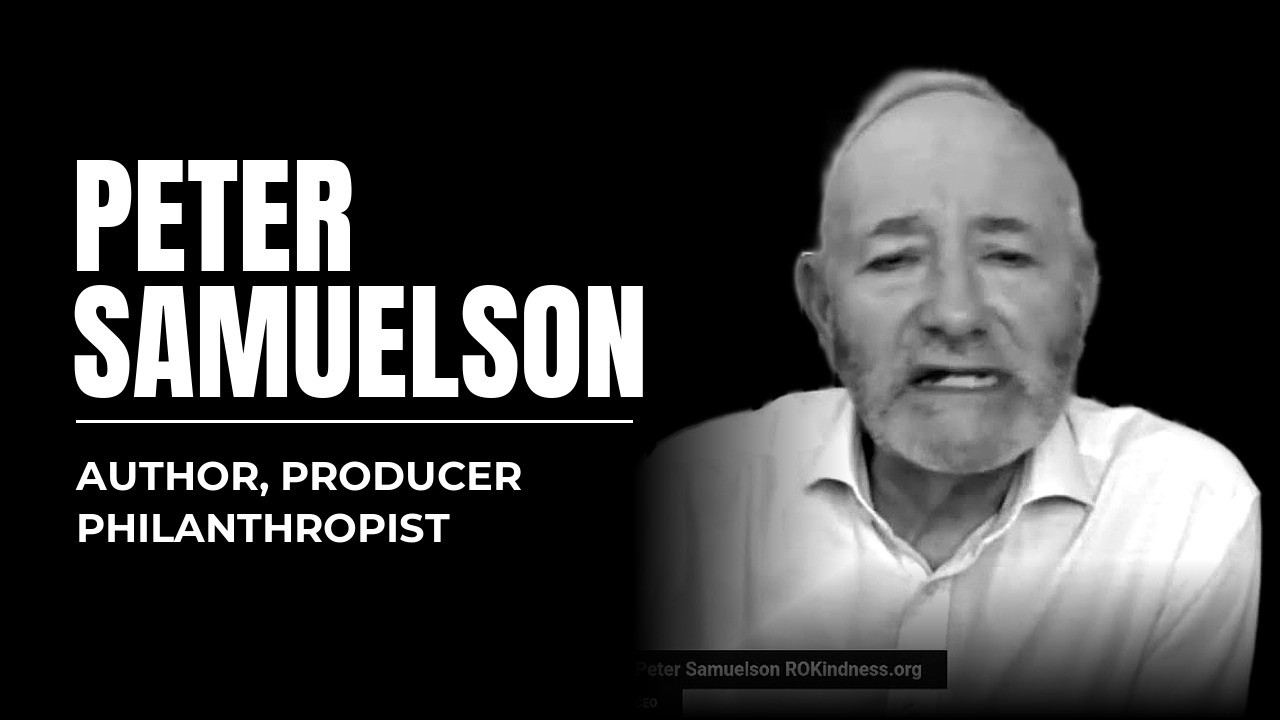
Peter Samuelson, an immigrant film producer turned nonprofit founder, built Firststar to support foster youth with an 89% college placement rate, ten times the national average. His Ripples of Kindness program gives teens $200 to design acts of kindness. He argues that producer skills like storytelling and budgeting work for social ventures, and that blending nonprofits with for-profit entities lets donors get tax breaks while investors earn returns.
Chapters
Welcome to another CEO Wisdom podcast. We have Peter Samuelson with us today. He's the CEO of rokindness.org. He's a lot of things, very successful to start with. He's an author as well as producer, philanthropist, and entrepreneur in Los Angeles. I think you're Steven Spielberg's co-founder, right? So to one of the org that you lead, Peter. So welcome to pods. Tell us a bit more about yourself and what you're up to.
So, uh, I'm an immigrant. I came in as a young man. I'm not a young man any longer. Um, I lucked out and ended up with a visa working at a film company, and eventually I got a green card, and then I got citizenship. I've been here ever since. I have a wife, I have 4 kids. I have 4 grandchildren and I live in West LA. I've made, I think it's now 26 motion pictures, of which 6 or 7 or 8 I'm really proud of. The rest we probably can avoid talking about. And what I think is more important than that is early on I worked out that the toolkit of being a producer, you can carry it sideways into being bold enough or cocky enough to think that you can address an unmet need in society. And as an immigrant, I've always taken it very seriously that, you know, America let me in, I should try and lift up America. So starting in the one that I co-founded with Steven Spielberg, um, I've taken that toolkit of being a film producer. You know, what is the story here? Is this important and needed enough that I'm going to give it 18 months of my life? Who's the crew? Who's writing it? What's— how do we put it together? What's the business plan? Where's the money coming from? Who's distributing it? And, and in the end, is it any good? Did anybody watch it? Was it what we thought and hoped it would be? So I've got 7 nonprofits. The latest of them is rokindness.org, which I think is hopefully going to be the granddaddy of them all. And we can talk about that in a moment. But that's kind of who I am. And I take this stuff very seriously. I wrote a book called Finding Happy, and bottom line, I can save you $19.99 buying the book. Finding Happy— my belief is you have to get outside your own zone and help other people. I think actually You can never make yourself happy by making enormous amounts of money. I did some of that, maybe not enormous, but a lot. I don't even think you can make yourself happy just by making films. There is happiness and some joy there. They work, they don't work, whatever. And if you choose carefully, you know, you can tell some important stories. But I think We live in a very troubled world, and I think it's on each of us to try to do something about it. And that's repetitively what I've tried to do. And I think what is paradoxical is that in doing that, you find your own joy, your own happiness.
I believe that one should get very rich and powerful before starting giving back. Is that thesis biased to some degree. I'm not saying I'm not giving back right now. I'm also saying I'm happy where I am, even without giving back abroad. I give back to my family, my community, and so forth. But can you relate to some of this?
I think that's upside down, with, with, with love and respect. I think you should start early, and I don't think you have to, you know, make planetary-level changes. To begin with, but I think it's a habit, and like all habits, you, you need to integrate it into your life. And the people who are the most joyous, happy, satisfied, content are the ones who have been connected with their community and lifting other people up for a very long time. Obviously, if you're young, Well, you haven't had as much life to do it in, but I think, you know, the earlier you start— I can give you a very specific example. My 3rd nonprofit is called firststar.org. So we serve the nation's 375,000 foster kids. We take— we currently have about 1,000 foster kids who are in a 4-year program, each of them. that starts in 9th grade and goes through 12th grade. We partner with large universities, UCLA, all the way across the country to the University of Miami and in between, and it's hugely successful. In the United States, less than 9% of foster kids go to college, but our kids, once we have them for the 4 years with a curriculum that is academic and life skills and encouragement, and we show them what a university is and can be for them. The most recent stat, this last June, early summer, um, we got 89% of our 12th graders into colleges and universities. So almost exactly 10 times the benchmark for American foster kids. And also Remarkably, almost twice the rate of conversion for non-foster kids, you know, middle, regular middle-class kids. We get twice as high a proportion of our foster kids in. So now they couldn't be worse off. They are in foster care because they've been abused or neglected, and they have no agency. They'll never march. They don't vote. They haven't got any money. Most of them don't even know that they're hard done by. The class that I teach— I teach 2. I teach videography, because if I don't know how to teach that, nobody does. But the one I get most happiness from is I teach a class in ripples of kindness. And it's actually 2 90-minute classes. In the first one, I say, okay, I usually teach it to 10th grade. And I say, all right, you're walking down the sidewalk. There's an old woman fast asleep, dressed badly, poorly, and you have 3 choices. Tell me what you take. You can stop and put a couple of bucks under her arm, don't wake her up, or you can wake her up, give her the money, or you can just look in the other direction, cross the street, look away. And tell me which you choose and why you do it. Leads to a conversation about the Golden Rule. which ignore all the spiritual stuff in all the world's religions. Just look at the secular stuff. Every single religion has this concept of social justice, of that it hits you in the heart when you see something that is out of whack, that's unfair. Wait, this old woman sleeps in a cardboard box and it says Sub-Zero on the side? I have that refrigerator. I get the refrigerator, she sleeps in the box. This is not right. I have to do something about it. That led to a charity that I founded called Everyone Deserves a Roof. So we do that class, and then I say, now you'll want to come tomorrow because something remarkable is going to happen. You're going to be shocked. Oh yeah, what? Well, every single one of you is going to receive $200. And they say, we're going to get $200. And I say, well, yeah, but you can't keep it. You have to write a short essay to whom or to what you want it to go. And then we're actually going to go and do it. We're going to, you know, go and give a pair of shoes to the unhoused guy or whatever, whatever is in your little essay. We'll actually do it. And then a few weeks later, we're going to go back. and see, you know, what happened. Did he sell the shoes to buy brandy? You know, philanthropy sometimes doesn't work. It is a shocking success, and remember, these are 10th graders in foster care, PTSD, abused or neglected, don't have 2 nickels to rub together. These little essays that they write are— they smack you in the chest. My name's Jose. I'm adding $10. That makes $210. 3 times $70. $70 is what you pay down at the Humane Society for them not to euthanize a dog. I'm going to save 3 puppies. The reason I'm going to do that is last time I was down there, I— they told me that there was this puppy that had been very badly beaten. And I looked in his eyes. And we recognized each other because I was very badly beaten as well. That's why I'm in foster care. So I'm saving 3 puppies. Love, Jose. My name's Sheila. My mom's going to be in prison for another 2 years and 7 months. She did terrible stuff, including to me, and she's in prison, but I know she hates the shampoo, and she's my mom, and I love her despite everything. And I'm going to put the money in her prison account so she can buy better toiletries. My point is this: these are 15-year-old kids. They have no agency in their lives. It's as though you're watching flowers grow. What they do with their $200 each is obviously pretty good for whoever it is they're helping, but it's also— astonishingly strong in lifting them up and making them feel happy, giving them personal autonomy and power. They've never had any ability to make a decision in their lives. Stuff is done to foster kids, but all of a sudden with this program, Ripples of Kindness, they are in charge. It's as though they're all taller, they stand more upright, after we've done this couple of classes. And I think it is true beyond foster kids. And I think starting early means that you will always be able to find time. Everyone can find time because some of the things you can do don't involve time anyway. And what's important for someone with business skills, in my view, is don't go volunteer at some charity to stick stamps on envelopes. If you're an engineer or an architect or a VC expert, or you, you know, you, you, you're a certified financial planner or something like that, that's what you should find an opportunity— that, that toolkit, that skill set. That's what you should do. Me, I'm— because of making films, I'm entrepreneurial. I know how to do startup. So I ask myself, what is a ginormous problem that no one seems to have done anything about? In that case, foster kids don't go to college. In the case of the one I did with Steven Spielberg, seriously ill children who are immunocompromised cannot be touched. only person that goes into the room is the nurse wearing a spacesuit? What if we use the internet to create a community across the country spanning multiple hospitals? We got millions of dollars from Paul Allen of Vulcan and his sister. We raised tons of money and we built this long before there was Facebook or Second Life or any of them. We had Starbright World up, running, being used 24 hours a day, and it was very, very early. And you can do things in nonprofit that are more difficult to do. We got people cooperating even though they were arch competitors because it was for seriously ill teenagers. So there are opportunities, but also— You know, sometimes kids ask me, teenagers, nobody loves me, how do I find love? And I say, well, tell me where you're going to find it right now. And they say, well, I'm on this app and that app, and I flip left and I flip right. And I say, but you know that's AI, right? That those aren't real faces, and you're gonna be disappointed when you go and have a coffee with this mythological person. And sometimes they say, well, you know, I go have a drink with someone. And I say, you know, when they're hiring a job, it's quite unlikely that the HR person doing the interview and the interviewee are both drunk. They tend not to make hiring decisions, let alone you who want to find, you know, a partner, someone to love and be loved by. So they say, well, what should I do? And I say, go volunteer. Volunteer a few times. Choose a charity that you care about. Go down Volunteer at the Humane Society, or maybe it's to do with cleaning up the beach because you care about ecology. Whatever it is, look to your left, look to your right. Who are these other people next to you volunteering? Oh, they care about what you care about.
That's great.
Choose, choose a likely suspect, take them out for a coffee after you clean up the beach. You know, you've got something to talk about. You have a shared interest, and I know what I'm talking about because way early at the beginning of the Steven Spielberg charity, I needed an accountant. And I'd had one date back in my single days with this lady, and I remembered her saying she was an accountant. And I phoned her and I said, hey, remember me? Sorry I didn't phone, but I need an accountant for this new charity idea that I've got. And she pitched up. And in fact, it was she who chose the name for the charity. And that was the second date. And, you know, eventually there was a third and a fifth and a twentieth date. And eventually we got married, and we've been married a long time, and we have four kids and four grandkids. So there you go. I am proof of purpose.
What are your thoughts on effective altruism? As a guy with money and power, you can just decide like. where I invest my cash and who, um, gets the highest chance of producing the outcome I want in society. Most of these investments, by the way, are social startups, uh, so they're actually making money while doing good, right? Like, uh, is there something to be said about that?
There absolutely is.
I'm—
listen, I'm a big capitalist. I, I, I like to earn a buck as much as anybody else, and I have. Um, there's nothing the matter with this. Um, and indeed, you're absolutely right. Sometimes it is better, and it makes raising the capital easier if instead of a tax deduction, uh, you can make it an investment. If you're really clever, and I've done this several times, you, you create an entity which is actually 2 twinned entities. One's a 501. and one's an LLC or a C corp. And that way, there is a way that is completely legal. You have to have good lawyers, but you can both take donations that have no return, but they do get a tax deduction and a nice thank you. Or you can also, in parallel, you can take investment where they would— yes, they would like their money back. They don't get tax deductions. Certainly not at that moment, but it's, you know, and they're investing for a return of capital and a profit and the rest of it. And there are increasingly now in, I think it's about 20 states, you can register something called a B Corp, which is a kind of special construct. It has articles of incorporation that are kind of like halfway between a C Corp or an LLC on the one hand and a 501 charity on the other. And what the bylaws say is that you absolutely should serve your stockholders, but also you are obligating yourself to balance in the boardroom, in the C-suite, being a good corporate citizen, you know, to Taking care of your staff, taking care of your customers, and what is so fascinating is that when you do those things, you actually make more money. Your bottom line, like I don't know if you saw, there's a recent Gallup poll that Generation Z, Gen Z, two out of three young American adults. will change brands if there is an opportunity to do something socially worthwhile by changing brands. If Brand B says, okay, we're Tom's Shoes, buy a pair of our shoes, they're really good, but every time you buy a pair of shoes, we're going to donate a pair in Africa. That's their marketing thing. It's— they're both commercial and they actually would like to give shoes to, you know, unshod kids in Africa. So you can create a win-win, uh, by, um, applying philanthropy. There's a chapter in my book where the chapter title is, um, Selflessness Can Be Selfish, and That's Absolutely Fine. And I really believe that. I, I think I've had all all sorts of opportunities in business because of people I met through my nonprofits. It's a very lovely way to get to know someone where you're not angling and they're not angling to make a buck off you. You can really bond with people. And then sure, you need a something or other, and you know that so-and-so is in the business of something or other, that something or other, that's who you Cool. And then now you're in business. So I think you can make win-win. And furthermore, we need to do something about how much hatred is in the world. I don't know what has happened in this country. It's not a political statement because I actually see the hatred coming from both ends. Maybe in the end, the extreme blue and the extreme red, they curve around the back and they're the same thing. round the back, maybe it's a circle. But I think the America that I fell in love with when I first came over as a young man, and I made short films in all 50 states over a 2-year period, you know, pretty much every week or couple of weeks, I was in a new place. Oh, look, I'm in the Navajo Nation. Look, Chicago. I read about Chicago. You know, that kind of thing. And everybody was kind to me. How I first came over was I worked for an American television commercial producer, Tony Buesching, and we filmed the Monte Carlo Rally. And when we got to Monte Carlo and we were saying goodbye, he said, listen, I have a thought. You want to come back to Los Angeles? And I said, wow. That's very kind. How would that work? He said, well, I'll give you a job. We'll get you a visa. I'll give you a job. I said, and would I— forgive me, but would I earn enough money that I could rent an apartment? And you need a car in LA and stuff like that. And he said, yeah. He said, and in fact, my family and I, we have an enormous house. 2 of the kids have gone off to college. We have empty bedrooms. You want to come and move in with us for a couple of months till you get on your feet? And in fact, we have an extra car. You can drive that around. And I couldn't believe it. That doesn't happen in Europe. You don't, you know, make a television commercial in Birmingham, England, and the guy that you met 2 weeks earlier says to you, you want to move in with my family? know.
But isn't that the power of capitalism in the end? It's like they, they saw that you could have commercial value also, right? Like they saw potential in you, and that's why capitalism is beautiful at the end of the day, is win-win.
Well, I think, yeah, well, I think it is win-win if it isn't evil. I think it comes in, you know, there's no one right type Yeah, there's no abuse, there's no win-lose.
Um, win-lose is evil.
Yeah, it's, it's, it's, it's, it's shades of gray, uh, from bright, shining, wonderful example. Um, I was just reading a whole thing about Elon Musk. You know, he, he took enormous risks, you know, the arch-capitalist, and he got an enormous number of technically proficient people to work with him because they were so inspired by what he was going to do. And I'm sure because they got stock options. And I think that's perfectly fine. I think, you know, what do they say? Horses for courses. I think there are some things like I wanted to do Rock Kindness, rokindness.org. I considered doing it for profit. But I thought, you know, I think we have to lead from the front. And if what it is is a platform, a social public ledger of good, I think we have to— the leadership needs to volunteer. So we pay the young'uns, anyone under 30, we pay them because they have to make rent. But over 30, you're either in as a volunteer or you're not in. Um, it feels appropriate to have done it that way. Furthermore, I didn't need an enormous amount of capital. Once I did a budget and I realized what it was going to cost to make the 2 apps, the Android and the Apple, and the website, and I managed to get lawyers, Sidley and Austin out of Chicago, volunteered pro bono. Um, it would have the legal on starting, you know, a public-facing, uh, public ledger of good or public ledger of anything, I would have, uh, never been able to afford as a nonprofit, uh, if they hadn't, you know, volunteered to just do it. Because you need the EULA and you need the terms of service and you need the privacy policy and this, that, and the other, and you've got to get trademarks and all the rest of it. you have to have lawyers. So, um, once they volunteered, I realized I can do this nonprofit, which feels more in tune with the ethos of the thing. It's a public ledger of good. But I can tell you where I got the science. I went and found the psychologist who advises one of the very big multilevel marketing companies. You know, there are several that are very big— Amway, Tupperware, Mary Kay Cosmetics. And I said, what is it in human psychology that you've conquered to be able to grow these enormous companies where it goes 1 to 3 to 9 to 27 to infinity? How, how do you do it? And he explained to me how it worked. And I said, well, if we did it where our only commodity was not money or Tupperware, what if the commodity was rocks, ripples of kindness, drop one in the pond? And we, we worked out, you know, how will it work? And the way it works is you're in a supermarket and the woman in front of you doesn't have enough money to buy her groceries, and, you know, you have to get home, and this is all taking a very long time, and you lean in and you give your credit card to the checkout clerk, and the old lady, let's say, turns around and says, oh my goodness, how can I ever thank you? You say to her, no, you don't need to thank me, it's my pleasure, God bless, but I would like to give you some of these, and you put in her hand a bunch of these cards, and you see that's a rock card and it has the QR code on it. She now joins the site and she is encouraged to go and do her own acts of kindness. She doesn't have any money, so she's not going to donate to anyone, but she can cross her friend up with the walker across the busy road. There are very all sorts of different things that don't take money that are generous and kind. And the idea is it goes 1 to 3 to 9 to 27, etc. It's a point system, a bit like a frequent flyer program, you know, the American Advantage system. But instead of, you know, bronze and silver and gold and platinum, we've got rock climber, rock champion. If you're a group like a church or a you know, the Kiwanis or something like that, or we have an entire town, Vail, Colorado, the whole town is in November going to be doing kindnesses. And you join up, and what is genius about it is you can see on your dashboard a kind of family tree, except it's round, with you in the middle You can see your first ripple, the people that you helped, and coming out from them you can see the secondary and the tertiary all the way out to— I'm up to like my 8th ripple out at the moment. Frankly, not because I'm kinder than others, but because I've been doing it longer because I was in the beta test. So it turns out that it's incredibly moving, like A month ago, I took a guy who was in town from Stamford, Connecticut. I took this guy to lunch. And at lunch, I told him about Ripples of Kindness. He said, well, give me a stack of cards. I'm leaving tomorrow for Paris, but I got to change planes at Kennedy. He changed planes at JFK. And in JFK, he did He experimented. He took opportunities for kindness. He did some ripples. He bought people Starbucks and that kind of thing. Those people then got on different airplanes and went somewhere or other where they did ripples of kindness. So I go on my map, on my dashboard, on rockkindness.org. I can see— sure, I can see it's the least of it what I did. Yeah, we were driving and the guy was cold and we had a rotten old blanket in the back of the car. I got out, put it around his shoulders. But what is more meaningful is that I can see that in an Iraqi refugee camp, there's a volunteer doing ripples of kindness who is like generation 8 of ripples out from me.
It's incredibly impactful.
And I think it's completely compatible with have a big career, make a bunch of money, but in the end, they're not going to put the money on your tombstone, and neither are you. It's all your impact on the world.
Thank you, Peter. Uh, where can people find out more about your business?
rockkindness.org. R-O-K-I-N-D-N-E-S-S dot rokindness.org. It's easy, it's free, we don't want anything. We would just like to give you the ability to kind of quantify and remember your direct and indirect effect on the world.
That was Peter and Charles for another CEO Wisdom Podcast.
More from Charles


Founder Wisdom: the audiobook, version 2 (5 hours of stories from founders and CEOs)

8 CEO Questions I Love Asking: the audiobook (64 founders answer, in their own words)





