Pradeep Kumar Sacitharan - CEO at Donsfield Group
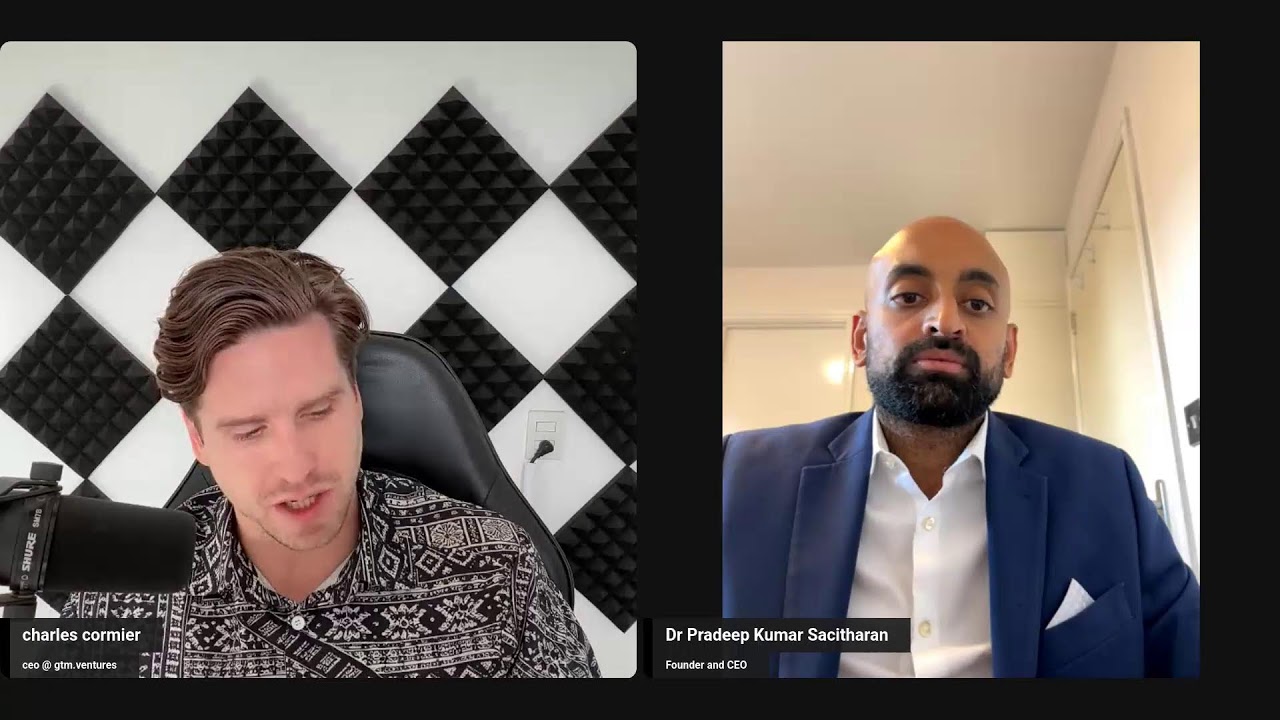
Pradeep Kumar Sacitharan went from war refugee in London to running a $1.6 billion biotech operation in China, then started Downsfield Group, a commodities trading company dealing in chrome and manganese across Africa, Turkey, and Pakistan. He credits Olympic weightlifting with teaching him discipline and emphasizes that big risks and learning to manage large sums are essential to building wealth.
Chapters
Welcome to another CEO Wisdom Pod. We have Pradeep Kumar Sathyendran with us today. He's CEO of Downsfield Group, a keynote speaker, educationist, a scientist and author based in London. Welcome to the pod, Pradeep. Tell us a bit more about yourself and your story.
Well, first of all, that's a great pronunciation of the last name. Many people get it wrong, but so congrats and thanks, Charles, for having me on. A bit about myself. I call myself a serial dropout. Didn't have much starting in life. Um, I was a migrant to the UK. I was a war refugee. My mum smuggled me in a plane, got to the UK, brought up in a rough social housing background, had to fight my way. Um, then got into a bit of trouble, nothing bad. Uh, luckily I had some Olympic weightlifting as a background. Sports was kind of a principle. Then I got into education at 21 with no education background. I managed to get to Oxford and Harvard in 7 years. Then I traveled the world. I went to Israel, France, the US as well. Then I settled in China as a vice president for a global biotech, eventually had a revenue of $1.6 billion and $400 million in budget. Managed 600 people, and then I also was an assistant professor. We've done some drug discovery in multiple diseases, mainly osteoarthritis. Then I had a terrific career and I loved the business side. When the pandemic hit, then I came back to London and everyone said I was too young and overqualified. I couldn't get a job. Then I tried for 8 months in science and I thought, you know what, I love the business side of things and how life was going, so I became another dropout, dropped out again of a traditional career, went and started my own business, first of all in e-commerce. We done well there. After the pandemic, we sold that business. Then I asked myself 3 questions. I want unlimited scale, unlimited revenue, and a long-lasting company that has global reach. And I settled on commodities. And we're a commodity trading house now, pivoted again, and we're doing very well now. We have companies worldwide and we have a group is now structured. So day to day, I'm a commodity trader. Now after 2 years, Charles, you're the first podcast I'm back on podcast guesting. So it should be good. And that's my intro.
Let's start with the childhood part. Like what, what are your first memories of being war refugees? How old were you when that happened?
Oh, I was 5 or 6. I remember my mom saying, hey, your name's not Pradeep, it's something else. Uh, we're going our way to London. Uh, first attempt failed, and the second attempt we finally got there. Uh, obviously my family were persecuted because of my family background. Um, and then, yeah, it was scary. I remember that I, I We— I met my dad who was already here in the airport, and he took us to a family friend's house. And the earliest memory is that this really nice guy, uh, he came out of the room, a young kid, he's probably 4 years older than me, um, and he gave his jumper to me because I just had a t-shirt, because coming from Sri Lanka it was cold. And that act of kindness, uh, was my first kind of glimpse into London and the UK. and he gave a jumper. He became a doctor. Unfortunately, he actually passed away recently, very young, at 44. But that was the first earliest memory of, uh, being a war refugee. Obviously the explosion stuff, but the kindness coming to London was the first, uh, kind of memory.
Interesting. Um, you were also like a teenage gangster after that. What happened there?
Wrong crowd. Um, that's when I look back. I actually walk around London now and I see a lot of kids growing up in gangs, in social circles, and so forth. I don't think you can call them gangs, but I look back and I said, hey, do you, uh, do you know the possibilities of your life? And it's just about you don't know what you don't know. So I was with the wrong crowd. We didn't know what education was back then. No one had a career. So you're just hanging out with the same people, uh, you getting into trouble. Luckily, luckily had weightlifting in the gym, and I used to go away at night and just train. So that got me out of— kept me out of serious trouble. But you're just hanging around with the boys in the hood where you grow up, and you don't think of these gangs. You're just having fun as kids and teenagers.
What did that teach you, uh, exactly? Was there some positive lessons, some negative ones as well?
Positive lessons, uh, looking back, um, uh, it made me very street smart. Um, you know, I, I said I never had opportunities growing up to travel the world, obviously of my family circumstances, but in London, in those areas, I knew what exactly different nationalities— very mostly diverse— I can sense people very quickly, I can sense environments, and the gut instinct was trained. I always prefer the gut instincts, and so made me very street savvy, high EQ, understood people very quickly and very sharply. And also it taught me how to hustle and just look at every opportunity and treat everyone as something, a new opportunity. And the negative is it taught me how to understand and be aware of people and what certain conversations or actions can lead to. kind of a positive-negative vibe there.
Interesting. And what was your first, your first story of love with education? Like, I see you got into science quite early, molecular biology. What was that phase of your life? How did you transition from a little gangster to like having an appreciation for how the world works?
I, I loved Olympic weightlifting. It was my passion. I was very good at it. I also was very in tune with bodybuilding, but never done it, and the gym world. So Lightweight Baby Ronnie Coleman, before people knew him, I was watching him in London. Dorian Yates, I used to have the VHS tapes as a kid. So I knew biology in terms of muscle, uh, in terms of HIIT training and so forth. So I was doing it without actually a curriculum. But when I started saying, hey, you know, weightlifting is not going to go anywhere because the Olympics are genetically out of my reach, but I got very competitive actually in the UK. So I thought, let me transition and try. I tried personal training. Then I said I really wanted to get into biology. Then I got into biology. So it's almost like a passion and love that came from the gym.
And why were you so good at it? Like, did you have a chip on your shoulder? Is it because you studied a lot? Like, tell me why.
Yeah, I'm not a big believer in Charles on, on, on, on chip on shoulders and this war refugee, uh, background, or, you know, um, uh, no education, then changing the mind itself to become one of the best educated. I'll tell you why. Because on that journey, I never thought of, oh my God, I need to prove someone wrong. You know, you run marathons, ultramarathons. I've run marathons. At 41 kilometers, I'm not thinking, oh, that person rejected me. I'm thinking about getting to the finish line, surviving it. So believer in a chip on the shoulder. I'm a big believer in just doing what's at hand, loving what you do. And that might be easy, but that's the only thing that can make you keep going on when you do massive impossible tasks. Which I have in several fields. But yeah, chip on the shoulder and negative motivation can get that journey started, but the love and the goal at hand is what you need.
Yeah, I mean, the chip on the shoulder will get you to the starting line for sure, right? Like that. But, and even that is a big exploit, like to, to get on the starting line of something shows that you've Train, show that you've done the logistics, you've paid, and you you're there, right? Like to start. But yeah, you're right. Like at kilometer even thirty, you don't think about like your your enemies, right? And if you think about them, if anything, they're tormenting you, right? And they're slowing you down. So it's better to run lighter and to to run on positivity. But yeah, sometimes a good fire starter, right? Like when you start a fire, you know, like that these leaves that you use to start the fire. Like sometimes anger can be good for that. But to sustain it, you need like I guess positivity logs, right? And these burn longer and fat and and steadier, right? And that's ultimately what makes the core of the fire. Okay, so powerlifting scientists. What was the transition from scientist to business, which is also pretty uncommon?
Yeah, I I always hate to do what's traditional, right? So you know when I when I was on a small University, uh, you call it probably— I forgot the American term for it.
Uh, I'm Canadian, by the way, but it's university in Canada, and in the US also it's university. Do you mean college?
Yeah, the equivalent will be community college. Uh, that's where I started, and then I was like, no way you can get to Oxford. Then I got to Imperial, then I got to Oxford. And now in Oxford, here's the thing— fantastic people, very successful, love them all. They're like, there's no way you can get to Harvard. Then I'm like, okay, I'm gonna get to Harvard. But I wanted to get to Harvard, so the way I got there is I wrote for my own kind of short-term, uh, it's called the Fulbright Scholarship. Um, got that. And then in Harvard, I thought, wait, wait, hang on, I don't want a traditional career because it's, it's not going to get me anywhere. It's going to be 40 years of torment, right? So I started writing for my own thing. I was dead broke, right? Again, entrepreneur mindset. Then I, on, on, on merits and scholarship, got to Israel, then got to France. Then the Chinese— that's, that story again was another story of luck and miracle. The Chinese picked up my CV, then got huge promotion in China. Then in my CEO, one of the CEOs in China recognized my talent as an entrepreneur because I was always writing for like, uh, grants for business from the science, how I can turn the science into a business. Then he's like, look, become a business manager. Then he quickly promoted me to vice president. So that's the love for business that came about, and I grew that business. And I'm going to be very honest, I tell my friends in science this: science is amazing, the academic training was amazing, but nothing tests me on a day-to-day basis than business, particularly at the global level— macroeconomics, geopolitics, logistics, marketing, sales. You've got to be a lawyer, you've got to be accountant, not— you've got to be a critical reflection philosopher as well. Nothing tests me like global international business. So I think that's where my mind is, because always constantly tested. So that's kind of the switch from the science to scientific business, then my own business.
Yeah, right. And just the invention of money, I like saying that money and capitalism is probably humanity's greatest invention so far, not even electricity and, and the internet. And I love internet, right? And AI and all of that. And I think most people still don't leverage that invention properly. A bunch of people still fear money, get anxious around money, don't understand how money moves, right? It needs to move from hands to hands. You need to trade it. You need to grow it, right? It's like some kind of seed that you plant, right? What do you have to say about that?
I totally agree. Coming from a background that you don't know how money works, you don't know what maybe even 6 zeros look like, you don't know what a business is, you have to educate yourself. Um, you know, talking about your capitalism point, every human, I believe, needs a reward. And that— and when that human gets that reward and they grow it, it's up to them how to spread it and give back. But there has to be a carrot there. And in terms of how you're growing it and how you get used to it, if there's kids out there listening, you know, start— don't be scared of 6 zeros or 7 zeros or 8 zeros or 9 zeros. Once you start signing contracts, talking to people, and when you see zeros coming in, You just realize that it's just $10 to you, it's just— and how you use it is the same as $100 million. But you just have bigger kind of pots of money and you have more people that you can liaise with and to actually control and grow that money. So everything will grow in steps and just don't worry and just keep— take those risks. And I'm a big believer in taking big risks.
Yeah, it's all psychology especially. I mean, If you borrow money from someone that has ten zeros in their bank account and they lose six zeros, six zeros for them is the equivalent of ten dollars for you, right? So, and if they agreed to the risk, right, and they knew what was going to happen, then that's 100% great. I feel a bunch of these kids, they—I mean—they think of business from zero to one, right? Which is like have a commerce. Sell some stuff, right? Add some margin. I feel the game of investing should be taught like way earlier, right? The act of borrowing money from someone with a lot of money and investing it in something and bringing them returns and bringing yourself returns while not having to work that hard. Like the act of investing most of the time is probably 100 or 100,000 less times harder than starting your own dropshipping business and e-commerce. Would you agree?
Absolutely. And I've done both, by the way. I've started my own e-commerce and I borrowed a lot of money and I pay back investors. And you know, it's a fantastic feeling when you borrow someone's money, even if they got 10 zeros or 9 zeros, and you just give it back. And you can see, even if it's someone that doesn't got much and they've, I don't know, a kind of a mid-level investor or a high net individual, and you see that you give it back and you build that trust. I love that feeling, that warm fuzzy feeling, because you're building trust. And also, if there's people who've, I don't know, given the money that they know on trust, and I give it back and they've spent it on their kids, you know, or spent it on someone, and you can see that your hard work and your returns are actually fulfilling someone else's life, and that's a fantastic feeling. So remember, giving back is not so about charity. You can actually give back to investors who might have more money, but they're actually spending on themselves, and that's a good feeling as well. And I wouldn't, um, I tell you, I show you something, and please kids, be careful with this. Uh, people ask me this question, how do you, how did you like, um, uh, change the mindset from academic to a borrower or take that risk? My Chinese CEO, uh, introduced me to gambling. Be careful kids, right? And he, he introduced me to blackjack, and he's like, Pradeep, You— here's a line of credit, go and play blackjack. And I said, in Macau, right? And here I am, I didn't know what blackjack was, I didn't know what casino was. But really, it's risk to reward, how many units you spend. Sometimes it's not about card counting or knowing, um, the system, it's about how to risk the reward, what your rewards are, and when to get out. Those are the 2 or 3 things you control. So if you know those, no matter how many zeros you're playing with, you'll be very good.
Yeah, gambling, yeah, not the best form of making money for sure. Even poker, right? Like some of my clients are hybrid founders and ex-poker champions. I guess you can transfer some skills, but yeah, gambling is definitely not the best way to make money. What are you doing nowadays? Tell us about like Downsfield and how you got into this and how you're making money nowadays.
Yeah, so we definitely don't gamble. No, we actually run a global trading house. So I asked myself again, 3 questions on what's the infinite scale? And the world will always need commodities, metals, and minerals. Even if AI data centers or Macs or PCs or whatever the next technology is, The fundamental metals that make up this is important. So we trade metals and ore. We are actually the miners and producers of ores. We do it in Africa, in, in parts of Turkey and parts of Pakistan. We trade with people. So we mitigate the risk for most of our corporate and governmental clients where we do all the hard work from mining, transportation, We bring it to a safe place and we sell. And we do that across the commodity spectrum. That's what we do. And we start also investing in ourselves. We don't invest elsewhere at the moment because we're growing and we invest into different verticals to expand different commodities.
How did you get into commodities and why is that your favorite way to make money nowadays?
I, I asked my question historically, who's the best company in the world and what can I replicate? Um, and I'm sorry, uh, the data is very clear and I'm gonna break some people's heart. It's not Apple, it's not Google, it might be SpaceX and Tesla. The best reputable pound-for-pound company in history is the East India Company out of the British Empire. I'm not saying to copy them on some of their nefarious activities But what they've done is they controlled the production to the customer, to the supply chain, and they had everything in-house. And pound for pound, they blew it out of the water. But they traded commodities— at that time was cotton and spices. Um, so every successful, uh, high-net individual or family office at one point had a base of commodity they traded. Number one. Number 2, e-commerce, as you suggested, and other materials or any other— there's always a ceiling of logistics or funding or market and so forth. But with commodities, there's no ceiling. It's always needed. And number 3, the huge amount of revenue, uh, Charles, I can't explain it. One ship is $10 to $15 million of chrome we do. Uh, one contract for sometimes urea is $60 to $70 million. So it sounds like huge profits, but the revenue is what we need because revenue, uh, is key. And as they say, you know, people say cash is king. I say cash flow is God. Um, so cash flow and revenue is huge as well. So 3— I'll answer your question— 3 things. Um, the best example in firm history Unlimited scale and unlimited cash flow and revenue and bigger numbers in sales.
Interesting. Um, I studied, uh, that— I, I— it was called the Dutch East Company, right? Was that the name of that company? I studied the Hudson Bay Company as well. They were trading pelts. I'm not sure if you studied that one. Um, but yeah, okay, how does that I mean, yeah, minerals to make chips, right? Like, is where my brain's going because it seems the greatest commodity of our time is software and data and AI, right? Like, how does that lock into these trends? Is the demand greater for these minerals now that data centers are burgeoning throughout?
I mean, you hear a lot of the news, you know, the sexy, like, critical minerals for data and AI chips. But again, you know, I'm always big on boring businesses and boring angles, right? So even if we can't— we do some of those critical minerals, but we look at the 2 most abundant things that China and India doesn't have, which is manganese— well, India has a bit of it— and chrome. Those 2 are needed for steelmaking, and steel is still needed for data centers. Steel is still needed for, uh, construction work. And most of these things that actually you have, like laptops and chips and stuff, are made in structures and places where you need steel. So it will never go out of fashion. So to answer your question, yes, we see a huge demand for critical minerals. But what we also see is people talk about the AI revolution. At the moment now, sad to say, there's actually a huge spending on defense, huge. defense spending huge across the world. So we need— we— there's a separate battle going on for critical minerals and metals, even non-critical minerals and metals for defense, um, and also construction as well in relation to defense. But I have to put it out, we're not in— in— in— we're not, uh, supplying any defense company and so forth, but that's also a reason our end users Or might be in those sectors.
And how do you get these in touch with, like, these first materials company, like the ores and the mines? Like, is that part hard, like, to get a hold of them? Did you have to visit them to, to know, like, if everything was running? Like, tell me a bit more about that part.
Yeah, 2, 2 points. A, cold calling, so hard, but it If you don't give up, you'll get there. Second is networks and kindness. When I was a VP in China, I actually gave a lot of vaccines and medication to Africa, and that kindness was returned when I had some investments I wanted to start. I actually reached out to some senior people, business people in Africa, and they said yes, they recommended me. So recommendation and cold calling. And, you know, I went to Africa. You have to park your ego. No one cares if you went to Oxford or Harvard or You've done all these things. I packed my bags. I'm— it's now level zero. I'm back as a founder. Went to the middle of Africa, dead heat, lions in the corner. I kid you not. Went with people with security guards on me, and I just went to mine after mine site talking to people, building networks, opening accounts, opening bank accounts, logistics, and, you know, lawyers, accountants in every country. And yeah. Cold calls and networks.
How did you— I'm a fan of cold calls, by the way. I used to own a call center. I'm not a fan anymore, but how did you find the right companies? Right? Like, because you had a list. Once you had these meetings, did you compare a couple of these mines to see which one had the better prices, which one were run the best and logistically were the most efficient? How did you choose from that list?
The list is, I have to be honest, is always revolving and evolving. Um, some calls are hot leads. This is commodity space, unlike e-commerce and others. If you just set up a supply chain, it doesn't mean that supply chain will last for you for years. This guy might have a better price than another guy. It's a constant hustle. Maybe that's why I'm addicted as well. Um, but yeah, so you just have to get everyone and talk to everyone. One of my best leads, couple of the best leads I had was talking to drivers, Uber drivers, taxi drivers, and drivers from the airport from countries. I always befriend them, always give my business cards because they know where all the money is and who they are because they're probably transporting those individuals in that country. So every cold call I followed up, uh, we keep a list, uh, we have a lead generation, we have a directory, and then, uh, we use WhatsApp, uh, efficiently and groups and You know, most of the individuals are always evolving and prices and supply chains always change. And then we know exactly if it's in this country to this port, it's not going to work out in this environment. And that's very important. Every morning I wake up to global news, Chinese market prices, Indian market prices, global bonds, money markets, and I know exactly figures where they are and my team knows it. And we know what commodities to go for for that week or that month or that quarter, and what commodities and areas to avoid. So to your question, it's always an evolving puzzle, but it keeps us excited. Love it.
Well, thanks for being on, Pradeep. Where can people find out more about you?
At www.donsfield.com, www.donsfield.com, and my LinkedIn is PK Sasi Dharan or Pradeep Kumar Sasi Dharan. And, um, yeah, just, uh, look me up and I'm always here for anyone, and we're open, open
More from Charles


Founder Wisdom: the audiobook, version 2 (5 hours of stories from founders and CEOs)

8 CEO Questions I Love Asking: the audiobook (64 founders answer, in their own words)





