Rae Lambert - Co-Founder & CEO DNNR
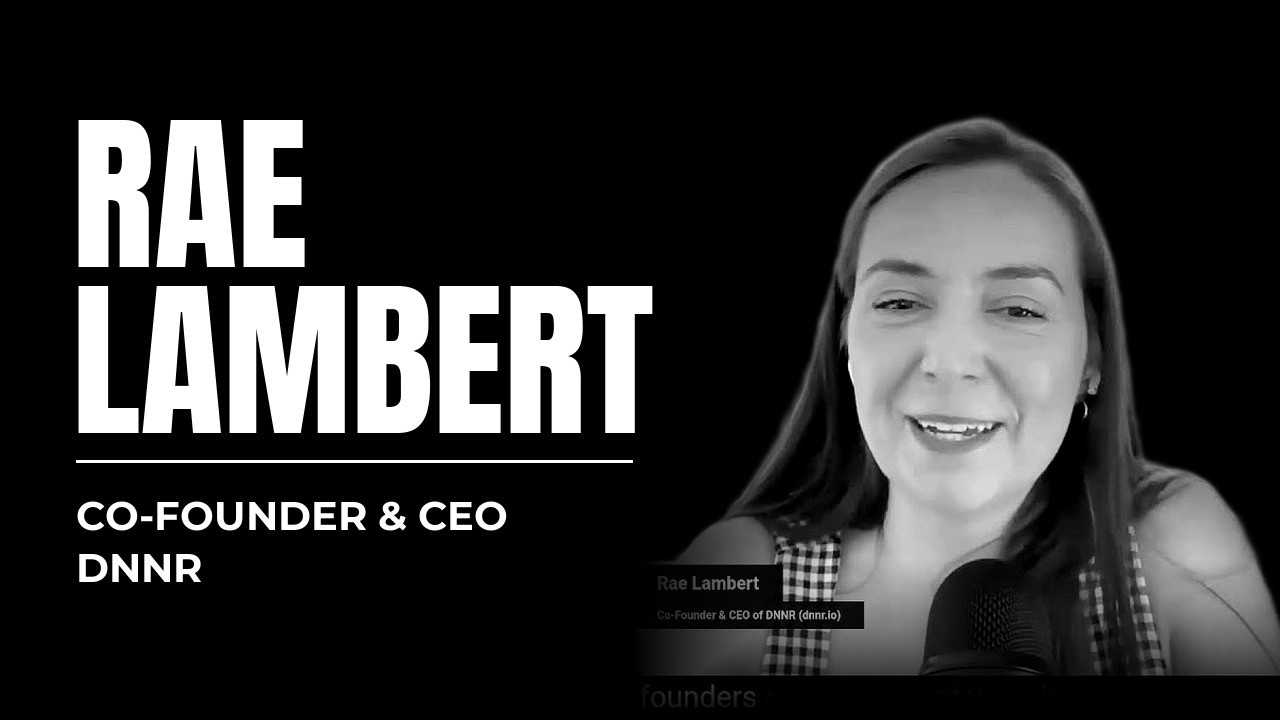
Rae Lambert built DNNR, a platform that lets creators run branded dinner clubs where a matching algorithm seats strangers together. She raised $100k from Jason Calacanis and pivoted from her previous app River, which had 150-200k users but couldn't monetize. DNNR takes 30% of ticket sales while creators keep 70%.
Chapters
Welcome to another Founder Wisdom podcast. We have Rachel Lambert with us today. She's, uh, helping creators monetize their audience and build community with white label dinner clubs. Super interesting at, uh, DNNR Dinner. Uh, Rachel, welcome.
Pronounce dinner.
Pronounce dinner.
Thank you so much. Pronounce dinner. I could not afford to buy any vowels.
Uh, what's up with you? Tell us a bit more about yourself.
Mm, I'm based in New Hampshire now. I've lived in San Francisco, New York, Miami, Boston, spent a lot of time in Portugal, Mexico City, and Austin, but trying to build up the startup community and founder community. It's small but tight in New Hampshire. And then I'm building this dinner, this white, white-labeled dinner club platform. We Launched about a year ago, we have 100 dinner clubs live and thousands of people meeting around the world every month.
Nice. I want to launch my own dinner, but I'm unsure, so we could use like me as a case study, right? So I'm a go-to-market guy, one of— I built like one of the most successful GTM channels on Earth. So it's like, why would I go sit my ass in a restaurant and listen to others for 3 hours while I could be making, I don't know, 5, 10x more money with like, I don't know, my podcast method. So like, um, yeah, can you answer that objection?
Yeah, yeah. So you probably wouldn't be a good fit for Dinner. We either work with hyper-local creators like Instagram influencers, newsletters, like local business communities, local nonprofits, or we work with like hyper-scaled publishers like the Free Press or 6 AM City where they have like, you know, millions of subscribers all around the world. We don't really work well in that kind of in-between zone because you have to be a creator who, hey, you have a niche enough content that your audience wants to meet each other. They want to meet other Free Pressers. They want to meet other people in their community. And basically we white label it for you. So in your case, you could have like a go-to-market dinner club, maybe in New York or LA or San Francisco. It'd be like the Charles go-to-market dinner club. You'd have your own branded landing page, your own personality quiz. So you could batch people like, are they more like social go-to-market? Are they like, you know, paid ad growth go-to-market? Are they like product go-to-market? You can group people however you want. People pay to book a seat and then they get matched with 5 strangers for dinner and then they buy their own dinner and then locally You know, per city, all the tables will converge on after-party bar after. So it's like a social dining experience. If you've seen Time Left or 222, those are only in major cities and they have their own audience and their own app. Ours is white-labeled, so any creator, politician, nonprofit, business community can launch their own branded dinner club and then our app does all the orchestration for it. So most creators use it to make money.
Can you explain how all of these stakeholders make money in that equation? Including yourself?
Yeah, so the creator usually charges $15.99. Some creators charge more to be part of the dinner matching experience. We keep 30% for making all of it happen. All the creator has to do is pick the date and the location and announce to their audience. We make the rest of it happen. Uh, the creator makes money. They keep 70% of the proceeds from their dinner club, and then the local restaurants and the bars that we send people to, they make money. Because we don't support Fridays or Saturday nights. It's only midweek dinner clubs and it's only independent restaurants. We don't support chains. So it kind of drives a lot of local GDP on like off nights. So everybody makes money.
Right. Just unclear about the brand thing, because I'm on your website and I see Troy, Landon, Sam. They have audiences, most of which are lesser than my audience. So why wouldn't I be a good fit? Can you double down on the recipe?
Yeah, it has to be like either very, very large global audience or it can be a small hyperlocal audience. So if you're kind of like a B2B creator on LinkedIn, you just, everyone might be really spread out and you might struggle to sustain a dinner club in a particular city. Although if you were going to be like traveling to, let's say you're going to be in a conference in New York and be like, hey, I'm going to host a Charles Cormier Go-To-Market dinner club. I'll see you all at the afterparty. You could do that. But yeah, there's kind of this no man's land in between. Like most of our creators, they might only have 5,000 to 10,000 email subscribers in a particular city, which is normally considered very small if you're competing globally, but hyper-local-wise, you can actually drive a lot of ticket sales.
Got it. Second time you mention after party. Why? Tell me a bit more about the after party.
It's the most fun part. Yeah, so let's say you're meeting up at a dinner club in New York, let's say Flatiron, If there's 100 people going to dinner, we would send them to like 10 different restaurants, let's say. And then all the tables after dinner get a text message— well, they get a text message during dinner revealing where the after party is, and then you'll meet all the tables from that night dinner club. So it's like a fun way to— you kind of make your close friends with those 5 people you're at dinner, and then you kind of roll up to the after party with people that you already know. And it's just like a fun way to meet new people. So we usually do a 2-phase part of the night.
Okay, so it's like two events and after party is more relaxed, push the table, like, uh, I mean, I remember like after parties back in my days at 3:00 AM, blackout drunk and just like, uh, finishing the, the party at the after party club. I, I haven't done like after whatever, so what is more like after dinner drinks, less, less after party late night blackout, but more like After dinner, drink. Okay, got it. So you eat and then you just socialize and all that. Okay. And what is your business? You take care of the full event planning, which is a massive headache. You find a venue. Like, what do you do exactly?
Yeah, so we host— everyone has like a subdomain landing page. Our match— we have— you can build your own personality quiz, which powers our matching algorithm for matching people. So some communities, every community is very different. There's a moms group in Brooklyn. They send you out to dinner based on how old your teen— your children are. So like, if you have toddlers, you'll be at a table of other toddler moms. If you have teenagers, you'll be at a table with teenage moms. Some business communities send you out to dinner based on like what industry you're in, if you're in hardware or AI. Um, so our quiz does this like matching algorithm and it's very powerful. It takes into consideration like diet, budget, allergies, ages, interests. And then also we integrate with the Google Maps API and we source all the restaurants, we make all the restaurant reservations, and then we sort out the, we give the, we call the after party and let them know that everybody's coming. And then we do all the email communications and text messages so that everyone gets to the right place at the right time because thousands of strangers are meeting up at restaurants and there's no host. It's completely hostless, so the tech has to work flawlessly.
And the part that they're responsible of is getting the people in, so they need to have an audience. That's something you don't, uh, take care of, right?
Correct. Yeah, you, you basically bring your own audience and then we do all the work. So you pick the date, the city, and you announce to your audience. And so, yeah.
Okay, and let's say I make my dinner— how much? So I pay you 30% and I sell the ticket at least $700, that would say No, people charge $15.99 usually for their, like, the dinner club ticket.
So we would keep like $4.80 of that and you would keep $11.20 of that dinner ticket. And then this is just to pay for the matching experience. People get separate checks and buy their own dinner once they get to the dinner club.
Okay, and tell me about the matching experience. You have a special algorithm behind that?
Yeah, I mean, it's very powerful and very flexible because every community sets their own personality quiz, which then you, you set the questions, the, the logic and the weight. So you might have a for funsies question that's not that important in the matching, or you might have like a really critical question like how old are your children or what tech, what industry are you in, and that's like the core and a reason of why you're matching people. And that is up to the community creator. So they just like, everyone has their own bespoke matching algorithm basically.
Why did you launch that company? I saw your experience, uh, I saw cool companies like Intercom. You've been marketing and product, then you your own company, Olivine Marketing, I think it's called. Why launch that company in 2023 precisely?
Yeah, I mean, after I worked in a lot of tech startups in San Francisco, including Intercom, which just rebranded to Finn and sold to Salesforce, and then I wanted to move back to the East Coast. So I started my own marketing agency. I co-founded it with a partner, Ashley Wilson, and we scaled that and actually recently sold that as well. And then early days, I helped her and her husband co-founder, they were co-founding a company called Momentum, and I was there with the early days with them, and that also sold to Salesforce. So I had 3 liquidation events this year. Um, when I started, it was initially called River, and it was a meetup platform. I started it because I was moving— I had moved to Miami and was not really enjoying the tech scene that much there. It was a lot of like crypto boys. Like, I own crypto, so like, no offense to that, but like, it just was—
bros in Miami, that's so Can I imagine that?
Um, yeah. And I had, uh, I was like an early listener of the All In podcast, which back then was like way less political and a lot more business, um, tech focused. And they had hosted a summit in Miami, which I attended. And then it's kind of a long story, but we had just moved to Miami and I was like, you know, I enjoyed the people I met at that summit. Let me try to meet more of those people. So I hosted an All In episode 100 listening party in Miami.. And I DM'd with Jason Calacanis, the host of the podcast, and I was like, hey, you should livestream it for my party. Um, and he's like, I'm not gonna livestream the pod, but this party sounds cool. I'll retweet your signup form. And I was like, okay, better think bigger than Miami. So I've lived a lot of places. I knew a lot of people that would host. So I made a signup form that just had a few options. It ended up going viral and we helped orchestrate meetups in 24 cities. Uh, and then we ended up doing it again 25 episodes later in 50 cities. Um, and all the existing meetup platforms were just like not scaling. We could, we could get into it deeply, but they just weren't scaling well for this use case because every other event platform assumes that you personally are hosting the event and that the one creating the event is hosting events. So there's just like a lot of technical problems. Um, Jason invited me to come work for him and I was like Oh, thank you so much, but you seem like a lunatic to work for, and I work for myself, and I don't work on Fridays, so no thank you. Um, and then a few weeks later, he's like, I think this is actually a really interesting problem. What if I invest $100,000 and you start a startup and come to my accelerator? It's like, okay, well, I won't come work for you, but I'll work for myself for a lot less money and a lot less certainty. So I joined the startup accelerator program, and we are building this meetup platform. We ended up getting like Tim Ferriss, Brian Johnson, My First Million, All In, all on the platform. Um, basically the concept was crowdsourced fan-hosted meetups. Um, maybe not a surprise to other people, uh, I could not get the business model to work, could not get revenue to grow. We had like 150,000 or 200,000 users on the platform, but just revenue was like stalling at $5,000 a month. Uh, I saw social dining— we saw, our team saw social dining was kind of exploding in major tier 1 cities, but that there's a ton of creators who probably have the audience to do something like that but not the tech skills. So we decided to build it for them.
Why is it exploding? Is it the post-COVID trend and just that humans are social creatures, especially around food?
I mean, yeah, you answered it. I feel like breaking bread around a table is like the oldest playbook, um, for like making deeper connections and I think we've all kind of dispersed after COVID out of a lot of major cities. A lot of people like moved back to their, you know, hometown, but they like need a new network of friends, not just the people they went to maybe elementary school with. Um, yeah, I think people like in the age of AI, people are kind of seeking that authenticity. And, um, we're also all bored and everyone's freaking lazy and no one wants to plan anything. Um, so it's easy to just like fill out this quiz and show up.
Is Luma competing in that category? No.
So my meetup app before was maybe a little bit competing with Luma because that's an event app. But, um, no, I mean, if you're just going to host your own dinner party night, you might use a Luma or a Partiful. But if you're trying to orchestrate like 100 people to go out and join a dinner club, there isn't another tool that does that, right?
Have you got more funding since then, since the $100K?
Yeah, shortly after that $100K, I raised $50 grand from Balaji Srinivasan, even though I was like not enjoying hanging out with the crypto boys. Um, he's like a— he's like a— he's a big shout out to crypto boys. I love you all, I just don't want you to be my whole life. Um, yeah, so I raised the $150 grand of angel checks, you know, $100 from J. Cal, $50 from Balaji. Then we went through the accelerator program. I, and I raised a pre-seed round of $1.6 million, and that was for River, the initial idea. And then, um, recently for Dinner, we raised like a small bridge round just to like help us kind of— we, we have product market fit and we're growing very fast. If only I had come up with this pivot idea 3 to 6 months earlier, we wouldn't have needed to raise like a small bridge round. Um, no one wants to talk about bridge rounds. They're not cool. You're not supposed to announce them. You're not supposed to tell any about them, but that's what happened.
Can you define the crypto bro archetype? Because Balaji, yeah, uh, great, and one of the greats, Kyle Kanas as well. But I feel the followers of these guys sometimes a bit, uh, degenerate. Are you like, um, talking about the NFT yacht, uh, type of, uh, Miami bro? And, uh, why are they plaguing you so much?
Yeah, well, I think Part of it was just Miami was such a monoculture of crypto in a sense. Like, you know, I think New York and San Francisco have those things, but it's not like the only thing people want to talk about. And, um, yeah, I think sometimes crypto and like the Web3 community, they're trying to like give old things new names, and it's like, it's, it's really the same. It's all the same thing, you know. Um, new notions of like organizing yourselves, I, I really appreciate about the Web3 community. I think that's interesting. I think like decentralization on payments is great. Um, but yeah, like the NFTs and like pumping and dumping and the, like, you know, I think we can like live without these like meme coins. Um, and really my frustration was just like, I felt like I couldn't meet— in Miami, I wasn't meeting serious operators. Like, I was meeting people who like maybe raised a lot of money but weren't like working towards building a profitable business. Or, you know, I had like one guy like puff his chest at me and be like, Um, you know, well, I'm the CEO, I'm the face of the company, so I'm just like out here fundraising. I don't know, it was like he was running out of money and I was like, well, why are you at this party? And he's like, well, I'm the CEO, I'm the face of the company, so I have to be out. And I was like, well, I'm also the CEO of my company and I like do work and stuff. Um, and he, he noticed the slight and he's just like, well, what's your burn rate? And I was like, what? Like, I run, I run an agency, we're profitable, we don't like, we don't have a burn rate. And it's like he just like had never existed in like a revenue-generating space.
He was just like, who has the biggest burn rate?
Which is like totally fine, but like at the same time being a complete jerk to me and like my business, which is doing like $2 million a year in revenue at like a 40% margin, you know. Um, so yeah, I, I don't— I feel like the thing about Web3 is it's just like the same thing about America. It's just like a huge community, so you're going to get people on all edges the bell curve, and some of it's fantastic and some of it isn't. But it can be like, just like a, a not fun culture to like try to break into. And then in Miami, of course, everything's just like accelerated because it's Miami.
Yeah, well, you plunge yourself into it, right? All in Miami. Um, My First Million has like a— oh, of that. I mean, how do you leverage that without like losing your mind is my question, right? How do you— yeah. How do you deal with that?
Well, I might be older than I look, coming up on 40, been in tech a long time, been working, like running my own business for a long time. I don't know, I've seen all shades of startup. When I, the first startup I joined in San Francisco, it's called Sauce Labs, and like, you know, we had strong growth rates and like stuff, but man, we lit money on fire. There were just parties all the time, conferences, Boondoggles, you know. And then I left Sauce Labs and I joined Intercom, which had raised way more money and had way more revenue and spent way less money on dumb shit. And so I think just like as you age, you become more rigorous and you can kind of instantly sniff out like who's serious and who's just like very pompous, or who's like chest-pumping at you versus like who's serious. I find— I tend to find like the more serious people are, the less they're like bragging about what they've done. They're kind of trying to undersell it because they don't want people to like try to take advantage of them because they're so successful.
Interesting. And how do you leverage Jason's network, Balaji's network, My First Million network? How do you leverage more than their, their money to stimulate growth in Dinner?
Yeah, well, those things haven't necessarily translated into like helping me grow Dinner as much. I mean, Jason's always good for a retweet. He's like kind of slutty that way. He'll like retweet anything, which I love about him. He's very generous with his network and he'll introduce me to anyone. I mean, he's definitely the reason we got like Tim Ferriss on the platform when we were building the meetup platform. Yeah, I have a lot of emails from River meetup days, but it hasn't been quite the right audience for that. Honestly, our growth for dinner has just been powered by people seeing, following other local creators, seeing the dinner clubs, noticing that, oh, this is quite a lot of work for one person to try to do. What is this DNNR thing? And then people find out about us. And then I also just am like pretty good at direct, like outbound sniper snail sales where I just like hunting big fish that I like that I think would be a good fit.
How do you do that? Is it LinkedIn outreach using your brain and one-liner? How does that work?
You know, I don't ever have as much luck with LinkedIn. Twitter X tends to be more MySpace or I've done well on Instagram for dinner. Yeah, it's really just like, honestly, there's no shortcuts. It's just like following, following the person, liking the person, actually reading their content so that you know what they care about. And then when you do finally DM them, it's like very value prop targeted, like pretty hard-hitting. You're not just like generic copy-paste volumes. Um, I'm definitely more of like a hunter. I can go after a Like I can hunt like a big whale, but I, I do struggle with like growth, go-to-market, like mass outbound. I've never really done that before.
I've done that extensively. We're yin and yang. Um, yeah, let's talk some more after this podcast. How do you target like all these creators though? Because that's always been a struggle in my world. I do well with B2B, but creators tend to be more on the B2C side of things, scraping their YouTube, their Insta. Back in my day, I think it was a tool called Ninja Outreach or whatever. So how do you do that? Is it Clay? Just like simple Clay table or?
Well, we've been using a lot of OpenClaw to power our outbound. We have OpenClaw, a Notion database, and Slack. I would say those 3 things are like pretty powerful trifecta. So if I'm just like in bed scrolling through Instagram, if I see a lead that I think is good, I copy the Instagram URL and I drop it in a prospect Slack channel and I'm like, hey, OpenClaw, Please add this to like our prospective lead list. And then that gets stored in a Notion database. And then there's like a scheduled cron job that you can schedule from Slack saying like, hey, you know, every day look at the new prospects list or every week formulate an outbound email for them and like, let me review it. And then you can like edit it and then you can approve it and then use— I can't remember which. Email tool we're using to send emails out. Um, but yeah, that's how we're doing that.
Who's your co-founder? Why are you both complementary?
I have two co-founders. Um, one is my husband, uh, Ryan Lambert. He's an AI, like, data science guy. And then our other co-founder, Bernie Kobos, he lives in Poland. We all worked together at Sauce Labs back in 2012, and he's Just a sniper. Um, very good. A bunch— when I raised money from Jason and Balaji, a bunch of our friends from Sauce were like, how'd you get Bernie as a co-founder? We're more impressed with that than the fundraise. Um, yeah, so Bernie makes sure that the app works in all time zones and everything gets delivered. Um, I would say, yeah, I'm just like more of a go-to-market product person, and then Ryan powers— they build the algorithm, and then Bernie makes sure the whole thing actually works and gets delivered.
And how do you and your husband not kill each other after 2 years of working together?
Yeah, great question. I don't think it's for everyone. Um, we have worked together many times. We've been married 18 years. Uh, we, we did a hackathon together in Miami with another friend, like, oh, Miami Hack Week. We won first place at that. Um, we, yeah, we've worked together at a couple other companies. Like, they knew we were married. Um, we just have always been kind of builders at heart and just enjoy building things. I don't think it would work for everyone, but I will say I don't think it's unusual as people think it is. Uh, Canva, huge company, married co-founders. Also, like 100 years ago, everyone was married to their co-founder because like your husband was a cobbler and so you were like the wife was like cooking the books or whatever. Like everyone used to be much more entrepreneurial and family, like family-run business used to be kind of the the M.O., and we just kind of got away with that in a more modern way. But I actually don't think it's that as unusual as people think. Um, we sleep well, we sleep separately, so we're always well rested.
We sleep separately as well, but that's because we have a baby. Um, yeah, that helps a lot for my own sleep personally. What does a day in your life look like?
Every morning, I'm partly— I'm manifesting this, so that is definitely true. Every morning I go to F45 and do gym session, and then we pop next door. There's like a banya, sauna, cold plunge place. Get that in and then lock in lots of meetings and focus work. I block Fridays are my like podcast days. I only have to look cute one day a week. Tuesdays, Thursdays, no meetings day. It's like deep focus work. This is something I learned from Intercom. We did that there. Um, that was great. I work most weekends, you know, less on Saturday and Sunday, but I do work a lot. And then, um, yeah, day in the life. Um, creating content for Dinner, um, needing some product stuff. Um, I have a finance background, that's what I studied in school, so like making sure we're actually on our way to profitability and not doing stupid shit.
And what's the desired outcome with Dinner? Is it like an exit 3 years down the line? What, and by whom? Like what kind of company would acquire Dinner?
Yeah, that'd be interesting.
Eventbrite? It's like I haven't studied the event industry in like forever.
Yeah, you know, I actually think it'd be more likely to be like a Beehive or a Kit that already has a ton of creators. Like most of our, you know, most of our 100 creators that we have, most of them are already on Beehive. So that might make sense as an acquisition. Um, I don't know, I could also just see running it profitably for a long time. Um, probably you're not supposed to say this out loud, but probably a little less interested in like IPO. I'm just like, I think there's just a lot of headache that comes with that. Um, I prefer running small, small, lean, mean companies. I really love Instagram, the way they did it, you know, billion-dollar acquisition, 13 employees. It's pretty smooth.
Yeah, I don't think Wall Street bros would get it, uh, so the IPO, I'm not sure. Or yeah, yeah, retail investor. Um, who do you study nowadays? Like, we named a couple of great people today— Tim Ferriss, Balaji. Um, who else do you study as, uh, quote-unquote mentors?
Hmm, I listen to Moonshots a lot, the Peter Diamandis, uh, podcast. I listen to a lot of podcasts. I don't I don't have a ton of time for reading. I always love like the Hard Thing About Hard Things books. I listen to— I think like YC has a good podcast. I can't remember what it's called, but I'm usually tapped into that. And then honestly, I just have a community of founders around me that we meet pretty regularly and everyone's kind of like comparing, comparing their AI bots like, oh, this one's better on this model. Um, I like to do a lot of in-person stuff.
What does your ideal dinner look like?
My ideal personal dinner?
Like, uh, business dinner? You could go personal as well.
Oh, oh, oh, so like, what is the ideal business of dinner look like?
Yeah, yeah.
Um, yeah, right now we're working towards being profitable. We're growing pretty fast but not quite there yet. Um, Probably going to expand beyond dinner into other types of in-person experiences. So being like a subscription IRL experience platform where any creator could launch other social activities besides just dinner clubs. Um, people already kind of like hack us to be like happy hours or brunches, but then people are always confused because like it says dinner. Um, yeah, so experience, uh, expanding to like other kind of experience subscriptions.
I meant your ideal events. I just realized the confusions because your business is called Dinner, but like, I meant what's your— you show up to an event, right? Like a mastermind dinner. What's your ideal one?
I see, I see. Yeah, I love dinner parties. I love house parties. Um, I love groups of like 6 to 12. I personally don't like these huge events. Like, you know, I know Andrew Yang is like really popular for hosting these like huge tech events like 200 people, and I was like, oh dear God, that's like— sounds like my personal hell. I prefer smaller curated events. Um, and then I don't really drink a lot of alcohol. I mean, I do like occasionally, but yeah, so it has to be food, not just like espresso martinis, otherwise I'll be under the table.
Okay. And the setting, uh, is there like specific tables? How much people per table? What's the setting of the table? What's the dynamic? Like, if I want to organize my own and have it be highly successful? Like, what's the, what's the blueprint to that?
Yeah, so if you're doing like an executive style dinner that you're hosting, like, that could be founders, CEOs, investors. Yeah, I think that 20, like 18 to 20, is a good size, like max size that you could rent like a private room and kind of negotiate like a preset menu with the restaurant and whatnot. Um, I always think that you should force name tags. I know no one really wants to do it, and you Um, but it actually really does like scientifically prove that people are more conversational. You just can't let anyone opt out of it. Like, you have to be the host and you have to be like totally Nick Gray, like, we are doing name tags and no one is getting excused. So name tags help a lot. Um, I like to assign seats. Um, I like to break up couples or just like break up co-founders so that people are having a little bit more of a surprising experience. When I host my own bigger dinner parties, like for a friend's birthday, I usually do family style, and then after the appetizer, I make everyone get up and change seats, um, so that they get like more, more people to experience. Um, but if you're looking for just like one conversation at dinner, I would always say 6 is, is a good number. Once you get past 6, you basically have 2 tables of 4. Like a table of 8 is basically 2 tables of 4, and there will be 2 conversations happening all night. But if you keep it to 5 or 6, there will be usually one conversation throughout the night, so you can go a little deeper that way.
Interesting. Yeah, wasn't it Nick Gray? I think I had him on my pod. Like, he's great, right? Like, when it comes to him, it's around that.
Yeah, he's got the book The Two-Hour Cocktail Party, which I love. He actually inspired me to host because I love hosting parties, but sometimes I burn myself out and I just like do too much. Um, so on Christmas Eve, we started hosting a cocktail party, and like anyone can kind of breeze in on their way to other plans, and it's like such a great way to see people without it being overwhelming. Uh, yeah, and he's a big proponent on name tags and just like really how to like wrangle a room and kind of foster a lot of connections. So I always recommend checking him out.
I love it. Rae, thanks for being on. Where can people find out more about you?
Yeah, I'm on Twitter at Rachel Lambert, but my name's spelled funny. It's R-A-E-C-H-E-L. I'm on LinkedIn. Uh, I got a newsletter called IRL is Greater Than URL. It's a Substack with 20 4,000 subscribers. So yeah, I'm Chronically Online. You can find me anywhere.
It was Ray and Charles Cormier for another founder
More from Charles


Founder Wisdom: the audiobook, version 2 (5 hours of stories from founders and CEOs)

8 CEO Questions I Love Asking: the audiobook (64 founders answer, in their own words)





