Rocky Lalvani - Profit Comes First
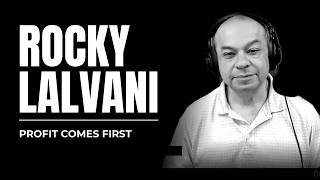
In this Founder Wisdom podcast episode, host Charles Cormier interviews Rocky Lalvani, the "Profit Answer Man," about his journey from an immigrant family with $25 to becoming a profit‑first consultant for 7‑ and 8‑figure business owners. Rocky explains how early family conversations about money made him aware of the cultural taboo surrounding finance and shaped his mission to demystify money for entrepreneurs. He describes his empathy‑driven consulting style: quickly diagnosing a client’s true financial picture, showing the math, and offering value without a hard sell. Rocky distinguishes two owner mindsets – those who chase revenue as a vanity metric versus those who focus on profit and cash‑flow, emphasizing that profit‑first thinking is a mindset shift. He outlines his own business model built around recurring revenue, automated monthly drafts, and eliminating accounts‑receivable hassles, which he calls "energy‑efficient" and highly profitable. The conversation moves to how AI has reshaped his workflow: rather than letting AI build entire spreadsheets, he creates a shell and uses precise prompts to fill gaps, treating AI as a collaborative tool. Rocky stresses that cost‑cutting is a small part of his work; instead he helps owners evaluate shiny‑object opportunities, allocate capital wisely, and adopt a broader investor mindset. He discusses leveraging his podcast as a pull‑marketing funnel that educates prospects and builds trust before a sales conversation. Finally, Rocky critiques the lack of practical financial education, explains the importance of understanding one’s money story, and advocates for entrepreneurs to become capital allocators rather than just reinvestors, drawing on frameworks like Profit First, Traction, Scaling Up, and Clockwork.
Chapters
Welcome to another Founder Wisdom podcast. We have Rocky Lalvani with us today. He's the Profit Answer Man. He's, uh, the profit architect for 7 to 8 figure business owners, helps them create an ELF business— easy, lucrative, fun. I remember that acronym from the book. Uh, he's the host of Profit Answer Man and Richer Soul podcast. He's a CFO Goldman Sachs, part of Genius Network. I could get into that. And your parents came with $25 in their pockets. So Rocky, welcome to Pods. Tell us about your story.
Thank you for having me. As you said, my parents came here when I was 2 years old, $25. Clearly, we didn't live in the good part of town, but over time, I I saw how they and others moved up the, uh, economic ladder. And some— the couple of things were different when they got together with their friends that had also immigrated. They talked about money, they talked about how these things occurred, how they were getting started in America, how they were building success. And so those were normal conversations. I just assumed everybody had money conversations. It wasn't till much later in life I realized most people don't talk about money, which is, I think, why so many people struggle with money and why so many business owners struggle with money is it's a taboo topic. But if you want to get wealthy, you have to understand money. And as a kid, I knew, hey, this side of the family has a lot of money over here, those people, and I wanna be rich like them. So that kind of gave me that thing to go out and hustle and figure out how to make a buck. And I did that as a kid and I made money. And within a single generation, you know, I got a good, wonderful American dream lifestyle that I get the freedom to live it on my terms.
I see it pretty much every day that my founders, I target founders, CEOs, and VCs, right? So VCs, obviously they speak about money. Founders, they have that transparency to them. Um, they do answer my money questions, which is good. Do you think— I don't think they answer them honestly. How do you fix that?
Bring up the facts. So like, I, I will get a new potential client come to me and I'll be like, what's your revenue? And they'll throw a number out, you know, and then I'll go into the books because they'll give me access to their books. I'm like, no, that's not your revenue. No, that's not your average sale. No, that's not your average customer. What you think is happening is not. And that's one of the things we do for our clients. We give them clarity on what's truly happening so that we can make decisions not based on our gut, but based on what the math says. And when you show them the math, they're like, oh, that's a thumbs up or a thumbs down. And that's how they make better decisions.
So how do you convince a stranger in the street to get naked? It's sort of the question.
You know, I wish I knew the answer to that. I just know that when people talk to me about money and I go, would you like me to help you? And I need to take a look at your financials. They go, sure, here you go. And I don't know why that occurs.
I just know because they trust you and they know that you have an answer to their solution. Like Women get naked in front of gynecologists on a daily basis because they know they can help them fix their ills, right? So it's like you're the, the numbers guy, you're the profits guy, and they're willing to sacrifice short-term comfort for long-term, uh, peace, right?
That they are. But there's other people in my industry and people don't do that for them. So that's why I'm saying I don't know what's different about the way I do it. But something's different.
Well, do you share your own numbers first? Do you share your own background? Do you have a way of approaching these things with empathy or—
I approach with empathy. I under— like if I talk to a business owner, I'll know in a couple of minutes what the underlying problems are and we'll talk about it. And as we're talking, he or she knows that I understand their feelings. That I can see their pain and what the problems are just through a few questions of understanding what's going on. So I think it's that they, they know that I understand what's going on. And throughout that whole process, I'm not selling anything. We're just having a conversation and I'm continually giving them value of how they can do something in their own business, even if they walked away and never talked to me again.
Right. Well, the doctor's not selling either, right? So they come to his office with a pain, with a problem to fix. That's the, the right approach in sales. And in sales, you ask good questions, and only people can sell themselves. You never want to sell something to someone. That's like wrong territory already. That will not have you close anything. Um, what's your— uh, I mean, we talked about like the, the numbers part, the talking about money. My parents never talked about money. My dad was an entrepreneur. He— it was pretty obvious that he made it in life, right? But why are humans mostly traumatized with numbers? Is it because they keep comparing themselves and the grass is greener and it's really hard to make it in life? Like, why? Why is that the case?
I think in certain cultures money is taboo. In other cultures, money is not so taboo because, as I said, my parents were talking with their friends So money wasn't as taboo in that culture to have those types of conversations. I think in a lot of Western culture, it is a taboo, and every country is a little bit different, but it seems to be the issue across. And people don't want to be judged about how they do things.
Yeah, well, in the employee culture, it must be toxic to talk about money because especially at the office, right, like it can create conflicts and politics and employees are capped by nature, right? If they want to be uncapped, they need to be negotiating with their bosses, which is very awkward to do, which is why I think most people should be entrepreneurs. In entrepreneur circle, it's actually great to talk about money, which is why I think my clients don't have problems, uh, answering their questions. I just need to ask better questions and potentially get access to their real numbers like you advise me to. Um, But yeah, like, I feel if at least you make the jump in the cold water, then it can be more comfortable afterwards, especially if you talk with someone that can help you grow, uh, their money. How do you help most people? Well, let's start with their problems. What problems they usually have even before they show you the number? Like, what's the context of the call most of the time?
So usually And this is the thing. There's two types of business owners. First of all, the first type of business owner thinks the solution to the problem is more revenue. And so they're going to grind it out and try and get more revenue. The problem is they hit seven figures, they hit eight figures, and there's still no cash. And then they start to wake up and go, what's going on? The second type of business owner understands revenue is a vanity metric. It's wonderful, but how much money do I keep and how much can I remove from the company? And so it's a very different mindset shift of how to run a business. The purpose of the business is to make money. How am I going to make my business make money? And you can tell through the conversation where they are in that particular space, and then you can meet them where they're at and help them to improve.
And the toxic thing is that a lot of these people, especially marketing gurus, will use their revenue for marketing, right? Like, that's so toxic, and we see it all the time, all the time, the social media advertising gurus. Um, okay, so I mean, yeah, that makes sense. That's what they teach in the Profit First book, right? How do you make it not boring for them, and how do you make like the, the medicine like almost immediate for them? Because it takes a while to change a business and optimize for profit. So like, I come with this problem to you, how quick can you fix it for me? How quickly can you double my profits of margins?
I can do it— diagnose your problem very, very quickly. I can show you the path to the solution very, very quickly. The question is, how fast can you actually implement and change? And that varies dramatically by businesses. Some businesses can do it very quickly. Another business might say, if I raise my prices today, I have to get through this current cycle of contracts that I've already committed to, and I've already quoted these contracts. So truly, even if I raise my prices today, I won't see it for 6 months. If we look at their labor, and we look and say, you have too many people, it's going to figure— take time to figure out where is the extra burden in the people, who do we make a choice on, and then when do we make those choices to either put them somewhere else or, or to let them go. If they've gotten themselves into massive debt or they're stuck into contracts, it's a matter of how long is it going to take us to get out of the debt or out of the contracts. So everyone's in a different space. It's a question of how fast can they move once they know the right direction to move. And that's the key. This is the fastest, easiest path to making more money.
And why not do it for them, right? So coaching business, why not for deployment? That model has been quite popular as of late. Like, why not deploy people that can make it happen for them?
When you say deploy people to make it happen for them, what do you mean by that?
I mean people that can execute on your plan and not depend on the entrepreneur trying to move pieces, and employees that are not reluctant to move much and are comfortable in what they have. You deploy people, consultants, inside their business to make shit move incredibly quick and probably take a percentage of the extra revenue or profit.
That is up to the business owner how quickly they want to move. Every one of them is different. If they want to move fast, they can move fast. And you brought up an interesting point. The entrepreneur is reluctant to make the decisions and reluctant to take the action. So what you're saying is you're bringing in the bad guy to do all of that for you. That's fine, you can, but The business owner has to say, I'm willing to bring in the bad guy, and I'm willing to let them burn my business and do things that I'm really uncomfortable with at this moment.
Because that was the corporate raiders model, right? Like the KKR, whatever, like these guys were called back then.
How is that any different than PE today? When PE comes in and buys your company, they're playing the same playbook. They're doing the same thing I'm doing. The difference is I'm doing it with kindness. They're coming in and they're doing it ruthlessly.
Right. But what is the true cost to a business owner? Do they really lose employees? Do they really burn social credit and their reputation at the cost of making more money? Like, can you truly lean out the business with like very few bad effects on the other side?
I think that depends. Here's the bottom line. No matter what the business is, you can only cut so much. The key is not to cut into the muscle. The key is to cut the fat, and you have to know what the fat is and how to do that. Think about it this way though, and there is a saying that I always love: A players hire A players, B players hire C players. If your business is a B-player owner hiring C-players, it doesn't really matter. If you've got a B-player owner hiring A-players, he better get out of the way, because if he doesn't, the A-players are gonna leave. You're gonna lose your best people if you allow the C-players to stay in your business.
How has your process changed since the dawn of AI?
So we do use a lot of AI in what we do, and I am still learning what the best way to use AI is. So in the beginning, I would go, oh, AI can build me a spreadsheet. And so I'd have it build me a spreadsheet only to have to argue with it for 4 hours about everything that was wrong. Now, what I'm finding is what's much faster is to build my own shell of a spreadsheet. And then have AI come in and I'll go, okay, right here, I need you to do XYZ. All right, I need you to do this. I need you to do that. And in that way, it's getting built the way I want it. It's getting built faster and it's getting built right. When I let AI just run wild, it goes down its own rabbit trails. It makes its own mistakes. It doesn't always listen to I'm not clear enough, maybe, in what I said. And so it's made an assumption that wasn't there. And so you've got to have very clear conversations with AI and have it question you to make sure that it understands exactly what you want it to do. What I have found is AI treats you the way you treat AI. You come in and you use AI to do something babyish, like just write me an email. You'll get a nice sounding email. But if you come into AI and say, hey, I need to write an email to so-and-so, this is what he's like, this is his personality type, or help me figure out his personality type. Here's the outcome that I'm looking for. Here's the way I want it done. Now help me take the email and my main points and turn it into the email I want, you're going to get a 100x better answer. You have to decide what that looks like.
How profitable is your operation? What does it look like? Because you, you obviously designed the best thing for yourself as well, using your own models. So like, tell me a bit more about it.
So the company itself, how profitable it is?
Yes. What did you build for yourself based on your—
So a couple of things we did. Number one, I did not want to deal with AR, right?
So AR, can you repeat that?
What's AR? Accounts receivable. I don't want to go collecting money. I want my money to show up in my bank account on schedule every month. So we built the business where it is set up that we auto draft our money every month from our clients. So it shows up in my bank account when it's supposed to. I don't have to go looking for it. Number 2, monthly recurring revenue. I don't want to have to find new clients every day. So if we create a model that is monthly recurring revenue that people want to be part of and want to stay part of, then it, it really reduces all of the the marketing and, and all of those issues. So there's that. We keep things simple, right? I love spreadsheets. People drive me crazy. So I, I built a business model that works around the way I like to behave, doing the things I want. And I just figured out what do I need in, in, in money out of this business? How do I reverse engineer it to deliver that? In the most efficient way. And so that's what we've done. And so highly profitable and energy efficient, probably.
I think is— that's my favorite word in business, energy efficient. You invest one token and you get 10 back on the other side. That's my full life and business philosophy and creating systems, right? Um, the podcast, it's like front-end funnel. Like, what's your, your podcast strategy there? How do you leverage that to get new clients or close more?
It is a front-end funnel and it's a pull strategy versus a push strategy. What I mean by that is if you think about it today, everyone gets too many emails. Who's answering their emails? Hardly anybody. Who's reading them? Hardly anybody. Even today, you, you call somebody up. If your number's not in their phone, they're not answering your phone. What does the podcast do? It's a pull strategy. I put great content out, people find it and they start listening to it and they just continue to do that. And we get people who listen to hundreds of episodes, like if they connect and it makes sense to them, they binge. And so, and then they show up on the calendar. When they show up on the calendar, they know me. They know how I think, how I talk, how I look, how I work. They're ready to make a decision. They're just like, hey, can you help me? What's my monthly investment? Are we going to be able to work together? And so it's, it's a wonderful funnel and it's one that I enjoy working on because I have fun making my podcast.
And your business, has it grown? Is that even a metric for you? Like, and once you make it, is that it? Like, do you find ways to get yourself out of the comfort zone and stimulate growth in you?
I, I think where I'm just naturally a constant grower. So let's face it, if I, my clients come into me and I get them from A to F, now they want to go from F to M or X. If I'm not growing with them, then they're going to leave and go find somebody better. So I have to constantly up my game so that I'm always ahead. So we had a whole conversation on AI, right? My clients want to use AI. I'm one of their leading people to go to, to say, hey, how do I use AI effectively? It's not part of our offering. We don't charge for it, but it keeps me more relevant to them and more valuable to them because they see me as the go-to. For whatever it is that they need.
And is more than 50% of what you do about cost cutting vs. adding to the top line?
Cost cutting is a very small part of what we do. We only do cost cutting when it's appropriate, because the reality is in most businesses there's only so much cost to cut. And once you cut it, what are you going to do after that? Nothing. Like, that's not a business model. So it's how do we manage growth and how do we deal with all the problems, issues, and choices that come up? Most business owners have shiny object syndrome. So what we also can do is sit down and look at the shiny object and we can look at the model and say, hey, what is this going to do if we invest here? What does the growth look like? What's the profit look like? When are we going to get the cash back in our pocket? And how much are we going to make, and is that worth it, yes or no? Does it fit in, in your value system? Does it fit what you want to do, or did you just get excited by something that came along? I just had another business owner the other day had an opportunity to buy another business, got excited about it, and we talked about it, we looked at it, we talked about numbers. At the end of the day, he's like Yeah, that's not a good decision. Like, yeah, all right, cool. And, and he knows now because the one time he didn't listen to me, he's stuck in a business that doesn't make a ton of money. He's like, yeah, now I realize I have to listen more. We got to look at the numbers and whatever the numbers say is what we do.
You read tons of books, you have a bunch behind you. What stood out about Profit First and Traction?
So what stood out about Profit First is what Mike talks about and how to segregate money is what I was doing since I was 21 years old. It's how I built my wealth. It was just, he took the same exact system and changed the story to how does a business owner do this? And so I really understood that. Traction is just one of many books about how to create systems and processes. I'm a systems and process kind of person. How do we build systems and processes that get everything done faster, quicker, easier? And so Traction is one that allows us to have a unified language. Again, I don't want to do the work of writing a book like that, creating a system, marketing it. Not my wheelhouse, not my fun. I'll use that. I'll use Scaling Up. I, you want to use E-Myth, use E-Myth. I don't care what system. Mike's got one too. Um, I forget the name of his book. Uh, Clockwork. That's fine too. I'll take the best ideas out of any one of these and say, how do we use it in your business in a way that works best for you?
The educational system. Do you feel that, uh, enough is taught to kids about finance nowadays? How would you reshape it?
Nothing is taught about finance to kids. I have a, a Bachelor of Science in Economics and I have an MBA. They didn't teach us about wealth building. They teach you a lot of theory, but they don't teach you practically how to build wealth, how to have money conversations, how to even examine your own money story and your beliefs around money and, and how are you managing those beliefs? So that's one of the reasons that when we bring a new client on, one of the first questions we ask them is about how they grew up and how they learned about money, because whatever that behavior is psychologically, it's going to show up in the business. And so if we want to help them build wealth and grow their business, we have to understand how they tick. And where the pitfalls are and help them to overcome that.
I think like banks teach us to save, even most parents, instead of investing. Isn't that like fundamentally wrong?
Well, the only way you can grow money is to save it technically.
I mean, invested should be the better term. Like, who gives a shit about saving?
But how do you invest money you don't have? So step one is get extra money, right? Save it. Now, once you have the money, yes, we can go invest it. The question is, what do you consider an investment?
Something that can grow, something that has risks, right?
Well, first of all, why does it have to have risk?
Because that's the nature of the market. It's, um, it's competition, and we have options, and the capitalistic market rewards What wins.
But if you look at Charlie Munger and Buffett, they don't like risk. They like low risk. They like the lowest risk possible for the easiest win. And I believe that.
And that's why they interviewed 100 businesses and founders, right? Like, that's how they de-risked it. And they interviewed hundreds, if not thousands of companies and found out that Coca-Cola was a big winner.
Correct. But see, if you think about the average business owner, most of them say, I'm going to invest in my own business, I'm going to reinvest in my business. So I ask you the question, is that really an investment? Because are they getting— yes, are they getting a return?
Because it's like what they know. But I feel that most business owners should graduate to allocators like as a mindset, right? And evaluate more opportunities, create an ecosystem under them so that they can compare not only what they built but potentially invest in faster, stronger horses, which always exist, right? You may think you're the best, but no, there's this guy next door that's built like a fridge that will lift way more than you do.
And that's the key. You have to actually sit down and allocate capital by understanding the risk-reward and pressure testing it. And I don't think most business owners do that. They just go, oh, I got money, so I need to invest it. This is the latest shiny object, so I'll go get that. And the money disappears over and over again, because if it didn't, most business owners would be a lot wealthier than they are today. And if they're not wealthy, it's because they're not allocating the capital correctly.
Yeah, and you're right saying this, uh, it's very much a limited view. It's like a horse with blinders, right? Like, it's day to day, it's in the present, because it's what cortisol tends to do. It shortens your, your, uh, your worldview, I would say, um, instead of like having a view over the full market and thinking in longer terms. But I guess that's the trap of entrepreneurship, isn't it? And the pervasive thing is that even succeeding at your own business is incredibly so hard. The odds are so small, right? So once you have a bit of success, you really grasp onto it. And you make sure that you never, you never let go of it. And you try to do what you did again and again.
What got you here won't get you there. The world is changing. We talked about AI, it's changing the name of the game. COVID changed the name of the game, things are constantly changing. And so you have to constantly constantly be changing as well. And you have to be reevaluating your clients, what's happening in their market, in their world, because whatever is happening in their world is going to affect your world. Most business owners aren't understanding what's happening in their clients' world.
Yeah, yeah, start, uh, start close to you and interview them on a podcast or something, right? Like, ask questions, get data, be curious, be an investigator. That's very good. Rocky, where can people find out more about you and your podcast?
So they can find us at profitcomesfirst.com, and on the website they'll find the podcast, they'll find the book, which is my book, not Mike's book, tons of resources. It's all there for you.
This is Rocky and Charles Cormier for another
More from Charles


Founder Wisdom: the audiobook, version 2 (5 hours of stories from founders and CEOs)

8 CEO Questions I Love Asking: the audiobook (64 founders answer, in their own words)





