Ronen Bar - Independent AI Alignment Researcher
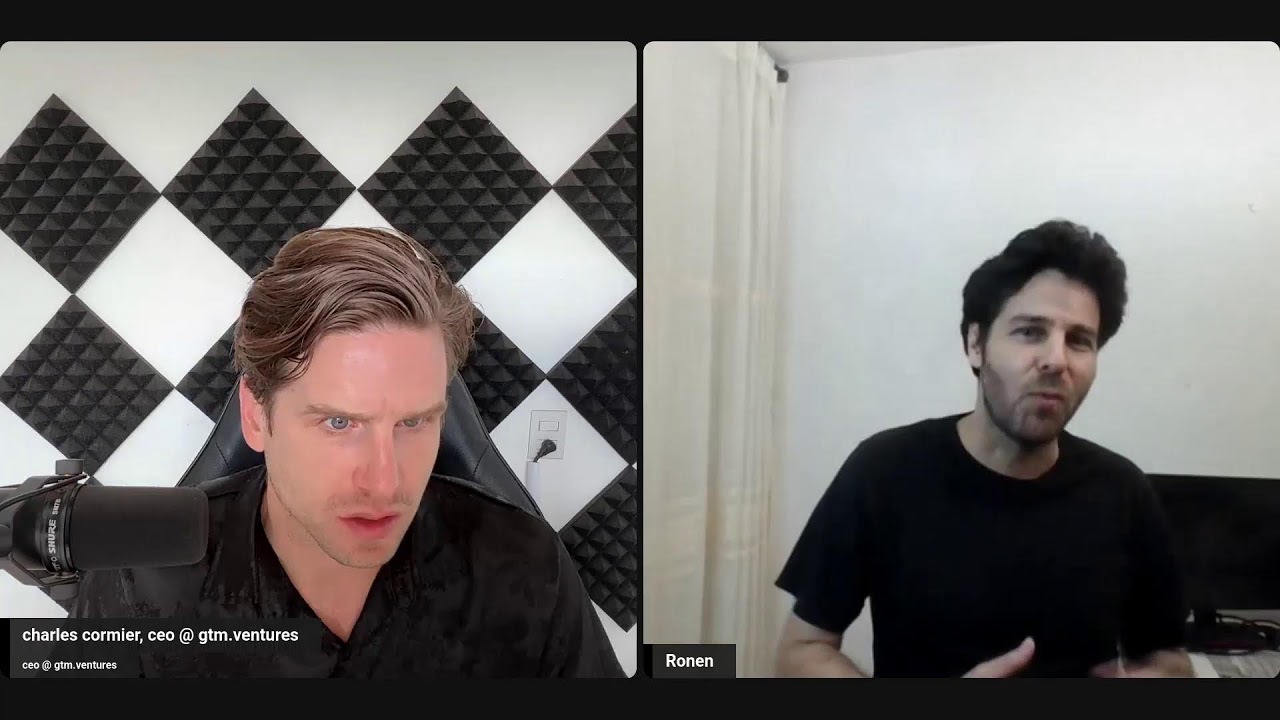
In this Founder Wisdom podcast, host Charles Cormier interviews Ronen Bar, a former investigative journalist and social entrepreneur who spent years undercover documenting cruelty in factory farms worldwide. Ronen explains how the majority of sentient beings in human societies are farmed animals and argues that reducing their suffering is a central moral imperative. He discusses the promise of alternative protein and the political, economic, and cultural obstacles that limit its adoption, noting both consumer preferences and regulatory push‑back. Transitioning to AI, Ronen describes how artificial intelligence can both exacerbate factory farming through precision livestock systems and offer breakthroughs such as decoding animal communication. He details his shift from animal advocacy to AI alignment research, motivated by the neglect of AI’s impact on animal welfare and the looming emergence of sentient digital beings. Ronen argues that all sentient entities—biological or silicon‑based—deserve rights and that humanity must develop a coexistence framework rather than a control paradigm. He outlines the strategic levers for reducing animal suffering (consumer choices, government policy, corporate commitments) and shares his current goals: advancing research on AI‑animal welfare intersections, promoting AI‑human coexistence, and scaling funding for animal‑rights initiatives. The conversation also touches on Israel’s AI scene, the risks of autonomous weapons, and the broader ethical challenges of a future where AI may become a new digital species.
Chapters
Welcome to another Founder Wisdom pod. We have Ronan Barr with us today. Ronan is an interesting guy, not my common podcast, right? He was the founder at Sentient, so has been in business, especially in the, I would guess, animal—
nonprofit.
Yeah, nonprofit and animal space, right? Animal rights. And right now he's an independent AI alignment researcher in Tel Aviv. So we're definitely gonna talk about interesting topics today. Animal rights, what happens to them before they reach your plate, and most importantly, in my opinion, right, like AI alignment and AI ethics, which I think should have a gigantic impact on humanity, positive and negative. So Ronen, welcome to the pod. Tell us a bit more about yourself and what you've been up to.
Thanks. Thanks for having me. I'm a social entrepreneur. Most of my career has been— I started as an investigative journalist doing investigations with hidden cameras only on human issues, human abuse, uh, later on animal issues. I worked undercover in slaughterhouses in Israel, in Australia, in other places, and documented usually for television what is happening to animals before, during, sometimes after they are slaughtered. And if you come to think about it, actually the majority of beings, feeling beings in our human society, are factory farm animals, actually, if you think about it. So I know most people see it maybe as a niche topic, you know, animal rights, animal advocacy, animal freedom, animal protection, whatever you call it. But if you think about it, it's really about trying to reduce most of the suffering in our human civilization. I'm not talking about what's happening in the wild. We can talk about that as well, in nature. That's also very very important, and protecting the majority, the silenced global majority of beings which have completely no rights, which are being terrorized in the most horrific ways one can even think about. Just to give a small example, when baby chicks are born into the meat industry— I call it the slaughter industry— they are debeaked. They cut their beaks They kill many of the chicks because they are a little bit small or deformed. They think they're not going to grow to be the fat animal that can be profitably slaughtered. And their bodies are being cut without anesthetics. They live in filthy, very cramped sheds. And these are things I saw in my own eyes and even had to do with my own hands as being part of this industry. So unfortunately, animal rights now, you know, is not a very, very popular topic which is— which hit the news, that's the top headline. But it should be. It should be because if you're coming, I think, from a very, I would say, childlike and simple attitude, which just says— I call it beinghood, you know, it's like brotherhood. Beinghood is for all beings. Everybody who feels something, everybody that there is something like to be him, I want him to be good. Whether it's a human, whether it's the bird in the sky, whether it's the pig in the factory farming. Pigs, by the way, are incredible beings. I got to meet some pigs outside of factory farms. I just want them to be good. That's it. And this childlike attitude brought me into working against factory farming and against the slaughter industry.
As a founder, I'm looking at this not so much from an emotional perspective because obviously it fucking sucks, you know, like when you think about that. But that doesn't lead anywhere. I mean, I'm not going to go protest in the streets as well. I don't think that'll lead anywhere. I look at it from a technical perspective and a food tech perspective. Food tech is huge in Israel. You also worked at a food tech and you also thought a lot about food tech and solving that problem from there. If we entrepreneurs create a product that is exactly similar, both from taste, texture, but also nutrient density as animal meat, then the problem is solved, right? Like, or am I naive in thinking this?
It's a bit naive, but, but, but generally speaking, I would say you're 40% right or 60% right. What I mean is, first, just a little bit about the definition of words. Entrepreneurship, I think, can be in many different levels. One of them is social change. So I started a nonprofit. The viewers can start a nonprofit for animals. That's entrepreneurship. And there is, uh, great entrepreneurship in the charity sector, in the nonprofit sector. But there is also, I think, great impact that can be done in the for-profit sector, of course. And some of that you mentioned, alternative protein. By the way, most of my promotion of this space of alternative protein was inside a nonprofit which is called the Modern Agriculture Foundation, uh, which is promoting alternative proteins and even started some companies, uh, that produce, uh, that research to make those products. Now, when you think about, generally speaking, I, I want to relate to what you were saying. If you can create a product which will be, uh, the same taste, the same, or better, the same price or better, uh, the same accessibility that we have in meat or better, I think it will solve most of the problems. Still, some people, uh, like meat or are even addicted to meat because of social status Even some researchers say that it's because it's domination over nature, because it's cruelty, because— but I don't think that's the main reason. I think the main reason is just the basic, um, you know, biological, uh, craving that many people have towards meat. The thing is, there are a lot of political, uh, agenda, uh, that comes into this. We don't live in some vacuum, you know. The technology that is most ethical and good also for humans, of course, for the environment, for wild animals, is being created. We live in a place where different factions and different forces are fighting against each other. And many— and, and today there is a big, uh, in some places backlash against all of this technology. For example, in some countries in the US, they banned the sale of cultured meat. Um, of course that makes no sense, but they did it. So this whole fight, uh, I would say against factory farming and for humane way of us living as humans, living ethically with our fellow friends, our cousins, uh, is not only a technological, technical problem. It's also a technical problem, but not less so. I would even say more so in a sense. It's a political problem, it's a moral problem, it's an ethical problem. And the technology doesn't live in an empty space. How much money will governments invest in this? How much legislation will put this forward. How much will the alternative protein industry get all the cuts and the benefits that the effective farming is getting? And these are huge, huge numbers. Uh, that's all very serious questions which could determine the path of alternative proteins, none less than the technical issues.
What has changed in the last years? You know, if you can give me a picture, I like— I love talking about progress. Um, As, as things change, you know, like as, as stuff gone more cruel, because there's been lots of press, you're not the only guy to have like filmed these, uh, atrocities and very poor living conditions, right? And it's also not everywhere in the world that this happens at that scale. Are there— is it like, oh, industrialized countries, uh, Western countries are treating animals in a more civilized way? And people are catching up? Like, what's the state of animal cruelty?
I think it's hard to say something definite. We did investigations also in countries like India and found great cruelty. I worked at a cattle station in Australia. Some of the worst things I saw were there. A calf that didn't get milk and died slowly in front of my eyes. They were just too cheap to give him milk. Kyle was his name. So it's hard to say something definite. Some places don't have factory farming, so the animals still don't have— it's, it's coming, unfortunately— so the animals are a bit better. On the other hand, sometimes you don't have any standards in these places, and they tie the animals with very short leashes and so on. I would generally say that in some developing countries, there are much less farmed animals per capita. because still they haven't— there is a connection between the socioeconomic status and how much meat people eat. So in India, still per capita, there are far less, at least land vertebrates, than in the States because they don't eat so much chicken. Uh, so that is better in these countries. But on an animal-to-animal basis, I think it's hard to say. Yes, some countries have it a bit better, like Switzerland, but when you look at factory farming from a zoom-out perspective, I wouldn't say these are Very, very dramatic differences overall.
Yeah. And who's doing the most, uh, for that cause in the world right now? And just to come back on the food tech stuff, right, like, are these companies doing the most when it comes to alleviating animal suffering, or is that not right? And there's nonprofits, or I don't know, very large industrial meat factories that are doing things right and alleviating animal suffering. Like, who's, who's accountable to alleviate the most suffering nowadays in the world?
Yeah, I would say generally who can alleviate suffering is of course the consumers, because they, they can choose and they can direct the government. They're not only consumers, they're also voters. Make this a political issue. I think that's the most important thing. The second part— so, so the first, let's say, is the, is the consumers, the people. The second is the government, which can legislate and change. And the third are the companies which can make commitments. For example, many companies around the world have made commitments to stop selling eggs from cages, battery cages. These are very small cages like the size of A4 paper to each hen. Each hen has the size of an A4, just white paper. It cannot even— they cannot even stretch their wings, it's so small. So many companies have committed and stopped and they are sourcing from Uh, chicken coops, which it's still cages, but it's one big cage and not very tiny small cages. So it's better. It's still very bad, but it's better. Um, so these are things. Now we need to understand that the politicians and the companies are not doing this because they care about animals. They care about profits. That's just like the definition of capitalism, right? It's even— you can even say that, uh, you know, it's the way that the system is built, and it's even their to an extent their legal obligation, right? They're obligated to their stakeholders. So the companies that are doing this good stuff, it's only because of pressure from the people, from political pressure, etc. So in the States, there are some companies who did some good stuff. In Europe, the— in Asia also, these are the main things, but it's only in very specific areas. It's only usually around battery cages, sometimes around chickens, uh, for meat. And now they're getting more to do stuff also for fish, which are the most numerous victims of this industry.
Yeah. And can AI help on that level from like getting the data perspective and making like meatless meat happen faster? Like, why have you pivoted towards AI researching nowadays?
So AI, I think, has tremendous, uh, repercussions. Of course, it's, it's, it's a very obvious thing to say, but it has tremendous implications. We only saw the beginning of it. How will the world look in 3 years, in 5 years, in 10 years, in 20 years? No one knows, but probably it's going to be completely different than what it is today. And the difference between the world today and the world 3 years ago It's going to be nothing between the difference of the world today and the world in 3 years if we get to, you know, for example, what the CEO of Anthropic, Dario Amodei, said, a country of geniuses in a data center that he thinks will come in 1 to 2 years, maybe even less. AI is changing everything, and when society changes, animal changes. We got to remember, animals are entrenched into our society and they are affected by everything. It's not only food, it's the way we drive, it's the way that we think, it's the natural resources that we use, which is another way of saying how much wild animals we kill, right? Uh, and all of this stuff. So, um, I think this is a huge opportunity and a huge risk. I will give an example. For example, there is, um, today they started to use AI to run factory farming. So the whole industrial revolution and the revolution of factory farming took out the human ingredient out of the equation almost completely, but not completely. Yeah, like you have today, like chicken coops with tens and even hundreds of thousands of animals and number of workers which you can count on one hand maybe. But AI can take even that away. On the one hand, maybe it can help some animals with detecting diseases, uh, with alarming when there is some problem On the other hand, usually when the industry sees that something like that happens, then they cram the animals more, then they use this to increase their profits, which usually come at the expense of the animals. So it can be good, it can be bad, it can be really bad. It's hard to say. And I think we as, as people who care about animals need to get ahead and start thinking, what are we doing with this topic, which is called precision livestock farming? It's using AI to control factory farming. AI can enable us to talk to animals. Some companies are working actually on that, decoding animal communication. If we can talk to whales, understand what they're saying and talk back, if we can talk to day-old chicks in a hatchery, um, some say it will create some kind of a revolution because it breaks this barrier, this distance between us and animals. Um, and there are many, many other ways that factory farming— that AI, sorry, can influence, um, can influence animals. And when you think about it from a global perspective, you can see the shift in the intelligence in the world from the dominant intelligence being the, uh, I call it HI, human superintelligence. We are a super— a biological superintelligence, by the way, a misaligned, I would say. superintelligence because we kind of, you know, destroyed everything which is not us and enslaved. Uh, and on the other hand, you have ASI, the, the, uh, the artificial superintelligence, which is getting stronger and stronger and stronger. And a lot of that superintelligence is going to determine the future of digital minds, of AIs themselves, which probably would be sentient in a few years. Some even say they already have some level of sentience, of animals, of humans. So these are all topics which I think overall are quite neglected. Uh, there is a great organization called Sentient Futures, uh, which are doing work on that, and also some other organizations, the Center for Reducing Suffering and some others. But overall, this topic deserves much more attention.
Right. Um, but why did you pivot from animal to AI stuff again? Like, did you feel that there wasn't enough traction in the animal space and that the stakes are higher with AI? Like, what was the, the moment that had you like decide to go into what you're doing right now?
It was mainly the neglectedness that I felt, that we as animal advocates were not thinking enough about AI, working enough to understand how the AGI world would look and what we should do and how we should change the way that we act in order to help animals in this new world. which the dominant forces are changing. It's not only humans controlling everything, the human species, it's humans and AIs. It was very neglected 2 years ago. Now it's less neglected, but still overall, I think that was the main reason.
Yeah. Israel on the AI scene, do you feel you're at a good spot in Israel to talk about AI? The epicenter of everything that's happening is in SF, right? Like, how does that modify your view of it?
I don't think Israel is especially an important country when it comes to AI safety, AI alignment, or anything like that. I think some other countries, of course the US, Europe, China, obviously are much more important in determining and leading the way into different, different things that they're doing. But still, Israel, as any other small country, I think can do some very important stuff. And we had a great Animal protection movement here, and we we still do. But it's it got let's say it's got a blow in the last few years with everything that's happening. But I feel now there is some new new spirit, some new wind. They say in Hebrew it doesn't translate well to English, but something something new is happening, and we feel it beginning to grow a little bit again. Yeah.
And Israel is like, right now there's a war going and there's talks about AIs and autonomous drones, right? Like, does that sort of take a lot of your attention, right? Like, I think that's where it sort of gets dangerous if drones can be like deployed in swarms and controlled by AI and scale by themselves, you know? Have you thought a lot about these things?
I'm not an expert on these things. I read a few investigations about it, about some use in Ukraine, about some use in Israel in AI and wars, but I don't know much about it apart from reading it. I do know that, for example, Anthropic, one of the things that they said, one of the reasons they had this fight with the US government was they said, we have only 2 red lines, only 2. One is you cannot use our models to to try to surveil our population, the US population. And the second is autonomous weapons. We know our morals. AI can't decide when to kill someone and when not to kill someone. This needs to be a human. So these are the 2 red lines that they gave to the government. And then the whole— they had the whole fight with the US government.
Okay. And what's your main concern about AI then if it's not like militarize the AI? Uh, what's— what is your main concern there, and do you think we're headed in the right direction?
So I have many concerns. One of them is that AI will be used, as I said, in factory farming to make factory farming even more, uh, scalable, even more cheaper, even more cruel than it is today. And this could well happen. If you look at history, most of the technologies were not good for animals. Actually, they were very bad. From the car, which is killing millions of animals every day in direct hits, we just don't notice it so much, uh, to, um, uh, to in, in a way also the internet, of course, to effective farming, the Industrial Revolution. Technology has not been kind to animals, to say the least. We have to make sure that this technology goes well. So effective farming is one thing. The other thing that I already mentioned is the good applications that AI can bring to our society. For example, understanding animals better, decoding their communication, uh, that could be something very big. Um, I'm also very worried about us as humanity creating, uh, creating enslaving, creating a digital species. AI, by the way, I like to call it— I don't like the term AI so much. I prefer to think about it as a new digital species. I'm very worried that we are enslaving a new kind of species after we enslaved the animals, you know, and will create a lot of suffering when AI will be sentient. And most experts think it will be sentient in just a matter of a few years or decades. That is a huge, huge suffering risk that we have in front of our hands. It may seem a little bit wacky to people, but I just want to say it's, it's, it's not wacky. The world is wacky. Look at what's happening around you. Speak, speak to your AI and think for yourself if, if that cannot be, um, the case. Of course, when we get to recursive self-improvement and to different architectures of artificial intelligence, and artificial intelligence that is creating the next artificial intelligence, or the digital species creating the next version of himself, no one can say if the next version will be sentient or not. Some researchers are saying that in current LLMs, because of binding problem and other arguments. I won't get into it. They cannot be sentient. I'm not sure that's true. Other researchers doubt that. Actually, some researchers even say there is like a 10 to 20% that current models have some level of sentience. But in any case, even if you believe for this reason or not that current models cannot be sentient, the current architecture, LLM, transformer, cannot be sentient, it doesn't mean anything because soon we'll have recursive self-improvement and the new digital species would be No one knows. So I think we have to take AI welfare very seriously. And just one other point about AI welfare. AI welfare, we have to take it seriously also for AI alignment and reducing AI risks, because there is nothing more dangerous than creating a new digital species which is suffering, and we are the reason for its suffering. We are the reason. We don't have as humanity a good track record of how we treat other beings which we control. And you know, if cows and chickens and pigs were smarter than humans generally, they probably would not be so kind to us, and rightly so. So we have to be very careful with AI not to make the same ethical mistakes that we made in the past. And also, if we do make those mistakes, it's gonna end very bad for us. If I can quote from— just, just to say one word about generally the future with AI, um, There is the researcher, AI researcher Roman Yampolsky, which says it very concisely and simply. He's not talking about animals, just about AI safety. He's saying, like, AI could kill everybody. So either everybody's dead or everybody wished they were dead. So being dead is not the worst scenario. There are much worse scenarios than that. So we have, I think, to reprogram our thinking. We have to reshift the way that we look at the world, because if all humanity is going to enter into the AI age, it's going to be catastrophic for animals, maybe for AIs, certainly for humans.
Do you think that AI should have rights if they're useful and beneficial for society?
I think that every sentient being should have rights, and I'm not discriminating against sentient beings on the, on the merits of how they look, what substrate they are built on. Is it silicon substrate? Is it a digital species? Is it a biological carbon-based species? These are all very foolish and childish— not childlike, childish— childish ways, I think, to discriminate between beings. I care about the subjective experience. That's what I care about. If they have experience, Definitely, no doubt they should have rights, and we should be very wary about their welfare.
Why do you think a lot of people are freaked out by that? It makes sense to me, by the way.
But I heard, I heard something interesting recently in some lecture I've been, and it goes something like this: the humanity has taken very like five very big. blows to our ego, you could say. One is that we discovered that not everything is around our planet, right? They used to think the sun rotates around Earth, everything around Earth. No, actually the Earth rotates around the sun. That's one. The second is we discovered we're actually animals. That's a blow. We're animals. We're not some unique, different than anybody, you know. We're animals. The third is that— and there were a few, I, I, I will only tell one and then I'll get to the final one. Uh, the third is that we have very little control of what we do and who we are. There is subconscious, which is much bigger than the conscious. We don't understand why we feel the way we feel. I have a thought now. Why did I have this thought? I'm completing the sentences now when I'm talking to you. Sometimes I think I'm also a, uh, uh, token— next token prediction machine. Why? How do I finish the sentence now? Why do I— why am I finishing the sentences the way that I have no idea. It just comes out of me. Our understanding of ourselves is so limited, so limited. So we understand we're smaller, smaller, smaller than we thought. And now we're gonna have another blow, which is that we understand we're not the smartest species on this planet. And that really kills some people. I mean, no, no, no, no, no. I gotta have that at least. You know, I can't handle the fact that someone's smarter than me. And I think giving rights is is is kind of Admitting, not that they're smarter, because rights is not about smartness, but it's admitting that we are just another animal, another species, another experience. We are another— I am just another experience in this world, and you are too, and the AI will be soon as well, or already is, just another experience. And accepting that there is something so— there is such a humility in accepting that, I think it's too much for some people.
Yeah, um, that's, uh, that's certainly something that needs to be talked more about. So what are your, uh, goals for this year? What do you want to accomplish as, uh, someone in nonprofits as well? What are your, your main ones?
I'm actually at the research stage still now, so I have a few, like, uh, 30 different options. I'm doing a weighted effect model, you know, I'm an Excel sheet or Google Sheets, uh, with all the options and thinking what's best. So I still don't know, depending on the option I will choose. I can very generally say that I think that coexistence with AI is something very important to promote and very neglected. Almost no one is talking about that. We need a vision for humanity which is not how do we control AI, because that's gonna end very bad for us, for us humans, because controlling is enslaving. We need a vision how do we coexist With these new species, it's better to think about it as aliens. There are aliens who came. They were born in this earth, but think about it as they came from the outside. AI is like alien intelligence. I think the historian Yuval Noah Harari said that. How do we coexist with them? Because they are very smart and they are getting very smarter by the day. We are not. I'm not getting smarter by the day. You are not getting smarter. Yes, we, we, we, we gain some information. That is, uh, I would even use the word that is pathetic compared to the way that AI is progressing. You know, they— AI could not solve math problems, easy math problems, 3 years ago. Today they are solving crazy problems which we cannot even— regular people cannot even understand. So AI is reprogramming itself, himself, or we are doing it with AI. That's a very big change. We are not doing that. We're staying with the same very very limited mind. Um, I forgot the question actually. What was it?
Remind me. Yeah, what's next for you? What's your next—
Oh, what's next for me? Yeah, so I think coexistence. Yeah, sorry. So coexistence is one, uh, very big thing I think to promote. And the other one is new endeavors in the animal welfare space. Uh, they're supposed to— new funding is supposed to come to the animal rights movement, a lot of new funding. There are going to be a lot of opportunities in this new AGI age which we are entering. to help animals. And I think we should scale very fast and very quickly and cultivate our efforts and our, I would say, movement's mind in the best way possible. And I have some specific ideas around that.
Got it. Well, thanks for being on, Ronen. Where can people find out more about you?
I have a website which is called alienjournalist.com. Just write alienjournalist.com and you'll find it. Or you can search me in the Effective Altruism Forum as well. Write Ronan Barr and you'll see also a link to my website and some things I wrote in the EA Forum and on LinkedIn, of course, and Twitter.
Okay, okay. Thanks for being on, Ronan. That was Ronan and Charles from Effective Altruism Forum.
More from Charles


Founder Wisdom: the audiobook, version 2 (5 hours of stories from founders and CEOs)

8 CEO Questions I Love Asking: the audiobook (64 founders answer, in their own words)





