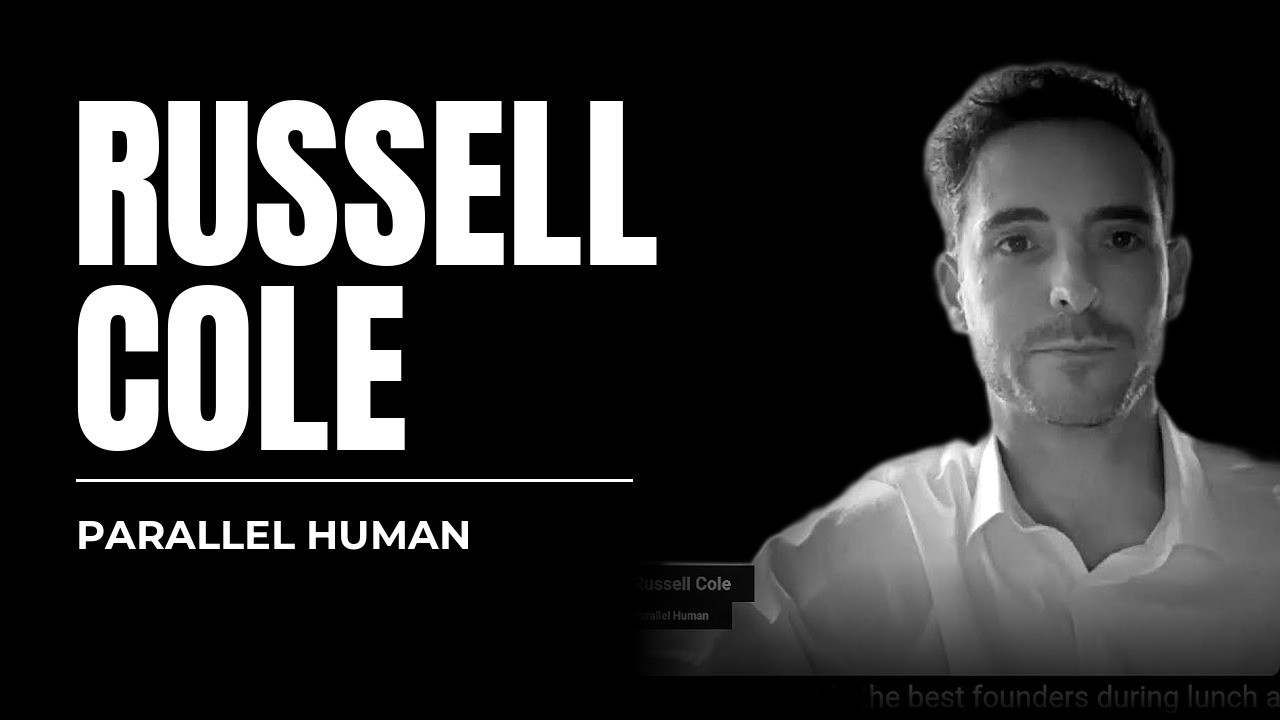
Russell Cole runs ParallelHuman.ai, launching 11 AI ventures in two months with $25-100k seed capital each to test what a solo founder can build. He practices "vibe coding," shipping a dog-groomer app in two days, and built Koya OS to engineer products with sales in mind from day one.
Chapters
Welcome to another CEOism podcast. We have Russell Cormier with us today. He's a startup advisor, board member, founder of multiple agtech ventures. He's an AI native operator and loves good conversation, which we're gonna have today in Toronto, Ontario, Canada. Russ, welcome to the pod. Tell us a bit more about yourself, what you've been up to.
Hi Charles, thank you for having me. Yes, it's, it's an exciting time. I'm actually up north in Washago, Ontario at the moment. And I've decided to turn my computer around so you can actually see what's behind me. It's really nice weather, even though there are the clouds from the fires up north. But overall, work has been really good. I think this year, actually just the last 2 months have been extremely life-changing for me, I think with AI and being able to start integrating AI into everything I do as a foundational practice. I'm really excited about it. I think the conversation will definitely focus on that, that AI piece quite a bit. And ultimately, it's just been a lot of hard work on a lot of ventures and creating a thesis that I've, I've really structured towards testing the limits of what one single founder can do. I've been an entrepreneur for 8, 9 years now, and I've always wanted to push myself as a solo founder. I, I had co-founders for one venture, uh, but the rest were solo founded. And I, I'm a multi-layered thinker, call it ADD, and, and always looking to, you know, create something. And that's my passion, right? So being able to create many things as a result of leveraging AI is, is where I think our society is today, whether people know it or like it or not. And I've built a really cool approach towards testing the thesis of how far one person can go.
I love it. Yeah, you said since 6 years, but I look at, uh, your first job here and it was owner at University Painting, uh, so technically you've been a founder for more than 22 years.
Yeah, I mean, I was born, uh, into a family that was very entrepreneurial. My parents ran Canada's largest IT trade show for over a decade, and I was always licking envelopes and, you know, saying hello to guest speakers, keynotes, and exhibitors on the floor when I was a really little kid. It was hosted at the Metro Toronto Convention Center and a huge, huge, you know, lift for my family, and I can only really appreciate it now as I'm older. But, um, yeah, that, that painting business was one of my first real businesses that I ran. It taught me a lot about how to get business, how to be perseverant, and how to manage people, sales teams, knock on doors, do projects, deal with complaints, uh, you know, fix problems and just always keep moving forward. But yeah, I've been an entrepreneur for a long time. I think I've always been— I've always struggled with the idea of wanting to be in the corporate world to make sure my parents felt I had a security net. I think a lot of parents want their children to be able to get a job, right? Just in the corporate world. But as soon as I realized I could do that and that it was available, I was just very motivated to become an entrepreneur again. So I've gone back and forth, and for the last 9 years, it's been pure entrepreneurship.
You're such an interesting combo, started in, uh, as an entrepreneur with entrepreneurial parents, got in sales, and then, uh, started Vesta AI, which looks quite technical. It's like building AI systems in 2017 when OpenAI didn't even exist, right? Um, so one could say you're almost like the full package, right? You also scaled the business to $45 mil a year. Tell us a bit more about that.
That was $45 MRR, monthly recurring revenue, uh, not million. That would just be— oh shit, that would just be a totally different life. But But no, and Vest AI, it's funny, um, just to straighten the record, Vest AI was, was the co-founded venture that I mentioned, uh, that pretty much convinced me not to enter co-founded ventures. Um, nothing against the co-founder, great guy, great aspirations, um, abilities on the tech front. I— it was my first real startup, my first real tech startup. Um, I really, I really enjoyed learning how to build a startup during that process of Vesta AI. Vesta, the mission it was on was to put a restaurant smart speaker on a table for any quick service restaurant or FSR, full service restaurant guest to order anything they wanted and to receive it in a timely fashion so that they didn't have to wait on a server and had a better experience. CirCorp, Jack Astor's invested. It really didn't succeed actually. The venture that succeeded and hit the $45K MRR was an AgTech venture back in 2022-23. We can chat about that some, sometime. But Vesta ultimately made some very big promises, and the technology co-founder side of the business, uh, couldn't develop what we really set out to develop. And like you mentioned, it— I would say no, nothing bad about the co-founder because AI really wasn't where it it is now then, um, we were building the, the foundational language models to, you know, erect that company. So what, you know, your OpenAI or Anthropic has now, we were trying to build that, right? Uh, the, the closest competitor to us would be called SoundHound. I'm not sure how they're doing now, but, but they were a great company doing some pretty cool things with restaurants at the time. Ultimately, that venture taught me a lot. And the main takeaway was I really need to learn how to code. I think, I think that was the biggest takeaway. And if I had a crystal ball, I would have seen my current self that now codes, right? Like Lightning. And everybody who can code, you know, similarly, that couldn't before, probably feels the same way. Like they can create anything and it's so exciting. I think that really, really, again, convinced me to be a solo founder after, but it still took many years after, you know, that was 2018 until 2025, call it, you know, a lot of learning, a lot of pain, a lot of loops to close because I couldn't develop. I was a sales business expert without the development side. And finally, and thankfully, and I'm so excited to say I can code and I've been building some amazing things.
So do you feel all-powerful now that you can deploy products and sell them at the same time? It's like full stack.
It is full stack, and it's amazing. And, and what I'll say is I'm still in the phase of realizing how much is actually possible. I think every day I continue to amaze myself, not with my abilities, right? I think my ability is just to research, investigate, and understand what's possible. But what's actually happening is my research is telling me that what I didn't think could be possible is possible. And I'll give you a really interesting example of this. AI tools today, they speak to developers or vibe coders or whatever you want to call it, non-classically trained developers to fully, you know, full-stack engineers. They still speak to you in a way that is conservative and in a way that makes you feel like something might actually take a long time. So if you're building— there was a challenge. I built a lot of web apps, right? Because I didn't realize I could just build native iOS and native Google Play apps, right? And not every situation calls for the native app, but I built several web apps to start my vibe coding life, right? This was maybe 2 months ago. And then about a week or two ago, I saw a post, uh, AI Builders on Instagram or something, uh, and, and he builds everything AI native, right? Or not AI native, obviously. He builds everything, um, app iOS native. And I just asked the question on his feed. I said, why, why are you doing this? Why not web apps? You know? And it got me thinking. The reason I was hesitant was because my own coding tools told me it was harder to build a native app, right? Which programmed me to believe that I couldn't do it quickly. And at that point, I didn't even need a response from AI Builders, the post I put up, um, or the reply I put up. But I just said to my agent, I went back to my, my Vibe Coding Studio, and I said, I know you're saying it's going to take months to do this, but let's do it right now. And I built a production web app that I'm delivering to dog groomers. It's— my partner is a dog groomer, so I've built her an app. And I built— I turned her production-grade web app that handles money, handles schedules, handles everything into a native iOS app in 2 days. And it just made me realize again, like, it's the only bottleneck that exists in life today when it comes to developing software-related solutions maybe not hardware, um, is you, right?
Yeah, it's ego. It's, uh, all the obstacles our evolutionary brain puts in front of us, right? Like, where most of our brains are just not made for, for scale, they invent all kinds of excuses, right? And push-cortisol in front of us instead of serotonin and dopamine. I also think, I think you're quite unique. I think most builders, they don't know how to sell, and that's a huge challenge. I think a trap nowadays is like building, building, building, and scope and feature creep, right? And, oh, I'm gonna deploy, or I'm gonna sell when, but most people don't know how to sell, right? So they, they code amazing apps that no one is using. And the sad thing is that if you don't have users, you're like building features for yourself. So you don't even build for scale. And I really think that, yeah, people should complement their vibe coding skills with selling, right? And just quizzing their users and building for them and outreaching to them. 'Cause else it's just, this is gonna build a very fancy app that no one's gonna use.
Yeah, and it's funny 'cause I think because of my sales background, the way I prompt AI, twofold. One of them, one fold is I will bake in the sales approach into the build. So I mentioned even if I'm building something as simple as an app for my partner that dog grooms and I wanna help her life, I built the app to an enterprise-grade level thinking of what an enterprise would require to say yes., right? I think I always have in my mind that whatever I do touch and whatever I build, I want to be able to sell to the highest authority and go as far as possible. I always build that structure, um, and I keep that in mind. But I also think, you know, I've realized that selling is difficult for people that don't know it, but once you really get in the swing of it and do it a few times, Um, it's not something scary. It's, it's just making sure that you can guarantee. All selling is, is making a promise and delivering on the promise, right?
Well, I would say even before selling, a promise is like— sounds being a doctor and asking questions and diagnosing a pain and then quantifying that pain. It's like, okay, uh, you can go by your own and try to fix your problem, but the cost of that, and 2, 3 weeks from now or 4 weeks from now is $40,000. That's what you wouldn't miss out, VS, like hiring me, right? Before it is like delivering on a promise. It's like the diagnosis first. What do you think?
Yeah, I would say a discovery and understanding pain points and all of that. Yeah, I guess I just gloss over it because it's my core DNA of how I look at things. And funny enough, I've built a whole studio to, encapsulate all of this personally. It's my own AI studio that I work from every day, and it's built to make sure that anything I build is built to the standard of being able to sell it, being able to understand the problem. And I can go on about that more later. It's, it's called Koya OS. I haven't launched it publicly for anybody else yet, but I, I've been using it. It's amazing, and I build it every day. It was my first AI project that is now holding all of my other AI ventures, um, as I said, to test how far I can go with AI and how many ventures I can build and etc. I think, I think it's, it's a lot of fun. But when, when you think about selling and asking those questions and understanding a user's experience, I think you get to, to really enjoy learning and then again get into that stage of being able to provide a proposal, provide a promise. Um, where I think it's difficult to sell in a lot of cases for a lot of companies and salespeople, and maybe not yourself because you seem to own the whole process, is when you have to work with other people who own parts of the process, right? Uh, so if you're working as a sales expert but you have a solution engineer that you bring into the sales conversation to talk to the technical people on the team and to architect a solution, which you as a salesperson have to make sure is, is good. You're now all of a sudden responsible for other people in the sales process. So I think that's the, the, the other take on sales is you're only as good as, as like the deliverable. And that, that's really what the weakest link, or the weakest link.
Um, so does that mean, uh, I mean, you're bullish on solo building, right? And just you and your army of agents that the business of the future? And is the one-man billion-dollar company far-fetched, or is it something that's happening?
Yeah, I'm not, I'm not focusing on a billion-dollar company. Um, at least I could. I mean, I haven't really defined the amount of money the Venture's value will become. What I'm focused on is taking a new look and a new approach to venture capital with respect to AI charged founders. Uh, I am Study Zero. I'm building what's called Parallel Human, parallelhuman.ai. And Parallel Human, uh, it essentially allows a founder to start many concurrent businesses rapidly, 5 to 10 of them, that an investor can invest very little money into, let's say $25,000 to $100,000, instead of your typical $500,000 to $1 million pre-seed or seed round. And you'll get just as far or further with your several smaller ventures with less money. This is the thesis, uh, than you would have if you just focused on one venture with one lead investor and a few other angel checks. I think that's something that I'm, I'm proving right now. So, so I think, you know, my first— I have 11 ventures that I've spun up in the last 2 months. Uh, some of them are B2C, some of them are B2B. And again, I'm doing all this to test my limits. I'm working harder than most people probably would, but the efforts I'm, I'm producing right now are going to lead to ending up bringing another founder person who has similar DNA and wants to create several companies at once in order to then create investability within many of those ventures. So of the 11 I'm building, I might have 3, you know, that become investible, right?
I'm running that machine as well, but from a pretty different angle. One, I don't do B2C, right? Like, I think B2C is doomed on so many angles. Um, and I have a cold email system that you're being part of right now that, um, helps me get ICPs to some of my proven, um, business models, right? So I start businesses incredibly rapidly and I test them out through just talking with 10, 15 ICPs of mine. The thing with me is my ICP doesn't change, right? It's always like founders and CEOs or investors, right? Why? Because that's who I know and I think humans are incredibly complex to understand and I'm one of these myself, right? CEO, founder, and investor, so. I just like know what these folks want. I already have them in my community and I speak to them in real time, um, and that grants me like a success rate that is way higher. What, what do you think about that model vs yours?
Oh, it's, it's great. No, and that's why I'm just testing my model. I think it's tried, tested, and true. What you're doing is to triple, quadruple down on what your niche is, right, and picking that niche and running with it.
Or building products for them, right? Like, I know them, I know what they're gonna like, and my chances of success are, are way higher. Plus I can self-fund with my cash cows. I have some agencies in there, I have some SaaS that are not cash cows, right? They take money and they're more risky.
Um, but yeah, I think it's a great approach. I think it's, it's what I would be doing if I wasn't just excited by seeing how much one human can really accomplish. And the 11 ventures I mentioned right now for me are scattered. So I actually have the same opinion. I want, when I bring this to the next step and the next founder that comes into the system, I want each founder to focus on one niche segment, right? And build either only B2C apps, which I appreciate you think they're dead and that's fine, or one segment of B2B, whether it's fintech or health tech or prop tech or whatnot. And being able to, to do all that. But, but what, what I think is key and what I think is, is the unlock to success— so you're, you're kind of already past the unlock to success. You know what you need to do. You're doubling, tripling down, and you're just moving and you're enjoying it. And that's great. That's fueling you. A lot of people might not be fueled for as long as you have been as well. I don't know, everybody's different. What I think is really interesting is the recipe. It's discovering the recipe for success. And so your recipe is yours, right? The way I look at my recipe of success, at least from where— however I've gained success, has always been, uh, there's an age-old debate of building a solution for a problem that exists or building a solution to find problems, right? And you're shaking your head because you know which one's better.
Uh, but I, I shook my head, but then I was like, Facebook Right? It's like, sure, Facebook didn't solve any immediate problem, they— but they're still a multi-billion dollar behemoth, right, that created something out of nothing.
So I would say that's, that's debatable. I'll say that Facebook's debatable, probably another whole podcast segment. I think you can just research a few things on Facebook and how it was started. I mean, yes, in a dorm room, yes, whatnot.
But yeah, and I study— I have like triple PhD in Facebook story, but one could argue that like Dorm room culture was already through the roof, right? Um, and then Mark just like did FaceMash and then, uh, the Facebook, uh, his college strategy was genius, by the way. I think his GTM system is truly what got them there. But Mark was also a beast while he was shipping code, uh, uh, 20x, 30x, while no one was, uh, even thinking of, uh, building social media now in these days. But And yeah, to the B2C thing, I'm not saying it's that, it's just like the competition, plus I won't build products for people I don't understand. I still have a hard time to understand normal human beings, right? Like most people cruising in a 9-to-5 job and somewhat knowing that AI will completely obliterate most 99% jobs in like 5, 10 years. By the way, I'd love to hear your opinion on that, but just, I have a hard time, I won't try to understand people that are not understandable to me.
Me.
So, um, and it fits my values as well. It's like who I am, it's what I'm building. It's an ecosystem of founders, investors, CEOs, which I think are in charge of the world. We're building businesses, we're putting products out there. So I, it's like it checks all my boxes.
Yeah, I would say I appreciate that for sure. It's, it's, um, it's a journey, I feel. What was the exact question you had though, if jobs will, will—
yeah, the, the AI questions. Like obliterate jobs, you know. Like, I've heard opinions on this podcast, uh, very few are willing to, to take the, the other side, you know. Like, the, the people call it the Doomer side. I don't call it Doomer because I'm not like a Doomer. I'm pretty much of an optimist when you talk to me, but I'm also a real realist. I'm a scientist, uh, the guy that speaks to a lot of people and, it's— and speak to very smart people, and it's just, I, I can't wrap my mind to a future in which, like, most human jobs still exist. Um, this— it doesn't make any sense. When you've seen it, you know, you can't unsee it. And I've been on that thesis for, what, 6, 7 years now? I'm from Montreal, right? From, uh, Yoshua Bengio is from here. From there, you're You do some work in Toronto, right? Geoffrey Hinton. I've been studying this phenomenon for a lot of time, and it's just like we're creating something way smarter, way more powerful, way like better than us on pretty much all levels, right? Then we're still denying mostly because of our human ego that jobs will stay the same. So anyway, what's your take on it?
I think it's a really large discussion, and the, the conclusion I have is if you just look at the past history of things evolving and each revolution or evolution of our society and existence from thousands of years ago to hundreds of years ago with the Industrial Revolution, things changed very similarly. I'm not saying in the same pace, at the same pace. I think the pace is going to accelerate, but at the end of the day, my— I'm very optimistic. I think the way the human species will continue to exist is going to be to adapt to the current status of AI, digital transformation. We're talking about 80% of the world. Of course, there's 20% that will still live in a different era, age, right? But I think, I think what we'll see is a lot of people adapt and find new opportunities within the new system that's being built. And A lot of people are just scared right now because it's very new and unknown, but the more people like yourself and like myself and anybody who touches AI and talks to someone else about what it can do, um, continues to use it and even evolve it— like, it's, it's has a long way to go. I see a future where I'm currently building apps today that take a week or a few days or a month or whatnot, which is way faster than most people could have done before, but it's going to be instant. It's everything, the template, everything's just going to be instant. We're all going to be able to just rapidly do what we need to do. Imagine a world where that's possible and what jobs— like, we're asking what jobs are going to exist, you know, with what we have today. Imagine you can just create something magnificent within a minute without humans. Without humans? No, I mean, there's taste, without employees, there's taste, and there's always, uh, aesthetic, and there's always, um, going to be something that if a human wants to use something, they'll need to have some input, right? Because their desires matter.
Yeah, guys like you and I, but that's the 1%. What happens to 99%?
I think our whole society is going to shift to a different business model, a different working model. I think we're going to focus—
that's why I'm saying like most jobs won't exist, you know, like it will be 1%ers financing the 99% of people that frankly don't want to work. If you ask any human, they just don't. They'd rather be chilling, you know.
Yeah.
And I would rather look at retirees. Look at retirees, right?
I would rather do this.
Yeah. I would never retire. You would not either. It's fun to work. We've engineered something fundamentally interesting, but most people just want to chill, you know.
They want to watch TV and be entertained and We're fortunately part of a really beautiful phase and time of our human existence. I will, I will comment though on that note of how things are changing so much and jobs are going to change, but the focus of taking care of people is always going to be there, and it's going to be debated and it's going to be contested, and lots of different things will change and evolve. People will need to be taken care of whether they want to work, whether they work or not. And something that I should mention as well, in, in, I'd say all of the work I do, about 30% of the ventures I've created are focused on human, human flourishing. Human flourishing is a great way to put it. The, the focus I have is on helping my small community that I live in. It's a township called Romera Township, and all I'm doing is building tools. And then again, 30% of my venture activity goes towards helping my community. And the reason I'm doing this is because I want to figure out how AI and tools can actually help small communities today so we can learn and scale that understanding to other small communities and other mid-sized communities and other global communities, whatever they may be. The enjoyment I get out of that is second to none. I actually really love helping this small community. And I'll say this, It's similar to a developer trying to solve a large problem. And like you mentioned Zuckerberg's GTM strategy, just the idea of finding a very small test bed so that you can build something in a production environment, but actually in a small, small, safe contained space. I'm taking that same approach to building assistance for people, if you will, helping people. There's a company, I'll just plug it, it's called Ramera. Helps.ca. Uh, it's not live yet. The domain's been purchased and I've built the entire platform. I just have to test it and launch it. And this has been the last few days, literally. Um, it's to help people in the community who are seeking help find the help, and to help people who want to help give the help in small communities. Because I think a lot of the bigger cities we live in have a lot of those services. They're, they're already there. Smaller communities don't. And the world is facing a lot of challenges in small communities. So the community I live in, which is small, is now going to get that luxury. And you— and I'm using this community as a test bed to build this service for other small communities in the future as well. And I love it. I think it's, it's really exciting. I, I have no real interest in even thinking about monetization on these ventures for my community. Um, I think if that comes, great. If advertising happens, if somebody wants to donate, who knows? I don't care to think about it. The only North Star is to help somebody, right, in, in this community. I think, I think it's really exciting, and I think that's why I've decided to put 30% of my time towards it.
I love it. I'm just gonna challenge one aspect. In the capitalist age, building something without financial accountability, aka payment mechanism, is very dangerous, my opinion. Uh, the antithesis of scale. Um, Why not have them pay and have them, uh, put skin in the game for their own success?
Yeah, it's a good question. I mean, it's been a few days that I've been building it. If, if it turns out that people will be able to have better outcomes if there's a paid mechanism, then so be it, and that's something to explore at the time. For now, I think the community that I live in has a lot of different demographics. Some people just can't afford to pay anything, they're struggling, and then some people can. So there is the conversation of if the people who can afford to help can contribute either donations or pay for things so that the people who can't can get the help they still need. Like, I live in a community where there's no cell service in certain pockets, right? And you have some 60 to 100-year-old people living in these pockets who have no access to help, right? So if you just boil it down to that, I just want to help those people. And yes, so I appreciate that if you don't charge money, it's like the antithesis of scaling. But for now, I think it's about rallying the people of the community, getting people excited about what's happening, and being able to have a healthy population of people who are interested in helping and a healthy population of people who are interested in seeking for help and finding that resource. And accessing that resource is really all I care about, number one. But yes, getting back to the plan would be, uh, it would be silly not to look at the opportunity to integrate some financial mechanism if it will improve it.
Yeah, I love it, dude. Where can people find out more about you?
You can find me on LinkedIn. It's funny, my profile is pretty sparse, um, like in terms of what Russell C. Russell C. My last name is Cole. Um, parallelhuman.ai, you can see all the ventures that I'm building. You can see the thesis that I've put forward in terms of, in terms of pushing one person, one founder to the limits. I really want to help the investor community as well understand what's possible. I think there's a huge disconnect in the investor community, in the consulting community, in the business community with what people should really expect now that AI is, is where it is. People are taking a lot of time to catch up to it. So parallelhuman.ai is probably the best place to find and encompass you know, package of what I'm up to.
I was Russell and Charles for another
More from Charles


Founder Wisdom: the audiobook, version 2 (5 hours of stories from founders and CEOs)

8 CEO Questions I Love Asking: the audiobook (64 founders answer, in their own words)





