Russell Lazaruk - Managing Director at NCP Capital Partners
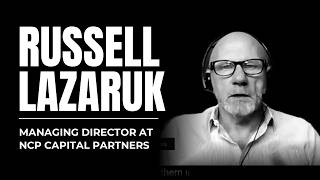
In this Family Office Wisdom podcast episode, host Charles Cormier interviews Russell Lazaruk, Managing Director and Portfolio Manager at NCP Capital Partners (NCP). Russell outlines his unconventional background—five years in the British Army, farming on Salt Spring Island, and work in the forestry sector—before entering finance in the early 1990s, progressing through Fortune Financial, Scotia McLeod, and Macquarie before taking an equity stake in NCP. He explains NCP’s origins as a single‑family office serving a quiet, multi‑generational Canadian/European family and its current transition toward a multi‑family office to spread costs and broaden services. The conversation covers how NCP builds trust with ultra‑high‑net‑worth families (primarily through referrals, long sales cycles, and demonstrating competence via a private‑equity limited‑partnership model and an options‑heavy absolute‑return public‑market strategy). Russell discusses portfolio construction, emphasizing a quant‑amental approach, global public‑market diversification, and a private‑equity focus on “electrification of everything” (manufacturing wear parts and power transformers). He notes technology and machine‑learning tools boost productivity, but he does not foresee full AI replacement of portfolio managers. The episode also touches on Canadian family‑wealth trends—residency‑based taxation, the appeal of Canada as a safe‑haven, and differing mobility of tech‑derived versus resource‑derived fortunes. Russell clarifies that NCP does not provide tax preparation directly but collaborates with clients’ tax advisors. Finally, he shares contact information (ncpdfo.com, rlaruk@ncpim.com) and mentions a weekly insights page on LinkedIn.
Chapters
Welcome to another Family Office Wisdom podcast. We have Russell Lazaruk with us today. He's a managing director, wealth management and portfolio manager at NCP Capital Partners in British Columbia. So Russ, welcome to the podcast. Tell us a bit more about yourself and what you've been up to.
Okay, thanks Charles. Um, happy to be here and thanks very much for the invitation. I'll just give you a bit of a background on NCP and then myself. So NCP's origins are as a single-family office. Our principal family is split between Canada and Europe. We take care of the Canadian side. We're on generation 4 and 5. That's about all the information I'll give you on our principal family. They are very, very quiet. And, but as you can tell on generation 4 and 5, they've been careful stewards of family wealth. Myself, I've been in the investment business since the end of '91, beginning of '92, starting off with a, actually a national financial planning firm in Canada, Fortune Financial, which has since been absorbed by a number of other firms. And was there for a few years, moved to Scotia McLeod as an investment advisor there. And then left there in— and while I was there, I was a branch manager, worked in the private client group. So I had a pretty good run there and left there to join Macquarie when Macquarie was in Canada. For those that don't know, Macquarie was a, or is a major investment bank out of Australia, which was a really good experience. I had a really good time working for Macquarie. Once they left Canada, we got bought and sold a few times. I got a little bit tired of working for somebody else, so started looking and had the opportunity to take an equity stake in NCP, where I am now. Before that, before the investment business, I had a bit of a varied career. I left Canada and joined the British Army for 5 years. I had a farm on Salt Spring Island. For those that don't know, it's in the Gulf Islands off the coast of British Columbia. Did that for 11 or 12 years. Spent 11 or 12 years up in the Comox Valley. Spent some time in the forest industry. So the varied background, I thought, for wealth management actually gave me a pretty good, some good insights to people. And because wealth management, whether it's a family office or whether it's retail wealth management, at the end of the day, it's a people business. The technical skills you can learn, you go to school and learn those. The people skills are really learned by life experience.
And why the army and farmer and forestry industry turnaround? Like, what justified that? You were just Tired of like, I don't know, finance and office work, needed some fresh air?
Well, those, those all predated, uh, predated finance. So, um, I joined the Army right at, uh, almost right, right out of high school. I, uh, I finished grade 12 here in Victoria, um, went to our community college for a semester, and then myself and 4 friends decided that, uh, we wanted some adventure in our lives. Uh, we actually went to join the Royal Navy, Uh, but the Navy said it was going to take 6 months to get in, um, which when you're just 18 years old is a lifetime. Um, so next day we went down to the Army Recruiting Center on the Strand in London, and 6 days later, uh, I was in basic training.
And how did that shape your mind? That teach you discipline? Like, uh, did you get your dose of adventure?
Definitely got my dose of adventure. Um, Discipline for sure, and discipline in, you know, certainly my experience was discipline was self-imposed as much as it came down from above. It also taught you teamwork. My first regiment unit was armoured reconnaissance, so you were always working in teams. I did some other stuff as well, but it was all very much team-based. You had, whether you were a trooper or an officer, you had to, you had to work as a team, take initiative, pay attention, because, you know, the rest, the rest of your team was always dependent upon you.
And how does that transcend in your works nowadays, the sense of adventure, right? You said like the the human skills, the human touch. Um, tell us a bit more about like the families you manage, uh, the money for, like how you find them and what's, what's so passionate about like having their cash grow. Because I could think of more exciting and more adventurous stuff than managing other people's money.
Um, well, the markets are always exciting, as we know that. Um, but it's, it's the intellectual challenge. You know, the old saying of, you know, if you've seen one family office, you've seen one family office, is absolutely true. They all function, function differently. Our journey at NCP, although our roots are as a single-family office, you know, we are working to grow, to grow it out to be, to be a multi-family office. Part of the reason behind that is just to spread the costs amongst a wider base. Everybody gets a better deal at the end of the day. But it is the intellectual challenge, taking the soft skills that you learn about dealing with people and managing people, understanding them, understanding goals, understanding their motivations, and then molding that into a portfolio that will meet those goals. And part of that is technical, understanding the markets, understanding how to analyze proper portfolio construction, all those things and how it melts together. So that is where the challenge comes from. When I'm looking for more adventure, I'll go back on the rugby pitch 'cause I still play rugby. So if I wanna get knocked about a bit, I'll go play rugby and, You know, I've been doing some triathlons in the last few years. So I get my, I get to expend my desire for physical energy out there.
Yeah. Right. And was the Army intellectually stimulating or mostly on the physical side of things?
I wouldn't, my last role, which I won't get into, was more intellectually stimulating. For the most part, I mean, you learned. I mean, you certainly learned your technical skills and that, but I wouldn't say that it was overly, you know, certainly in the armoured reconnaissance, it wasn't overly intellectually stimulating.
And tell me, like, the family fortunes that you manage, like, what are their incentives to go to you, right? Like, most of these families already have someone to manage their money, so how do you get them to actually trust you and have you manage their, their well-earned money? Like, that seems to be a gigantic challenge, seems like a very long sales cycle to get these, uh, new clients in. Do you have like marketing or sales funnel for that, or do you purely operate on referrals?
Uh, referrals is a lot of it. Uh, part of it is, is networking. Um, you are right, you're absolutely correct, it is a long sales cycle. Uh, you have to earn trust. Um, we probably do it a couple, couple different ways of, um, and this is kind of an anathema on, on when you're doing retail wealth management here. I'll manage a small portion of your money money and show you how good I am. That's kind of a loser's game on retail wealth management. On the family office side, I mean, it really does take time, time to build the trust because, I mean, it is a significant investment that the family will make in you to, to, um, to, to manage their, their wealth and any, any of the other services that you offer. So a lot of our work comes from, we will manage this one part of your portfolio. So we have probably two ways that we do that. One, we run a private equity business where we create a limited partnership around each individual company or silo that we're going to invest in. And then the other side is on the public markets where our CEO runs an absolute return strategy that's very options heavy. It's unique. It's done well. So, demonstrating our competency and building that level of trust and empathy and communication between the families, that gives us an opportunity over a period of time to do that without them taking on a whole bunch of risk. And, you know, because they know their money's going to be managed, managed, and they hope they hope managed well. And certainly the experience has been that we've done a good job of managing those parts of their wealth. And then over time build up that relationship.
And these families, how many families can you handle as one portfolio manager? Is it like 5 at most, or you don't have a cap?
We've never set a cap, but But I think that there is one. You know, it depends on the complexity of the family and the level of wealth. I would say if you are giving true family office service at the level that we are right now with the staffing that we have, our limit would be probably 10. But then of course, to get past that, you would scale up on your staffing. Technology is certainly helping a lot with how you service your client families. You know, the whole expand— I mean, AI, I think, is an overused term. I could get pedantic here and say we don't have AI, we have really good machine learning. But be that as it may, those tools are true— what we're finding to be good productivity enhancers, which is increasing our ability to deliver good services to clients in a timely, timely fashion.
And in your profession, how do you specifically use AI? And do you feel that eventually portfolio managers will be like fully replaced by AI agents managing trades and transactions?
I don't think they'll ever be fully replaced, but certainly a lot of the grunt work will be taken care of. I mean, we tend to be more of a quant shop. On the public markets anyways. So we run, you know, we would call quantamental, you know, we're looking at the basically the numbers of the fundamental analysis to run screens and build our model portfolios from there. And so AI just speeds up that process. It allows us to test some of our theses as well by going back in and re-questioning it. So really, it's a case of being able to do more with fewer people, which is good and bad, but it's really about enhancing the process and speeding the process up.
In Canada, what is the status of wealthy families? Are most families staying there? Is there an exodus? Uh, are there new fortunes in specific spaces being created? How's, uh, the, the family wealth market in Canada?
I think part of that depends where the wealth came from. Um, I think that those that have made their wealth in the new industries and technology predominantly are probably a little bit more footloose and willing to look further afield. Those that have built their wealth on real estate, resources, I think they're a little bit more anchored, especially if it's real estate-based. The flip side of that is that Canada is also, for foreign investors, Canada is seen as a safe haven. Good rule of law, stable currency, AAA rating on our sovereign debt. So it's actually, you know, from people outside of Canada looking in, they say, no, that's a good place to be based. Taxes always play play into it and are often a motivation for people to move offshore and move their residency. Canada bases taxation— is based upon residency as opposed to, say, the US where it's based on citizenship. So if you're a US citizen and you move offshore, you're still going to have to pay US taxes. Canadian citizen moves to Cayman, BVI, wherever, if they've truly severed their ties to Canada, they can retain their citizenship but severed their ties, their residency, then they will not be eligible or not be required to pay Canadian taxes. So that, you know, the tax thing always played plays into it. The other thing that plays into it, of course, is sunnier climbs.
Yeah, that's a pretty good one that I personally subscribe to for sure. You also help your clients with taxes. Is that part of the service you offer, or—
We don't do the taxes ourselves. That's not within our area of expertise, but we will work with our clients, tax advisors, both on the accounting tax side and the legal tax side.
And on the portfolio side of things, is it mostly Canadian businesses, or do you look internationally?
On the public market side, we are very much globally focused. Our portfolios are absolutely global. Canada is a small part of the world's economy. That's not to say there aren't good companies to invest in Canada. On the private equity side, we— so to date, we've been predominantly Canadian-focused. Our private equity team, which is actually based in Quebec, has a good pipeline and a good network there, and that's where we've found most of our success. Although one of our private equity companies has, since we acquired it, has expanded down to the US, Texas in particular. And so we're not, we're not married to Canada on the private equity side, but it's just where we found our expertise and where we have found, found an opportunity to date.
Now, they're diversified, the actual portfolio, right? Is it mostly real estate, stock market? What about like tech investments? You touch those? Like, give me an idea of a portfolio you would manage for Excellent.
Okay, so on the— if we divide it between the public and private markets, the public market side will be broadly diversified. There will be fixed income. We'll have some alternative strategies in there that we don't manage ourselves, you know, long-short or arbitrage or things along those natures. But the core portfolio itself will be broadly diversified, so we'll have all sectors. Real estate depends on the particular family that we're working with. Our principal family is probably overallocated, but they're on generation 4 and 5, so it's accumulated over a century. So we don't need to add anything there. On the private equity side, our Current emphasis has been on manufacturing companies, and one is a wear parts manufacturing company based out of Quebec, and the other manufactures power transformers. And that fits into a theme that we've developed internally that basically what we refer to as the electrification of everything. When you look at, you know, looking from a Canadian perspective, the Prime Minister has announced a strategy to expand the grid by 100%, I believe it is, plus do the cross-border interprovincial ties. When you look at, you know, the rise of AI and the need for data centers, need for electrification there, the move globally from fossil fuels to electricity. We see this probably most predominantly in China, but we are seeing it in Europe as well. North America is a bit of an outlier because we are fossil fuel independent. They know we're a net exporter as a continent, but the rest of the world is certainly moving to electrification and renewables. As opposed to fossil fuels. So we see that as an ongoing trend. So it's an area that we are very interested in at this time. Probably just stepping back a little bit, I should explain how we approach private equity. As I said, we're the GP, we create an LP around each company that we buy, but our strategy is, you know, short, buy and build. So we will buy an initial company and do the usual things— good management in place, property capitalized, don't over-leverage— and then we'll grow the company organically. But then we start looking for merger candidates. And the wear parts company that we, that we run, Solurock, we have merged— I think we've merged 6 other companies into it so far. So it's doing quite well. The transformer manufacturing company that we purchased a few years ago, so far we haven't found— because our strategy would have been, or is, if we can find complementary companies that— this company manufactures transformers, but this one develops power management systems, switches, whatever it is, whatever ties into that value chain, then we buy, merge in, and build it that way. But so far, we haven't found anything that would be non-dilutive to the earnings of the company that we own. So, you know, it's picking through, making sure that you're making the right acquisitions and merging the right companies in.
Do most family offices actually get into acquisitions and mergers like this?
No, I, I think most family offices, um, go the, uh, go the fund route. Um, we happen to have the expertise internally that we can do it, do it ourselves. Um, we're very much prefer to go the direct route where we can. It reduces costs. It actually gives us, gives more accountability internally to us that we manage these things well. Our CEO, my partner Grant, is loath to ever have to apologize for somebody else's mistakes. If there's going to be mistakes, we'll wear it, but we don't have to apologize for somebody else's. And fees, fees play into it as well. You know, because we have the expertise that we can do this, we'd rather do that internally rather than be paying fees to another manager.
Love it, Russ. Let's do a round 2 sometime soon. Where can people find out more about you and the company?
Okay, you can find us on our website. Just look up NCP Digital Family Office. The website is ncpdfo.com, and you'll find us there. We have an insights page which we update every, every week because I publish it every week on, on LinkedIn. If people want to get in touch with me directly, they can drop me an email, rlaruk@ncpim.com.
That was Russ and Charles
More from Charles


Founder Wisdom: the audiobook, version 2 (5 hours of stories from founders and CEOs)

8 CEO Questions I Love Asking: the audiobook (64 founders answer, in their own words)





