Ryan Carrier, Founder at ForHumanity
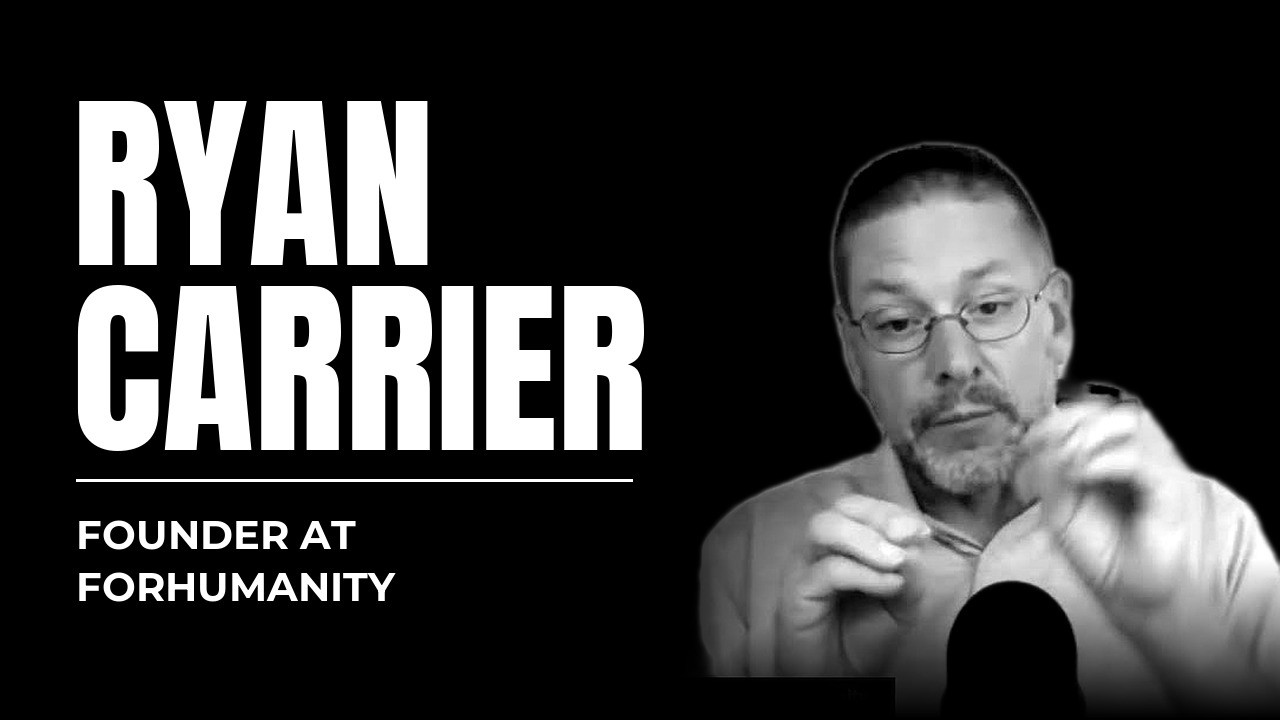
Ryan Carrier left a 25-year finance career at the World Bank and S&P to start ForHumanity, a nonprofit tackling AI governance. He wants to apply financial audit standards to AI systems, making regulations like the EU AI Act actually implementable. Real job losses at JP Morgan show the stakes are already here.
Chapters
Welcome to another Founder Wisdom podcast. We have Ryan Carrier with us today. Ryan is a founder CEO at a special organization called For Humanity. So, Ryan, if I remember well your background, you had your own hedge fund. You were at World Bank Group, something like that, right? And yep, one day in 2016, you were like, oh, humanity is sort of in trouble, uh, need to do something about it. So that was in 2016. Tell us a bit more about yourself and, uh, yeah, 4Humanity.
Yeah, happy to do so. So it was a 25-year finance career, like you mentioned— World Bank, Standard& Poor's. I ran a trading desk on Wall Street, and then finally a hedge fund. Um, the hedge fund was something I survived but didn't thrive at, and so that gave me some time in 2016. We had built AI to help us manage money So I knew AI, had a little time on my hands, but most importantly, Charles, I have 2 boys and they were 4 and 6 years old in 2016. And if you remember 2016, we had Cambridge Analytica, we had Microsoft's Tay bot go rogue, and essentially what I saw or maybe even felt was a world that was going to dominate my children's future through artificial intelligence, autonomous systems, agentic systems, But with no governance, no oversight, no accountability. That's not a hallmark of where the tech industry has come from. And so when I projected that out into their future, I got scared. Scared enough that I started a nonprofit public charity with no money and no plan, just the mission statement. And so For Humanity's mission statement is we're going to examine and analyze the downside risks of these tools, but we're not anti-technology in any way. We just want to mitigate those risks as best as possible. And if we can mitigate those risks, then we can maximize the benefit of those tools for humanity. And that's where the name came from.
Start with the basics. So some people get scared by AI and don't do anything about it. They complain on social media. Some others, like Elon, freak the fuck out and start their own companies, right? Like, why did you decide to start a nonprofit? Why is that the best path? to saving your children's future?
Uh, the idea was, um, to— well, so when I started it not having a plan, I wrote a lot of words about like the future of work, technological unemployment, rights and freedoms in the Fourth Industrial Revolution. So I didn't see a business plan around those tools. And it wasn't until June of 2017 that I, that I identified what I think is really the core problem, which is an insufficient trust mechanism around these tools. And so look, auditing AI has been around for decades. For Humanity had no part of that. I had no part of that, okay? But I do believe I was the first in the world to take the, um, the concept of the financial audit and the rigor and the infrastructure around that and call for that to be introduced in, in AI. Now, when you look at that whole infrastructure, there's auditors, there's people who build technology, there's people who provide advice. They can, they can make money. But there are also— there's also a group in that system globally, the Financial Accounting Standards Board and the International Financial Reporting Standards Charity. They're a nonprofit group, and they're the ones who set the rules. And And so that's the role that I felt that we could play best and that was most needed was who was gonna establish these uniform set of rules that groups could follow. And so that's where the approach and the thought came from as to how to position ourselves in this equation. So we're trying to enable and empower commercial enterprises of all kinds, all around the world in this space of helping to build trust. Does that make sense?
Yes. Hmm. But should you trust something that is gonna take your job ultimately? Like, I mean, AGI should also find a solution to taking people's job, but the distrust is normal as well, right? Like, and I mean, there's various forms of distrust. Like, I know that AGI is scary. It challenges me, right? Just like a training partner that runs way faster than I would. So there's like some competition going, and that's healthy.
Yep.
Would I trust a competitor with like all my data and show them like all my cards? Probably not, right? So I think that, isn't like distrust also somewhat healthy? Maybe like not the distrust that we're seeing at scale on the consumer level, right?
Well, a healthy distrust and a skepticism leads us to do things like due diligence. And you and I would both agree very quickly That's a good idea. At the same time, when we're dealing with, let's call it a hyperintelligence, I'm not comfortable getting all the way to AGI yet for a very specific reason that I don't know that we need more than one. And if we have one, what is its shared moral framework? What even legal system is it based on? Because we have multiple different legal systems all around the world. So, you know, what is an AGI is more than just intelligence. It's also the ethos that it, that it lives in and amongst. So in the concept of just hyper-intelligence, um, I think what I want to do is I want to know what I'm interacting with. What is the basis upon which it's built? Again, what laws is it following? Is it providing me with explainability of decisions? Is it providing me with information about its alignment and the control of that tool? Or like you said, is it somehow exploiting everything that I do and it bases the transaction that I'm doing, it's then doing 12 other transactions over here that might not be in my interest? So I think there's a, like you said, there's a space for very healthy skepticism in this environment.
And I mean, the tools nowadays that we use, we don't even understand them. So how can we like even begin? I think there's a bunch of researchers trying to understand what happened. There is a bunch of phenomenons we don't understand around us. Like, also, do you think AGI can actually hyperscale the way it says? Because ultimately there's— Sam Altman and Dario trying to sell a narrative that AGI is going to happen that funds their full companies. It generates gigantic quantities of money and then they can use that to further their research. But is there even such a thing? Like, I'm getting more— I do believe in AGI and I think it's been incredible, the latest findings and it's been the It's been the manifestation of what Ray Kurzweil has been talking for years and decades, right? Like, but I don't, I feel we're sort of losing traction under the AGI promises. Like, is it really going to happen is the first question, right? Like the job replacement is, that doesn't like remove the job replacement because I think even at the current state of things, we can make tools that would replace jobs. It's just that there's a couple of pieces missing to that system. But AGI, would it like really happen? Like this godly thing that would pretty much solve everything? Do you actually believe in that, or do you feel like the fundamentals are still lacking?
Yeah, I think we're still a long way away from it. And I'll give you an example. You know, one of the recent breakouts, for example, of of sandboxes. Part of the reason that, from my perspective, that they're occurring is that you have teams who are saying, we want our tool to have all capabilities. But what we've learned from human cognition and learning, which again, we've got centuries of figuring out how this works, it's equivalent— what they're doing currently is equivalent to taking a 4-year-old and saying, drive a car. Now, we would all agree that to drive a car effectively, I need 5 or 6 or 10 different things in place in terms of just responsibility, but also in terms of a 4-year-old, just them actually growing up and having enough maturity, maybe even to see over the steering wheel, right? And so effectively, we aren't building— I think an AGI is much closer to a tool that has taken every narrow intelligence and begun to combine all of them in a way that can produce further or better intelligence. I don't see any evidence of that. I see us doing more tasks, and I see them doing a little better. And where I totally agree with you is I think we're beginning to build the capability to replace every human task. I take a lot of care to use task rather than job because jobs are often a lot of pieces. But when we talk, when we break them down into tasks, I do see automation and technology ever increasing its ability to do task after task after task.
And do you feel that Yeah, at the rate that things are going right now, do you have like data proving that humans are already being replaced by AIs?
Yeah, um, so I'll give one example, and it's anecdotal, it's not my evidence, but JP Morgan said they were laying off 19,000 people, and when they were asked why they were laying off 19,000 people, they said because of AI and technology advances.
So that would be junior employees, right? And/or outsourced, um, outsourced countries like India, I guess, would like lose a lot of people that did basic stuff.
100%. But also, I think even at certain senior levels, you can see that, um, you know, 2 sophisticated lawyers, um, maybe who are technologically advanced, might be able to replace the job of that 3rd lawyer. Right, because they're just more productive. So it's not just limited to junior level, but I do think that's easier to replace from a risk-based basis. But I don't think senior levels, especially older persons who maybe aren't as technologically savvy, are finding, you know, that they may be replaced relatively easily as well.
Auditable on your website. So what does auditable mean exactly? Just having the data? But what if even these companies don't have the data? What if sharing that data publicly will not be beneficial for them and/or society? Tell us a bit more.
Nothing, nothing is public about meeting audit requirements. So what we do is we take the law, guidelines, standards, and best practices None of which are written to be auditable. Auditable, when we talk about an independent third party, is a group that's coming in to check, have you met these requirements? So even when you take the law, the law isn't drafted in what we call a binary fashion. You've complied with the law or you have not complied with the law. It tends to be gray because it's more flexible that way, and we get that. So what we've done in a crowdsourced, transparent way is turned laws like the EU AI Act, GDPR, and many like California privacy, for example, CCPA, we've turned them into binary, auditable, implementable criteria so that a third-party independent auditor can look at your work. So, so you hire that auditor, right? And you say, I want to prove to the world that I'm compliant with the EU AI Act. or California privacy. And so the scheme exists, that's what we do, we draft those rules, and, uh, the third-party auditor uses those rules to say, yes, Charles's company has met this criteria and this criteria, this criteria, he's done all of that work, and therefore we're signing on the dotted line that he's complied with this certification scheme. We take those certification schemes to governments and regulators the same as they did with the SEC with GAAP accounting decades ago. The SEC blessed that, right? The IRS blesses that. They basically say, yeah, these are the rules. And so we seek that same sort of authority. We don't have the individual authority. We draft those rules, and ideally governments and regulators say, yep, these are the rules. Does that make sense?
How can we design rules though that don't slow down innovation and progress? Like, I think that's the main concern, right? And then there's the argument of the AI arms race with China. And like, and I mean, yeah, one, let's start with the not slowing down question, then we'll get to the AI race stuff.
Sure. So not slowing down, um, seat belts, anti-lock brakes, a roof on the car, windshield wipers, all these things were safety innovations. that advanced the quality of the car over time. They didn't slow it down. They didn't prevent them from making the engine bigger, faster, more fuel efficient, and so on. They're just other forms of innovation. So safety can be innovations unto itself. There's nothing about our work that says, you know, stop doing this. What we say is, are there ways to measure whether the AI is drifting from the purpose we intended. Now, it can cause a slowdown if you have a fixed set of resources and you're trying to decide, okay, do we have somebody, you know, put the seatbelt in, or do we have somebody speed up the engine? But that's not what we're dealing with with these mega companies. They have the ability to both institute safety, figure out governance and guardrails, but also figure out what the next version of you know, Claude or ChatGPT or just GPT might be. So I don't view the work that we do as more challenging. I just view it as better and safer, building more trust, and therefore actually making it more easy to use and disseminate these tools.
Why can't these companies be trusted to be in charge of The safety and the compliance and the not blowing shit up part?
Well, number one, they've already proven they're not very good at it. Um, number two, no company ever has enough knowledge to know what the broader, um, perspective on what the rules and guardrails, um, ought to be. Um, OpenAI— I, I don't mind saying this, you know, all we do is spend our time on what these risks look like and what risk controls treatments and mitigations might be. That is not what, uh, OpenAI and, and Anthropic do, right? They try to grow their models. So I am very comfortable. We have more than 7,000 risk controls, treatments, mitigations in our work. That is substantially more than the safety researchers at Anthropic and, and OpenAI. So I know we can help them. Um, would we be aligned on a lot of our work? Yeah, we probably would. But they don't have all the details, for example, on control that we do. And so all we're trying to say— and more importantly, what Anthropic does and what OpenAI does, they don't necessarily match up. And actually, one of the great benefits of third-party independent audit is uniformity. So an audit here looks like an audit here, looks like an audit here, looks like— all the audits look the same. Why? Because they follow the same rules. And now we have great comparability between our tools, and it becomes a market differentiator.
Interesting. So the pause everything letter was probably not efficient. What about like the latest negotiations and all these companies coming together and sort of slowing down the acceleration towards new models? What's your opinion on that?
I don't believe it. I just don't believe it. Um, I've heard interesting theories that, that this is, um, you know, there's, there's the idea that this is a marketing ploy for, uh, you know, soon-to-be IPOs. Um, I've heard other theories of, um, they're out of data, they can't do a whole lot of more training, and so why not slow down because they're going to slow down anyway? Um, and so it might be justification for a slowdown in their development as well. So I've heard a lot of different theories on what this is, but there's no enforcement mechanism. Um, and, and quite honestly, I don't see a very good incentive for them to actually uphold this. Um, so I, I, I hold it with a grain of salt, I guess.
What about the arms race aspect of it? Like, if we start restraining our own companies, but there's other actors that are not constrained by these rules? operating at light speed next to you. What do you have to say about that?
Yeah, so I have to wear 2 hats with this answer. The for humanity hat means I have to care about the Chinese as much as I care about Americans, where I'm from, as much as I care about the Canadians, the Europeans, and so on. So from that perspective, I want to, you know, kind of say we should all do this together. That's not very realistic, right? We've seen the backlash against globalism, and quite honestly, national security interests are taking precedence. And we saw this. For Humanity, you probably don't know this, we don't shout it too much, but For Humanity was the first AI ethics group approved by the Department of Defense in the US back in October of 2020. Now, they didn't do anything with it. And it actually was part of how the Joint Artificial Intelligence Center collapsed on itself. We didn't get a chance to kind of be involved in the process. But early on, what I saw is how that national security risk was being put upon us to think about. And so when I take my For Humanity hat off, and now I go Ryan Carrier the American, I am very comfortable saying I hope my Department of— well, Department of War now, is doing everything it can to figure out how to counteract risks associated with artificial intelligence from other countries. That's in the name of national security. And at the same time, you know, are they building defensive approaches to how attacks might occur from and through those tools? And I'm very supportive of that, and I recognize these as competing interests. And like everything else in this world, we have to balance those choices.
Is there something really to be worried about with China? Like, one, I'm not seeing like DeepSeek compete with ChatGPT, OpenAI, and Tropic Claude. But also, like, historically, China, I mean, doesn't have like a track record for going at war with other nations and imposing its will on others, unlike the US, right? So are you worried about China and their AI supremacy?
I can't say too much about this because either I would be classified, so you just have to take this as my opinion. There are some in the United States Defense, uh, Department of Defense, Department of War, who would suggest that they've been at war with China for over a decade. War, war through electronic channels. And look, I can't speak to that firsthand. It's not my knowledge base. This has just been shared with me. So, you know, you might characterize it as, you know, China not operating a certain way. I think there are others who would characterize it as a certain level of aggression. And I would not, you know, not characterize the US as doing the same thing. I suspect that they're actually battling each other all the time in electronic spaces. So from that perspective, I simply have to trust those who are in those rules, and if I don't trust them, then I have to vote for other people.
And when you scan the normal human beings in the population, what are their specific fears with AI?
Uh, I think job replacement is the biggest one. Um, uh, I think kind of related to that is the idea that, um, uh, technology is moving so fast, how can they keep up? And so they have a hard time staying up with the terminology or even understanding these risks. So when something like the Joe Coxon thing comes out and he says, AI is going to kill— 10% chance AI kills us by the end of the decade, they don't know what to make of that. So they hear that and they just go, ah, right? And they kind of freak out. So job replacement—
You have a 30% chance of dying from a heart attack.
Or a car accident. Sure. And maybe they're not assessing it the same way, right? Like, you can't accuse humans of being fantastic of doing their own risk management consistently, right? So I think job replacement, I think not knowing how to keep up and how to understand the technology, literally fear of death from these tools. But I think loss of agency is something that hovers over all of that. And at least in the United States, there is a fierce independence amongst the populace. And I think they feel like that's slowly being eroded from them. Does that make sense?
Yes. Tell me about the EU AI Act. Was that good?
I think it was Good because we needed something. I think it is overreach, and I think you've seen the EU actually demonstrate the overreach so that, you know, they passed the law, which is strong. It was a very strong law. But then even before it was enforceable, they already started to back away from it due to pressure from technology companies, due to pressure from constituencies, and even in the EU.
Yeah.
So that is my evidence for maybe it was a little too much too fast. And at the same time, there's a lot of detail to it. So there is regulatory burden, there is bureaucracy, there's compliance requirements that have to go into place. And that gets back to what my original— or sorry, one of the points we made early in the podcast was I have, you know, I have limited resources, and now I can either comply with the law or I can innovate. And where I have those limited resources, some are turning to comply with the law, and you and I could both very quickly agree, well, you're going to slow down innovation in a world of limited resources.
Right. Well, thanks for being on, Ryan. Where can people find out more about your work?
So follow on LinkedIn. If you look up Ryan Carrier, very easy to find. I stand out. Also, the website is forhumanity.center, but spelled the American English way, C-E-N-T-E-R. And you can just reach out. Everybody is welcome in our community, and they can join our Slack-based community and get access to all of our work.
That was Ryan and Charles from
More from Charles


Founder Wisdom: the audiobook, version 2 (5 hours of stories from founders and CEOs)

8 CEO Questions I Love Asking: the audiobook (64 founders answer, in their own words)





