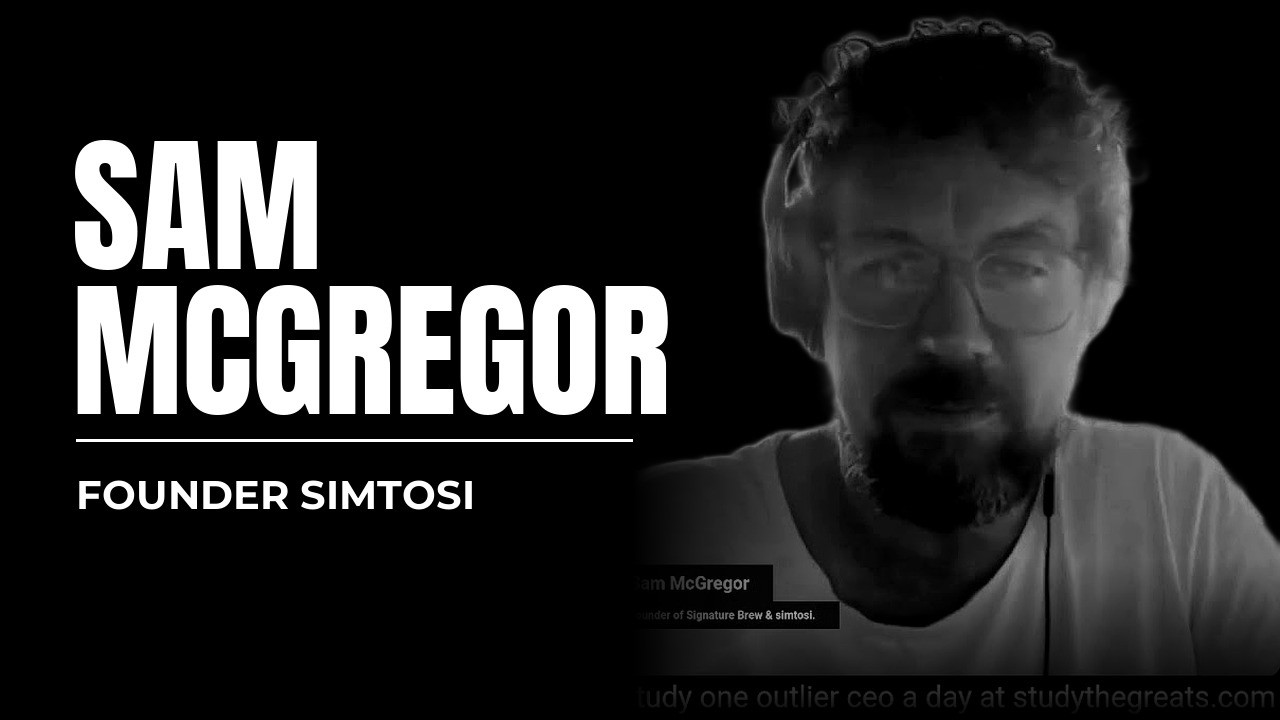
Sam McGregor started Signature Brew in 2011 after getting frustrated with beer at music gigs, growing it into London's largest independent craft brewery with £7 million in annual revenue. He now runs Syntosi, an advisory firm helping founder-led businesses with fundraising and operations, built entirely through networking and LinkedIn with no formal marketing.
Chapters
Welcome to another Founder Wisdom pod. We have Sam McGregor with us today. Sam is a founder, uh, and managing partner. His company is called Syntosi. Uh, it's brand new. We're gonna explain what it does. He was previously a founder at Signature Brew for 15 years. Uh, he's a non-executive director now. Uh, so Sam, welcome to the podcast. Tell us a bit more about yourself and what you're building.
Yeah, what's up? Thanks for having me, uh, have me on the show, Charles. Do people call you Charlie? Does anyone call you that?
Charlie, Chuck, Charles, however you want to call me.
Okay, um, well, yeah, well, thank you for, uh, thank you for inviting me on the show. Uh, it's cool to be here. Yeah, um, I set up Signature Brew, uh, 15 years ago, 2011. Um, a musician and didn't want to drink terrible beer at gigs anymore. So I decided to fix that problem by collaborating with musicians and bands to create beers with those guys as a way of like fixing that problem. Um, I never really realized that like I was an entrepreneur, or there was no— well, I wasn't aware of any like founder culture at that time. And we went on a, you know, roller coaster, and I went on the roller coaster with the business. Um, Grew it to the biggest independent brewery in London now. We raised across a bunch of rounds over £3 million UK GBP pounds, and and yeah, just we came pretty close to the edge of going bust a bunch of times. So I stepped back once we'd kind of got the business into a secure position, and I felt like I wanted to sort of help other founders. Avoid some of the crazy shit that I had to do. So I set up Simtozy, which is like kind of my consultancy advisory business where I work with, you know, founder-led businesses, hands-on, get in the mix. I was just looking at a deck on WhatsApp that one of them had sent me just before this call started. And yeah, loving it. So it's cool. And yeah, that's kind of the vibe.
Tell me about, um, what prompted you, what, like, uh, 15 years ago to start Signature Brew?
Uh, yeah, it just was being in bands, um, and I was working in the music industry. And yeah, a lot of times, well, most of the times you go to a show, and it's still the case today, like, you go to the shows and the beer is terrible. And I was like, Why is this? Lots of people in bands, um, musicians, because they're loads of them traveling all over the world, they're really into local beers and discovering beers, but then you can't get them out front. So I was like, well, let's make some beers with some bands. And my— so that was it, really.
Interesting. And what's the scale of the company, right? Like, what have you reached, uh, at on a success level with Signature Brew?
Well, that's an interesting question because like, you know, I want to talk to you about like founder. I always say, what does success look like? And the natural answer that the answer to that question is just me to just bang out a revenue number. But actually, like, what is success? I think there was definitely times in the last certainly 5 years where it wasn't, didn't, it could have been £100 million revenue and it wouldn't have been successful to me. So yeah, the successes that the business has had, won loads of awards, Beer of the— Brewery of the Year twice, won a bunch of marketing awards. The revenue question, it's about £7 million annual revenue at the moment. And yeah, it's growing okay, still majority controlled by me and Tom, who's the other founder, who's my cousin. And yeah, like, but yeah, I think the question that people ask themselves is what is success and what does success look like? And I think it's really easy to not know the answer, especially the further you get into the journey.
And what's the non-number part of success, right? It's like reuniting people together. Aren't most pubs already doing that and other beer brands? Like, how do you do it differently?
Yeah, I mean, the way that I kind of defined success for the brand, you know, fairly early on, maybe within the first 5 years, was like helping people enjoy their favorite music more. So if you're going to see an amazing artist that you love and you know every word, and you also get to have a beer that they've collaborated in, or a beer that's to do with music, and you want that beer, then you're gonna have a better time. If you're listening to your favorite artist at home and you get a beer that they've made with the— you listen to that record, then that's also cool. And that was, yeah, that's the success for the brand. And I think I never answered the question what success was for me personally. for quite a long time. So, and yeah, it went varied from early days. I've said this on the other podcast now, but I've been saying it for years, like, at the early stages of Signature Brew, like, success now looking back at it was trying to impress my dead dad, which is obviously stupid. And like, then later, later years, it was like survival. Success was doing the— making the payroll, like, You know, so it could swing between all those things. I think, you know, it obviously changes from person to person as they change, the companies change, you grow as a person, the brands go in different directions. So I think it's really important to come back to it. And honestly, sometimes it gets a bit boring when you have these conversations with founders where you like, it always comes back to that question, like, oh, what's my go-to-market strategy? You're like, well, what do you want to do? Like, I want to sell the business. Okay, why? You know, and some people, some people it might just be, I want loads of money, and that's fine. You know, sometimes some people might say, I want to— I don't want to work ever again. That's also fine. But it's just knowing what it is and being able to articulate it, I think, is something that lots of people struggle with, including myself.
So you had lots of fun running the company, but well, I mean, doing the events, the collaborations and all of that, but it was tough to make the bottom end line meet? I mean, it's a tough business, like, uh, DTC, CPG. Um, so what, what aspects of the business did you absolutely love, and what aspects of the business did you absolutely hate?
I think there was moments where, like, I would go in a pub and they had one of our beers. Our most popular beer is called Roadie IPA. Um, and it's the 2nd most popular session IPA in the UK, if you— depends on who you ask, but if you ask me, that's the question answer you'll get. When I realized that it was some people's favorite beer and that was the beer, and it was like, oh, it's real, like, people— it's made it into the kind of daily consciousness of some people's, like, lives, which is cool. So I really enjoyed that and obviously enjoyed like hanging out with most of the musicians, um, and seeing the, seeing the beers go from conception to real life and in seeing people enjoy them. That was really, that was really cool. Um, and bits I didn't like, I guess, I mean, just, I just kicked off loads of boring stuff down the road when I should have just grabbed it with both hands and been like, okay, I don't care how many times I need to be told this, just explain it to me again and again until I understand it. So some of the accounting stuff, cash flow, that stuff, like, um, I just sort of shied away from it when I should have just— it's just part of it, you know, just gotta learn it.
Give me some artists which you've collaborated with, like some of your most successful collabs.
Um, yeah, like, um, we did a collaboration with, um, Dynamite MC. He's a, a producer, rapper, um, an MC, and he had a whole concept and it was very, it was very aligned with his album. And he did a release show which we managed to pull off during COVID which was cool, having a drum and bass rave in the brewery, which was cool. That was successful. I think there was a couple of ones where we really hit the timing right for certain artists and certain beer styles. We've got one just come out recently, which is with an artist called Groove Armada, and that's gone into all of like one supermarket chain in the whole of the UK, and it has a message and it's like, it makes lots of sense and I think that's like, that's a really successful one. But yeah, I mean, there's loads, loads, loads of them. I think some of the early ones as well where it was like, it kind of was almost served as proof of concept for the business. So it's like, oh right, okay, if we did this, it works. It might be really slapdash and messy, but it proves that this is a good idea.
And let me give you my understanding of the business, right? So You either have your own brewery or you partner with some brewery, right? And then you go to some artists and you're like, hey, you could have your face on a can or your new song in your new album. Um, find a budget to print like 5,000 of these, right? And it's gonna be used for your next event at a couple of bars. Um, and that— then you partner up with them, they pay you upfront. you share revenue on the cans? Like, it's— I mean, it's a complex model. Just try to walk me through it.
Yeah, so what you just described was kind of the first couple of years where it was, it was just going, making a collaboration beer. Signature Brew was very small on the, uh, packaging. And then what happened was we, we have our own range of music-inspired beers that are not collaborations with anyone. And in that sense It really is just like a normal brewery. So it's a normal brewery. Brooklyn Brewery's theme is they're from Brooklyn. And, you know, Lagunitas' theme and inspiration is like getting stoned and the guy's dog, whatever. So like ours was, was like supporting music and being part of the music community, and we would always do the collaborations as well. So they were kind of our seasonals and our limited editions. So that's how we built the business model. We built our own first brewery, 2015, and then we outgrew that one and we built another one where we're at now, which has a 400-capacity music venue inside it. So the, you know, the business model now is very similar to just, you know, a kind of any craft Any microbrewery, craft brewery.
Right. Do artists, do most artists have that cash flow to pay you? Is it like an order of, I don't know, £2,000, £5,000? Aren't most artists dead broke?
We did do the revenue share model, the one you described, and we've done it a few different ways. Sometimes we'll do like a kind of deal where they'll do a a show, a performance. So we'll fill up a venue and that will also pay for some of the other parts of it. Um, sometimes it's just the record label buys them all and gives them away. That happens too.
Do people care about like having the artists on their cans? Like, just don't they just want to get wasted?
Uh, I think it really depends on the artist.
It's a collectible, I feel, as well, right?
Yeah, we've definitely had a few of those. You know, I think it's a mix of like we started the business a long time before celebrity drinks were like so massive, so that has also helped and hindered like the people's awareness of it. So, you know, you could talk about Casamigos and Aviation Gin and people like that, but also it's sometimes it's just a passion project for the artist, so they're doing it because they love it. And it's one of the things that they get to do because they are an artist. But yeah, I do, I do agree some people don't care and they just want to get smashed for the cheapest amount.
Uh, yeah, they just want to buy some Pabst beer and chug down, uh, 6 or 12 cans in one roll like I, I would, uh, back in my drunken days. Um, I think it's— it's so— in the printing part of it, like, uh, how do you manage that? Is it complex to have like some beautiful printing on that I mean, you have a designer that does it like before the show, right? How is that all handled?
Yeah, so depending on the volumes is depending on what type of printing we would do. To do keg badges, like, you know, that goes onto a tap inside a pub, that's pretty small amounts to do and it's quite quick to get done. If you're getting printed cans, That takes a lot longer and it's like 70,000, 80,000 minimum run. But the usual way for cans is just we do labels. So we just get labeled, we have a format. So it's not so much design, it's, it's, they all look the same, the same framework.
I love the design that I'm seeing on the website, looks so good. Even like the, the thing that you used to open the can is like the same colors, looks very good.
Oh yeah.
Tell me about the beer itself. I think it's pretty damn good as well, right? So with who did you partner? How did you test the beers? Like, yeah, how did you select that, the best batch?
Oh yeah, okay. Well, yeah, so we've been— we developed the recipes, like some of the recipes have been developed over years. So initially Tom created all the recipes. And then we would, as we moved around breweries before we had our own, you'd change it on each batch and you'd tweak it. We have really high-quality ingredient partners, and then as well, over time, head brewers change, people make suggestions from the team, so they all get developed. We do a weekly tasting panel where all the beers get scored batch to batch. Sometimes batches don't pass and you have to throw it away. So there's that kind of quality assurance type process that's in place. And yeah, we just sort of see what works, see what doesn't work. But yeah, it's just as you get bigger, the process of how you develop your recipes and maintain the quality starts to become quite similar to the other bigger companies. Oh, you're on mute there, mate.
What prompted you a year ago to launch your new venture, uh, Syntozi?
Um, yeah, basically I'd been, I'd been, I had been asked quite a few times to help, uh, other founders, and I just find myself talking to people and giving out advice. Um, and I just wanted to do it a bit more properly, I suppose, and I needed to create like a vehicle to do it and kind of had fun with coming up with a brand and the idea and stuff. And yeah, it's definitely centered around founders' like overall experience, especially early, early years experience. Um, but yeah, that's, that was it really. I kind of knew that I had to, uh, bill some people, so I needed to make a company.
And you've went through so much shit, like, uh, because I, I feel, um, building what you've built is Going through business in hard mode, right? Like I've my first company was a nootropic. It was like ten years ago supplement DTC. It went down pretty quickly. I could have kept on going, right? Like I think my partner was not so down with the the entrepreneurial game and so forth. But technically, I could have scaled it to I don't know tens of millions of dollars and exited. But I would have played hard mode, right? Which I would have had to work. probably 5, 10x as hard as I did right now with like building B2B SaaS, right? And building software products, right? That would have made me a harder entrepreneur, right? But it, I don't know, I would probably make less money in the process. What if a software founder comes to you, right? Is it still relevant? Because you've developed like a set of skills which makes you like quite special, but you've, You're also not building the same space as theirs. So what do you, uh, how do you, uh, stitch up that dichotomy?
Yeah, I think, I mean, I've talked to quite a lot of tech people at the moment, and I think it can be the same. It can be the same process of like, don't quit unless the, you know, I mean, I've met people who've like mortgaged their house or sold their apartment to facilitate things. And I think it is, I think that coming back to that question of why, it kind of, it's sector agnostic. It doesn't really matter what exactly you're doing. It's like knowing enough why you're doing it. But yeah, I think maybe SaaS versus like physical products versus services versus, you know, what other types of business are there? They're all of them, but like, it's, I think the overarching challenges are the same.
Yeah, and the founder, what type of contracts do they go through with you? Is it hourly rates? Is it a monthly package? Is it focused on one specific thing like fundraising or?
Yeah, at the moment everyone's pretty much on like a kind of retainer basis which has like times built into it. But I'm looking at different ways to do that and making it a bit more, a bit more easy to use, I suppose. Like, I think that the, you know, so I started a consultancy sort of, but I think the consultancy model is gonna— is getting out of date pretty fast. And I think that that's gonna have an effect on it. So I think making it easier for people to access knowledge, um, that's out there is, is something I'm really interested in for myself and for other people. So, um, so yeah, I think, uh, you know, one of the things I seem to be doing a lot at the moment is like reviewing decks for people and giving like really detailed feedback sometimes. Well, usually for free. So like, and I might be able to point something out that they've not seen that they might make a big difference later, but I know it's quite interesting as well. Like founders, especially bootstrap founders, are very like I am, like very tight, don't want to spend any money. But also you can actually spend small amounts of money to get a lot of value, certainly over the long term. But it's just not knowing where that is, is difficult.
And you have a huge network, right? Like how do you get these startup founders to buy your advising services?
Like so far I've done like nothing and I've got enough clients. So I need to figure out how to figure that out longer term. Yeah, like I don't really post on LinkedIn enough. I do this stuff because I quite enjoy it and this sometimes leads to things. But yeah, basically just having conversations, just being out there. I'm a member of a few communities. So I meet people through that. Um, shout out to Founder Nation if, um, if any of your listeners, uh, want to check that out. It's really cool. Um, and yeah, it's like I don't have a strategy, put it that way.
Yeah, yeah, dude. Well, thanks for being on, Sam. Where can people find out more about you?
Yeah, well, ironically, based on what I just said, uh, just hit me up on LinkedIn. It's just, uh, McGregor Sam. Just, yeah, Google me. I look like, I look like this.
That was Sam and
More from Charles


Founder Wisdom: the audiobook, version 2 (5 hours of stories from founders and CEOs)

8 CEO Questions I Love Asking: the audiobook (64 founders answer, in their own words)





