Shannon Byrne Susko - 2X Exited CEO · Founder, Metronomics™
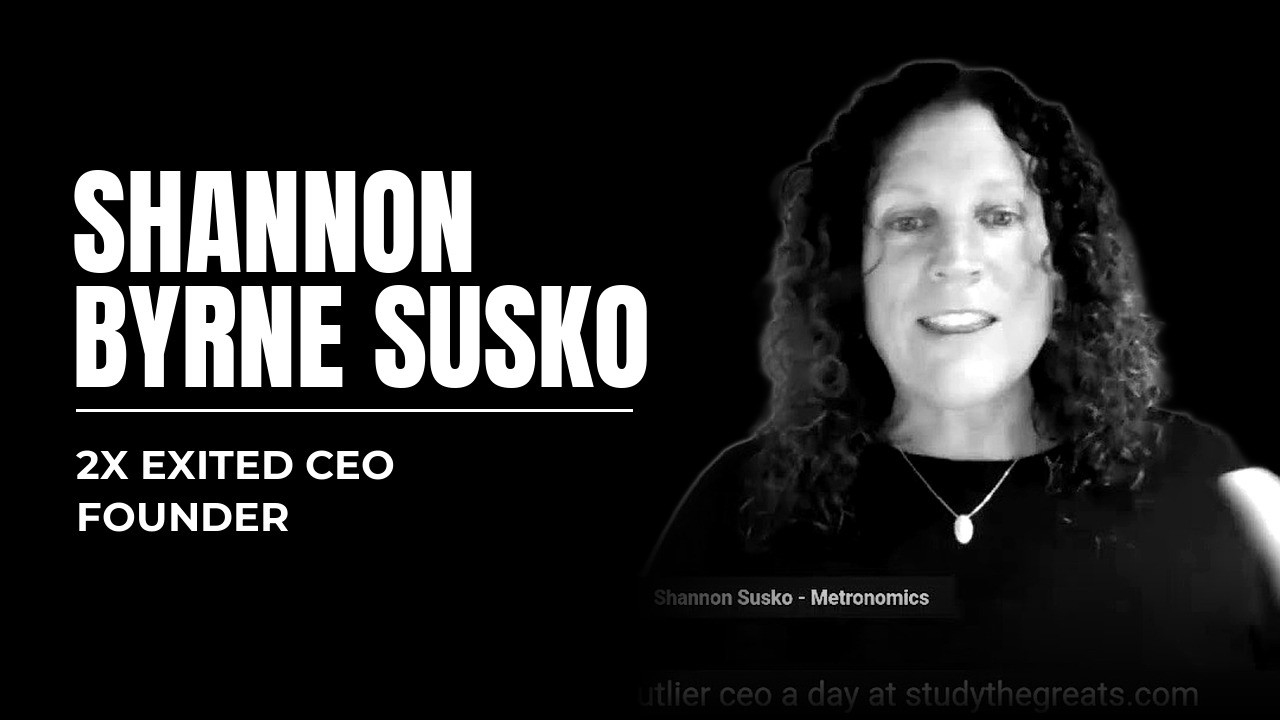
In this CEO Wisdom Podcast episode, host Charles Cormier interviews Shannon Byrne Susko, a two‑time exited founder and creator of the Metronome Growth System (Metronomics). Shannon recounts her early entrepreneurial journey—raising venture capital at 26, building a global payments platform, and later a post‑trade compliance solution (Subservio) that exited at a 60× top‑line multiple. She explains that raw grit alone didn’t drive those exits; instead, she discovered the power of behavioral accountability, cascading ownership of both fiscal and non‑fiscal “widgets” throughout the organization. This insight led to the development of a repeatable system that aligns long‑term (10‑year), medium‑term (3‑year Highly Achievable Goal, or 3HAG), and short‑term (quarterly) objectives, reinforced by daily 15‑minute huddles and a real‑time dashboard. Shannon describes how she turned the system into a SaaS platform (Metronomics) used by over 25,000 users across 3,000 companies and 200 certified coaches. She contrasts Metronomics with EOS, positioning it as a complementary strategy layer that adds long‑range vision and metric cascades to execution frameworks. Throughout, she shares practical advice on metric selection (keeping it to a few critical numbers), handling moonshot goals with rolling 36‑month forecasts, and maintaining motivation through behavioral habits. The conversation closes with Shannon’s current priorities: expanding the system’s reach, updating the 3HAG methodology (3HAG 2.0), and hosting a Growth Summit in Toronto.
Chapters
Welcome to another CEO Wisdom Podcast. We have Shannon Berensusko with us today. She's a 2x exited CEO. She's a founder at Metronomics. She helps CEOs build predictable 3 years growth. 4x bestselling author up in Whistler, British Columbia. Shannon, welcome to the pod. Tell us a bit more about yourself and what you've been up to.
Yeah, super great to be here. Thank you. I think the big thing this year that we've been working on is really talking about the system, the behavioral accountability of the system to get the exit, to end up where you want. Really, it's all about where you want. You spend the time, the effort building your organization. We've all been there, right? If you're new to this, it's all about writing down and being clear on what you want to end up with, and then aligning your team. And that's the big effort. And we've been really focused on creating the behavior, creating the system, and getting those, you know, getting those exits, getting those, you know, wins for CEOs and their teams.
And your story, you started running a company at 20 years old. How did that happen?
Yeah, so 26, 26 years old, I was super schooled. It was, you know, you know, just over the mid-'90s, you know, so it dates me. But it was, you know, the time where you could take a great opportunity, get it venture-backed, and then, you know, swing for the fence. And we definitely were swinging for the fence. But super challenging, right? Super challenging. So you raise all this money. I know lots of people listening in have raised money. Once you celebrate raising the money, but then you're on the hook to deliver that return on investment. And at 26, I definitely felt like I was on the hook to return that investment to those investors. And we needed to figure out how do we pull this world-class team together that we had in Whistler, BC. We had the team here, over 120 people building this global payments platform, and we really just wanted a system so that we could enjoy building the company and enjoy— I'm gonna say skiing a lot of powder.
You said it was also very messy, right? Like, what do you know now that you didn't know at 26?
Well, I think the biggest thing that I know now that I didn't know then is that pure grit, commitment, and passion for an opportunity isn't gonna get you to the win. It's really understanding how we create a team behavioral team accountability to not own the win that you want as the founder, but to own the win that we want. And to connect not the fiscal numbers but what I call the non-fiscal numbers, the widgets, the things that flow through your organization. Connect that all the way through the team. It must cascade through the team. And once We figured out you get the leadership team aligned to that and owning it. All the monkeys off my back as a founder and CEO. And then, getting their leaders to own it and their team members to own it and to cascade it all the way out. That's the thing that I wish— honestly, Charles, I knew that before I started the company. I played on enough high-performing sports teams to understand that. And I was so I'm so pissed 4 years in that I didn't just apply what I know about behavioral team accountability and high-performing teams. So, we just have to connect the business, the strategy, the cash plan to people. And that's the thing that unlocked it all. It's not just the CEO owning it. It's really sharing that ownership with the whole team. Easier said than done.
Yes, um, that one ended in 2009, right? Was it an exit? Was it—
So 2000— yeah, 2006 we exited, um, and we had lived through the bubble, we'd lived through September 11th, we lived through a lot of market pressures. And so we're happy, happy to exit that. We sold it to a company out of California. And they, you know, we fully integrated into their team and they adopted the system that we used to build the company, which was really cool. Not only the technology, the people, the platform, our customers, but they also brought in the system to actually grow their company.
And that led to Subservio. That one was in the financial service space, right?
Yeah. So, another niche play. The first one was a global internet payment processing business. The second one was, it's a Wolfull, a post-trade compliance solution for broker-dealers. Another niche. 2008, we opened the doors. We opened the doors leveraging this whole system we call Metronomics. We had it all dialed in before we opened the doors. So that one was like we knew exactly what we were doing. We had the confidence, the clarity. We had the support of our core customer, the strategy. was working right off the bat. And that one grew over 12 quarters, 3 years. We sold on our 3-year highly achievable goal. The buyer paid the value of 3 years out. So, a nice strategic value at 60 times top line. Yeah, 6 zeros. 60 times top line. And one of the top 3 mid-market deals on Wall Street that year. And the story is like, that's a great story for the value. But the big story is that we didn't kill ourselves. Time, grit, all that. We didn't miss enjoying our life while building it. The system works and the team aligned to the system. It's behavioral. It's accountable. And we had that clarity to actually, as you think about 2008, we opened the doors in 2008. And think about that year. That was one of the worst years in all the markets. And we were selling into the broker-dealer market. But we were, you know, when a market blows, compliance is pretty hot. And we shifted our messaging. The core customer didn't change, but their needs changed. So, we shifted the strategy that year to really serve the needs of those broker-dealers, the clearing firms, and just to really drive what we had. into the market. And we had an 80% opportunity for market share. You know, our big elephants in the market, you know, there are the 2 big ones, they only took the 20%, that enterprise level, we took everything else.
Fascinating. So that one was a home run, let's say. And then what happened after that? Was that straight up the Metronome Growth System after that one? Or did that come later?
The interesting thing is, you know, after all that, I had young kids at home. You know, I had 3 kids in less than 3 years. And, you know, like, I'm living, you know, being a mom, building businesses, working with my husband who stayed home full-time to support, you know, the whole family life. So I, you know, like, retired, you know, went home. But I got a call, you know, soon after that from a CEO. In Vancouver, British Columbia, who was like, I just watched you grow one company over 10 years. You sell it. You work for that company for a couple of years on contract. And then, you go build another one and sell that like less than 6 years later. He's like, I want that. What is that? I've been slogging in my business for over 15 years getting not the results that they wanted. So, he called me and called me and called me. He wanted me to come and coach uh, you know, himself and the team on the system. And I was like, yeah, I just don't know if it'll work for you. Like, I was really like, I just don't think— I don't know. The other 4 I was involved in, so I was like, I don't know. And so he kept calling, kept calling. Months went by, he kept calling. And I finally said, okay, let's give it a go. I said, what kind of coach are you looking for? And he said, look, I want a CEO plus leadership team coach. And that's the kind of coach I had in my first business, in my second business, that coached me and my leadership team together in the room, like on the field. So I said, that's the kind of coach I want to be. I'll come. Let's figure it out. I mean, I definitely in the first time round coaching this system in, I learned a lot. They learned a lot. And but it definitely worked. And he told 2 friends. And another CEO came and they told 2 friends till I thought 6 clients was enough to coach the system into. I also felt that with my software background and what I wanted as a CEO running the system, I wanted a way to peer into the field. As I became a coach and coaching my team, I really wanted to look in on the field and coach my team. And so, we built a platform. Like I contracted one of my developers from my last business to build a platform for my clients so they could see their game being played on the field every day. Are we moving towards our 10-year, 3-year, 1-year, our quarter? Where are our metrics, fiscal, non-fiscal? And so that over time, others started seeing the system and wanted it too. And I really didn't want to have anyone else on that platform because I'd already built my software companies and exited. But you know what? Over time, people really wanted it. So we said yes. We said yes, we'll put others on the platform. It's called Metronome Growth Systems. And there are over 25,000 users on that platform globally today. Over 3,000 companies, over 200 coaches use that platform of all genres, not just Metronomics coaches. And so that grew up and it continued to grow. Then other coaches were asking about like, what's this 3HAG you talk about? Like, what's the 3HAG? And I was like, oh, the 3HAG. I explained it. I didn't write about it in my first book. And yeah, I wrote my first book because I could only coach 6 clients. So I wrote the book to give it away so people actually would stop calling. But that's just a fallacy, right? People call you more. And then, when we get to the 3-HAG, again, coaches wanted to know about that. I gave it all to them. They had great success. So, we wrote that down. We wrote down the 3-HAG Way system.
Right. And is EOS a competitor, for example, just for us to situate ourselves?
Yeah, that's a great question. So, EOS is a great execution system. It's one that works for a company who really wants to commit to that disciplined rhythm, commit to the behavior. We love EOS. The thing that we brought to the table because I grew up with a great execution system was I couldn't figure out how to overlay the strategy system with the execution system. So, anyone using EOS would be very attracted to this strategy system because it takes all the good work you have. But you don't have the long-term view. You don't have that 10-year and 3-year. Some I know have the 10-year. That 3-year and mapping out 12 quarters and building the strategy system around the great discipline you put in place is really critical. So, we are one of those growth operating systems. But we have put in the missing piece of strategy. And that was my biggest challenge as a young CEO in my second company was just we have to layer it up. So that it's this ongoing feedback loop of how we're going to evolve to where we want to end up. Because without it, you just have a strategy on a shelf, really nice static thing. And in 3-Hag Way, this is a system. This is why coaches were attracted to it. This is why we have 80 coaches around the world who are certified in this solution to actually deliver this back. And EOS is A system that can absolutely— anyone using that system, anyone who's graduated, you know, from their implementer, this is a great system for them to pick up and continue on their journey.
Right, right. Let me share my screen so the audience can see what I'm seeing. Um, I mean, I checked a bunch of pages on the website. The one that caught my attention— where's that one? This one here. Um, yeah. So unlike dashboards, I've tried a bunch of things, right? I've tried EOS, I've tried 12 Week Year and all these frameworks and methodologies. I've always churned for some reason because I think if I ask myself honestly, it's because there's so many pieces to these methods and building a successful business is so hard, right?
Yes.
And the attention is like so limited that Yeah. As soon as, I don't know, it doesn't stick, well, we just give up on the system and start trying something else. So nowadays, I mean, I do have some dashboards in my businesses and so forth, but I'm not like that religious about following them every day and just checking them out, right? So why do you think that I fail? Why do you think most entrepreneurs don't have a system like that? And what's my probability of success, let's say, if I use the Metronome Growth System?
The interesting thing about using the Metronome Growth System with the communication rhythm, the execution rhythm, that is like our teams that use this platform and log in every day and have this 15-minute huddle about what they're going to do every day. It sounds like overkill. It's not. It's very human. When you log in and look at this every day and then you say what you're going to do, towards that and aligned to the quarterly priorities— yours, the company's, the corporate— you actually get it done. And so, we have data. This platform's been around for over 10 years. We have actually had clients on the platform for over 10 years. Their growth and everyone else's growth for the teams that log in every day, run their huddles every day, and focus in on what they said they want and where they want to end up actually achieve that More like 30 times more than their peers. We've already seen that. And their growth rate is at 30% plus per year. And it's just about behavioral focus. It's such a human piece. And I loved what you said. It's really hard to keep them alive. But if you have a team holding each other accountable of leaders and then their teams and so on, and we all agree that this is the behavioral habit, This is the thing, funny enough, that keeps it alive, that keeps it going, that keeps the story alive.
Interesting. And that dashboard I was showing, don't you think there's like too much in there? Because the brain can only focus on like 3 things.
Yeah, I love that. So across that, you can see the alignment from the long-term, near-term, to the 1-year, to the quarter. The interesting thing is the meeting area in that platform pulls in the current quarter and the current critical numbers that are your score. If the whole team knows the score starting with the leadership team, and it's not like a dashboard of too many things, it's the critical numbers, right? So, I was with an organization last week. They have 2 critical numbers. If those numbers are not on track, meaning they forecast the number for the day, week, month, quarter, year. So, they know exactly the context of where they are. When they know that, they make decisions sooner. And many can make decisions sooner on how we're going to actually make sure we stay on the forecasted number, like we keep winning, or we exceed what we thought was winning, or if we're behind. How do we make better, faster decisions, not wait a month, not wait a week, not wait a quarter, right? Because that's what slows down our growth. So, that focus day in and day out. And the meeting area, funny enough, it was an add-on to the platform. It was one of my first clients. They said, hey, we're prepping for this outside of the system. What if we just had an area where we could prep and we could see everything that we needed to focus on today? And so, we built that pretty quickly. And that's the thing that behaviorally has unlocked the success of organizations using metronomics.
Another thing I had looking at this is like, how do you determine all of these metrics, the BHAG, the life values? One, seems like a lot of work, and two, I'm not a perfectionist, but I want to get it right. And it seems when I tried these methods, there were so much vocabulary describing other stuff. And I felt that we're like trying out stuff and metrics that didn't really, that weren't like solid, right? Like, and I had to come back again every, I don't know, quarter, every week and just change the metrics in there. So that destabilized me, hence why I turned from that method. What do you think about that?
So I love that. Because I'm a recovered perfectionist. I'm all about it's got to be good enough for that point in time. And some people go, what? Like, it's got to be good enough. And we have to be okay with good enough. Because if we don't start with some score, we'll never have a score. So that's why breaking it down, like keeping it simple to just a couple numbers in the beginning and have them owned by someone. And as we cascade the system out, if every leader around the table owned 2 numbers for the score for their functional area, and then in their team, everyone owned 2 numbers, the updating is what I call real-time. But it's people real-time. So, if every day you had to update 2 numbers, that's going to take you honestly about 30 seconds. So, if we do that every day, we create that cadence and we create that weekly. Like we all have dashboards in our functional areas in our business— marketing, Sales, ops. And overall, we need a score because no team, no team, no professional team plays a game without a scoreboard. No one would even go watch it. No one plays a game and at the end of the game, they flick the scoreboard on. They go, oh, we lost, right? We just don't do that. In business, we do it a lot. We do that a lot. We play a whole month and we don't know if we're winning or losing. So, by breaking it down to just a few and having Each leader owned 2 metrics, right? Just 2. There's more in their organization and their functional area. That's how we update. That's how we keep it alive. But, and keeping everyone engaged too, because you get to forecast those metrics and then you're going to put the actual in. And to your point, as we create businesses and we come in with big ideas, we're like, yeah, we're going to do $50 million in dollars. Then we got to break that down to how many of what do we need to deliver that year, right? And we're going to iterate that.
Right, right. Another thing is that business is really hard, and most of the time you lose 99% of the time. As in, a guy that loves winning like me, that's very depressing, um, when I look at the dashboard like this. So how do I recondition my brain to To get to love this, right? Because nowadays I do run on systems. While it's not like if I run on nothing, right? I have a calendar. We have goals. We have agents, right? We we have a solid view of the business. We have a Stripe dashboard, of course.
Yeah.
But I gamify. I'm trying to gamify the full thing so that it's fun for my brain, so that it feels like a video game. And back then it felt like a poopy pants party, right? It was like. Every time we look at the metrics, it's all dire in the red. And also because I like moonshotting, I like— yeah, I don't get excited by normal goals, right? I get excited by moonshots. So I would go with these moonshots, but all the time I'd be like, oh, 30% there. So any thoughts on this?
Yeah, big thoughts on that because we definitely moonshotted in our first business. We moonshotted, we raised, you know, Yeah, over $30 million US. Like, you really— you're like, then you have to deliver on it. You have to manage the expectations to deliver on it. Everybody wants to win. It's human. Nobody wants to play a game to lose. So how we handled moonshots is we always put in that where we want to end up at 3 years. Though, how we win, why we call it a 3-year highly achievable goal, because if we write down the moonshot for 3 years and then we pull it back, to like the 1-year, 2-year, 3 years, there's only a few big decisions that need to be made, right? And within those decisions, it's building up like, what can we do from a score perspective? And we still put those big numbers in there. But one of the things that really saved me in my first business was having the moonshot. That's our best case. Having our worst case, all the things that could go wrong that could blow us up. And then having the most likely. And if we operated within that range and we're really clear on a rolling basis, we do a rolling 36-month forecast. Most people go, what? We start with 12, right? We'll grow to 24. We'll grow to 36. But that allows us to keep us in the winning zone because this is the winning zone. The worst case is not blowing up, not losing everything. The win is like out of the park. We just trounced somebody, right? And the most likely is keeping our cash aligned to our growth. At the end of the day, it's all about cash, right? And forecasting cash first. So, that's how we kept it real. But nobody wants to be in the red all day. And so, being able to evolve what we call a rolling metric to the situation we're in keeps people in the green and keeps us still driving towards the best case.
So I guess having an agent that can sort of do that on command, right, without taking too much time, energy, recalibrating some of these goals and just putting the right pieces of the puzzle to your brain to motivate you, right, to, to have your eyes on the goal, right, but also to To keep you motivated and alive, which is like the name of the game in business, is like staying until you figure it out.
For sure. Like, you think about the first phone call I got. Like, you know, love that CEO because they'd been in for so long, hadn't got the results they wanted, almost like gave in to crummy results, almost gave in to their dream and their wants. They're like, oh well, that's just not gonna happen. And they're leaving so much value on the table. Like, no, that doesn't have to be. Let's just get the clear lines in the sand, get the team aligned, right? Get the right who. It's going to drive the how. We know that, right? So, it's really about— and the who's on the team. When we have a team of A-player leaders who want to stay in the green, they're going to figure it out. When they put a number down, they're going to figure out how do we get there. And it's not all on the founder, the CEO, the entrepreneur's shoulders. It's, yeah, no, we've got the right person in the team. We're going to set it up so we win in that area. And what the CEO is responsible for is making sure all the areas are winning. We have a system that will help us win today, tomorrow, the week, the month, the quarter. Because it's no fun otherwise. I probably wouldn't have stayed in business.
Yeah.
Who wants to lose every day?
Yeah, yeah, it's challenging, right? You need to learn to love the, the game and the pain. Uh, what, uh, are your top goals for this year, Shannon? Your top 3?
Yeah, so my top 3 goals. Number one is to, you know, well, it's great to be here and talk about the system, but share the system more broadly. It has definitely changed people's lives. It's really, you know, not only like their lives but their family lives because you're not tied to your business. You're not drowning in your business. That's number one. Number 2 is doing a rewrite and like 3-Hagway 2.0 with the strategy system. It's so important. We talked about it like, how are we different? That's the system that's different. When we have confidence in our strategy as leaders, we make better, faster decisions. We do things different on the execution side. We actually win more. So, re-upping that book that was released in 2018 is to like get the terminology, what's evolved. I mean, it's been a decade. Strategy is really founded on long-term. But there are things we can do in the system to actually help leaders get more confident sooner. And then, the third goal for me is we have a big Growth Summit happening in Toronto, Ontario in October. We have speakers coming from around the world. Dan Priestley, Liz Wiseman. Oh my gosh, I'm still like Brad Giles. And just getting a room full of leaders, CEOs and leaders who believe in a system like the system and winning and how we get that done is so powerful. It's one of the biggest things I'm looking forward to this year.
Shannon, where can people find out more about you?
Definitely metronomics.com has everything. Lots of free resources, opportunities. Like everything I do in my retirement is to give this back so no one has to be as desperate as I was to grow a company. So, it's all there. Everything. You can even reach through and contact me. I'm also on LinkedIn. And it's easy to find me.
It was Shannon and Charles for another CEO Wisdom Podcast.
More from Charles


Founder Wisdom: the audiobook, version 2 (5 hours of stories from founders and CEOs)

8 CEO Questions I Love Asking: the audiobook (64 founders answer, in their own words)





