She runs Two (!!) Million Dollar AI Companies after 10 years of Corporate
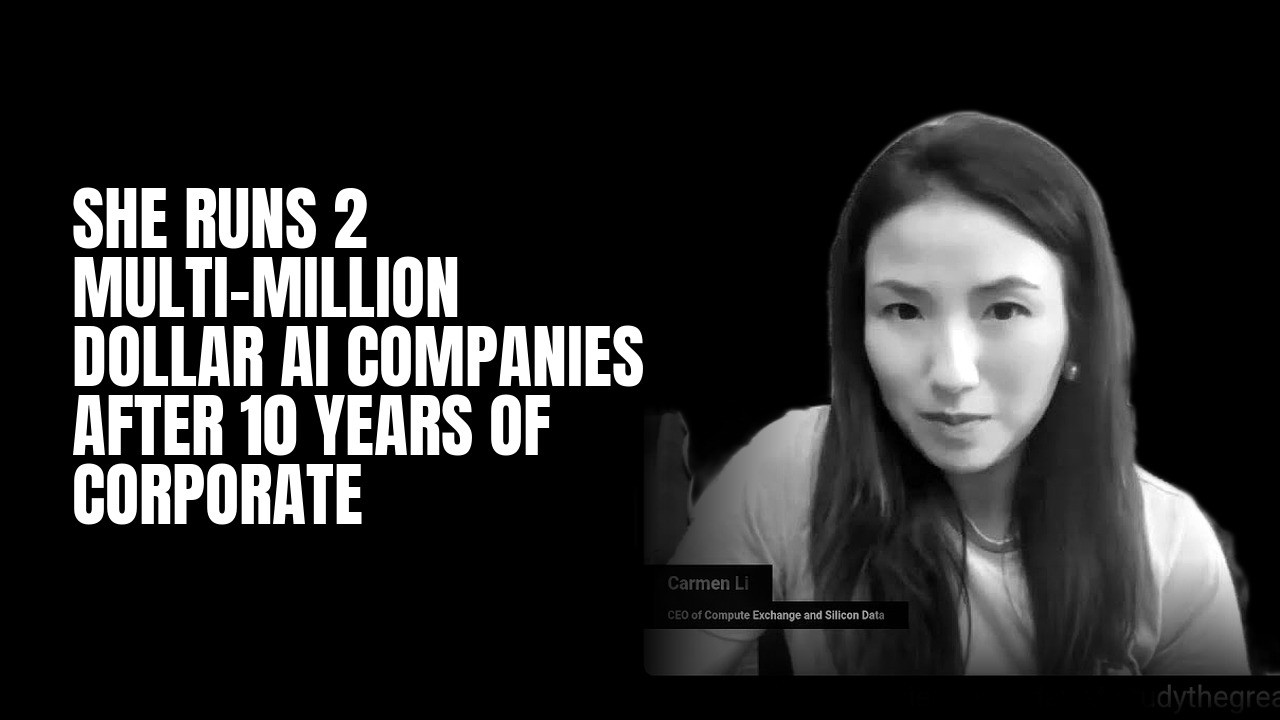
Carmen Lee runs two AI companies launched in 2024: Compute Exchange, a GPU marketplace that hit seven-figure revenue, and Silicon Data, which offers compute benchmarks and futures contracts. She built both from her background in options trading, banking, and Bloomberg, and both are already profitable.
Chapters
Welcome to another CEO Wisdom pod. We have Carmen Lee with us. Carmen is a CEO at Computer Exchange and Silicon Data, innovating in compute and market intelligence. Two very intriguing companies, uh, pre-talk with Carmen today. And yeah, I'd invest in these companies, they look very good. So Carmen, uh, welcome to the podcast. Tell us a bit more about yourself and what you're building.
Thank you, um, it's great to be here. Um, so there are two companies that I'm involved with. The first was Compute Exchange. So it is a marketplace for compute resources. So essentially you can procure longer-term contracts, reserve contracts for GPU as well as tokens. And you also can procure secondary servers and GPUs from Compute Exchange. This is pretty exciting where we believe we provide a liquidity layer for people looking to get more resources.. And the other company is called Silicon Data, which is the index layer on Anything Compute. So think about Silicon Data as the S&P, Bloomberg of compute. Essentially produce indices, benchmarking services, data products for compute industry. So in the future you can trade futures on my indices, SCME, very soon. So that's quite exciting for people to hatch their, price volatility, just like they can hedge oil prices today.
Intriguing. And you started out in banking, right? Uh, why start your own companies in, uh, 2024?
So I start off actually in, um, trading. So I start as an option market maker in Chicago, um, out of college. So that was a great 4 or 5 years. Um, and then I moved to banking, um, spent a few years at Citibank. And then moved to Bloomberg Data. So I managed global data integrations for Bloomberg globally. So I, back then, I covered all data content, all products for Bloomberg Data for integrations. Um, it's quite exciting. Um, I always want to do my own startups, but I, I, I guess I'm on the— unfortunately, I'm not one of those geniuses able to start a company in their early 20s. I wanted to, but never had idea. I think at least I can justify to myself why me, why do I think I can have an edge than anyone else. So that's why I stayed in a place I still enjoy working. And this is the first time I feel like, yes, I have enough context for the knowledge, industry knowledge and know-hows to create industry that's sustainable and have competitive edge over the long haul. So, yeah.
Okay, interesting. And these companies, um, how are they scaling so far? We, you know, we've talked about like some of the pricing packages, right? Do they share a similar go-to-market motion, right? Does one client enter one company, Trojan, and then goes to the other? How does that work?
It's completely separate entities, um, and then we actually have very different clients. Um, so for Silicon Data, it's pretty interesting. We are on the 7-digit AR space, but there's no salesperson. It's all engineers and one operation person and me. Everything's organic. We don't do ads, we don't do anything. So people, if you asking question, Googling certain things, we will come up and then you will get engaged and you will figure out whether right solution for you. So it's been amazing. I have all the transaction clients, over 1,000 clients. Everyone is organic. Um, so for Compute Exchange, it's a marketplace, right? So we pivoted quite heavily last year. Um, this year we went revenue from almost zero to seven-digit year-to-date revenue. So that's amazing hyperbolic growth.
And two companies, right? I know that most of, uh, it overlaps, right? But how do you manage that, these two separate entities, right? Do you schedule time in your calendar for one company and then the other?
How does that work? They overlap in terms of context, in terms of stakeholders, but they are quite different in terms of the actual work. So however, while our conversation is very interesting, right, some of them are my providers, right, from Compute Exchange. They are my clients for Silicon Data. Same time, they are providing data to Silicon Data, and then we also benchmark their GPUs, right? This is a very, very interesting relationship we have with a lot of strategic stakeholders. Timing, time management-wise, it really depends on the day. Sometimes, for example, Silicon Data is going through a major product launch. Obviously, I will spend more time in Silicon Data, or Compute Exchange is going through a major product launch, I will focus more on Compute Exchange. The good thing is Silicon Data, we're pretty much East Coast-based team. Following the East Coast time zone and it can be changed to Palo Alto headquarters, right? So we have teammates, we usually start a day a little later, which helps at least with my team meeting planning point of view. And both companies are global, right? So, and I try to do a lot of work on the weekends. If things I can do by myself, I will just always push to the evenings and weekends.
Interesting. And to what degree can you outsource to AIs, right? I see you have like fractional people on your team as well. So It's a pretty unique business model. I mean, it's a business of the future, but I see very few CEOs building businesses that way. Tell us a bit more.
I really— the only reason why I think I torture myself to do this is I really think I provide so much more value to both sets of clients, right? So if I only do one company, I think when they engage with me, I can give them, you know, a set of insights. Since I'm doing two, I can help them in a more comprehensive, holistic manner. So that's really, and I see how much value I can create for my clients in addition, right? Compared to one. So that's really the main reason why I'm excited to both. Yes, we use tons of AI for both companies, right? All different workflows from operation, data ingestions to output, to marketing, PR, like everything, right? Personally, I use a lot of tools, right? There's a lot of skills you can use to manage. But at the end, things come to me is mostly what AI cannot figure out, right? The team sees a lot of great AIs and we have a lot of potential business development partnership, which AI can't really do. They can't really negotiate deals, right? So those are really the things I'm managing.
How much did you raise and for which company was it, or did you raise for both?
So both companies has raised money. Silicon Data did a Series C round last year. We raised $4.7 million last year, seed round. Compute Exchange did a, like, I guess, whatever, called pre-seed round in 2024. So they're all in a Series A kind of stage right now, which is quite unique.
Right. And what kind of growth are you experiencing right now? What does your GTM systems look like precisely?
Yeah, the go-to-market is always being fascinating, right? So Silicon Data, obviously it's a very data company, right? I don't think your mom, my mom needs like data, right? It's just, you know, it's a data company. Um, ComputeChange, I would say the audience a little wider, right? A lot of people need to compute, a lot of people need GPU or token, so we have a little bigger Audiences and Silicon Data. The go-to-market motion obviously is different, right? For Silicon Data, again, it's organic, right? And people come to us. We constantly cited at Bloomberg, Reuters. We are on Bloomberg, CNBC all the time for different top— anything compute AI related, right? Financial Times. So we— it's a lot of organic references to our data products. So that's very helpful. For Compute Exchange, word of mouth. People just love what we do. We bring so much value to the clients. And even for the Neo Clouds, they have done deal with us. They love what we do. We provide efficiency, provide obviously revenue to them at a lower cost. So it's a lot of referral based. Um, and then we want to do more go-to-market motion, host events, etc. Yeah.
And both companies have different ICPs, right? It's like not the same.
Correct. They have very defined IPs.
Okay. And if we start with computer exchange, right? So AI labs, AI infrastructure companies, enterprise AI teams, right? Like, and you said organic, like why not drive traffic to them like cold email or LinkedIn or ads?
So I'm sure we do that. I think I'm sure we do outreach based on signals we receive, right? People sign up to our newsletters and so on. Sometimes we reach out, right? Be, hey, we need a product launch, are you interested, right? So we do do that. One of the things I want to be mindful is no one likes to get spam emails, right? Just not fun, right? And for us is how can we be helpful to people? Again, our ecosystem is not like a consumer apparel company needs everybody, right? We're looking for a specific subset of people needs buying procure GPU resources. So we do that, and then we love to host industry events, right? And it's really not about us sometimes. It's about creating connections and creating a forum people want to convey and discuss the challenges. We are in a very infancy stage of the industry, right? And a lot of moving parts. It's really, we only solve a tiny part of the whole value chain, right? We have so many partners that they can be helpful. Our goal is to make sure that the ecosystem is really vibrant. Robust, right? The bigger the ecosystem is and the better business we will have, right? So we have different incentives here.
And is it still compute exchange, right? Is it catching like wildfire right now? Is the demand organic? Are people just like rushing, uh, gold rush type to get GPU?
It, uh, we have a lot of demands. And then the one thing I love, not just because the volume, right? We, we can only satisfy like 40% of our FQ demand. Right? We have so much volume we just can't satisfy, right? Um, but that's not— obviously I'm, I'm good with that. Um, I wish I can meet all demand, but the one thing I really love is the variety of the demands, right? We have people requesting for one GPU, one node, right, for monthly, 3-month contract, all the way to 20,000 GPUs, right?
20,000?
Exactly.
So what's the cost of that?
Depends where you want to be.
It's like millions. It's, it's tens of millions.
No, starting point, which if you're looking at, it's A100, page 100, B300, where you are at, is Infinity Band connected, right? It's a lot of nuances to that. But my point is, being exchange, right, I want to make sure we have access to all different shapes of things, not just Nvidia chips. We do Nvidia and AMDs, and we do anything, right, as long as there's providers. We want to do the B2B marketplaces. We want to migrate systems. I want to make sure we help one-node companies and startups all the way to large companies. That's one thing that excites me, the variety of people we can help, we were able to help.
Is there still a shortage or was that temporary?
If you look at price.
In the US, not China.
Exactly.
I know there's huge shortage, but—
We are 100% ex-China company. We have new cloud providers. Majority, I would say, if not all of clients are based in the US. Um, but our provider can be in Europe, right? So we do have people, they can just buy, you know, use European NeoCloud if they want to. Um, so back to your question, um, shortage. If you see the price, yeah, if you see the price, usually price is a good indicator where demand-supply cross, right? You see price keep going up, that translate to is high demand potentially, or at least more demand than supply can manage. So there's definitely still a very robust demand side that supply side struggling to meet.
Man, I love it. Um, but there's a lot of competition, right? Like I feel in that niche, you're not the only one doing that. How do you do it better?
I mean, I, if you ask me the question a year ago, I would say yes, it's a competition, but now like not really. Um, because everyone, my competitor back then, they all pivoting to become a provider, a new cloud, which we love all providers, right? Um, if you are a provider yourself, itself, it's actually— you still can't—
you buy the chips, you bought the GPUs, right?
Only the GPUs, they manage the GPUs, right?
Why do they do that?
Because, you know, it's different business models and they have control, right? So for example, I don't have any control over the providers because I don't own them, right? They're my providers. Um, but essentially, if you look at, um, me being a natural player, meaning I don't have any stakes any providers, meaning I don't have control. The flip side is I'm completely unbiased. I charge the same fee to everybody. So if you're a client, you, you, you know, you are a provider, you should know that I won't favor anyone, right? So for me is what's your product? What do you have? What's the benchmark results? Clients pick your best match, right? So people trust us being an unbiased platform because we don't own anything essentially, right? So some of my competitors become the only thing, so they have a control piece. Which is if you look into orchestrating, become a token factory, you sort of have to own certain things, right? It's like the nature of your business model is shifting. So that's why I don't think we have any competition in terms of a true marketplace resources platform.
Okay. And compute exchange business model, you provide a quote and then you take a percentage of the total quote.
It's like, it's like transaction fee, right? If you're buying stocks through NASDAQ or LSAC, right, you pay a transaction fee to the exchange. Exactly. Like that.
Okay, how big is it? Is it 2.5, 5%?
So all the platform fee which we put on website is 4% transaction fee. So the way we, the way we look at it is, you know, if you compare your alternative, right? So if you are a new cloud, you're looking to get a client flow through a broker, they will charge you a lot more than what we charge you. If you hire your own sales team, which is also generate traffic, or like right for you, they will charge a lot more than 4% we charge you, right? It's all relative to your alternative options and the efficiency we provide, right?
I love it. Um, what's the average transaction price per client? Is it a million per order? And is there like a minimum?
There's no minimum. The minimum is one node, one month, right, starting. Um, so that's one node, usually come with 8 GPUs and CPU. So That's the smallest we do. We only do reserve contracts starting with 1 month. So it's again, what I said, it's a huge variety, a huge variance, right, from 1 to 20,000, right? So which is exactly what exchange is for. If you think about this, right, you only do like small deals or large deals, you sort of, you can't cater to all. So we do all of them. So it's a big variance. The average probably doesn't make any sense at this point, right? And then we see 20 nodes. You know, a thousand nodes, 5,000 nodes, depends on the chips. Um, yeah.
And you say per month, why is it per month? Is monthly usage of that— I thought you would sell the GPU itself, or this is just the monthly usage you sell?
We have both. We have reserve contracts, meaning you reserve for a month or a year or 2 years or 3 years. So those are reserve rental contracts. We also do secondary sales, meaning it's— you actually get physical delivery service to you. You own the server. So we do both.
Interesting. Okay, that's intriguing. Yeah, I love it. I love that, uh, model. Now, uh, if we speak about the, the sister of Computer Exchange, Silicon Data, uh, tell us about the ICP of that one. So this one is, uh, is much different, right? Like trading firm, hedge funds, banks. Uh, how do you prospect to these people? How do you get them through your pipeline?
So it's kind of amazing. I think the process really, again, it's really organic. People do their own research. They'd be like, hey, I want to finance this deal. Oh, I might have exposure to this. I'm long GPU. How do I manage my risk-to-value risks? So they're looking for answers through internet, and then we come up naturally through Google search or any LLMs models. So they come to us, right? They come to us, they do a trial, they talk to us, they understand what we offer. And they become subscriber, right? We're not consulting firm. Again, we have— it's already the whole team's all engineer, right? Um, and then the operation person, me, there's no salesperson. I don't have an assistant, whatever, right? So it's pretty straightforward. We give you data, and if you're a bank, if you are a hedge fund, you find out your own alpha through the traditional way, right? Digging through data, understand correlation, figure it out. So we did the company essentially. And then we have clients that's not, not financial services. We have people, the hyperscalers, the new clouds, the semi-industry participants, the design houses of chips, the manufacturer of chips, the fabs. We have people in the industry, right? So you think about their planning team, their strategy team, their finance team, right? For the fabs, they want to understand, hey, I'm creating GPUs, obviously they're fabs, but then I, they want to understand what's the future supply-demand curve., right? Because they're planning factories like what, 5, 10, 15 years ahead of time. So for them is, am I building too much of facility or too small facilities? And at the end, they are serving the clients, it's you and me, right? We're going to use the GPU, use the tokens. So they want to understand the end customer trend line as well, which they don't really have that exposure, right? They could use— they're producing chips and they sell it to someone else, right? So I think we give them different contextual knowledge base.
It's pretty funny that you went from banking and like corporate to like all in, like burn the boats in entrepreneurship, running two companies at the same time. Uh, I still can't wrap my mind around that. What happened in your psyche?
I always want to start up. That's the thing. Like, I always want to startups. I just never have the conviction into why. Why I'm the one, why I'm better than you, for example, doing this, right? I have to convince myself first. So my experience, again, creating, uh, trading, uh, indices, uh, future option indices, which helps me design a product that's actually tradable right now, because it's not an easy thing to do, right? Billions gonna be traded on my indices. My indices better be top-notch quality, right? It's not a joke. It's a real thing, right? With financial services, regular industry. With no experiences, I think will be really hard for me to say, I have seen that kind of volatility, the step function doesn't work, this is one not big indices, this is not going to be tradable, the basis trading is all wrong, right? So have all those experience matters to create indices. And obviously I was in data company, I managed a whole data, understand the licensing structures, right? What will work, what is the norm, what's the pitfalls, right? Really. And then how do you engage with financial services? Because I was working in a bank, right? Everything's regulated. You have the rigorousness that's already built into my brain, essentially. And also hardware, right? So it's a very important piece to understand hardware. I have exposure to FPGA and FPGA when I was doing trading back then. So really full on all those languages is very critical. So yeah, throughout my career, I always have quarter-life crisis. Like every quarter I have a crisis because I don't want to do something different than I was just doing a job, but this is the only time I have strong conviction. In 2024, I was like, yeah, I'm the person to do this because no one else understands servers, you have to understand GPUs, right? Because again, they're not homogeneous product. You have to actually benchmark GPU performances, right? Because they are not just— electricity is the same everywhere, but servers, they are not. Understand the performance variance, understand how to normalize the servers. Because they have different CPU, different RAM, different disks. That's, that's critical, right? Or you just compare apple to oranges, which is not going to work. Um, and understand that your data cannot be manipulative, right, by others. Um, yeah, I think all my experiences of BetterWorse really come together for this. I don't think I can do what I do right now with no experiences in my 20s.
That's so interesting. I can see like pent-up energy, right? Like you wanted to start this for quite a long time, you had the experience, and now you're You're going all in. Um, how do you manage like two companies, being a mom, like the stress that comes with that? Like, uh, how's that even possible?
Yeah, I don't think— the thing I'm very chilled. I don't think I'm stressed at all. It's pretty fun. It's, um, I'm combining everything I love, right? I love the markets, I love, um, data, I love hardware. I just— it's even my husband said I have— I'm so much happier person And since I started my own thing, obviously my children are important to me. So I spent all my time either working or spend time with my kids. I don't golf. I don't— it's not like— I think once you are a stable middle-aged person, it's not like you spend time dating 100 people, right? It's easier. Very simple life, right? Kids and work. Yeah. I have plenty of time with my kids and spend time with my mom, right? And on spare time and at work, it's really manageable. I don't know how to put it, but there's so much synergies again between the two companies. And yeah, I have very clear roadmaps. Everything is extremely intuitive to me. That's exactly why we don't even have a product person at Second Data. There's no salesperson. We don't need to. It's the self, right? I know exactly what to build. I know exactly what the market needs. Um, the intuition just so, so, so helpful. So I'm not confused or lost or anxious. I know exactly how I'm going to develop.
Fascinating. What are your goals this year? What do you want to achieve with both companies?
Yeah, so obviously with CME is launching, uh, futures on my indices, um, very soon. So that's quite exciting. We want to make sure the market is ready for that and get all the information they need to be ready. I think it's my responsibility to make sure the market is well educated, well understood the risks and really the use cases for the products. So for that specific data, for Compute Exchange, yeah, we're launching all different markets, right? Facilitating all different transactions. We're doing obviously Series A round at some point soon. So yeah, it's quite exciting to really expand the business. To see how fast we can grow. Again, ComputeChange is already on very hyperbolic growth from— we're already profitable, which is amazing, right?
I love it. Where can people find out more about you, Carmen?
Yeah, so go to computechange.com, compute.exchange, and stakingdata.com. Obviously follow our Twitter, follow our LinkedIn, right? We're pretty active.
Love it. That's Carmen and Charles
More from Charles


Founder Wisdom: the audiobook, version 2 (5 hours of stories from founders and CEOs)

8 CEO Questions I Love Asking: the audiobook (64 founders answer, in their own words)





