Sophia Millar - Co-Founder, CEO Sonibel Instruments
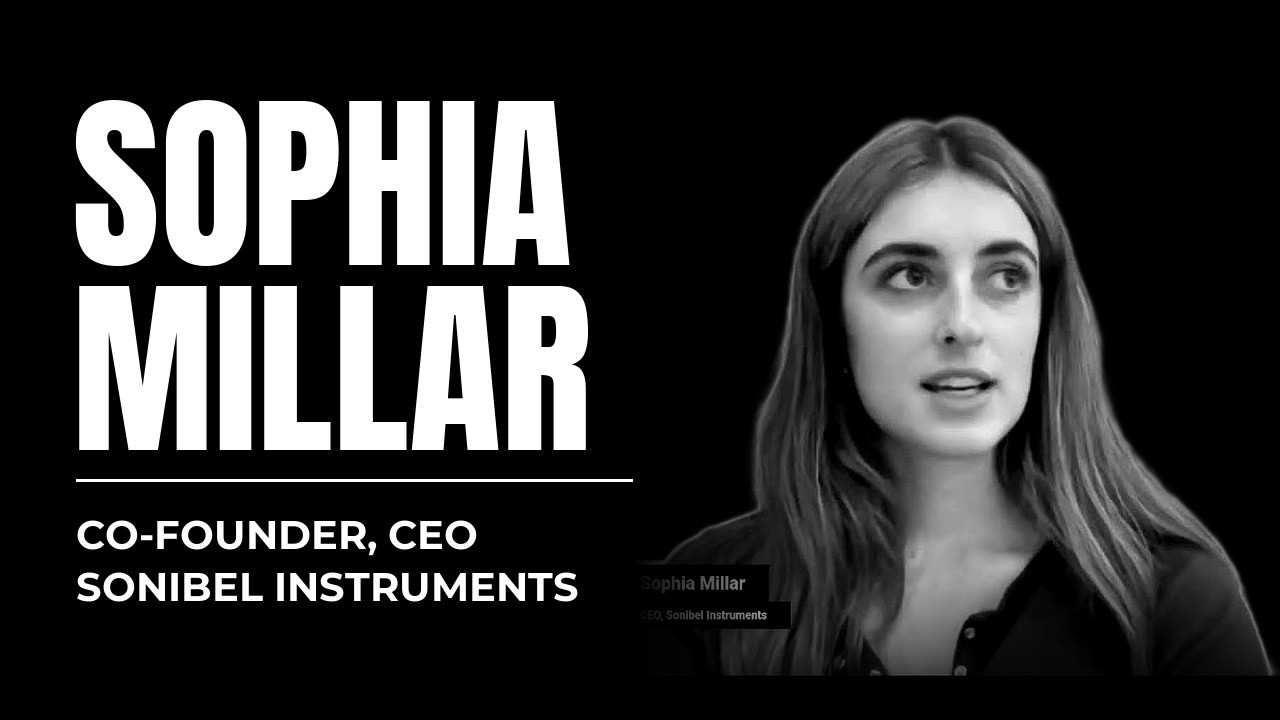
Sophia Millar co-founded Sonibel Instruments to detect weld defects in real time using an acoustic sensor mounted on welding torches. The company charges around $30k per unit, has a $9 billion addressable market, and recently piloted with the Canadian Navy. An edge AI processor classifies defects from arc sounds in noisy shop environments.
Chapters
Welcome to another Founder Wisdom podcast. We have Sophia Miller with us today. Sophia, CEO and founder at Sony Bell Instruments, been founding Matcha prior to that in BC, and very interesting industry. You're targeting ports or the maritime industry, I would say, and the TAM is very small, but it's pretty cool what you guys do as well. You sort of, it's a machine that with the sound tells the welder if they're on track or not, from what I understood, right? So welcome to the pod, Sofia. Very niche, very interesting. Tell us a bit more about yourself.
Thank you. Great, great to be here. Yeah, so I'm the co-founder and CEO at Sonnabel Instruments. We have this new little device that retrofits onto your existing weld equipment in about 20 minutes. And it listens for weld defects. So if we catch any of the 4 main weld defects that we see out in the field using just acoustics, we shine a light right in the welder's hood. So the idea is that they complete all rework immediately rather than waiting for inspectors to come and starting that whole rework cycle of back and forth.
I'm checking your background here. You started in biz dev, I guess. And SonnyBell, you've also, I guess you've been selling yourself, right? Like since you were young. So is that like the connection to how you got the idea for SonnyBell?
Yeah, well, I started in software. So this is my entry into hardware. And now, of course, I'm all into hardware. I think it's the last frontier. But I started out in finance. That was my first kind of work experience. My degree is in finance, and then got into software startups. I was the CEO's assistant at one for a long time, learned everything there, then got into biz dev like you're saying at another startup that went through Y Combinator, launched a few things of my own, and then met my 2 co-founders George and Hooman in our last year of university at the University of British Columbia. Hooman had worked at one of the biggest shipyards in Canada, and that's where he initially got the idea for something like this. So the 3 of us came together and started Sonabo from there.
And do you guys like pain? I mean, hard tech is hard as fuck. Like, do you guys know what you're getting into?
Hard tech is hard. I'm calling you from our lab. We Expanded the team this month. We got, um, 4 more people, so more than doubled our headcount.
Yeah.
Hard tech's hard. Um, but I feel like it's the best place to be right now. I mean, there's so much—
Reality.
Yeah, in reality.
Physical stuff.
You see the impact of, of what you're working on. I mean, we go walk around these, um, our customers' shops and there's welders working 12-hour night shifts doing the same piece and they're so proud of their work because they can point to what they've built. And so we sort of feel like we're taking a part in that too. We can point to what we helped get out the door faster.
And pro welders, right, like dudes that have been doing that for 30 years, do they need your stuff or Like, I think they're like epic at what they do already. Would they need your device?
They are, they are, they do. I mean, you know, you've been walking for however many years old you are, but you still fall sometimes. So there is still a need. We see out of the best welders, there's still around a 10% defect rate on average. Even guys who are getting A 2 or 3% defect rate, just because they're so used to that kind of work and the environment sets them up for that success, they still see a huge ROI from this tool. So sometimes we see a much bigger defect rate, closer to 40%, but the ticket size is generally lower.
Yeah, especially like the juniors, I must guess. And yeah, that's a big cost to the company. What does a defect rate look like? Are we talking on a big gigantic boat, they put it in the water and then There's a leak. Is that a defect? A very costly one?
That would be a very costly defect. That's not what I'm referring to here. So generally the process that we see is that critical welds like the ones we're targeting have 100% inspection requirements. So once all the welding is done, you bring in an inspector who's qualified and certified And that person will come in and inspect 100% of the welds. Generally, 10% of welds fail those inspections from what we've seen across the industries that we're targeting. And once a weld fails those inspections, it's 10 times more expensive to fix and it takes 3 times longer to fix compared to if you could just do the weld correctly the first time. Right.
And what are these tests? There's visual tests, but I'm guessing they have instruments and they bang on something and see if there's echo or whatever, right? So what's, what precisely do they test the defects for?
Either ultrasonic testing or X-ray testing. Huh.
Okay. Interesting. 10%. Hmm. Is there, so you're, hmm. Is there a way to know, like, when you're doing the task that you messed up? Like, aren't the experienced guys knowing that they messed up something, or they're like super confident and it happens anyway 10% of the time?
Well, you think about it, they're just going to work every day, right? And they have their speaker blaring, they're tired after a 12-hour shift. So I think it's easy for things to go unnoticed. But yes, a good experienced welder can hear some defects if it gets really crappy. They can see some defects. There is a good portion of defects that are subsurface, so they look like a perfect weld, but they would fail inspection. So certain things go unnoticed, but if the welder does see something form in real time, they usually stop and fix that right away. No one likes to have rework. It's just more work.
And how does the technology work precisely? It sounds— so is it the sound that the flame makes? And how, how does it know that there's a defect lurking in there?
Yeah, it's really cool. So we're listening to the interaction between, like, without getting too technical, between the arc and the puddle while you're welding. So While you weld, you deposit metal onto the piece. We're looking at the speed and the size of those droplets of the metal coming off of your welding torch. Um, it's really cool. I mean, we can actually see not only that a weld is good or bad, but we can see the difference between the defects. There's 4 main defects that we look for, and you can tell just by the sound. Which of those is occurring compared to a good weld.
That's crazy. So you had to isolate a lot of noise, I would guess, to get like that right noise. How do you do that? Is it software or hardware or both?
Yeah, both. The noise mitigation was a big concern when we were starting out. We use AI to power the tool. And when we're calibrating our machine learning algorithms, we have to make sure to put in a lot of background noise. So we'll have welders in the area grinding, arc gouging, just everything that could possibly be loud. We get music speakers blasting in there, which also makes it more fun, but we really have to build that all in so that it's not confused when it hears another welder next to it or anything like that.
And why is there a need for hardware in that equation? Why not put a microphone and have the software do the heavy lifting?
Well, the microphone is a big part of our hardware. I mean, we just have a microphone that we put into a very rugged mount so the welders can be super rough with it in the field. We attach that right onto the welding torch. So we do need some way to pick up the sound. And then we process it on an edge device. So there's no need to connect into our software or get anything Wi-Fi enabled. It's all just on the edge right next to the welder in an instrumentation module.
So microphone and having an app on their, their telephone wouldn't work as well?
It could. Um, you'd have to get a wireless mic, which complicates it. It would probably have to be bigger, which is—
Battery issues as well.
Battery, yes, exactly. So that's—
Why not connect to Ray-Ban Meta glasses? Or—
Yeah, you could. I mean, we were thinking of building a heads-up display for the welders because they're using their own helmets, and we could put the quality results right in their vision. Um, I think that would be down the line, like V2.
Yeah, yeah. But it's interesting that V1 is potentially even more complex. I understand why. What's, uh, what's the pricing on this? What's the business model here? Do you have a subscription as well?
We do. So we sell each unit upfront, and then we have an optional subscription if they want to Have a model that self-learns. So rather than just having a stagnant model out in the field that might be outdated. And then the subscription also includes maintenance, things like consumables, troubleshooting help, things like that.
Got it. So it's like, what, $30,000 for one unit and then thousands of dollars per month, something like that?
Roughly, roughly.
Okay, got it. Hmm. But as a guy that would own a ship place, I don't even know how to call these things, a welding shop or whatever. If I can reduce 10% of defects, because defects are very costly. I mean, there's an inspector to tell me about it before I ship it to my client, but it's huge savings, right? It's like—
Yeah.
Might have me save millions of dollars straight up. So, and what's the competing solution to that? What's the alternative? Is there?
There's certain things that a shop can do organization-wise. So, they can hire in-house inspectors. So, there's not a scheduling delay between getting something x-rayed or ultrasonic tested. They can train their welders in-house. There's a huge labor shortage. So, it's really difficult to get skilled welders. Often people are hiring welders right out of high school. They're not very experienced. A lot of the bigger companies train them in an academy before they get put on production. As for actual tech alternatives, there are a few systems that do sort of like real-time defect predictions, but they're based on the machine settings. So they miss most of the defects that we see in the field. Um, they don't have a great differentiator between the machine settings being off and causing a defect versus just natural variability in the person's welding technique.
What's the cost of a defect? Like, can I unwield something? Uh, what's the cost of that? that, the 10%?
It really depends on how the shop is laid out, but it can be huge. Like, it, it just includes so many different factors. There's the cost of the welder's time grinding it out and rewelding it, especially for a multi-pass weld where it takes hours and hours and hours to get that done. Then you have to Wait until the inspector can come, so there's scheduling delays, other projects are put off, and things are pushed back. Then there are— there's the inspector's actual time, and every time these projects get delayed, there's late fees generally by the customer. So it really just stacks, uh, and then of course your reputation as well if you start getting late. Everyone knows, and then you get less bids. It really adds up.
And Maritime is your beachhead, but it's welding as a whole, right? And welding as a whole is a way bigger TAM. Can you give us the numbers on both?
Yeah, so we are initially targeting— we have a lot of traction in Maritime. We, um, are doing a pilot with the Canadian Navy. So that's a big one for us. But we also have pilots running in with structural fabricators. So we have a bridge fabricator, another structural customer. Pipeline is another big one for us, but I think that'll come a little bit later down the line. Overall, the TAM is, is worth more than $9 billion in Annual revenue.
Just in maritime, like ships?
That's in all 3 of those industries.
Huh. Interesting. But don't most companies wield some stuff?
Like, yeah, yeah, yeah.
It's like a TV or a computer. It seems all these guys wield something to some level, right?
Well, yeah, there's welding everywhere. We are specifically targeting critical welds. So it's a subset of the entire welding work because we want those welds that are getting inspected. That's where the rework really costs a lot. If you're welding a bike and you can see it and it looks good, that's enough. You don't need to get it generally x-rayed or UT'd.
Hmm. Interesting. Okay. You raised like some money, right? Like right now you're going at conferences, you're investing in growth. When will you actually leave the beachhead of maritimes or have you started attacking the other 2?
We started attacking the other 2. So right now we have 3 customers. One of them is maritime, that's the Navy, and the other 2 So for us, the roadmap is more based on type of welding. We're focused on one of the main types of welding that we see, arc welding. And later down the line, we'll add the others. It just requires a little more time in integration. We're really trying to speed things up right now, get in the market really quickly.
And are these lines, is it LOIs or is it long-term contracts? At the end of the day, you're new, right? And how long did it take to close these deals?
Well, our first customer was Inbound, and they're pretty big. They have over 300 locations in the country. And we went from first meeting to pilot with them in less than a month. So that was really—
That's crazy.
That was crazy for us. That was our first big customer, first paying customer, I think.
Uh, pilot is like 10 units or 5, or—
Pilot for them is 4 units, so they're just testing them for a while.
Yeah, good start, big victory. Why was it so quick?
I think they just came in already knowing about the problem and looking for really any solution, and we're the only one out there right now.
And if you're talking about the Canadian Armed Forces, is that it's a bigger problem than just cash, right? It's like delay and deploying that big ship in that part of the world, it's like urgent, right?
Yeah, exactly.
30 days, there you go. So they act quick, but then that's surprising. Is it like the Canadian government or pretty much any governments known to be super slow? In their decision process?
Yeah. So the Navy did not act that quickly. They didn't sign in 30 days. That was our first customer did that. The Navy, I think, took closer to 6 months. So it's balancing out now. But when we got started, we had that 1-month-to-pilot timeline. We were super excited.
The car industry, is that another one that would need that machine or it's still like visual? inspection and we're good.
Cars are a big one. Uh, most automotive welding is— well, I wouldn't say most, but a lot of it is going towards automation right now. We are targeting human welders just to begin with because that's where we see the bigger ROI. Eventually we will hook on to robotic welds, but it's just not really the priority right now. Automotive is going to be Huge when we get there.
That was my next question. Like, shouldn't robots be doing that job and reduce the defect rate to 0.1%?
Yeah, well, you'd be surprised. The robots that we see out in production right now have oftentimes higher defect rates than the people just because they're getting started. They're still kind of in the prototype phase, a lot of them. But, uh, But yes, eventually, I mean, it's the same technology. We can hook onto a robot, stop the system if there's a defect.
Couldn't you get that data and have that proprietary data to build your very low defect algorithm later on and have a moat on that?
Maybe. There is no public welding dataset available in the world right now. that we could use. So we have to collect all of our own data, which is, like you say, a great moat, but it is challenging. Like, for every customer deployment, we need to calibrate our models, collect a lot of data. It's, it's just part of our sales process right now.
Interesting. What's next for you in the upcoming months? What are your goals as the CEO of the company? Sales? Fundraising, possibly, right? What's, what are you onto?
So we raised pretty recently. That was our pre-seed. We were slightly oversubscribed. So we're good for now for raising, planning to get another round in, uh, kind of end of Q1 2027. Right now it's really just a sales push. So we're getting the product up to a level where it performs well, reliably, repeatably in pilots. And is ready to be rolled out for our first complete sale. So that's what we're gearing up for right now. We'll have to eventually set up manufacturing and distribution lines. And, uh, well, we've, we've started growing the team, mostly engineers for now.
Why didn't you guys go into YC?
We are YC rejects.
Let's see how that plays. Usually that chip on the shoulder is enough to propel you somewhere. No, you're quite special, right? Like, what do you, what do your friends think of you? Like, most of your friends must be like non-founders, I don't know, investment banking or whatever. Like, you've panned out in a different way. Why is that?
My finance friends? Well, I don't know. I have a lot of founder friends or kind of VC friends, people who are interested in startups in some way, whether that's in their own startup or working in an early-stage startup. I think it's a really different personality. You're more risk-taking, more able to just walk forward when you can't see anything around you. So I think those kind of people attract each other. Most of my friends are somewhat entrepreneurs. My mom worked in startups before I was born, so interesting.
That's a long time ago.
Yeah.
Okay. Are you talking 1990 startups like dot-com boom or?
Yeah, yeah. Long ago. It was she worked in a couple.
Well, keep on going. And I guess your your YC stint also probably changed your trajectory, right? That Corgi. And you were at Pilot before that, so the CEO must have inspired you in some way to take that path. But pretty cool, very niche, to say the least. Where can people find out more about you, Sofia?
More from Charles


Founder Wisdom: the audiobook, version 2 (5 hours of stories from founders and CEOs)

8 CEO Questions I Love Asking: the audiobook (64 founders answer, in their own words)





