Stephanie (Gordon) Farsht - Co-Founder and CEO at Small Wonder
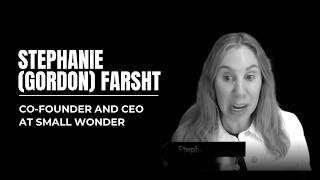
In this Founder Wisdom podcast episode, host Charles Cormier interviews Stephanie Gordon‑Farst, co‑founder and CEO of Small Wonder, a sustainable hair‑care startup that sells powder shampoo in a patented dispenser. Stephanie recounts her 15‑year tenure at Target, where she worked on early strategy and innovation teams, and how that experience shaped her problem‑solving mindset. She describes her parallel path as an adjunct professor at Kellogg and mentor at Techstars, emphasizing her passion for teaching emerging entrepreneurs. The conversation pivots to the genesis of Small Wonder during the COVID‑19 pandemic: recognizing waste in the beauty industry, she and two co‑founders (a branding/marketing lead and a former Neutrogena R&D head) created a powder‑based shampoo that activates with water. They spent years developing a formulation and a complex multi‑component dispenser that keeps powder dry in the shower. Stephanie outlines the go‑to‑market approach—initial D2C focus, limited salon partnerships, selective retail through Anthropologie, and plans for future retail expansion once a full product line (powders, serums, conditioners) is ready. She discusses sampling via travel‑size minis, customer‑centric feedback loops, and the importance of external benchmarking with peers, Techstars, and her VC‑entrepreneur husband. Funding history includes early angel rounds and a priced round closed in December, reflecting a broader trend of venture capital interest in beauty‑CPG. Stephanie reflects on her CEO strengths (problem‑solving, learning agility) and weaknesses (impatience, emotional volatility), and shares coping mechanisms such as tennis, a strong advisor network, and staying close to customers and the lab. The episode concludes with information on how listeners can follow Small Wonder’s journey online.
Chapters
Welcome to another Founder Wisdom pod. We have Stephanie Gordon-Farst with us today. She's a co-founder and CEO of Small Wonder. She's all about innovation strategy. She's a Kellogg adjunct professor and spent 15 years at Target, lived in France, now in the greater Chicago area. Stephanie, I'm glad to have you on. Tell us a bit more about yourself and what you're up to.
Thanks, Charles. Thanks for having me. I'm excited to be here. I think you captured most of it. Started the company about 5 years ago when I was teaching with a colleague of mine at Kellogg at Northwestern's MBA program, and it has been all-consuming ever since.
So tell me about like the 15 years at Target. How does one survive 15 years in a corporate environment?
I actually navigated in an interesting way at Target because I always I always felt the pull into groups and teams and problems to solve that were really disruptive. And so I was part of the first strategy team there. I was part of the first innovation team there. It was always an environment for me where things that didn't belong with the rest of the organization would land on our team. And so you kind of would stay out of the fray of large company politics and bureaucracy because you were doing something so different and so disruptive.
And how is Target's growth at your time there? Was it the time it exploded? Tell me a bit more about the company, uh, in starting in 2000, I believe.
You're right. Um, we actually partnered with Amazon when we first, um, started going down the foray of dot-com and digital commerce. They ended up being our partner that kind of got us up and running, which was a really interesting experience. Didn't have the greatest ending, but, um, was a really great one for us. Um, and we, we Grew, I think, from about 100— I might be wrong with the numbers, but I think we had about 150 or 200 stores when I started. And when I left, we had 1,800 or close to 1,800. So a huge amount of growth, major disruption in the retail space, mostly because of Amazon, especially from 2010 onwards. Most retailers, most traditional retailers really had to massively disrupt their business to figure out how to survive and keep up because there was so much change in retail in that decade.
And I believe you placed your order on Amazon, then you picked it up on Target. Is that the, the partnership? I never shopped at Target myself.
No, so in the beginning, my memory might be fading me because this has been a really long time, but in the beginning Amazon actually basically ran our site and fulfillment for us. So you were still at target.com, but it was a really early version of target.com. And they would basically be our 3PL. That changed over the 7 or 8 years that they were our partner. We went through a pretty large path of expanding SKUs. We called it SKU extrapolation, mostly because of search. We wanted as many SKUs possible so we could bring as many people to the site based on that search. And then we went through a major shift back to make sure that each SKU that we actually had generated something of value for Target. So all of those things happened while we were on Amazon, and then we built our own sites and own 3PL. And we actually ended up leveraging a lot of our store network, our store fulfillment networks for the next version of 3PL.
And while all of that was happening, you became an adjunct professor and then a mentor at TechStart and Kellogg School of Management respectively. I think it was Carlson School of Management initially. What pushed you to start down on that path?
I always loved coaching younger teams, especially at Target. And so the transition to teaching was a pretty natural one. I taught for 2 years when I was at Target in Minneapolis at University of Minnesota's business school, Carlson, which was a wonderful experience. And then when we moved back to Chicago, I wanted to continue teaching. I still had my job at Target. But I was remote at that stage because Target's based in Minneapolis. And so I seeked out the ability to teach at Northwestern, which was a wonderful experience. Taught a class called New Venture where we basically started 8 companies every quarter. We were on the quarter system. And if they made it through my course, they would get to progress into the next series of entrepreneurship and intrapreneurship type courses at Kellogg. And then a small fraction of those businesses actually end up launching post-graduation. So it was kind of like running an incubator, which is why I spent some time at Techstars as well as a mentor. Very similar type of work, but you really have to help teams make sure that they're solving a real problem. Do they have a real customer? Is there product-market fit? We just had some amazing, amazing student teams going through that process over and over again.
And then during the pandemic, you launched your own company. Was that— why like that timing first? And then was this a shock for, for you?
I never intended to be an entrepreneur. It was never in any path that I had anticipated throughout my entire career. I was teaching with a colleague of mine named Paul, who is also a professor at Kellogg, and he and I had kind of the same pain points and same confusion as to why there was so much waste in the beauty space. We were watching companies like Blueland, which was a cleaning supply company that came out with concentrates. Tackle the water and waste problem in the cleaning space. And we kept looking at each other thinking, why is no one doing this in hair care? We're shipping bottles that are 80% water, which is your shampoo, into your shower where there is water pouring down. Those ingredients are getting degraded and, and diluted because they're sitting in water and they're getting oxidized. And so powder form is actually a better format. Why has no one solved that? So we jumped in, we found our third co-founder, She was the head of global R&D at Neutrogena and had been a formulator and PhD in chemistry for decades. And so the three of us kind of filled each part of the tripod in terms of branding, marketing strategy, and formulation. And we took off and spent most of the pandemic working on formulation. We actually partnered with a really large global brand salon manufacturer that had spent almost a decade on trying to figure out how to dehydrate their top Salon Shampoo. And we worked with them for about 2, 2 and a half years on prototyping, getting customer discovery feedback. And then we actually acquired all of that technology and innovation from them and launched Small Wonder.
So how does it work? I'm on the website here. So I'm guessing the bottle itself is shipped once and then there's powder in it and I can order powder refills. That's how it works.
You got it. Yeah. So we actually very quickly realized that keeping powder dry in the shower, but dispensing like a normal shampoo is quite challenging. So we'd spent all this time focusing on formulation to make sure that the formulation was truly considered an upgrade from traditional salon shampoo. We hadn't tackled the dispensing capability. And so then we spent the next 2 years working with a top industrial design firm to figure out how to design a dispenser that dispenses like a normal shampoo pump, 'cause you want it to be just as easy or easier for consumers, but keeps powder dry in the shower. And so you buy the bottle once filled, it's already filled. All you do is dispense just like a normal shampoo, wet your hand, wet your hair like you normally do, activate in your hands, and it activates into salon-grade shampoo. And then you can refill forever.
Yeah, I love that graph. Like that graph, let's see, this one here. Explains it all. That's great. My question is like, yeah, most consumers care more about like the effect, right? And the end results. So do you— does it also provide a better end results? Like I've seen some awards, I think they're environmental related, or have you competed at like beauty types of conventions and have like a scientific proof that you know, it's— it makes your hair smoother and better and whatever. Like, do you have like clear proof on that as well?
It's a great question. Actually, our awards are not sustainably focused. We really don't lead with sustainability at all with our consumers. We lead with efficacy and potency. And so we won Best Shampoo awards in 2024 with Marie Claire. We won Best Clean Conditioner in 2025 with Marie Claire. Best Clean Beauty Award for our shampoo. Some design awards for the bottle. We do feel that we can go head to head with the salon brands. We actually are selling in about 40 or 50 salons now, and we sell on anthropology.com, and we're getting tremendous feedback. And that's the most important proof or scientific proof that you can get from consumers is just do they like it? Do they come back and purchase the refills and displace their normal salon-grade shampoo with, with our powder? And we're hearing that pretty loud and clear.
Nice. Tell me a bit more about the GTM part of the business. How do you get more customers? How did you get into retail? Have you got into Target? And what about the Amazon channel?
Yeah, so we, um, we're pretty heads down focused on D2C this year. Um, many people on our team come from, um, retail, and so we understand what it takes to be successful in a large retailer environment. And so we're patient. We don't feel that we're quite ready to be jumping into Sephora or Ulta until we have our broader product line launched. We're launching our powder to serum treatments in a couple of weeks, which is really exciting. I think it's gonna be our best product yet. Really amazing technology and science in our serum. And then we're launching our fourth product in September, which actually should round out what we're calling our ritual or routine. So a consumer can actually take care of her hair from beginning to end. We need to have all of those products in place before we can even tackle large retail. And so that's been our focus this year. Amazon obviously is a, is a ticket to play. You have to have Amazon up and running. Anthropologie has actually been a fun partner for us. We met them just by chance and they reached out to us to see if we could at least sell our shampoo and our conditioner on their website. We're not in their stores and they've been a great partner. So we've, we've kind of dabbled in a little bit of retail, but it's mostly digital retail.
Interesting. And the sample strategy, they can just like order a sample. You don't charge them anything. Do you follow up with them? Like, how does that work?
I wish we could do that. We, we can't. We're an early-stage startup. We do sell minis, which are up to 20 washes, and it's basically the size of a lipstick. It's a great way to sample and get an entry point that's a little bit less committed than the full-size bottle. So a lot of our customers purchase the travel size. We're calling these travel size because you can travel for 2 weeks. It's up to 20 washes and not have to use hotel shampoo. And then we see a lot of them come back and upgrade to the large full-size bottle and refills. So that's been kind of our sampling strategy to date. But we do have plans in the fall to start doing more in-real-life sampling with events and, you know, pop-up type environments so people can actually try it in an environment that's a little bit more comfortable to them.
And so far, has it been quite hard or has it exploded? Like, how's the business doing?
It's been, um, it's been both. It has not exploded. We are careful about slow and steady growth. Our supply chain is incredibly complex. Our, our patented bottle is a multi-component bottle that's manufactured all over the world and assembled in the U.S., and it's a complex strategy. And so an explosion would be pretty tough for us if we had a big blip on TikTok Shop and then plummeted after, like many companies do, that would be extremely challenging for our supply chain. So we've been trying to do strategic, consistent growth, testing and learning every single month, growing every single month. And that's been kind of our mechanism to, to scale. Um, and obviously there's going to be plateaus and steps that we take when we add things like in real life retail, but we're trying to be really conscientious and thoughtful about how we grow.
Do you speak to some peers in your industry? Like, how do you know if you're doing well or not? Or do you share like your, your problems with similar-minded folks in your industry?
It's a great question, um, and I push the team to do that often. Um, that's one of the, the best learnings I took from Target was to always look externally rather than internally. Target was such a large company and there were 12,000 of us downtown Minneapolis And it was very easy to be myopic because everybody wore red, everybody bled red, which was Target's color. It was such a Target mania environment that it was extremely easy to lose connectivity externally to get best practices. And so one of the things that I did at Target that I do often at our company is reaching out, making sure we're talking to adjacent companies, companies that have failed, companies that have been successful, companies that have taken unique paths or non-traditional paths. Um, that's one of the reasons I love Techstars and have, have been involved in Techstars in the past, and maybe the most important reason why I left teaching. It gets you exposed to so many different experiences and perspectives that, um, it keeps us looking externally. I do talk to quite a few entrepreneurs that are in the same space, especially in Chicago. We have kind of a nice community that shares best practices and helps one another. And then my husband's a venture capitalist, and that's been a very important resource for me in terms of understanding what he's seeing. He's further along in terms of the companies that they invest in, but he can share those best practices and, um, situations that we want to avoid quite readily, which has been nice for us.
Have you raised capital for that one? Are you currently raising?
We've raised, um, we raised 3 initial early rounds with angels, um, over the first 4 years. And then we raised our first priced round this past winter. So we just closed our priced round in December. And we have a Target colleague of mine that has a VC fund now. He was our lead, which has been great.
Is that typical for your industry to raise capital? Aren't most shampoo-ish businesses bootstrap?
Yes, I would say there's a percent that has visions of scaling to a pretty large large mainstream business and they're venture-backed. So there are quite a few venture firms that specifically target and focus on companies like ours. And there's quite a lot of, there's quite a lot of activity right now. Olaplex just obviously went private and got sold. You're seeing a lot of beauty businesses in the last 2 years exit, and it's been really exciting because it's showing VCs and investors that beauty and CPG actually are really, really appealing businesses, right?
Like, the play would be raising capital to get into Target, I guess, because you need to have like massive production once you get in there and always be ready to stock more, right? So have you thought or executed on that play?
Um, no, and we don't know if Target is the right match for us, at least initially. It's it's kind of an environment where you're going to want more support from a sales perspective. So an Ulta or Sephora might be a better match for us, or a Bluemercury. But all of those are going to take tremendous capital. And so we need to be in the right situation to jump into an environment like that so we can support it with sales ambassadors, influencers, creators, etc.
What other playbooks have you studied, growth playbooks, like, I don't know, Dollar Shave Club or Hims and Hers, right? Like, what are you studying nowadays?
We actually studied, um, our channels are unique in the sense that there are salons as a potential sales or marketing channel, depending on how you look at it, um, D2C and then retail. And so one sales or one example that we've really studied pretty extensively is a company like a K18 and an Olaplex, where salons are a very important part of that playbook. It's a, it's a credibility component. It's an opportunity to be experiential. Back to your sampling question, Charles. It's the, it's the best environment to sample when your stylist is actually washing your hair in the bowl and you like the smell and you like the way your hair feels. There's just no better mechanism. So that's a playbook we've extensively investigated. It's a different environment now than it was 5 years ago in the salon space. COVID really changed salon retail sales. So we've been trying to figure out how to adjust to that. But I would say we spent most of our time looking at companies in those situations.
And starting out in COVID, was it a disadvantage or an advantage?
I would say it's an— it was an advantage. There was so much R&D happening for us the first 3 years and so much customer discovery. We actually benefited from it in some respects because we would interview customers, we would do pilots with all the different prototypes that we were generating. And then when we would interview customers, they would be at home on Zoom and they'd be able to take their laptops into their bathroom and show us. We would ask them, what other kinds of products do you use? Or what happens when you have the bottom 1/3 of your liquid hair care still in the bottle? And they would say, oh, I'll show you. And they would take us into their bathroom and into their shower and turn the camera and show us that 6 or 7 bottles would be turned upside down so they could get the bottom 1/3 of the liquid goop out of their bottles, or they would show us that they would have 10 or 12 different things in their routine and they didn't love that. They wish they could kind of simplify and, um, have a more structured, um, mainstream or streamlined routine for their hair that still provides the same outputs. So we really got to be in their homes, which is something we used to do at Target. You would actually do shop-alongs and you would go home with them. This was just another mechanism for a startup like ours to be in their homes, which was great.
And do you continue, uh, do you still close that loop between you and the customer nowadays? Like, how do you make sure to always stay close to them?
It's a great question, and that's, I think, the most important part of my job as the CEO is, um, I actually share the customer service email with our customer service manager Liz, who's amazing at it, but I'm always in there. I think I'm in there faster than her. I want to see what every single customer says. It's on my phone. Sometimes I drive her crazy because I'm like, a customer just emailed, can you respond immediately? Um, but I am responding to customers. I'm responding to them on a Saturday afternoon. Um, I'm talking to customers with our serum launch coming up. Um, I've done kind of a mini pilot with a group of customers with our team, and I've been calling them, interviewing them, setting up Zooms with them to hear exactly how they're experiencing things. And that's something I would say all of us do pretty pretty often. We're a tiny team. We're an early-stage startup. If we didn't talk to the customer and see the customer, it would be quite strange because it's just us that are managing it. So, there's a huge benefit to that.
And I also see that you stay close to the lab, the product itself. Like, my first company 10 years ago was a nootropic, and I was mostly responsible for the formula. I was managing scientists 'cause I took supplements myself, right? Individually, one for memory, one for alertness, one for cognition, and the goal was to pack them all together in one pill, right? So I was closely related to R&D, and it was one of the most difficult but also most fun parts being in the lab with the scientists and just like A/B testing formulas, making sure it's scientific. Tell me about how you manage that part of the business.
We have a network of labs and formulators that we work with. So when I have the opportunity, I try to, to be in the lab. But it's such a complex process. And we have the most amazing experts in the world from our perspective that understand hair and powder. And so I, I try to keep up. I've learned a tremendous amount about chemistry that I don't think I learned in school. But by no means can I say that I'm in the lab helping actually formulate. I'm in the lab actually watching from afar because it's just a really, really complex formulation process to figure out how to get oils in a conditioner, as an example, but in powder form. So it's been a really fun process to learn.
What are your greatest strengths and also weaknesses as a CEO?
I think my greatest strength is I'm a problem solver. I've been a problem solver for, I think, upwards of 20, 25 years. In my career and running a startup and building a business, the number one skill set that I believe you need is to be a good problem solver. So, the fact that I've learned to code in Shopify, I've never coded in my life. I've never done tech. John, our Chief Growth Officer, and I, we basically built our entire Shopify site together. None of us had ever done that in the past. And that goes across every aspect of our business. We just figure it out and learn. And this was before AI. Now with AI, it's really helping, helping because you actually have kind of an advisor that you can ask. Sometimes it's right and sometimes it's wrong. But I would say that's the number one skill set that you need as a CEO in our environment. What was the second part of your question?
The essential back end of it.
Yeah, I think my biggest weakness is impatience. You know, I came from environments that had a lot of resources, and I'm in an environment where we have very few resources. And so having that patience to know that I see the vision, I know exactly where we need to be, and sometimes we just can't get there fast enough. I think that's maybe the hardest part for me. And then obviously getting so involved— it's— this is my baby. And so there's a tremendous emotional toll for the highs and for the lows. The highs are so incredible. But the lows are so low and they're quite lonely. So I really, I value the fact that John and I really run this company together. It's been a huge benefit in the sense that I don't have to have those lows alone. But it's, it's, I've never had such high and low emotions in my career.
Oh, yeah. I mean, that's entrepreneurship, right? I mean, the passion sparked like me, my number one quality is energy efficiency, which is also related to problem solving. It's where to invest energy and where not to, right? Like, uh, and I guess the best philosophy for that is stoicism. Like, be impatient about stuff that you can control, right, and outcomes you can control, but be infinitely patient with stuff that you cannot move, right? It's like, you don't have zero control, well, just let it go. My follow-up question is like, how do you maintain your sanity if you're that much emotionally invested, and yet you're, you're like impatient sometimes. What are mechanisms that you use to keep your sanity and keep you running at the end of the day when it's, uh, when it's so stressful?
I think, um, I'm really glad I'm not a 25-year-old or 22-year-old CEO or entrepreneur. I don't know how people do it. Um, I, I have 25 years of experience that give me perspective.
I think that arrogance is the, what the answer to that question is like, they just don't know what they don't know, right?
Right. Absolutely. I have an amazing network that I lean on extensively between Kellogg and Target and, and our friend community. We're all in a situation where we, we've had a tremendous amount of success in our careers for different environments and in different environments. And we lean on that. And so that's one big way to keep myself sane. I have really great advisors around me. The more physical way to keep myself sane is tennis. So anytime I'm stressed, my team knows I play tennis every Wednesday and Friday, no matter what. It doesn't matter what the meeting is. I do not miss my tennis. It's my absolute sanity. And I don't think I'd be still in this job if I didn't have that. I think I would have been been kind of crushed under the stress. So that's been, um, a really great outlet.
Oh yeah, tennis for sure. Like the cardio aspect, like when you get like in a long exchange, right, and you're just smashing a ball, you know, like humans have a lot of aggression into them and you need to need an outlet to that. Me, I have two punching bags out there, that's certainly my outlet, and don't know what I would do without, uh, that, that without my punching bags or the mountains in my backyard, right, to ultra run. That's where I let the steam out. Um, and the sauna, the, the real steam, right? Like, uh, Stephanie, thanks for being on today. Where can people find out more about you and your company?
Um, smallwonder.world is our, um, website, and we're on smallwonder.world on Instagram and on TikTok. So follow us there. We have so many fun launches coming up and big, big, uh, company news that will be announced over the next 3 or 4 months. And we're just really getting started. So yeah, we'd love to have everybody on, on our journey.
Stephanie,
More from Charles


Founder Wisdom: the audiobook, version 2 (5 hours of stories from founders and CEOs)

8 CEO Questions I Love Asking: the audiobook (64 founders answer, in their own words)





