Tanveer I. Kathawalla - Founder & Managing Partner Pioneer1890
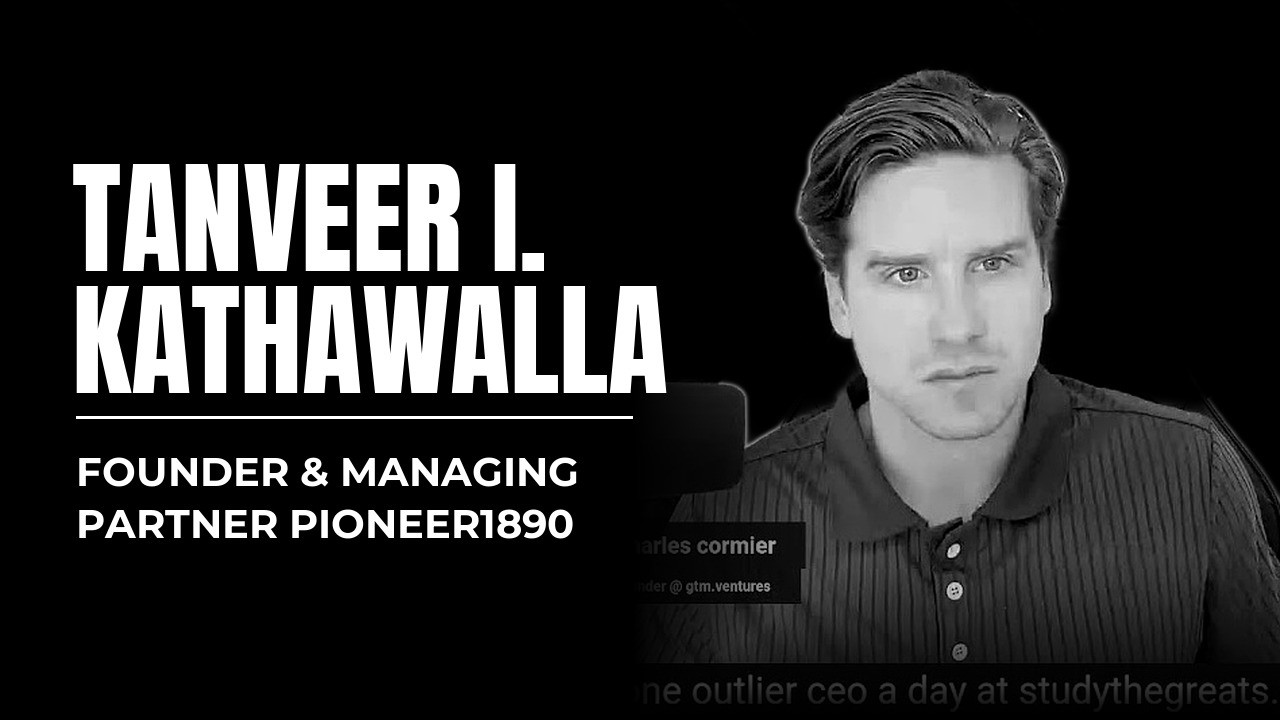
In this VC Wisdom podcast episode, host Charles Cormier interviews Tanveer I. Kathawalla, founder and managing partner of Pioneer1890, an investment and operating platform focused on strengthening the U.S. defense industrial base. Kathawalla explains the origin of the firm’s name—linking the 1890 frontier‑closure in America to today’s AI‑driven, geopolitical frontier—and outlines a mission to acquire, modernize, and scale small, niche suppliers that produce components for submarines, aircraft carriers, fighters, drones and future AI‑enabled systems. He recounts his personal background as the child of Indian immigrants, a peripatetic upbringing, and a career that moved from management consulting for the Pentagon to a drone startup, venture investing, and growth‑stage executive roles, culminating in the creation of a control‑oriented, $30 million fund that makes $8‑25 million acquisitions of sub‑$25 million‑revenue businesses. Kathawalla discusses his earlier venture Hedron (originally Analytical Space), its pivot from low‑cost satellite communications to defense, and the lessons learned about vision shifts and fundraising. He articulates the strategic thesis that, like the automotive industry’s tier‑1 suppliers, a consolidated network of mid‑tier defense suppliers can bridge the gap between prototype startups and large prime contractors, enabling faster, more precise, and ethically better warfare. The conversation delves into the Danaher Business System as a model for decentralized yet systematized value creation, contrasts it with Berkshire Hathaway, and highlights the need for new financing tools (private credit, project finance) because traditional venture capital is ill‑suited to capital‑intensive, long‑horizon defense hardware. Kathawalla shares a geopolitical outlook centered on the U.S.–China competition, citing the “Davidson Window” (2027‑2032) for a potential Taiwan conflict, and stresses the importance of building domestic supply chains to meet that challenge. He also touches on broader themes: the historical analogy of Caesar’s challenge to entrenched elites, his views on U.S. immigration policy and talent pipelines, a brief anecdote about Allbirds’ pivot to AI infrastructure, and ethical reflections on precision weapons versus collateral damage. The episode ends with contact information for Kathawalla.
Chapters
Welcome to another VC Wisdom Pod. We have Tanvir Kattawala with us today. He's acquiring and scaling the arsenal of democracies, an operator investor in Alexandria, Virginia. His company is called Pioneer 1890, of all things. And yeah, previously at NSI companies like Logically Hedron. And so forth. So Tanvir, welcome to the podcast. Tell us a bit more about yourself and what you've been up to.
Okay, well, first off, Charles, thank you so much for having me. Um, so I'm the founder of an investment and operating platform called Pioneer 1890. People always ask, what is— what is— why 1890? So 1890, there was the year the frontier was declared dead in America. So after 1890, you no longer could come to America, go out west, and get a free parcel of land. And if you wanted to find opportunity, you had to start inventing things or finding new frontiers. 1890 was quite fortuitous because that's why the Americans adopted the Industrial Revolution so aggressively, because there was no other opportunity. And you had the whole Industrial Age being built by people who were basically looking for ways to find improve their station in life. And I feel like we are very much in another 1890 moment. AI is transforming everything. Geopolitics is changing a lot of things. Generations all changing a lot of things. And we are at kind of that next frontier. And that's kind of the ethos. We're a very historically minded firm. That's how we'd like to think of ourselves. And so our mission is very simple. We wanna build and scale companies that are core to advancing American security and prosperity. And the way we do that today is we buy small businesses that are often supporting building the nuts and bolts or the locks or the specialized components that go into submarines, aircraft carriers, fighters. And we buy these businesses, we invest in them and grow them and help them develop products and relationships with the next generation industrial base. So we basically see if you're a company, if you're a small business that's maybe building things that go into the F-35, we try to buy those businesses and help them so they can make things for drones and robotics and eventually AI infrastructure.
I love it. And who are you? Who were you as a kid? Who are your parents? Did they immigrate to the US? First gen? Tell me a bit more about your story.
I'm a— I guess my entire life is defined by, I guess, transformation. So I was born— my parents, both my parents immigrated to the US from Mumbai, India. My dad was getting his PhD and MBA at Carnegie Mellon. That's where I was born in Pittsburgh and spent most of his career in the corporate world. Because of that, I like to joke, I have a lot of similarities with a lot of military brats. I changed schools about every 3 years growing up. So I was born in Pittsburgh, then lived in Cincinnati, then lived in Chicago, then lived in Boston. Then lived in St. Louis, Missouri, and then Paris, France for about 3 years. I went to an American school there. And then I went to college in the D.C. area and have spent most of my career between the D.C. area and the Boston area. So I'm proud as an adult. I said in 2019, I'm not moving anywhere. Virginia is home. I married here. I went to this— I went to— I did a leadership program here. My kid is born here. So I like to think now as an adult, I'm a— I have an adopted home in Virginia.
And why Virginia?
Uh, mainly, you know, I, I had a chance to spend some time here growing up and, uh, in my— when I was in college. I launched when I, when I had a satellite business. We had a fair amount of operations in Virginia and just kind of fell in love with the state, its people, and, and it's become, uh, I think the community of my adulthood now.
And where does that ambition of yours come from? You're still young, probably around the same age you and I. But I don't often cross paths with other very ambitious individuals. Where does that come from in your case?
You know, I think if, if you kind of take a step back, when you're a person who moves a lot, when you're consistently a new kid, you often have to figure out how to, you know, what's that new environment, who are the big groups, what are the social norms. It's very similar to kind of any entrepreneur who have to figure out a new market. And the, you know, one of the core things when you, you know, moving a lot gives you a breadth of a lot of experiences, but also kind of leaves you wanting for some version of belonging, being part of a community, having some level of stability. And I think a lot of my ambition comes from is, you know, I didn't have a community growing up. Now I've built one as an adult. And as when you now you're— when you see yourself part of that community, you want to make sure you do everything you can to protect it. And I think we, as I mentioned before, I think we're facing a lot of big challenges. And those challenges, you know, as you, I think, as you kind of reach older, you realize there's not, there's not the, there's not a bunch of other adults that are going to be solving them for you. We, our generation is now taking charge of a lot of the leadership of this, and our hands is going to be on the tiller. And so if you don't fix it, who else is, who else, there's no one, there's no one coming behind you.
Your connection is lagging for some reason. Um, tell me about, yeah, your transition from, uh, working at a company to launching your own fund, Pioneer 1890.
Yeah, you know, it was a very, uh, uh, non-traditional journey. So I started my career off, I was a management consultant. I worked for big— I worked for the Pentagon and, you know, big healthcare organizations. as corporate as you could get. And I saw that I struggled in that kind of environment because you're often more focused on making sure a process was done rather than driving an outcome. And that's what pushed me further and further into the entrepreneurial world. I eventually had a drone company I tried to start and then eventually led to a career as a venture investor. And so as a venture investor, I got to saw all these startups getting built and see all these companies scaling and what product market fit, how do you take an idea from concept to company and company to business? And then the last decade of my career, I've been the kind of growth stage executive companies have brought in when they've reached that inflection point where we know we have an idea that has demand, we have the the right ingredients to build something exceptional. And now we have to kind of put it together. And so that those experiences, having seen companies at the private equity stage, at the startup stage, kind of culminated into building my firm. We're really helping those companies at that kind of growth stage figure out, you know, the difference between staying as a startup and small business and then becoming a business, big business. That's kind of where we, where I've— Realize I have a unique set of experiences and skills.
And tell me about Hedron specifically, right? I guess that sort of shaped your mindset for 1980.
Yeah, yeah. Tell me, it was, you know, in the beginning, the idea of Hedron actually was called Analytical Space at first. And the idea was there were, you know, thanks to SpaceX, you could now launch something, launch a satellite in space that used to cost $10 million for $1 million. The cost of launch had gone down from— to launch a water bottle in space in the beginning of 2010 would cost you maybe $5 million. Now, by 2015, it would cost you less than about $500,000 to do that. And so you had this dramatic— as launch costs came down, people were building these new types of satellites. These are called small satellites. And you could build satellites for less than a couple hundred thousand dollars. And so there's a— whole wave of new satellites that are entering what we call low Earth orbit, which is about the same orbit as the space station. So you have 3 different orbits. You have low Earth orbit, you have medium orbit, which is about 15,000 kilometers away from Earth, and then 36,000 kilometers away from Earth is called geo-orbit. And that's— it's a unique orbit because you follow the curvature of the Earth, so you can have your satellite pointed at North America constantly, and it follows exactly where North America would be at any place where the Earth turns. And so there was a big challenge of all these satellites in orbit, but the connectivity, the communication system hadn't changed since the 1960s. And we were trying to build optical comm technology that would allow basically high-speed internet to happen in outer space. And the Earth has some physical challenges. The Earth is 70% water, 30% land. So you can't put ground stations all over the world. And so we were trying to solve that challenge. It was, you know, they had some high points and low points. Fundraising initially was difficult, then it got easier. And then I like to tell myself, man, I was a great fundraiser. But then I remember in 2015 to 2020, money was very widely available. So it was like, it's like fishing in a stocked pond. And I think what we've struggled with, we eventually found product-market fit in only being a defense company. And being a defense company, in 2018, 2019 was not what it is today. It was considered basically, you know, no one wanted to work at a defense company. No investors wanted to support a defense company because they thought there were some LP rules. They thought it was a, you know, you're in a market that no one really gives you a lot of multiple credit for. And so, you know, the company, when it tried to pivot into defense, it kind of fell apart. And I think there were a lot of management lessons I learned from that of, You know, how to— how do you better deal— how do you kind of deal with a change in vision and that conflict that kind of comes with that?
What was your turning point at which you knew that, yeah, defense was the right sector for you? Because defense is heavy, right? Like, there's some patriotism most of the time, but at the end of the day, sometimes you're, you also responsible for, for the death of other humans. So how did you— but obviously it's a good return, right? Especially in America, it's a gigantic industry. Um, what specific decision led you to, uh, go all in into this?
Yeah, I think there's like 2 points I'd make on that. So first is that I believe— I'm a very proud American, and I do believe For America to be able to determine its own destiny, it's got to have its— it's got to have the best national security in the world. And America generally is a force for good in the world. And if you're— if by helping America have the best tools, you're also, I think, helping America broadly on a national scale. And then number 2, you know, most defense technology allows you to have much greater precision. So if you think about it, you know, 50 years ago, if you wanted to, you know, have to make the unfortunate decision to, like, let's say, bomb a place in Afghanistan, for example, you would have to, you know, launch a missile, and there might be a much larger set of collateral damage. With a drone, you can target that exact person in that house, you know, in the, you know, in the windowpane, and only And only maybe put— and don't put any collateral damage at risk. So I think greater precision makes warfare much more targeted, much more ethical, and we avoid the, you know, we learn the lessons from World War II and not have, you know, millions and millions of civilians die so needlessly.
Maybe try switching browsers, Tandy, because we have a Hard time hearing you. Maybe just copy paste the link in a new browser. Um, uh, but I, I got the most part of that, um, that answer. Uh, how big is the fund? Because I read like some of your investment, like Andrew and all of that. Um, how big are your investment? Who do you raise from? Uh, give me a bit more details about the fund itself.
Yes, so we, um, We were going down the path of raising a committed fund about 2 years ago, and we made the decision that we want to change strategies and become a control-oriented fund. The decision to do that is— there's a saying Henry Kravis says, the world needs another private equity fund like the world needs another McDonald's. There's not just— and one of the things that we see that we can bring to bear is a different type of strategy in investing companies long-term, Not— we're not trying to sell like traditional private equity. We're trying to basically be the last home for these companies. And so due to that, we are actually not set up like a fund. We're set up as a company and our investors buy equity. And due to that, we have— so our kind of our investing structure is different. So we don't draw from a committed group of capital. We will just— we just sell equity every time we want to do an investment.
So how big is the fund usually? How much do you raise per year? I guess you're at fund 1.
Yeah, we're, we're at fund 1. We, we have about, um, $30 million, uh, uh, uh, pooled from our, uh, group of investors and limited partners. Um, and so we're looking to do 2 or 3 acquisitions in the next 12 months and then, uh, And you said these are smaller companies producing pieces for greater end products, right?
So, um, how much would one of these acquisitions cost normally? Is it a couple of billions— a couple million, sorry, not billions. Um, uh, give me an idea of like a potential company you'd acquire with, uh, with $20, $30 mil.
Yeah, so we generally are— that's what we're looking for. the deal values we're dealing with is generally anywhere from $10 million, you know, $10 to $8 million on the lower end, all the way up to about $20 to $25 million on the higher end. And mostly we are, these are, I would say, company revenue-wise, usually sub $25 million in revenue. And mostly these are businesses that are on sale for, driven by succession issues. So basically founder wants to retire or, you know, the business owner is tired and just wants to call, wants to kind of pass on the baton. We do, we did initially look at transactions that were kind of special situations in nature, which is usually when the company's in default of its debt or it's a corporate carve-out opportunity. We still look at those occasionally, but we view that we want, right now we're really focused on building a platform in the submarine space. So we're looking to find an anchor company to acquire, and then maybe we'll look at some of these more special situations transactions as complementary add-on businesses.
Got it. And what's your thesis behind acquiring these smaller companies that produce pieces? Um, because I mean, I've evaluated some of these companies, uh, that they're not always busy. Sure, they're cash flowing, they constantly have orders. Is your thesis that America is going to produce more Warships, or is like, why would it be intriguing for you to acquire these? Or is it that Anduril will eventually acquire one of these because they're part of their supply logistics chains? What's the thesis behind that?
Yeah, the vision behind that is if you kind of look at the automotive industry, you'll see you have GM, General Motors, and Toyota and Tesla, and then on kind of one end of the spectrum, but then you also have very large suppliers people who make windshields and they sell windshields to GM, they sell windshields to Tesla. And you have what they call these scaled middle-tier suppliers. And those are really important because GM doesn't wanna have to manufacture every component of a car that's not germane to its unique IP. In the defense industry right now, the primes, the big incumbent companies are very vertically integrated and they use that as a business advantage. But also that means that if you're a new company who's building maybe maybe a new prototype. Let's say you can build— you're trying to— you're a new drone company. You're often stuck because in order to now to get real contracts, you need to be able to produce hundreds and hundreds of these drones. And you cannot— there's not enough venture capital money to keep on just raising money to go build your own factory. There has to be much— there has to be intermediate suppliers, contract manufacturers, people who can give you the components without having to do it all yourself. And so We— our thesis behind is if you can buy a lot of these small businesses and band them together, you're going to be able to build suppliers that are going to be accessible for the people who are going from prototype to production. And there's still a sizable amount of demand for new defense systems. Like, for example, the US just awarded a contract of $76 billion for 4 new submarines just earlier last week.
Yeah, um, you said prototyping though, like prototyping is messy, it's more— most of the time it's not profitable, right? So I guess it's like scaling is the, is the argument for this, and then uniting them so that they're more efficient. You, you plug them on one backend system, one CRM, you organize them, you modernize them. I guess that would be the argument. You put like a sales team because A lot of these companies are run by older people that run the business the old way, right? Like they're sort of comfortable, they're cruising, they're, they're not going places. I guess modernizing these companies would be great and potential acquisition down the line by a bigger company could be great. What's that company called? The guy that's building submarines, the ex-Navy SEAL now, and banker. Have you heard about that one?
You're talking about Saronic?
Yes, yes, that one is a behemoth, right? Like, that one's growing extremely fast.
Yeah, exactly. Those, those are what they call the neo-primes. So you have companies that have been able to raise so much venture capital money that they're able to now compete with Lockheed Martin. There is a number of companies that are not going to be able to do that, and that's how we view our, our kind of long-term customer base. We view ourselves— if there's a defense company or kind of industrial company in the US called Danaher, that's where we are. Our template is we want to build very much of a Danaher like that for the, the defense space.
Yeah, I've studied Danaher not so long ago. Um, I, I couldn't figure out why it was exciting. Can you tell me? I mean, it's, it's exciting because of the returns, right? But I'm not sure how these 2 guys that ran the firm made it like that far, uh, that well. Is it like the Constellation Software model? Like, what— you've studied them deeper, like, why they're so impressive, Danaher?
I think there's, there's there was kind of 2 bets, 2 or 3 bets they made that turned out to be very right over time. So there was one model in industrial America, the GE model, which was the idea that if you could just buy— if you traded at 15 times revenue and you bought a company at 10 times revenue, as soon as you buy that company in a couple of years, now that company trades at the same multiple that you do. And so there was this multiple, huge multiple arbitrage to just be a conglomerate, because people thought if you're a conglomerate, you're so diversified, you're just bigger, you're better better company by scale. It turned out terrible model because if a company that sells light bulbs, why does it own a TV station? There's not really much overlap with that. And GE was really focused on trying to create all these synergies and selling all their investors on how they're able to make 1 1 3. The Danaher Constellation playbook is very different. They have a headquarters staff of less than 100 people that are running maybe a, you know, $20 or $30 billion revenue company. And they, when they buy these companies, they're highly decentralized. You know, uh, in, in, I think in Danaher, for example, you may not hear from a headquarters person for maybe— you might hear them only like twice a year. But the, the genius of their system is they created basically a system, uh, called the Danaher Business System that allows these companies, when they get acquired by them, to improve every level of their operations, their HR systems or manufacturing operations, the way they do business development. So they help give them an operating system to how to be the best version of themselves. But they're not prescriptive by saying you need to do X and X. So they allow the organization to operate with the leader who's got the best information. And they're not trying to dictate, force ideas that come from, from kind of a headquarters staff.
And how's that model different from Berkshire? I'm guessing it's a bit more modern, right? But what are the differences and similitudes?
So Berkshire is the most extreme version of that. You know, Buffett acquired an insurance company and he used the float, what they call in the insurance industry, the excess cash you can invest to use that capital to kind of build Berkshire Hathaway that we know today. The, you know, so it's the holding company model has been around probably since the beginning of the 20th century. Standard Oil could have been considered a holding company. And so we see there's a couple other models of this. You have Danaher, Constellation, Heico, TransDigm, a company called Amphenol that's been publicly traded for the last, you know, 40, 50 years. Where the other tech version of this that's been getting some press is a company called Bending Spoons. It also has a similar model. So basically it's the model is called the kind of serial acquirer where your core business model is you acquire other companies. And the goal is by your value prop is you can acquire other companies because you can help those companies grow better than they can grow by themselves. But you're not buying the companies as a part of the integration play. You're buying the companies because the company on a standalone basis is valuable.
Coming back to the philosophy, or I guess the geopolitical thesis on the US being a hegemony, right? Like, I guess you've studied that maybe a bit more than I did, but your thesis, right, to steelman it, I guess US has been providing world peace through hegemony, through capitalism. Uh, in the last couple of years, sometimes that system has failed, right? And I guess it's the Palmer Luckey argument that Lockheed is probably not in a good place, and all these, these big boys to keep America safe. There's growing opponents right now. And I guess that is your concern. That's why you're bullish on investing in new types of companies that can move faster, can produce more. so that world peace can be maintained. Is that your thesis? Is that a good steelman?
I think some version of it. I would say my, my, like, personal motivation, I'm very much— I mean, I was in the space industry. I very much think that humanity, you know, the core urge of every, you know, human, you know, since we came out of the cave is to explore and push further. And I do see space as the frontier that We should have done much better. I kind of look at our technological progress and say, man, we are— this is— this is— we should be much further along right now. So to give you a comparison, in the Roman Empire, when the Roman Empire— Roman— the Roman Empire was about 150 years away from coming up with the early part of the Industrial Revolution. If they actually had reached the Industrial Revolution, you don't have the Dark Ages. Humanity would be— we would— we would have colonized the solar system right now. We would have— 24th century technology in our current modern day, because the compounding knowledge that would have happened after that, you would have, would have changed the trajectory. But the Dark Ages basically set humanity back to basically where it was when it developed basic civilization. People went from basically having to not having to be a farmer to like, if you couldn't farm, you didn't eat. And so technology— humanity doesn't always move in forward progress. There's a lot of— there can be a lot of regressions if we're not careful. And since the 1970s, after we landed the man on the moon and we launched the Concorde, you know, people thought supersonic travel would be the mainstay in less than 10 years. The Concorde didn't work. We never went— after a couple additional missions, we never went back to the moon. And if you— most of our technology innovation has really been in software and applications on the screen. We really haven't done anything in the hardware realm really since the 1970s. And that we're still— so there's a— I think there's a fair amount of catch-up we have to do that if we want to build, to keep on exploring, we want to keep building the next frontier of humanity, we've ignored the kind of manufacturing hardware side to our own detriment.
What's the counterargument that let's say we create a Private corporation that's even stronger with government. Let's see that Andrew L., right, like starts producing a bunch of AI killer bots that are 100 times better than most humans, tanks, submarines, drones all combined, right? Like a super intelligent killing machine. What could that bring some disequilibrium into the world? Could that even turn against— be turned against the US?
You know, I think there's always like this with the Skynet Terminator argument, but there, you know, technology is a tool. All it is is a tool, right? And it's ultimately, no matter how smart we build AI, at least for our lifetimes, humans will probably build some sort of kill switch in that. And it really now has to become— if I think about— if you kind of think what I think is even more insane, we as a world, we have nuclear weapons, but we have the governance systems around the global cooperation systems of like a medieval— that are very underdeveloped. So I always joke, if aliens were watching us from above, they'd be like, Marvel, how do these guys have nuclear weapons but they fight over, you know, made-up lines on a map? The level of global cooperation is terrible. And so my hope is, as we develop, if the technology becomes, becomes so awesome and powerful, we also build institutions that enforce a level of responsibility and a level of cooperation to make sure that, you know, we don't destroy ourselves in the process.
Okay, so there's a bunch of these VC funds in the, in the defense sector. How big is that? You know, it is And what are the returns versus a typical fund that would invest in B2B AI SaaS? How do both compare to one each other?
So I'm gonna make a controversial statement. I think venture capital is very ill-suited to invest in defense as it's currently practiced. You know, defense is incredibly capital intensive, very long horizon cycles. They're, you know, the Pentagon today still spends less than 1% of its budget on venture-backed startups. You know, the reason why the budget's grown a lot, so it is the absolute dollars seem like a lot, but at the end of the day, there is, you know, the defense industry is still very, very dominated by the 5 incumbents. There's a reason why it's dominated by the 5, these 5 incumbents, and it is not— You— there, in order for defense tech to succeed, it's going to need much more longer duration capital. Venture capital is great for that technical risk part, but once they isolate that, finish that technical risk, they have to build factories, they have to build hardware. There needs to be much more capital deployed in that sector, like private credit, new types of defense, new types of loan spending. Very similar to— the US was not able to develop the Permian Basin in Texas until a tool called project finance came up where you could start investing in projects in an isolated way to isolate some of these risks. And I think we're gonna have to develop new financing tools in the defense industry. So there, a friend of mine started a company called the New Industrial Corporations. It's a new type of private credit fund to help fund hardware for a lot of these venture-backed startups.
I think in the answer, in the questions you answered and in the podcast, you talked about Allbirds. Tell me a bit more about that one and their latest weird pivot.
Yeah. So when I was an investor, we were looking at investing in Allbirds and I was just a junior associate at the time. But the analysis that came up is basically that the shoe industry is all about marketing. It's how much you can spend in marketing to get your shoe as many eyeballs as possible. And you look at Nike's ad budget or Reebok's ad budget, those are just billions and billions and billions of dollars. And the idea that you're going to have a direct-to-e-commerce shoe company and that you could be able to break through that noise. A lot of people had a lot of doubts on that. I think where the analysis missed is Nike sells, I don't know, thousands of different types of shoes. Allbirds at that time was only selling one shoe. And if you're only selling one shoe, that simplicity allows you to break through in a lot of ways that the— if you kind of assume the industry structure was not going to change, you would have missed. Now, I didn't have my bingo card that you're going to go from a shoe company into an AI infrastructure company, but I guess stranger things— we live in interesting times, I guess.
What's your take on the current immigration policy in the US?
I think I'll let this— I did write an op-ed about this, but I will say, you know, my from a high level, just from like the, you know, just from a high level, you know, the US has never had a higher portion of foreign-born citizens, foreign-born folks in the United States than since the 1920s, when there was like a massive immigration boom. And just like anything, if you have a bunch of people that are a bunch of new people and, you know, with different languages and culture, you're going to have some— there's going to be some you know, chaos and some growing pains. And I think the U.S. now has to really think about the assimilation and figure out how it's going to, you know, welcome a lot of these newly arrived Americans. And I think the U.S. is— I think the immigration debate really is also, I think, getting conflated with the economic scarcity issues where AI is taking a lot of entry-level jobs. People think people are constantly worried. A lot of companies are using AI-related— are spending so much on AI CapEx and they're using made-up AI productivity gains to do layoffs because they need to cut costs. And so I think when this economic scarcity becomes a larger and larger thing, people view— people kind of turn very tribal. And I think that's where a lot of our immigration issues are really coming from.
Tell me about the latest conflicts, um, in the world and what is your view of how US should intervene in them and how that affects your investment? Uh, Ukraine, Iran, um, also the strike in Venezuela, right? Monroe Doctrine. So tell me a bit more about your, your philosophies with that and how that would affect your investments.
Yeah, so our, our investment thesis is really based— I mean, we see these as kind of temporary I'm not smart enough to know how these conflicts will fully end. I think the most consequential— we see the most consequential, you know, competition is really the US and China, and that is going to be if there's a conflict in the Pacific. There is something called the Davidson Window. This former admiral in the Indo-Pacific said that by 2027, China will have the ability to take Taiwan, and China would do that anywhere between 2027 and 2031 or 2032. And so that— we're very close to that Davidson window, and fighting a conflict in the Pacific is a different sport than all the conflicts that are going on right now. In World War II, the US spent more money trying to build the B-21 bomber, which was the bomber that allowed the long-distance bombing in the war in the Pacific. That cost more money than the atomic project, Manhattan Project, did. Right, so the war— they call it the war of distance. The distance in the Pacific is so vast, it's going to— it will take massive leaps of our own technology today to figure out how to make drones that can go longer, how to make submarines, unmanned submarines go longer, build communication infrastructure, because there's, you know, there's a— China has technology that can cut subsea internet lines. So there's a— there's a— it's It is a massive, in my opinion, that is the core challenge and figuring out the tools and technologies and capabilities to get there. There's still a lot of work to be done.
Last but not least, you study history a lot. I think you're a fan of Caesar. Yeah, you're right. Like from the convos we had prior to the pod, like Caesar is sometimes being viewed as ruthless. Uh, politician, right? Um, yeah, like, why, why do you admire Caesar for what he did back then? Is he just a master navigator, someone that's, that's mastered, uh, achieving his objectives in, uh, an asymmetric environment? And who else do you study nowadays?
Well, I think, I think Caesar is an interesting figure because I think What gets missed about Caesar's rise is the Roman Republic. Yeah, it was a republic at that point, but really was not. It was basically an oligarchy where these very rich senators had basically taken most of the wealth and taken away from the people. So in Rome at that time, the reason why Rome went to war a lot is— but when you went to war, the farmers had to get off their land and join your legions. And then in return, these Roman senators would go and basically try to buy the land from the cheap because they would know that no one's farming it. And so these guys would come back from war and all their land would have been basically sold off for pennies on the dollar. And Caesar was the— Caesar was basically an avatar, would basically try to fight against that and fight against a lot of these, a lot of these very gilded-like system things in the Roman system to make it much more equitable, to make it, to make it, to spread opportunity throughout Rome. And because of that, that is why the Roman elites detested him so much. because he was challenging their dominance and their ability to kind of with impunity take whatever they wanted. And I think that that's the part of Caesar I really admire, is being able to have the courage of your convictions and stand up for the little guy, in my opinion.
There you go. Well, Tanvir, thanks for being on. Where can people find out more about you?
You can find me on Tanvir at LinkedIn. You can find me on X. I have a website, tanvircathcart.com. I would love to Uh, happy to hear from anyone.
It was time, Vina and Charles, for another VC Wisdom podcast.
Wonderful, thank you so much.
Thanks, dude. Um, this StreamYard thing, man, it's like— can you still hear me?
Yeah, I can see here. I checked my internet, it says I'm like at, uh, like the highest I can be.
Yeah, it's like right now I press
More from Charles


Founder Wisdom: the audiobook, version 2 (5 hours of stories from founders and CEOs)

8 CEO Questions I Love Asking: the audiobook (64 founders answer, in their own words)





