Terry Kim - Founder at Kaizen OS
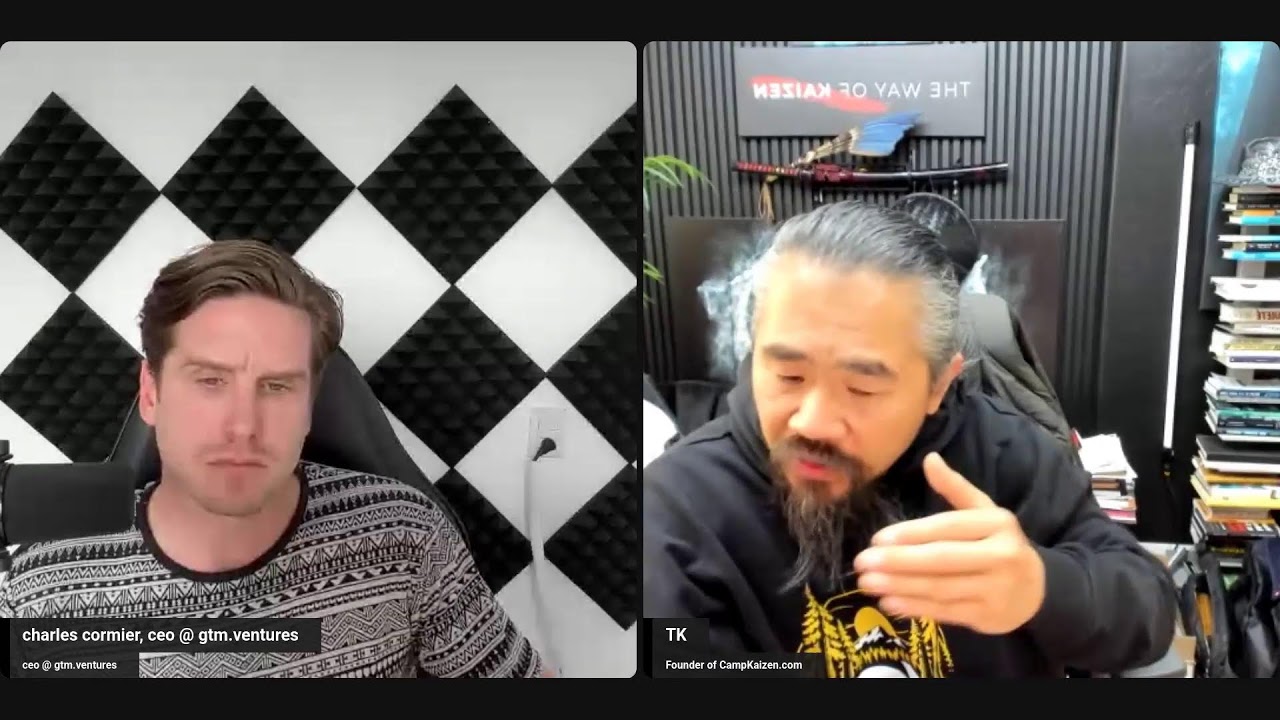
In this episode of the Founder Wisdom Podcast, host Charles Cormier interviews Terry Kim, founder and CEO of Kaizen OS. Terry shares his unconventional journey from a teenage DJ in Korea, through three years as an Air Force network engineer, to a dream of working at Cisco inspired by The Matrix. He describes the “red‑pill” moment that pushed him to leave a promising tech career and launch his first startup, eventually founding over 22 ventures, many of which failed but taught him valuable lessons. Terry emphasizes that money is a tool, not a source of happiness, and that true fulfillment comes from aligning work with personal gifts and purpose. He discusses the mental and emotional challenges of founder life, advocating for coherence practices such as forest bathing, breathwork, and plant medicines to reset the inner operating system. He introduces the S3 framework and Camp Kaizen, an immersive retreat in the ancient redwoods designed to facilitate identity shifts and heightened consciousness. Terry explains Kaizen OS, a modern operating system for building coherent, conscious organizations, and argues that AI can amplify but never replace the “human magic” of creativity and purpose. Throughout, he stresses alignment before action, clarity before movement, and an experimental A/B‑testing mindset for personal beliefs and habits. The conversation ends with resources for learning more about Terry’s work.
Chapters
Welcome to another Founder Wisdom Podcast. We have Terry Kim with us today. Terry's a great guy. I just met Terry and I see great things for both of us. Just recently became a client. He's a founder, CEO, investor, a mentor, Kaizen entrepreneur. He's sharing small daily practices for a remarkable rich life on his LinkedIn and on what is called Way of Kaizen. a newsletter, you can follow it. He's in the Bay Area, he's exited a bunch of companies, he's been featured on Going Public. I checked out his episode, it was pretty wild. And yeah, he's just a wild man, Terry. I, I, I'm very fortunate to have met you. Uh, tell us what's up and what's good in your life.
Hey, what's up, Charles? Uh, glad to be on the show, thanks for inviting me. And, uh, yeah, I'm excited about Camp Kaizen in the ancient redwoods happening on the 15th of October. So that's kind of top of mind for me. It's going to be a conscious gathering for epic founders that want to build what matters around a campfire.
Nice, dude. How did you get there in this life? How was your childhood? Let's start with that.
Yeah, um, let's rewind back then. Um, you know how my childhood was, um, You know, pretty wild. I would say I was such a good kid until my teenage years, and I got into a lot of trouble. So at 15, I ended up, um, getting kicked out of high school, um, and, you know, found a passion for, um, getting in trouble, but, uh, found an early passion for music, um, and became a house DJ. So my first kind of, uh, job in, in the real world, um, I remember making my first 500,000 won, which is equivalent to maybe, I don't know, $400 right now, let's say. Um, and it was my first paycheck, you know, all cash. I remember it was so thick, I was counting it. I was like, oh my gosh, I made my first, uh, monthly salary, and it was from a passion, you know, just, um, working at a nightclub. My first job, I saw someone spinning, um, these vinyl records on stage, and it really piqued my curiosity. And I would say, yeah, that kind of, you know, got me into music. I got into K-pop, had a couple albums, um, whole different life time ago. And then, um, yeah, I would say at 18, 19, um, I got into— I ran out of my visa because I was in Korea. Um, my dad's in Army. I was a military brat. My dad was Army retired, and I had to find a way to stay in country. And so I got a job at a hotel to keep my visa current. But outside of that, I was really obsessed with music in my early years until, um, uh, 1999, pre-dot-com bubble. And I got the technology bug, so to speak. And, um, knew my, my, um, ex-wife was pregnant at the time, and, and I knew my DJ life and career couldn't— I guess in that, that frame of mind as a kid, I thought that wasn't a career to support a family. So, um, out of all things, I decided to join the military, and that opened up a whole nother chapter in my life.
Yeah, what did you learn in the military? I think you were Air Force as well, which is pretty baller. So, uh, what did that unlock in you?
Yeah, it helped me discipline. It, you know, it forced me to grow up, right? Um, went through basic training boot camp, and, um, I was miserable for a couple weeks, but it kind of toughened me, and, and I learned integrity and excellence in all we do and, and discipline, all these great values. that the Air Force has taught me. I did 3 years in the field as a network engineer, systems admin, doing IT work. And then for 2 and a half years, I volunteered for a special duty assignment in Keesler Air Force Base to teach basically 18 to 20-year-olds through a 16-week program to become cyber and network infrastructure kind of engineers in the battlefield. So yeah, learned a lot, cut my teeth through the Air Force, picked up a lot of technology skills, learned to grow up really fast. And yeah, that really set the foundation of how I became a network engineer. And ultimately, at 21, right before I joined the Air Force, I had this dream. My big dream was to go work for Cisco one day, because in 1999, they were building the plumbing of the internet. And I knew that technology was the future. In fact, what inspired me was the movie The Matrix in 1999. Have you seen it?
Of course. How could I not?
My favorite movie of all time. And I would say, yeah, that kind of started my IT journey or my hacker journey because I wanted to be a hacker after I saw Neo hacking away.
And do you think there will be such a future in which AGI will pretty much dominate everything and if there is such a future, what percentage of humanity will take the blue pill versus the red pill? Wow.
Well, I think it's already happening right now. I mean, you know, I, I always joke like, um, that, you know, when we have a pattern interrupt or something, we could become the glitch in the matrix, so to speak. Um, where, you know, most people— like, like, to kind of let— like, to To paint the picture is like when I was at Cisco, that's what I felt like. I felt like Neo, a cog in the wheel, and I felt like I needed to like I needed to wake up out of that. I needed the red pill, and my red pill was my leap into entrepreneurship and and the world of startups, which I had no idea about, and and how to even start a company, right? I didn't know these things. So fifteen years ago, I took the leap at the biggest time of my IT career. I decided to give it all and go into the unknown.
Yeah, because technically you could have still been there, right? Like some people have done that 10, 15 years at one company scaling from $200K to $500K to $1 million a year. And then you sit on boards and with old people and it's all the same thing. It's all a game, right? A game that pretty much fills your pocket but empties your soul, right? Like why did you decide to take that risk and Did people around you agree with that risk you were taking launching Check Action?
Yeah, I think people thought I was crazy, and and I think people don't understand what you're going through, and it's really a decision for yourself at a certain point. I think there's the study I read by Harvard University where they did a study of people like joy and happiness levels, and. They realize like once you make over $72,000, um, you know, your happiness doesn't increase as much as you think it would, um, based on, you know, the world saying you need more money, more success, and all this. And, um, I love the movie The Family Guy— uh, The Family Man, Nicolas Cage. Um, it's a perfect metaphor of like where he got to go back in time and see a different timeline versus him being lonely at the top with all this money But no one to spend Christmas with, where in the other lifeline he had two kids and married his you know soulmate. So the question is like: Is is it money that's providing you happiness? Is money a tool? And I realized that money was a tool, and the more I made didn't make an impact to how much joy or fulfillment. But having true alignment and working on passion projects, I find, or something I'm curious about—it's obsession, is it not? most of us entrepreneurs have to find something we're obsessed with. And I think that's where you can find something where you can create something new that is meaningful for you and could be tied to one of your gifts. 'Cause I believe that all of us carry gifts that are not unfortunately actualized in this lifetime. And it's like, let's discover ourself enough where we can start actualizing these gifts that really matter versus being a cog in a wheel in a corporate 9 to 5. And there's nothing wrong with the corporate 9 to 5. I have many employees that love our mission and their jobs. And, you know, at one point I was also obsessed and passionate about Cisco technologies. But there's a certain point in life where we hit a plateau and we just keep doing the same grind or doing the same work. And we never ask ourselves, why don't we get off the hamster wheel? Is there another path? Why are we doing this job that's creating so much suffering?
But there's trade-offs as well, right? Like, even when you have your own business, it can become quite stressful. Did you go through the ups and downs of the founder life? Describe some of these, uh, events and moments.
Yeah, I mean, I've had my fair share of failures. In fact, I've had more failures than success. I probably had launched 22+ businesses that have failed, or ideas. And nothing is really a failure in my entrepreneur playbook. They are all lessons. And to be honest, anything that you start as a side hustle or work on and you lose momentum is that you're just giving up. But if you don't give up, like, you know, the way I've built this company where we're 10 years changing lives, we're doing our 10th year anniversary. this year. And this company is dear to my heart because it, it, it, it didn't come from, oh, I want to be on Forbes, or I want to be on TechCrunch front cover one day. No, I just loved changing lives, you know, mentoring students and getting people into the IT field. And then one question was, how could I scale this when colleges are saying that you need 4 to 6 years of, um, degrees or years of, of education and these degrees in order to break into engineering? Which I knew wasn't true because why? I taught the 16-week, 4-month boot camp to take 18-year-olds into the battlefield. So we know that you don't need 4 years to learn something that's a high-demand skill set, you know, to build a career out of.
Yeah, and nowadays it's mere days with Claude Code. I'm starting my own AI school for kids, right? And it's definitely, uh, stuff we'll be teaching them, right? Because for next generation, it's a bit scary. Will they have jobs? You know, if like there's AI and AGI out there, I personally don't think so. I just think that founders will be able to survive since they have grit, since they have creativity and other acquired skill. And I think most people will take the blue pill, right? Like, was that the pill that just like everything keeps on going normal? Yeah. The red pill is like stuff starts to change. Entrepreneurship is very much of a red pill. But even as an entrepreneur, sometimes I found myself plateauing, right, and not going anywhere. What's your cure to that? Right? Like you and I, we've talked about my DNF that I had at a race not so long ago. So maybe imposing too much on myself, maybe too much noise, not enough clarity, not enough retreats and stopping, right? So what's your diagnostic on that?
Yeah, my diagnostic is returning to coherence. It's such a great question. How do we return back to coherence? For me, that's going into nature. So nature has the codes. And there's also studies that show that when you go into a forest— you ever heard of forest bathing in Japan?
Yeah, of course.
Yeah, so it's an incredible practice that nature has codes to downregulate. And so we can remove and peel off the distraction, the noise. Basically, there's so much noise, right, of how we've been conditioned, who we should show up as, and, and, and then the people-pleasing kind of invalidation, and the ego starts coming up. And then we get drowned with all this ego and outer noise and all these to-dos, when in reality we can return to stillness and find all the answers that we're truly seeking. But entrepreneurs are designing their calendars where they don't have that downtime. They don't have the ability to downregulate because we were told to hustle. We were told and taught that you have to, you know, grind to midnight and burn the midnight oil. And sure, I've done that, right? But I've learned that all the things— listening to 1,000, you know, founder interviews or going through all the self-doubt into the abyss— because you are going to go into the abyss and self-doubt and all this is gonna start accumulating, when the business doesn't work, we try to blame all the outside circumstances, whether it's the economics, the, the team, the co-founder. We'd like to shift blame. Why? Because we don't like to accept full responsibility that everything that's happening is due to our inner world. And so I just learned this the hard way. And to be honest with you, I've never talked about this because It's been an 8-year spiritual journey I've been on, and what I found is I'm learning constantly, and the character is the ceiling. That's what I found in my recent discovery, is that in order to build all this outer success as a founder, or what I call a conscious company, because that's what we're really all about— kaizen, change for good, or change for virtue as a substrate— is that Conscious companies can only be built by conscious founders. So what does it take for a founder, an entrepreneur, to become more conscious, to become more intentional about what they are producing into the world? And if that gets aligned, then action can come after. But I always say alignment before action, clarity before movement, because a lot of us move without that clarity piece.
Yeah, dude, so much. I'll connect you to a friend as well. You guys are in the same vibe, uh, George Siosi. He's in Thailand. It's powerful stuff, dude. Like, yeah, my brain was like, okay, is the brain sort of a computer? The data is already there, but we can't access it because we're not like in a specific state. We're just like in execution mode. Okay, we're stopping. We're stopping execution, but at the expense of finding insights that can bring 10,000% more value, right? Like, sometimes we need to stop, right? We need just to Give it a pause and have it synthesize stuff, and then you can top it. Top forest bathing and breathwork with like psychedelics, which in my opinion are like the ultimate portal, right? Like yeah, I can I can try to meditate myself in a very deep state. It'll take me like an hour or two, and I'll be bored the fuck out of my mind. Or I can take psilocybin and get there very quickly. But that's also because I'm a psychonaut— is that how you call these people? Like, I, I have like experience with these things, right? But in my opinion, they're the ultimate hack. How do you manage that as a medicine, as a tool to access your higher conscious?
Yeah, I mean, I, I am a, um, um, believer that plants also have codes. And if we've been indoctrinated with a certain frequency, uh, plants can basically expand us to a new vibration. It can also pass on, uh, wisdom. And so whether it's psilocybin or, you know, um, peyote cactus, uh, these type of plant medicines, um, can help, uh, you reach altered states of consciousness but ultimately help you reprogram and rewire your stories. Mainly plant medicines I've seen in the entrepreneur community or even the founder community is people that are wanting a shift in identity. Now, one thing is you don't need plant medicine, but if that becomes a modality to expand your mind, your consciousness, mind, body, spirit, I'm all for that. But you can't be using these substances to be in a loop, uh, constantly, or to use it as an escape, uh, mechanism, because I've seen founders do that as well. So it's all really about the intention, whether you're using plants, medicine, to help you accelerate your spiritual evolution, or you are using natural modalities such as DMT breathwork, which probably maybe a lot of listeners haven't heard about But, um, I think it's like the Grof, um, couple from Hopkins University. I forget their full name, but there was a couple that did big research on LSD in the late '70s, and they basically banned LSD. And then this couple was really interested in the altered states of peak levels of consciousness people would reach, or reaching these, like, um, having an enlightenment experience, so to speak, right? And, um, they basically studied breathwork and how breathwork can achieve those same states. And so what I find very interesting is that, um, uh, you can— they did a 3.5-hour study of breathwork, but you could achieve this in about 60 minutes, um, deep breathing, uh, through the mouth, um, and exhaling through the mouth. And so I've developed my own version of, uh, this modality which we'll have at Camp Kaizen called Awaken with Om. So it's a 30-minute Tai Chi Qigong opening to align the chakras, and then we lay on the floor doing the holotropic breathwork that I mentioned, um, and we get into altered states of consciousness to be able to release trauma that's stored in the body or to be able to go back into the subconscious and plant new seeds, right? And to reprogram that. Because sometimes our, our brain and our mind is like an operating system. Sometimes things get buffed up and things need a reset, a complete reset, just like your computer sometimes needs to be rebooted. Well, how about the human operating system? We need that reboot. And so I, I always say, look at meditation, look at breathwork, look at walks in nature before you start exploring other plant alternative medicines. But yeah, these are all powerful tools we could, we could use a lot as long as we have the right intention.
Right. And ultimately, what is identity, right? Isn't it like some luggage we carry for evolutionary purposes? It helps us because it's stuff we can relate to. It's stuff that is safe. It's stuff that has served us. And when do you know that you need to let go of it? Because most humans are incapable of letting go of that. It's too safe. And they're too much in fight or flight to let that luggage go. It's like hoarding stuff in a house, right? It's like it's safe, it's there to serve me, but ultimately it fucking suffocates you at some point, right? And sometimes you need a cleanup. So when do you know that you need a cleanup and how do you make that cleanup happen? Should you start with psychedelics or should you start softer, right? Should you start with a psychotherapist? Like, what's your take on that?
I mean, from my experience, you know, this kind of advice would differ for the certain individual, but just on a high level, I would say that if we are not evolving from day to day and my life is not getting better, that's your signal. That's your signal that we need to change. We need an identity shift because we're living in trauma or fear that's holding us back from moving to that next level of evolution. So identity shift can happen with just the stories that we're telling ourselves. So, you know, the S3 framework is that we're going to learn through at Camp Kaizen is rediscovering yourself and aligning your story that aligns with your higher self, your true soul's mission. Because what's happening is you're probably living some other story. You're living some victim story, some traumatic story, something that needs to heal. But you're not giving time for that to happen. So how do you rediscover yourself? Well, how about, how about going into the forest for a few days? How about going into nature? Because if you go for a big run, I know you're a big avid runner. I'm sure on those 100-mile runs or, you know, marathon runs, you're having also processing a lot of emotions, right?
Getting lots of layers.
Yes. Peeling, discovering, and lots of— you're processing a lot. I could— I can only imagine also for those avid hikers that summit big mountains. You know, I just recently for Lionsgate went, um, to Colorado and we summited Cresson Peak at 14,500, right? What does that do to a person, right? That's, that's, that's what I call like a vision quest. And, and those 3 days can be transformational where you can shift your identity by a frequency shift. And a frequency shift means that all of a sudden you come out of breathwork and you're a new vibration, right? It's because something internally just shifted, just even one degree, and now you're vibrating at a higher frequency. So change for good, right? Every day you're improving yourself from the day before, and if that's happening on a continuous basis, your life's going to be a very rich life because that's what compounds. Good change.
Yeah, I love that. What about like A/B testing stuff? Maybe I should let go of, I don't know, uh, these friends on a Friday at the bar, right? Maybe I should not hang out with that person. Maybe I should stop believing that this thing that my dad told me at like 5 or 7, maybe I should stop believing that and see what kind of effect that has in my life. Do you subscribe to this, uh, experimentary mindset and just like start shedding things and A/B testing what works rather than going like in one drastic swoop?
Yeah, absolutely. I think A/B split testing, for the nerds out there, you know, is definitely, um, good experiments to have, especially in your 20s and 30s. You want to be experimenting, you know. I love Carl Jung's quote about everything is research up to 40, and he's so right. Like, Life really begins at 40, and that was 8 years ago for me. Um, in the Big Basin, I had a big spiritual awakening where I had a huge identity shift happen. And so I would say, one, always be open to question your belief system, because your belief system, as you expand your level of consciousness, it will shift and it will change over time. But if you're like dead set, I'm not changing this belief system, Right, then it's not going to allow you to grow. So these belief systems get programmed in us by the time we're, you know, 8 years old. So by the time you're 8, our parents probably and our teachers probably put a lot of influence into our belief system, and we carry these throughout our lifetimes until you can get into that subconscious state and pull them out. That's why it's so hard to do an identity shift for people Because a lot of the belief system doesn't just, you know, reside inside your head, but at a deeper subconscious level.
Yeah, that's deep stuff, man. So how do you merge the spiritual aspect with like the cash-making aspects of, I guess, old Terry? Like, how, how do both can dance together and scale together?
It's alignment and clarity. So when we're aligned with our true mission Right, that really serves our soul and our entrepreneurship. You can have both because through entrepreneurship, as you add enterprise value, whether it's a B2C business or B2B, you're adding tremendous value. And this is another topic, you know, I can talk for days, is around just being obsessed with the product, the service or product, right? If you've create a service or product that provides 10 times more value than what's existing, you will get customers. And that's how you build a company, right? Not through great marketing, not through a great landing page, but through an exceptional product or service offering. And so if those 2 things align, where you're working, you've got gifts, and you're creating a product and service that's changing the world and making impact, like That's, that's where you want to be.
Where do you want to take, uh, the Kaizen OS, and how does human magic merge with AI scalability?
Yeah, so Kaizen OS, we, um, me and my co-founder, uh, Justin Valentino, been working on this for the past year, and, you know, we basically have built this native modern operating system for coherent and conscious organization building. Because what we found is that there is no tool really that focuses specifically for building coherent and conscious organizations. So that's the birth of KaizenOS.
And how do you merge human magic with AI scalability? Like, AI can scale things, can execute things. I feel it's still not at the frontier human intelligence level, right? Like, you're super creative, you've compressed years and years of data, you have human magic in you, right? Which is not in everyone, by the way, but you have that. You merge the TKOS with like AI, you get AI, you get human magic at scale. How do you merge both of these things? And will AI magic replace human magic altogether one day?
Yeah, I mean, the short answer is no. AI will never replace human magic. We are a divine being that can tap in. I mean, this is a super intelligent, uh, living, um, body, right? System, whatever you want to call this being, right? So if we all— by the way, just a correction— not only TK, but everyone has magic inside them, and that's the gift that they can actualize. And then that magic can be the essence that you put into AI, because your essence is creating with AI an accelerated version. That's why this is crazy. Like, forget 1999 pre-com— pre-dot-com bubble. We're living in the golden AI era where you can recruit 2 people and 3 people, and as an MVP team, can make so much impact and change the world for the better. Right? So I believe that all of us have this magic. We just have to instill it. And we are the ones, not AI, that can tap into a higher intelligence, the source code. So if we have the ability to tap into source code through stillness, right, and pull that magic, and then with our heart, open heart, execute that with a team that believes in the mission and the values, that, that company stands for, you're bringing magic into the world. I love it.
Thanks, TK. Where can people find out more about you?
Yeah, just come to Camp Kaizen. Join us in the ancient redwoods happening on the 15th through the 18th, where you can rediscover yourself, align your stories to what matters, build the systems you need to create a better life, and to work on something that lights up your soul. So Camp Kaizen, and you can find, find me on House of Kaizen.
More from Charles


Founder Wisdom: the audiobook, version 2 (5 hours of stories from founders and CEOs)

8 CEO Questions I Love Asking: the audiobook (64 founders answer, in their own words)





