🇺🇸 🦾 US Transhumanist Party with Gennady
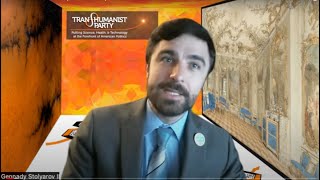
Gennady Stolyarov II, chairman of the U.S. Transhumanist Party founded in 2014, discusses the party's 43-article Bill of Rights and platform applying science and technology to governance. The party backs ranked-preference voting to reduce polarization, frames AI as opportunity rather than threat, and explores alternative governance models like seasteading.
Chapters
Longevity Wisdom Podcast Round two today with Gennady Stolia. Last time we did speak about a lot of cool topics which are relevant for US Futurists. Today we're going to focus on the US Transhumanist Party. So, Gennady, welcome back to the pod. Can you tell us a bit more about the Transhumanist Party?
Yes. Thank you very much, Charles, for speaking with me again. It's a pleasure. The US Transhumanist Party prizes science, technology and rationality. So, as our motto states, we wish to put science, health and technology at the forefront of American politics because we see these subjects as being transformational to the human experience. But discussion of them is sorely lacking among mainstream political candidates. And that is unfortunate because we see a lot of division, we see a lot of frustration today in contemporary politics, be that in the United States or in Europe. And yet technology has the ability to bypass all of these issues which have created societal and cultural divides. So we advocate for constructive solutions. We try not to take sides on conventional partisan wedge issues, the kinds of issues that get people emotionally riled up, but not really working to actually solve anything. What we want to do is figure out how technology can arrive at solutions that actually work for as many people as possible. And of course, longevity, the extension of healthy lifespan, the ability to cure diseases, to cure disabilities, to address sources of material scarcity. Those kinds of pursuits can be truly revolutionary in improving the human condition. And they are going to make a much greater difference in people's everyday lives than any sort of conventional political stance on a divisive issue. So that is what we try to focus on. The Transhumanist Party was founded in 2014 by Zoltan Istvan, who is a journalist, an author, world traveler. Now he is studying philosophy at Oxford University. But he ran for president in 2016, and he had a campaign on what he called the immortality bus. He took an old 1978 RV and he converted it into a coffin shaped bus. And he drove around the country in it in 2015, and he wrote a brief document called the Transhumanist Bill of Rights, which he actually delivered to the United States Capitol building. Now, after the 2016 election, he decided to move on to other endeavors. And he asked me to take on the leadership of the Transhumanist Party. And I have been the chairman of of the US Transhumanist Party since November of 2016. And I have introduced a variety of initiatives that enabled the Transhumanist Party to grow and get more input from within the Transhumanist community. So we took this Transhumanist Bill of Rights document and we requested suggestions from our members. And we did two rounds of ranked preference voting in late 2016 and again in late 2018 to greatly expand that document into 43 articles discussing essentially what are the rights that are desirable for not just human beings, but any potential sentient entities to have in a future, more advanced society. And furthermore, we have developed quite an extensive platform. You can find it on our website@transhumanist-party.org which addresses a variety of societal, governmental, economic issues from the standpoint of how science and technology could be applied, as well as how rationality and logical thinking could be applied to resolve some of the problems that people face today. So I think the Transhumanist Party strives to transcend common societal fault lines. We consider ourselves to be trans partisan. We welcome people from a broad spectrum of conventional political views. So one can be on the conventional left wing, one can be on the conventional right wing, one can be a centrist, one can be outside of the conventional political spectrum, one can be apolitical, and we would still welcome one's input as long as one cares about the future of humanity, one cares about actually solving problems, and one believes that there's a role for science and technology in achieving those solutions.
Interesting. Do you think you can do that with influenceable folks and common mortals in the US that watch TV all the time and are addicted to serotonin and are very much influenceable, or would it be better to just start a country from scratch, which I think, in my opinion, is equally hard?
Well, there are challenges involved in both of those approaches. Certainly when you're trying to change an existing political system, there are a lot of entrenched vested interests who desire to maintain the status quo. And the kind of sensationalist media influence that you described is certainly a mechanism for maintaining the status quo. Because if you keep people distracted, if you keep people addicted to the latest sensational event or site or some sort of controversy, then people miss the bigger picture. And that allows the ruling elite to essentially continue its own plans, its own projects, without as much oversight or as much possible objection from the public. On the other hand, of course, establishing a new country is a lot more difficult now than it would have been, say, 500 years ago, when there was an entirely new hemisphere essentially for people to settle in. I think right now, the challenges are approximately equal in magnitude. That is, however, not to discount the approach of trying to found a new country. The US Transhumanist Party in its Platform supports efforts such as seasteading, for instance, which is the creation of mobile, modular ocean platforms that could potentially serve as essentially basis for political experimentation, where people could try a different form of government or a different set of laws, and they could join together, or they could disconnect if one community decides that it doesn't want to be part of some larger political experiment. So there is merit to this approach. We also support micro nationalism. So if somebody wishes to declare a small jurisdiction to be its own country and experiment with a certain set of laws or a certain set of approaches, then we are in favor of that, because that could lead to policies that are more conducive to scientific innovation and technological progress. But again, there are some practical constraints to that. In order to create seasteads, one needs a lot of investment, One needs a lot of technological infrastructure, and one would need the countries in the vicinity of the seastead to respect that seastead's territorial integrity, which doesn't always happen. So in many cases, these kinds of emergent efforts Would need to partner with some existing countries in the vicinity. For instance, the Seasteading Institute has tried to set up essentially the equivalent of free economic zones and partnership with certain countries. But sometimes those partnerships have been fraught. So I think reforming the political system in the United States, while it is also a challenge, is an approach that is more accessible to a larger number of people. People who live in this country, people who want to remain American citizens, people who want to continue participating in the political system of this country. But they are frustrated at the mainstream, quote, alternatives, which aren't really alternatives at all. They're essentially all components of the same political establishment. And they want to bring about something different. So getting elected to office is not necessarily our objective, because that would be an enormous hurdle to overcome. But what is our objective is to get our ideas out there through the campaign process, through participating in elections where we can, and more importantly, through influencing policy, influencing policymakers from other political parties. To take these ideas from the transhumanist party platform seriously. And I'm quite encouraged by the campaign of our new US Presidential candidate, Tom Ross, and his vice presidential candidate, Daniel Tweed. They will be running all the way through November 2024 and spreading the ideas of transhumanism, Spreading a different type of approach toward artificial intelligence. Because this is an issue that has risen to the forefront recently with the emergence of large language models. And a lot of people have an irrational fear of AI. A lot of people think, one, that these models are capable of more than they actually are. And two, that they somehow pose an existential risk to humanity or that they're going to take people's jobs. And we have a different narrative. We try to focus not just on how AI could help people, but also what are still some of the unique human advantages faced by AI, but are rather complementary to the capabilities of AI. And these are faculties that we humans can develop and that our candidates can encourage more humans to develop and look at as opportunities brought about by the rise of AI rather than threats.
Right. Isn't it the problem though, the electoral system and democracy in itself? It has some limitations because when you have so many people in a country, I do think you're gonna get division and not sure how clear this is, but I have this dichotomy that if I would want to start my country, I would want to have people sharing similar values to mine, yet I don't want everyone to think the same. So I want this diversity. Yet I do not want, for example, folks that do not have respect for lives and folks that are lying more than 5% of the time, let's call it that way. So tell us about that dichotomy first, starting with the electoral system, going with the democracy, or you can take it piece by piece and we can continue the, the conversation in that, in that direction.
Yes, and certainly these are quite legitimate concerns with regard to the electoral system in the United States. It is dominated by two major political parties that are essentially aligned with one another. They're both part of the same political establishment. Even though they're very vocal about their differences, those differences are really in terms of these so called wedge issues which get a lot of people inflamed, but don't make a significant difference in day to day policy or how the government is run, or what everyday people's experience of life is. So this is a problem because it really wasn't the way the, the United States was supposed to operate according to the Constitution. The Constitution doesn't have any political parties. The original founders, George Washington, for example, warned against the emergence of political parties and factions that would be deleterious to the ability to have a country that is governed constructively. However, they realize that factions are a persistent threat. So the solution that the founding generation came up with, and James Madison wrote about this extensively, is that the danger of factions can be overcome by having so many of these factions that no one faction becomes dominant or has the risk of becoming dominant. So the problem with the two party system today, which I will argue is getting close to a one party system, is that it's so easy for one wing of the establishment to become quite dominant. And if some people feel threatened by it, they're going to react in also a manner that is quite extreme. However, if we had, say, 20 political parties or 50 political parties, and none of them came even close to getting a majority, then we would have a system where there wouldn't be two large blocks of public opinion. We would have a system rather of continuously shifting political coalitions and alliances. And people would actually have to pay attention to perspectives that are different from their own in order to get anything accomplished, in order to actually have some policy achievements. So in my view, a system that allows for more political diversity, a kind of hyper pluralist system, is superior to a system that leads to two large factions or two powerful wings of the same faction predominating. And the problem with the electoral system is that the way in which voting is done in the United States encourages this kind of polarization into two camps. The reason for this is we have what is called a plurality voting system or first past the post kind of system, which is also winner take all. So somebody who gets not the majority of the votes, but the plurality of the votes wins the election, wins all of the powers of that office. There's no proportional representation, and in most jurisdictions people just get to vote for one option. So they think of which option is the lesser evil in their view. And if they really dislike one wing of the mono party, but they think the other wing is also not particularly good, just a little bit less bad, they're going to vote for that other option. But what if they could rank order all of their preferences and then they could still reflect that relative preference for one of these so called mainstream options over the other. But if there is another option or multiple other options that they would prefer to a much greater extent, they could indicate that as well. And this is what we actually do within the transhumanist party when we vote on our platform sections, or when we vote on which candidates to endorse. If multiple candidates are running for a particular nomination, we use ranked preference voting. And the outcome of a ranked preference election is generally more reflective of nuance and it tends to be more moderate than the outcome of a plurality or winner take all kind of system? So if more states as well as localities in the U.S. adopt a ranked preference system, I think we could see a change in the political dynamics of this country. And Alaska and Maine have already enacted ranked preference voting. There have been attempts to implement it in various cities, including New York City. The problem with New York is it's so heavily bureaucratized that they took a process that you could literally administer in Excel or using a simple computer program. And I have done both. And they made it essentially a bureaucratic nightmare. But it doesn't have to be that way. It can be done very easily by even a single individual who knows what he's doing. So I think that is definitely a path forward in terms of improving the electoral system in the United States. And of course, we in the transhumanist party stand firmly behind that. But also the educational role of a political campaign should not be underestimated because there is a lot of information out there about transhumanism, about life extension, about the scientific efforts in this regard, about the philosophical writings, for instance, of people like Max Moore or David Pierce or Anders Sandberg, all of whom are great thinkers in the transhumanist tradition. And then there's of course, Ray Kurzweil, who is famous for his books like the Age of Intelligent Machines, the Age of Spiritual Machines. The Singularity is near and now the Singularity is nearer. And yet some people don't pay attention to that milieu. So they won't attend academic conferences, they won't read books on philosophy, they won't necessarily follow the science. But if there's an interesting political candidate out there with good media appeal, they might listen to that individual, and that individual might be a gateway to all of these other worlds of possibility. So what we really want is to introduce some different set of influences into the public discourse so that people realize that these mainstream, let's say, sources of propaganda are not their only options and certainly not the only possibilities for how the future is going to turn out.
I think the main problem is that there's somewhat of a gerontocracy that's one, two, I think the four years term is way too long. And third, all these problems are somewhat related to the lack of accountability in our leaders. I think they should take notes of how companies are run and apply similar processes. When you were talking about voting and percentages, I was thinking about having, let's say, a list of 10 main goals, right? And each, each person that is elected would be elected on their chances and the likelihood of them accomplishing that goal. I would, I would have these folks there for, well, you know, the timeline is quite tricky. Should it be shorter? Should we induce like more scarcity and urgency in them for one year, or should it be longer? In my opinion, should be shorter. Yet how can we mitigate the short term behaviors, right? And the rhetoric and the marketing, oh, I will do this, I will do that. And next thing they know that they don't do anything and people lose faith in their leaders doing stuff is incredibly hard. Running a successful startup and bringing it to where the investors, the investors in that case being the citizens, bringing it to where they want it to go is incredibly hard. And then the other question is do politic, do folks going in the political arena are suit for that? Are they, are they gladiators, are they business people or are they talkers? And I do think it's the latter rather than the former. And if that is, then how can we get more of these doers, AKA Elon Musk in the arena? Although like Elon is very controversial and it's kind of a kid, you know, I'm not sure like if he should run a country and post these memes on his Twitter account. Meanwhile, I think we need, you know, someone maybe a la Jeff Bezos, kind of. But what do you think about all
of
privatizing or applying the, the startups concept to running a country? Because transhumanists, I think it's, I wouldn't use the word far fetched, but not a lot of people will believe in this. Just, it's just the nature that of humans. But people do believe in getting shit done and fulfilling your promises. And I do think that this is somewhat of a low hanging fruit. What do you think?
Well, incentives certainly matter and there are a lot of short termist incentives for today's politicians. For instance, there's the well known revolving door phenomenon where people essentially alternate between government and industry. So they could be in a certain period of their career in a regulatory agency, or they could be an elected official, but they develop ties to the private industry that they ostensibly are supposed to oversee and they have some sort of expectation afterward that they might be rewarded for making certain favorable decisions. And those might not be decisions that are good for the rest of the public or even for competitors within that industry. So they might favor certain incumbent players who might then reward them later on. And a lot of it is perfectly legal, so one doesn't have to take bribes for example, or accept any sort of favor while in office. There could just be this expectation that once people move on, they might get a very well paying job in one of those industries that they had some involvement with. And they could very plausibly claim that they have experience, they have expertise, so they should be getting those kinds of rewards. So it's always important to look at incentives in terms of how long a politician's term should be. There are of course, arguments in either direction. On the one hand, we don't want to have an entrenched political elite and the kind of gerontocracy that you mentioned is an example of this. So some sort of term limit I think is reasonable. Now on the other hand, we don't want a situation where someone is campaigning for reelection all the time because that does lead to a situation where people are making promises that may be unrealistic and they're overly vulnerable to shifts in, let's say, irrational or range of the moment kinds of public opinion, including shifts that could be the result of smear campaigns by their opponents. So people, when they're running for reelection, they feel that they're particularly vulnerable in terms of not being able to take stances that are too unpopular because they think, well then they might lose, then their opponent might exploit that and say, well look, this person is completely crazy. He doesn't represent what you think. But that person might also be innovative. That person might be ahead of his time. That person might be in favor of, for instance, certain technology oriented policies that most people just don't understand yet. So I think it's important to give government officials a certain degree of freedom to take courageous and unpopular stances, but at the same time to curtail their ability to, let's say, single out any constituency for special favors and also curtail their ability to become too entrenched and unchallengeable. And power. So it's a job.
It's, it's such a complex and beautiful issue at the same time. You know, a lot of people, they stray away from politics, but I believe it's a beautiful problem to solve. It's incredibly complex because there's humans involved. And to what you were saying, the equivalent of being in, in a fundraising campaign is. Yeah, it's the same as a founder. When you raise fund, you are distracted from your main goal, which is to build an amazing product. And we want to avoid that. So there's that, that con if you want to be constantly on elections yearly. But yeah, I have a bunch of ideas. I'm definitely agreeing with a database system, probably some AI to make some decisions as well. This according to this, this should be the best candidate according to the population's feeling and so forth. Losing, gaining points. You know, I really much believe in data in politics, which is why I'm interviewing a bunch of govtech founders nowadays. I'll keep you posted as per my finding but cool convo today, Gennady where can people find out more about you and the US Transhumanist Party?
Well, to find out about the Transhumanist Party, Please go to transhumanist-party.org to find out more about me, please go to my website@rationalargumentator.com and you could also find both me and the US Transhumanist Party on Facebook, on Instagram, on Twitter. I have a YouTube channel which is G Stolierov II, where we also frequently post videos on the US Transhumanist Party's activities. We have a weekly Virtual Enlightenment Salon stream every Sunday at 1pm Pacific Time, 4pm Eastern Time where we delve into many of these ideas in depth and we have some of the most fascinating guests in the world, so I hope you will join us there.
Thank you.
More from Charles


Founder Wisdom: the audiobook, version 2 (5 hours of stories from founders and CEOs)

8 CEO Questions I Love Asking: the audiobook (64 founders answer, in their own words)





