2011H1TZ1a.mp4
Charles Collingwood works through high-level chemistry problems: calculating solution concentration from mass, stoichiometric ratios in reactions, deriving molecular formulas, balancing combustion equations, electronic configurations, periodic trends, transition metal colours from d-d transitions, and counting sigma and pi bonds in organic molecules.
Questions this video answers
0.10 mol L^-1
9 g
C4H8
13
[Ar] 4s2 3d3
Chapters
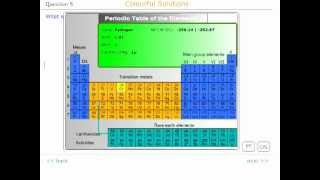
High Level Paper 12011 Time Zone 1. 1.7 grams of sodium nitrate is dissolved in water to prepare a 0.20 litre solution. What is the concentration of the resulting solution in moles per litre? We want the concentration and the concentration is given by moles per litre. So we must change the number of grams of sodium nitrate into moles. This can be done by dividing the grams by the relative mass, which is given as 85, 1.7 over 85. Recall of the calculator. 1.7 divided by 85. And this gives us 0.02 moles. 0.02 moles of sodium nitrate. Now, this is per liter. So we must divide by the number of litres, so the concentration equals 0.02. The number of moles and the number of litres, we're told, is 0.2, 0.02 divided by 0.2. If you can't see it, 0.02 divided by 0. 2 and this gives us 0.1. 0.1 moles per liter. On to question 2. What mass in grams of hydrogen is formed when 3 moles of aluminium reacts with excess hydrochloric acid according to this equation? So we're told that we have three moles of aluminium. So the coefficient for aluminium in the equation is two. Two moles of aluminium makes three moles of hydrogen. So we've got three over the number of moles here to multiply by three to get the number of moles of hydrogen. So what we're saying here is that if we had three, if as two moles make three moles, well, three moles is three over two times two moles, and that will make three over two times three moles of hydrogen. Now we must change the number of moles of hydrogen. Let's just put moles in here so we know what we're talking about. We must change the moles of hydrogen to mass and to change moles to mass, well, moles times relative mass equals mass. So in this particular case, 4.5 times the relative mass of hydrogen. Well, hydrogen has got an atomic mass of one, so its molecular mass is going to be one times two, which is two. So that comes to nine grams. Oh, 93. Nine grams. On to question 3. Relative molecular mass of a gas is 56 and its empirical formula is CH2. Remember the empirical formula. Empirical formula is the simplest ratio. So the relationship between empirical formula, empirical formula. The relationship between empirical formula, empirical formula and molecular formula is that there is a certain number of empirical formulas. An integral number N is equal to the molecular formula. Formula. Well, the empirical formula is CH2 in this case. So what we've got is n CH2s, let's put it in brackets. N CH2s will equal watts. Well, how do we know what the watt is here? The molecular formula. Well, the mass obviously of CH2 multiplied by N will give you the mass of the molecule. We're told what the mass of the molecule is, it's 56. So what we have here is N is equal to the molecular formula 56 mass divided by the mass of the empirical formula, which is C12 and two hydrogens 14 and that comes to four. So our molecular formula. /4/12, which is C4H8. Move on. Now we need to work out what the sum of all coefficients is when the following equation is balanced using the smallest possible whole numbers. When we balance equations, we should always start with elements that appear once only on both sides. Now, in this case we could choose carbon or hydrogen, because carbon and hydrogen appear once on the left and carbon appears once on the right. Hydrogen appears once on the right. So that would be quite valid. To start there, we need to keep to the smallest possible whole numbers. Well, hopefully we can see that if we leave C2H2 as it is without a coefficient, that will give us one H2O on the right. And that's going to give us an odd number of oxygens. So we need to have at least two C2H2s. So let's start off with two C2H2. And we don't know how many oxygens there are. So I'm just going to leave it as oxygen for the moment. Now, if we've started off with 2C2, that's four carbons. So we must have four carbon dioxides and we've got two H2, so that's four hydrogens, which is enough for two water molecules. Now, let's add up the oxygens we've got. Well, on the right hand side we have four CO2, two H2O. So there's four O2s, which is eight oxygens and two O's which is two oxygens. That makes 10 altogether. So that's telling me that I have to put a five here. So the sum of the coefficients. Is equal to 2 plus 5 plus 4 plus 2. And we can see that comes to 13. Question 5. The electronic configuration of vanadium. Well, no one expects you to know where vanadium is in the periodic table, or you probably remember that's in the transition metals. Fortunately though, we've Always got a periodic table to hand. So let's have a look at the periodic table and find vanadium. Well, vanadium is in the transition metals. There we are, element number 23. That means that all of the shells in the first, the second and the third periods are full. And if we go to the right over here, we can see that the full shells are represented by argon. And so we can start by putting argon in square brackets. And that represents the electronic configuration of argon. And then after argon, well, we have a look and we'll see that there's 4. We're in level 4 here, and it's level 4s electron 1s electron 2. So that's 4s 2. Now, the next electron is in the 3D level. So this is 3D 1, 3D 2, 3D 3. So to complete the electronic configuration, it will be Argon 4s 2, 3D 3. Which quantities are the same for all atoms of chlorine? Well, the number of protons. Yes, number of protons. True, because the number of protons gives us the identity of the element. What about the number of neutrons? Is this true or false? Well, chlorine has two isotopes, and isotopes have different numbers of neutrons. So this cannot be true. This must be false. 3. Well, the number of electrons is equal to the number of protons in all atoms. In all neutral atoms, not anions, but in neutral atoms. So this is also true. So the answer is one and three. Which property generally decreases across period three? Well, what have we got? We have atomic number, electronegativity, atomic radius, and first ionization energy. Well, the atomic number, if we look across period three, this is. Period three goes from 11, 12, 13. Well, this is the increasing. We know the atomic number increases as we go across a period. Electronegativity. Electronegativity increases to fluorine, so it increases towards the right. Fluorine is the most electronegative element. Atomic radius. Well, as we go across the periodic table, we're adding in protons to the nucleus. This makes the nuclear charge greater and the polygon pull or the attraction on the outer electrons becomes greater as well. And this shrinks the size of the radius. So in fact, the radius gets smaller as we go from left to right and to cover ourselves, the electronegativity, we have that. The first ionization energy. Well, sodium's got the lowest, magnesium has got a higher one than sodium. And gradually it. It doesn't increase linearly across the periodic table because of the different types of orbitals. But there is a general increase across the periodic table. So our only possibility here is the atomic radius. So the answer is C atomic radius. Next question involves group seven, involves the oxidizing ability of group seven. Well, the thing to remember here is that fluorine is the strongest oxidizing agent of all of the elements. And so as fluorine is at the head of this group, this means that fluorine has the tends to get reduced. It oxidizes and the rest of the elements follow the trend going down, so they become progressively less good as oxidizing agents. So we can discard D, for example. D is impossible. We can't say that iodine is not a stronger oxidizing agent than fluorine. Bromine will oxidise chlorine. Well, no, it can't be chloride ions. It can't, because bromine has got to be a weaker oxidizing agent than chlorine. We've already said that fluorine has a fantastic tendency to be reduced. So B is incorrect. So it looks like we're on C. Let's check C. Chlorine will oxidize iodide ions and this is true. Chlorine reacts with iodide ions in this way to give chloride ions and iodine. Which electron transitions are responsible for the colours of transition metal compounds? Well, the transition metals are colored, all except for scandium and zinc in their compounds. Well, this suggests there's something about the electron distribution of these central D transition metals which isn't shared by scandium and zinc. The answer is they have partially occupied D shells. So when we have a partially occupied D shell, we can have transitions between D orbitals. In fact, they're electron transitions between non degenerate D orbitals. And the energy of the light that is absorbed is equal to the difference in energy between the D orbitals. Remember this term, non degenerate means not having the same energy. Next question. How many S and P bonds or sigma and PI bonds present in a molecule of propyne? Well, the answer here is that we need to look at the structure of Propyne CH3CCH. Hopefully we remember that carbon always forms four bonds. So when we write CH3 or H3C, we're saying there are three single bonds to the carbon that then single bonds to another carbon. That means the first carbon's used up all four bonds, then it single bonds to another carbon and then there's a bond to the next carbon, which is a triple bond. And the triple bond is made up of 1 Sigma and 2 PI's and then finally, we end up the molecule with a ch. So if we're adding up the Sigma bonds, we have three here. We have one here. That's four. There's one in the triple bond. Five, and there's one here. Six. Let's check that. Three, four, five, six. There are six Sigma bonds, PI bonds. Well, the only place the PI bonds appear are in the triple bond, and two out of three of the bonds in the triple bond are PI bonds.










