Acid deposition
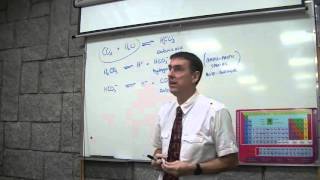
Lecture by Charles Collingwood explaining "acid deposition" (broader than "acid rain"). Covers: categories of sources (anthropogenic — e.g., fossil-fuel combustion; natural — e.g., volcanoes, lightning), the key acidic gases (CO2 as weakly acidic, SO2 forming sulfurous/sulfuric acid, and nitrogen oxides NOx forming nitrous/nitric acids), chemical equilibria in water (carbonic acid system, dissociation steps, amphiprotic buffering by HCO3−), formation pathways (SO2 oxidation to H2SO4 in presence of O2; NO and NO2 formation via high-energy processes and subsequent disproportionation to HNO2/HNO3), environmental impacts (ocean acidification, damage to materials, respiratory health, secondary pollutants), and mitigation strategies (reducing fossil-fuel use, removing sulfur from fuels, flue-gas desulfurization using bases like CaO to form CaSO3, catalytic converters and traffic/policy measures to lower NOx).
Chapters
Missing this class. So if he wants to see this class, he can see it, but actually he could. Yeah.
You know.
All right, what did I say? It's going to be about. Position. Now, the reason why we've changed the name from acid rain is because deposition then covers dust, it covers snow, hailstones, basically things that aren't rain. But fundamentally it's the same thing. It's about how acidic materials arrive on the Earth from the atmosphere. So this is, this is what we've got. We've got acidic material getting into the environment. We'll say, Now there's two sources of acidic materials. Two, This is a generic two sources. Listen, there aren't actually two sources, there are far more. But there are two categories, if you like. One is anthropogenic. And the other is natural. All right, so anthropogenic, what does that mean? So man made sauces. Yeah, anthropogenic. Man made. I think it comes from anthros, Greek for man. That's important. Man made natural sources. So what we're looking at then is things that men do that produce acidity. Anna.
Okay, never mind. You just explained my question.
I've just answered your question. Yeah, right, answer, Virginia. Things that man made. Obviously, the population we have at the moment on the Earth approaching, was it seven and a half billion on the Earth at the moment, that's an awful lot of people. So it doesn't take very much change in lifestyles and habits and things like that to have a large effect on the entire Earth. We're also in many countries, we're highly industrialised, we produce an awful lot of stuff. So that's what we're looking at. We're looking at the things that are made by man that can affect the acidity of the environment. Natural sources. Well, the Earth has always been highly active in terms of things such as volcanoes, weather, things like that, all of which can produce acidity. But let's have a look at the anthropogenic sources first of all. So. Well, now let's look at what we mean by the acidic material. What acidic materials have we got? We're fundamentally talking about acidic gases. The acidic gases are released in some way and those acidic gases interact with water in the environment and they produce acids. So we've got acidic gases. What acidic gases do we know about? Nitrogen is not an acidic gas. Go to the bottom of the class. Carbon dioxide is a weakly acidic gas. Right, well, have a look at this. Carbon dioxide is a weakly acidic gas. Sulfur dioxide, it's very weakly acidic. Sulphur dioxide. What's the proper name for sulfur dioxide.
Sulfide?
Sulfur 4 oxide, because sulfur dioxide's got the formula so 2, another acidic gas.
Something with nitrogen is right. I'm 100% sure, but I don't know what ammonia.
Well, in fact, there are several nitrogen oxides. So I'm just going to write nitrogen oxides. And because there are several of them, we give this the formula NOx in this kind of realm of chemistry. So this could be nitrogen dioxide, it could be nitrogen monoxide, it could be dinitrogen tetroxide, dinitrogen pentoxide.
Is there sulfur trioxide?
Well, there is sulfur trioxide, but it is normally formed afterwards. It's not one of the principal gases right now out of these three gases, three acidic gases. Carbon dioxide is clearly is a prevalent substance in nature. It is produced by respiration, animal respiration. It's also absorbed by trees, by plants in respiration. So carbon dioxide is part of a cycle. And there is a certain percentage of carbon dioxide that is in this carbon dioxide cycle, and it's fairly balanced, or it has been until recently. Carbon dioxide is produced by burning carboniferous material, by burning carbon, by burning things that have grown from carbon, such as trees and plants. And if we burn too much, then we change the amount of carbon dioxide in the atmosphere. It tends to vary from about 0.02% to around about 0.04%. That's the kind of variation in the carbon dioxide in the atmosphere. And we don't really consider that it contributes to acid deposition. It does, however, have effects. High carbon dioxide content in the atmosphere causes a change in acidity in the oceans. Because the oceans act as a big sink for carbon dioxide. They dissolve a lot of the carbon dioxide. And this can affect things that with a delicate acidity balance, such as coral reefs. Maro.
No, I was thinking about carbon monoxide.
Carbon monoxide is not an acidic gas. Carbon monoxide doesn't interact with water. Okay, that's probably the next thing we should mention. Why are these acidic gases? How do they interact with water? We all know that our definitions of acids, or the simplest definition, the Ireneus definition, is something that produces hydrogen ions in solution. And so if we have a look at These, carbon dioxide, CO2 interacts with water, H2O equilibrium and we get H. Well first we get H2, CO3. This is could be called carbonic acid, But it's very much, very much to the left hand side this equilibrium. There's very, very little carbonic acid. But what carbonic acid is, because so far, notice there's no hydrogen ions appear here. The carbonic acid itself, the H2CO3, then gets into an equilibrium with H and HCO3 minus. This is the hydrogen carbonate ion. And here's some acidity. Now, the hydrogen carbonate ion can further. HCO3 minus can continue the equilibrium to give H and CO3 2. This is the carbonate ion. So we see that these equilibria lie very much to this side. But of course, if there is any base, any oh, well, the OH will react with any H ions, pulling the equilibria to this side. Right. So although the equilibria is virtually 99.99% here, we can still, by adding base, make it go all the way to the side. Now, the other thing we can mention here is the hydrogen carbonate ion is amphiprotic.
More than one?
No. What was amphiprotic? That's right. This is an amphiprotic amphiprotic species. And you see that here, to go this way it's losing a hydrogen ion, and to go this way it's gaining a hydrogen ion. Now, this means that it can act as a buffer as well. It has auto buffering capabilities because it can absorb hydrogen ions going this way or it can release hydrogen ions going this way. Right. So amphiprotic species often auto. Buffers. They self buffer without the need to have anything else in there. And in fact, this is what happens in the sea. The sea has a certain amount of carbon dioxide dissolved in it. Under the conditions, we can form hydrogen carbonate ions and it tends to stabilise if we start adding too much acid. If you add acid, what happens? We push acid in, we push these equilibria back this way and we prevent this auto buffering capability. Right. So this is what happens with carbon dioxide. As I said, we don't tend to count carbon dioxide as acid deposition for the simple reason that it's so prevalent in the atmosphere. Anyway, it's part of the carbon cycle. However, the other two gases that we have, sulphur dioxide, SO2, Sulfur dioxide, SO2. This interacts with water. And we get h2so3 once again in equilibrium. And the h2so3. Can then dissociate to give h plus and hso3 minus. And the hso3 minus can also dissociate to give h and so3 2. This is the hydrogen sulfite ion. This is sometimes called sulfurous acid. Its other name is sulfuric 4 acid because the sulfur is in the oxidation state 4. Now, this is a weak acid. So in other Words, the majority of the species in solution will be sulphur dioxide and water. Very, very little sulphuric acid is made. Sulfurous acid is made. However, there is an issue with sulfurous acid because we live in an oxygenated atmosphere and in the presence of oxygen, SO2 and water and half, so oxygen gets involved. We can make H2, SO4, which is sulfuric acid, and this is a strong acid. So now we've got sulfur dioxide in the presence of oxygen, which of course is in the air, lots of oxygen in the air. So if you put sulfur dioxide into the air and with the water vapor and the oxygen, a certain amount of it can produce sulphuric acid, which is a very strong acid. So this then becomes dangerous to the environment. And this is one of the materials that's responsible for acid deposition. Clearly, I don't need to put the. What happens there. The sulphuric acid in the presence of water gives 2H plus SO4, two sulfate ions. There's the acidity. Nitrogen oxides, well represent nitrogen oxides by NO2, nitrogen dioxide, very, very similar. Nitrogen dioxide will dissolve in water to make H. No, This is actually going to be an oxidation reaction. I've chosen a bad one here. It's going to give HNO2 plus HNO3,5 there, don't we? So two of those. So nitrogen dioxide changes oxidation state. This is oxidation state 4. This is oxidation state 3, 4 going to 3 and 5. This is a case of a species being simultaneously oxidised and reduced. Does anyone know what that's called? No. Simultaneous oxidation reduction is called disproportionation. Disproportionation. Simultaneous. Oxidation and reduction of the same species. This one species both gets oxidized and reduced in this process. But what we get here is we get nitric acid, which is a strong acid and indeed nitrous acid. HNO2, nitrous acid. This can pick up half O2 and become HNO3, nitric acid as well. So it can get oxidized by the oxygen in the atmosphere. So here we've got a strong acid being formed. This is strong. So our nitrogen oxides, which I've chosen to represent by no 2, can produce strong acid. Sulfur dioxide can produce strong acid. So these are the two species, these two strong acids, the real contributors to acid deposition. So the next question is, how do they get into the atmosphere? Well, we said there's two sources, natural sources and man made sources. Let's take sulphur dioxide first of all, Sulfur dioxide. And the major source of Sulfur dioxide, believe it or not, is volcanoes. Volcanic action, Volcanic activity. Volcanic activity puts massive amounts of sulfur dioxide into the atmosphere. When they had that volcano in Iceland. Iceland, That's it. I think it was an if galler juckles it was, it put thousands of tons of sulfur dioxide into the atmosphere as well as the dust. So the sulfur dioxide that was put in the atmosphere then is able to interact with the water vapor in the atmosphere. It's also then it can make sulfuric acid. Interacting with the dust meant that the dust particles, apart from being highly abrasive, were highly acidic. And so if you got those abrasive acidic particles into airplane motors, aeroplane turbines, they destroyed the turbine blades, which is why airplanes had to be rerouted during the, during the period of volcanic activity. So this is a natural source. And a man made source is burning fossil fuels. What are fossil fuels? Dead animals. Burning dead animals that we always do. Not really dead animals, are they? Okay? Yeah. So they're fossilized forms of vegetation or dead creatures formed over billions of years. So why does burning fossil fuels release sulfur dioxide?
Living things have sulphur.
That's right, because living things have sulphur in them. Sulfur is one of the constituents of amino acids, some amino acids. How many amino acids contain sulphur? Ah, you said 20. There's 21. There's 21amino acids, not 20. 21 naturally occurring amino acids because one's been added very recently. Selenocysteine has been added. It's a version of cysteine which contains selenium instead of sulfur. That's amino acid number 21. It's implicated in biochemical processes, although we didn't know about it until quite recently. So there are 21 naturally occurring amino acids. However, I've just mentioned cysteine. Cysteine is a sulfur containing amino acid. So if you've got proteins which are made of links of amino acids and a couple of the amino acids contain sulphur, then logically your proteins also contain sulphur. So the living systems contain sulphur and so the fossil fuels also contain sulphur. So when we burn a fossil fuel, then we're going to burn fossil fuels to get energy, mainly by burning the carbon content. But of course, any sulfate in the fossil fuel will react with oxygen in the burning process and it will make sulphur dioxide. Now what can we do about volcanic action? What can we do about sulfuric dioxide produced by volcanic action? Not much. Very good answer. There's nothing we can do about it. We can't Stop volcanoes and therefore we can't stop the sulfur dioxide emissions. So we have to accept this as part of the law of the land, part of the law of nature. We're going to have huge amounts of sulfur dioxide. What can we do about the sulfur dioxide produced by burning fossil fuels?
You weren't there.
I can edit it out. It doesn't matter. What can we do about burning fossil fuels to sulfur?
In burning fossil fuels, I would react with some. Something more reactive that displaces it and it's not a sitting.
Or stop burning fossil fuel.
No. Right. Okay, let's have the possibilities. Possibilities. One, don't use fossil fuels. How practical that is, we don't know. Another possibility, reactant. What do you mean reactant? Now I don't understand.
Like what I would do is react what, the sulfur dioxide with something that displaces the sulfur and it's not acidic when. When it's coming out.
Right. Okay. So. So we could take the emissions and remove the sulfur dioxide. So we can remove sulfur dioxide from the emissions. Remove SO2 from emissions. Anything else we could do?
Use an alternative for fossil fuels.
Well, we've got that here. Don't use fossil fuels. Well, it's logic, isn't it? We don't use them. We take the sulphur dioxide out afterwards. Before. Or we take the sulphur out before, Remove sulphur from the fossil fuel. Which of the three do we choose to do?
The second one, I'd say.
No, the third one. I do the first one.
Actually. You're all right. Everyone's right. We do all three, don't we? We do all three. We try to avoid using fossil fuels. We do remove sulfur dioxide from emissions from burning fossil fuels and we do remove sulfur from fossil fuel. What a great. What a great world we live in. Yeah. Now clearly we can't. None of the three are going to be perfect, which is why all three are done. All right, but if we have a look at don't use number one, don't use fossil fuels. How practical is that? Well, it's practical in some areas where you've got hydroelectric energy, where you've got solar energy, where you've got aeolic energy. But in some places it's just not proud you've got nuclear energy as well. Nuclear energy doesn't produce sulfur dioxide. But in some places that we just can't avoid using fossil fuels, at least up to now, historically, we've not been able to avoid using fossil fuels. So we have to accept that there are some places where we're going to burn fossil fuels. Alright. So if we have to burn fossil fuels, we can then look at these two possibilities. Now, removing sulfur dioxide from the emissions, any idea how we might do this? How might we. What qualities of sulfur dioxide might we use?
The first idea that comes up to me is neutralization.
Right. And that is the most sensible idea. Removing SO2 from emission gas. What made you think of that, Mauro?
Because it's an acid.
It's an acidic gas. Yeah, it's an acidic gas. Right. So all we need to react the acidic gas with is a base. A base, that's right. We would choose a base that's. We choose a base that's very common base that can be easily, easily produced. Very, very common, such as calcium oxide. So we would pass the emissions past the emissions through. We actually call these scrubbers because they scrub the gas, they remove the materials from the gas containing a base, Calcium oxide. So in the calcium oxide, then Cao reacts with the SO2 to make CaSO3 calcium sulfite. Now, calcium oxide. Well, where do we get calcium oxide? From limestone. When you heat limestone, it dries off carbon dioxide and you end up with calcium oxide.
Oh, right.
So like an acid rain. That's why the statues like deteriorate.
Sort of vaguely, but only sort of vaguely because it's a kind of different reaction. Acid rain. Sulfur dioxide's reaction with calcium carbonates. Yeah, the marble, marble statues of any custom color. But this is a strong base, so this is a way of doing it. I suppose in principle you could use calcium carbonate for this as well. So the systems are fairly clear. So any gases emissions are then passed, forced to go through all these regions where they've got this lots of base. The calcium oxide reacts with most of the sulfur dioxide. We get calcium sulphite, which can then be removed and used for other purposes.
Is it efficient?
Nothing's 100% efficient, but it's not bad.
Is it expensive or not?
No, it's fairly cheap to do as well, because calcium oxide is a very cheap material. What about removing sulfur from fossil fuels before we burn them? Well, it depends really what fossil fuels we're talking about. For oil it's not too difficult because oil is in a liquid form. So we can actually capture that. We can distill or effectively remove the sulphur by various different processes from oil, but from coal it becomes quite difficult. So removal number three, removal of sulphur from fossil fuels. Depends upon the fuel. Obviously natural gas is a fossil fuel as well. Natural gas. We're Less likely to have sulphur in natural gas. We will have sulphurated hydrogen, hydrogen sulfide in natural gas. But if possible, if the sulfur gets removed before. Not always so easy. Certainly for things like coal deposits, we would tend to choose coals that have a very low sulphur content. Alright, we'll leave it further. We're gone after the break. We'll do nitrogen oxides. You don't want me to do adverts. Oh, my God. Come on, Mr. Tarantino, hurry up.
What a compliment.
Right, all right. Nitrogen oxides. No, X. As I said, there are lots of oxides of nitrogen. N2O. No, no, two. N2O3, N2O4 and N2O5. So we can express all of those just by NOx. They're not all acidic.
How come? If all. Like the N also varies from N to N, like, why would you want to give it N? Yeah, like, why would you call it N or X if also N?
Well, here X is a half, here X is one, here X is two, X is one and a half, X is two again and X is two and a half. It's just what this is saying is there is a ratio, a variable ratio of nitrogen to oxygen. They're not all acidic gases. This first one, nitrous oxide, is the gas that's otherwise known as laughing gas. Right. It's the only gas, apart from oxygen, that supports combustion. Remember, oxygen helps things to burn, so does nitrous oxide. N2O. Nitrous oxide, they used to call it. It's nitrogen 1. Oxide is proper term. But if you work out the percentage oxygen in N2O, which is not difficult to work out, oxygen's got a relative mass of 16, nitrogen's got a relative mass of 14. Two nitrogens are 28. 28 and 16 is 44. So oxygen makes up 16. 44 times 100%. Whatever that comes to. I have no idea what it comes to.
36.36, right?
36. All right, so about 36. About equal to 36%. What's the percentage of oxygen in the air?
21.
About 20. Right. So in other words, this is almost double the percentage of oxygen in the air. So this supports combustion much, much better than air. And that's why they use N2O cylinders in hot rod cars. So they might have the. They put a cylinder in there which provides nitrogen, nitrous oxide, nitrogen 1 oxide to burn the fuel. So the fuel burns that much hotter. It isn't as obviously as good as pure oxygen, but the pure oxygen Will cause the fuel to explode. But this gives much more energy, much more possibility of burning.
Why is it called laughing gas?
Because it makes you laugh. Really?
Why?
Well, it produces a feeling of euphoria in low concentrations. In high concentrations, it's an anaesthetic. When I went to the dentist when I was a child, they gave me this gas to make me unconscious so they could do operations. And it is still used in the dental industry.
It's a typical video you see of the kids are drugged out in the car with their parents, just like. Just came back from the dentist.
Oh, is it the mask they put?
Yeah. So it produces. In low concentrations, it produces a feeling of euphoria. It's used in clubbing as a legal high. In some places it's been banned. In some places still, it's still allowed.
What do you mean, like nitrogen oxide?
Like the room is filled with nitrogen oxide?
No, you buy small cylinders on it to breathe. I think the legislation. Legislation is working against it at the moment because there's been accidents, obviously. It's an anaesthetic gas. It causes problems with your brain. It can lead to collapse and death. So in a dental situation, it's being highly controlled. You've got an anaesthetist who can check all of your vital signs. In a clubbing atmosphere, it's not being checked at all and it can cause lots of problems. It isn't an acidic gas, first of all. Seduction 2 oxide, no, is a gas that's very, very reactive. This gas is produced in certain ways. We say, I'll allow one in a moment. But when it's produced in the air, it reacts instantly with oxygen. This is at room temperature. This reaction is instantaneous or very, very fast, should we say. And we get no. 2. Two of those. Two of those. It's a very fast. Very fast. Under normal conditions, we say at RT room temperature. So that means it's very difficult to make nitrogen monoxide. You make nitrogen monoxide, as soon as it hits the air, it turns to nitrogen dioxide. So it doesn't really matter whether that's acidic or not. It isn't, but it doesn't really matter because as soon as it's in the air, it becomes this, which is an acidic gas. N2O3 is not that common. We'll leave that out. So let's just look at no. 2, then no. 2. When this reacts with oxygen, it makes. Sorry, oxygen and water. Water. It makes HNO2 plus HNO3. This is the disproportionation reaction I showed you earlier. So this is a weak acid. Weak acid. And this is a strong acid. So in other words, if we make nitrogen monoxide, it's going to make nitrogen dioxide. You in the air, nitrogen dioxide is going to react with water. So effectively both this and this, these two gases are both contributors to acid deposition. Why is nitrogen monoxide so reactive?
Free radical.
Oh, very good. Good shout. Why are nitrogen compounds. Nitrogen compounds in general tend towards making free radicals. Why? Because they have an odd number of electrons in the outer shell, which means that nitrogen monoxide, if we draw a Lewis structure and nitrogen monoxide, well, even if we share all of the available like this, for the oxygen, that's still going to leave us with. That's still going to leave us with one. Nitrogen is electron efficient. It's got seven electrons in the outer shell. So this is a free radical. So it's a free radical molecule. And no. 2 indeed itself is a free radical molecule. There it is. This is also a free radical molecule. And this explains their high reactivities. Mauro can tell us all about nitrogen dioxide.
Like how it's produced.
What's it look like?
Ah, yellow. No, cookie dough.
Orange.
Isn't that what introduced.
That's what you were making in the fume cup when you reacted the copper with concentrated nitric acid. You made dark red brown fumes.
Yes, sir. My memory.
Your memory, which was such a long time ago, Mara, wasn't it? Last week? Right. Okay. So this is a dark red brown gas. And it's very reactive. Now, do we want something that's dark red, brown and very reactive in the environment? No, no. It causes respiratory problems. It's implicated in the development of pneumonia in the lungs. It also reacts with other chemicals that are in the atmosphere, organic chemicals, particularly, to produce secondary pollutants. So it's a highly polluting gas. So how does it get into the atmosphere? Well, not going to bother with these two. Dinitrogen tetroxide is formed when two of these get together. It's actually another form of nitrogen fluoroxide caused by this single electron pairing up to make two nitrogen dioxides joined together. But they easily break apart at slightly elevated temperatures. So N2O4 is in equilibrium with 2NO2. So effectively, when we deal with N2O4, we're dealing with NO2. N2O5. Not that common. We're going to gloss over them. So how does nitrogen dioxide, or how do nitrogen oxides in general get into the atmosphere? What about a natural source?
Decomposition, tissue?
Natural sources of.
Maybe the nitrogen cycle?
Not so much. No. Is There. B.
No, this is methane. I was thinking about methane.
Well, what's nitrogen oxide? It's a combination of nitrogen and oxygen. And where do we find nitrogen and oxygen.
In the atmosphere?
In the atmosphere? 80% of the atmosphere is nitrogen. 20% of the atmosphere is nitrogen. It's oxygen. So all it takes is a bit of quite a large amount of energy to bind them together. Under what circumstances do we get a large amount of energy in the atmosphere? Thunderstorms. Electric arc, Electric discharge. Electric discharge is in the atmosphere effectively provide columns of incredibly high temperatures. An electrical discharge might have temperatures of several tens of thousands of degrees in the very localized point or channel where the electricity passes. And so electrical discharges are sufficient to bind together N2 and O2 to make two. No. This is my pathetic attempt at drawing a lightning bolt. Electrical discharge in the atmosphere will bond nitrogen and oxygen to make N2. No. This isn't an acidic gas though, is it? So what's the problem with no?
They will bind to with oxygen, immediately.
React with the oxygen in the atmosphere. So 2 no plus O2. 2 no 2. And then we're off. And that can then dissolve in the moisture in the atmosphere to make nitric acid. Nitrous acid. The nitrous acid can react with the oxygen in the atmosphere to make more nitric acid. So electrical discharges, how common are thunderstorms. In the Earth in general? Very common. In the course of a year, there might be a hundred thousand of them. There is a huge number of thunderstorms right now as we're speaking. There will be thunderstorms somewhere on the earth, almost certainly. Which means that every time there's a bolt of lightning in a thunderstorm, we're binding together nitrogen and oxygen. So it's a natural source. It's a natural source. Now, we've already mentioned the nitrogen cycle. It's quite useful in a natural cycle, the nitrogen cycle. The nitrogen cycle puts nitrates into the soil. So we've got the nitrogen oxides, nitric acid. Nitric acid falls on basic soil such as calcium carbonate. It makes nitrates solid, which are all soluble. All nitrates are soluble. All nitrates are soluble. And what happens to a soluble nitrate? Then it gets taken up by the plant and used in the plant's growth apparatus to produce what? What does the plant need nitrogen for?
Amino acids.
Amino acids, that's right. So all nitrates are soluble. You get plant uptake. To make amino acids. So you see, the natural. The nitrogen cycle is an essential part of the earth's cycles. Of the earth's. Natural balance. So we have thunderstorms, produce nitrates, produce acid deposition. The acid deposition gets into the ground. The vegetation uses the nitrates to then produce the amino acids. Nearly all plants require nitrates of some kind. Nitrogen. Soluble nitrogen compounds. There are very few plants that can fix the nitrogen out of the air. Does anyone know what they call a plant, what you call a plant that can actually take the nitrogen out of the air and use it?
Nitro frying. Nitrifying something with alpha.
They're called leguminous plants.
Oh, is that why they do plant rotation?
Yes. Nice.
Oh.
Now, in fact, the plant itself can't fix the nitrogen. It requires bacteria. So this is an example of symbiotic growth. The plants, leguminous plants, have got root nodules in which bacteria live. And the bacteria use a particular chemical element to help catalyze the binding of the nitrogen and the oxygen. Anyone know what the element is? No. It's molybdenum. So bacteria, bacteria in the root nodules. Use molyb. Molybdenum to fix the nitrogen. Example of leguminous plants. Lentils, Lentils, peas, beans, clover, chickpeas. Clover is a classic one you often see, for example, in England, when you're talking about crop rotation, they might leave a field with just clover because the clover then will fix the nitrogen, the clover will die and it will return the nitrogen to the soil. So it will not take anything out of the soil. It will provide nitrogen from the air for the soil in the form of natural nitrates, amino acid, break down nitrates, ammonium compounds, all of which can be used by the next crop of plants. Right, so these leguminous plants are examples here. Peas, beans, clover, lupines. What? Lupines. You talk of flower lupins. All right, all of this is the natural sources of nitrogen or nitrogen oxides. What about the baddies? Anthropogenic. Well, think about, think about what was needed to fix the nitrogen naturally. Electrical sparks. Where do you find electrical sparks? Anywhere.
Electricity.
Not so much. Where do you find a regular repeated electrical spark in a car engine? Car engines. Not diesel cars, but ordinary petrol car engines. Petrol car engines. Every time the piston compresses the petrol air mixture, a spark sets it off. Now, that spark then will bond some of the air, will bond some of the nitrogen in the air to some of the oxygen. And so every cycle, let's say a four cylinder car, which is just ticking over, it ticks over at 10,000 revolutions a minute. So that 10,000 times four is 40,000 sparks a minute for One car. And that's if a car's not driving. If a car's driving, it will be going. It would be doing 30,000 revolutions a minute. So 30,000 revolutions, that's over 100,000 sparks a minute. Now, you multiply that by the number of cars there are on the world and the minutes. So a single car, single petrol car. At 30,000 rpm. Produces over 100,000 sparks a minute. And every one of those sparks will produce a tiny amount of nitrogen oxides. But as I said, it doesn't take a genius to work out that we're talking about a minute there. In an hour, we've got 600,000. 6 million. Now we've got 6 million sparks from one car. How many cars are there in Spain? Millions. Millions. There'll be millions of cars. There are. There are, what, 50 million people. Petrol, right? Petrol, yeah. 50 million people. Say, it would be reasonable to say there's a million cars, wouldn't it? Reasonable? I would say some of them be diesel. Would be reasonable to say there's a million cars. So each car perhaps operates for the. For 300 days a year. How many hours for each car? You can work it out. You could put together a sum and you will find absolutely fantastic amounts of nitrogen dioxide are being produced. So considering. The vast number of, should we say, car, car hours driven per year, This contributes a huge amount of N to the atmosphere. Now, we are actually privileged to live in Madrid. What happened in Madrid last Thursday?
You could only drive at 70.
One of the things we couldn't do. You were not allowed to drive on the ring road more than 70 miles an hour. What else?
You had to drive, like a car that had an odd. Like a negative number. Yes, my dad is doing that.
Not in Madrid.
No, they couldn't park in Madrid.
You were not allowed to take your car into Madrid and park in the blue parking zone to restrict. In other words. What I'm saying here is measures are being taken in Madrid to reduce the amount of cars in the streets, to reduce the amount of car usage. Why specifically at the moment? Because levels of pollution are high. Why are levels of pollution high in Madrid at the moment?
Because it hasn't rained.
Yeah, yeah.
Not so much the rain.
The temperature.
Is high, or the wind, I mean.
Because there hasn't been any wind. Madrid is in a bowl. It's in a depression between three mountain ranges, which means there is a tendency for the air to settle in this particular region. The mountain ranges stop the air from moving out, so the air gets trapped in this particular area and if we have conditions without rain and with sunshine as well, because the sunshine will produce secondary pollutants. The number of the amount of nitrogen monoxide or nitrogen oxides that are produced, nox that's produced will make the air particularly unbreathable, resulting in lung problems, diseases and other effects. Right. So we're actually here, we're actually witnessing the effect of cars producing nitrogen oxides. So what can be done about it?
Maybe public transport costs could decrease. Is there in France when the pollutions turn really high, they make public transport free.
Right. So what you can do is you can take. You can have political legislation to reduce the number of cars. You can politically. Reduce car use, whether that by making public transport free. By doing what they do in Paris and having one, as you say, even numbers and odd numbers. Which they do in Paris. Yes, they do even numbers and odd numbers. So one day you can drive a car with an even registration. Another day you drive a car with an odd registration. That by making multiple use of a multiple occupation of a car cheaper. Like the bus vow they've got in on the carrotel de kurumia. So if you go, if you've got more than two people in the car, you're allowed to use the central reservation that encourages people to have more people in the car, therefore less cars. What else can be done? Let's think about more chemically. What else can be done?
Yeah, diesel.
Well, diesel's got its own problems that I'll go to in a minute, but we don't want to be encouraging.
Diesel not having the spark.
Well, that's all right. Cars without fossil fuels. Hybrid hybrid cars or directly.
Yeah, electrical cars.
Hybrid electric cars. What else?
Maybe we do the same as with.
Sulfur like neutralizer, sort of. Are you on the right lines? Come on. We actually probably know the answer to this, but you just haven't worked your way through it. It's going to be made in the engine. How can we stop it getting out of the tubore escape? How can we stop it getting out of the exhaust pipe? What do we put in the exhaust pipe to prevent emissions of bad gases? No, a catalytic converter. You never heard of a catalytic.
In your house?
A catalytic converter. What a catalytic converter does is it takes the exhaust gases that are coming out of the car and it reacts them with. It uses a platinum or rhodium catalyst. So we have, for example, one of the gases that comes out the car is carbon monoxide. One of the gases that comes out of the car is nitrogen oxides. In ox. One of the gases that comes out the car is water from burning the fossil fuels. So a catalytic converter might take these and it will trans change the. It will take oxygens, give them to the carbon monoxide to make carbon dioxide, and it will leave the nitrogens their own. So this is a catalytic converter. Usually platinum, Rhodium. Sorry, Rhodium, not rd, rh, Platinum, Rhodium, transition metal catalyst. There are other types as well. This is just a simple. This is just one. There isn't one particular equation here. There are lots of different equations. This is just an example of what goes in carbon monoxide, nitrogen oxides, and what comes out carbon dioxide. And nitrogen. Is nitrogen a pollutant? No. No, because obviously it's 80% of the air. Carbon dioxide. Well, carbon dioxide, yes, that is a pollutant, but not in terms of acid deposition. Just carbon dioxide is pollutant in terms of the greenhouse effect. Is this 100% efficient? No, if it was 100% efficient, then we wouldn't have a problem with nitrogen oxides. If you go to a high place in Madrid and you look towards the horizon, you. You will see that the horizon is reddish brown. You will note that reddish color. And that reddish color is because of the nitrogen dioxide.










