Short instructional video by Charles Collingwood that distinguishes three acid definitions: Arrhenius (acids produce H+ in aqueous solution), Brønsted–Lowry (acids are proton donors; not limited to water), and Lewis (acids accept electron pairs). The video compares scope and applicability (Arrhenius limited to aqueous systems; Brønsted–Lowry allows non-aqueous proton transfer; Lewis covers electron-pair interactions such as ligand–metal bonding) and gives examples (NH4+ as a Brønsted–Lowry acid, AlCl3 as a Lewis acid). It also notes water autoionization and the [H+] = [OH-] = 1×10^-7 M at 25°C in pure water.
Chapters
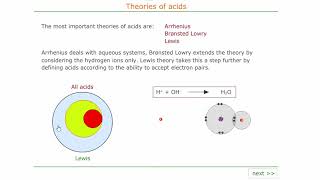
Different theories of acids. Three most important theories that we use are Arrhenius theory, Bronsted Lary theory and Lewis theory. This short video just intends to separate the three theories to make it clear when and why we use them. The usual definition of acids comes from the Arrhenius theory and Arrhenius ionic acids are chemicals compounds that produce free hydrogen ions in solution. This means that the compound either interacts with water or is broken down by water to release hydrogen ions. Now because it happens with water, it means that Arrhenius deals specifically with aqueous systems. Bronsted Lowry theory looks at the acidity or acids from the point of view of the hydrogen ions only. But it doesn't require water. Which means that it is possible for Bronsted Lowry substances Bronstedary acids to be non aqueous. Lewis extends the theory a bit further by considering not hydrogen ions but but electrons. So first of all let's have a look at the Arrhenius idea. Here we see effectively the kind of all encompassing theory is actually Lewis we hold hover over here you'll see that Lewis is kind of a broader theory. So it applies to everything within Lewis. We have Bronsted Lowry theory and the red dot here represents Arrhenius theory of acid. So if I click on this, let's have a look at Arrhenius. This is what we got. So Arrhenius acids, Arrhenius acids are the hydrogen ions in aqueous solution. So when a hydrogen ion is produced, it interacts with water and we get hydroxonium ions or hydronium ions. So anything that releases these hydrogen ions in solution will be an Arrhenius acid. Have a look at the Bronsted Lowry theory, what we're dealing with. Well, Bronsted Lowry theory looks at it from the point of view of the hydrogen ion donor. Whichever species donates the hydrogen ion is considered to be an acid. Now the hydrogen ion then goes on and interacts with. This Picture actually shows H20, doesn't it? Okay, so this is a reaction between hydrogen and oh. So I've made this video and I forgot what I put in there. Hydrogen and oh. So the hydrogen ion is being donated to the oh. And so whatever donates the hydrogen ion is a Bronsted Lowry acid. Let's have a look at Lewis Lewis theory. Well, Lewis theory looks at this like this electron pair, effectively the electron pair, whatever donates the electron pair is a Lewis base. And so the species, the H that's accepting the electron pair is The Lewis acid. So in all three, all three Arrhenius, show it here. Arrhenius, Bronster, Lowry and Lewis, we can all demonstrate the same reaction, be demonstrated by the same reaction. Let's go get in a little bit more detail. Alright, so Bronsted Lowry, Bronsted Lowry theory considers only the hydrogen ions and doesn't specify they have to be an aqueous solution. So in this particular case we could take an ammonium ion. Ammonium ion is NH4 with a positive charge. Now if this ammonium ion donates a hydrogen ion, well, it's effectively acting as a Bronsted Lowry acid. So if we show it donating a hydrogen ion, this can donate a hydrogen ion to any species. And so the ammonium ion then becomes a Bronsted Lowry acid. Now if this happened in liquid ammonia, for example, well, it's fine, it's a Bronsted Lowry acid. Lewis, however, is involved with the electrons. Now here we have electron, we have an aluminium trichloride, which is an electron deficient species. Count the electrons up around the aluminium. There are only six electrons. Normally eight electrons is a full complement of electrons in a shell. So it's missing a pair of electrons. So this species, aluminium trichloride can accept a pair of electrons. It is a Lewis acid. This species chlorine can donate this pair of electrons into the outer shell of the aluminum to fulfill the electron pair requirement. And so here we have the chlorine behaving as a Lewis base. Now this has nothing whatsoever to do with hydrogen ions or any reaction involving hydrogen ions. So the advantage of Lewis theory is that we can, we can apply it to systems that are non aqueous and don't have anything to do with hydrogen ions. This means that anything that donates an electron pair in a reaction can be considered to be a Lewis base. So for example, when ligands attach to transition metal ions, the ligands themselves are Lewis bases and the transition metal is a Lewis acid. And just to remind that Arrhenius is all about free hydrogen ions in aqueous solutions. All aqueous solutions contain water molecules and water molecules themselves dissociate into hydrogen and hydroxide ions. You can see the process here is a water molecule and dissociation occurs. This hydrogen ion is then captured by another water molecule to make a hydroxonium ion. And it's this that causes the acidity. In this particular case, the solution would be neutral because the water makes as many OH ions as it makes hydrogen ions. In fact, there will be in normal water at 25 degrees Celsius, there will be 1 times 10 to the -7 moles per liter of hydroxide ions and hydrogen ions.