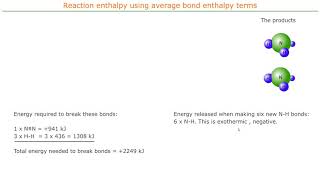
Charles Collingwood walks through calculating N–H bond enthalpy using the ammonia synthesis reaction. Breaking the N≡N triple bond costs 941 kJ and three H–H bonds cost 1308 kJ total. Using the reaction's enthalpy of −93 kJ, the N–H bond works out to 390 kJ per bond.
Questions this video answers
941 kJ
436 kJ
2249 kJ
−93 kJ
390 kJ per N–H bond
Chapters
Okay, Using the bond enthalpy terms to find the reaction enthalpy, or vice versa, using the reaction enthalpy to find the bond enthalpy terms. Here's a question. This is the reaction we're looking at. It's nitrogen is reacting with hydrogen, N2 plus 3 H2 to give 2 NH3. So this is nitrogen plus hydrogen gives ammonia. So in order for the nitrogen and the hydrogen to react, all of their bonds must be broken first of all and then reassembled to give the ammonia bonds. Let's have a look at how this can happen. So this is our reactants here. In the reactants, as you see, we've got one nitrogen molecule and three hydrogen molecules. So that's N2 plus 3H2. Now, if we want to break these bonds apart, we need to break the two nitrogens, and that requires putting in 941 kilojoules of energy. Likewise, to break up the three hydrogen molecules, we need to put in the bond enthalpy term, which is 436. Move down here, 436 for the three hydrogens. And because there are three hydrogen molecules, we must multiply the 436 by three to give 1308 kilojoules. So the total energy is the energy of the hydrogen, sorry, the three hydrogens and the nitrogen molecules. The total energy needed to break all of those bonds is 2, 22, 49 kilojoules. So what do we get when we break the bonds? Well, we get the individual atoms. So now the individual atoms are like the halfway stage of the process. So we've put in 2,249 kilojoules, and we've got the individual atoms. Well, the next thing is to use the individual atoms to make the products. And the products are the ammonia molecules. And you'll see here there are two ammonia molecules, which contains six in total, six nitrogen hydrogen bonds. So the energy released when making six nitrogen hydrogen bonds is six times the nitrogen hydrogen bond energy. This is an exothermic process, is the energy released when we make the bonds. So it's a negative energy. And the reaction enthalpy involves going from the reactants right at the very beginning to the products at the very end. And we're told that the reaction enthalpy is minus 93 kilojoules for the balanced equation. And so we take the energy that's required to break the bonds and we add it to the energy release, which of course is negative when we make the bonds, and we get the sum here, 2, 2 4, 9 minus 6 times nitrogen hydrogen bonds because it's negative equals negative 93, which is the reaction enthalpy. And then we simply rearrange that. We bring the 93 to the left to the right hand side, take the 93 to the right hand side here and it becomes plus 93 and that equals take the negative 6 times nitrogen hydrogen to the right hand side, it becomes six times nitrogen hydrogen positive. And so our sum here becomes 2249 plus 93, which gives 2, 3, 4, 2 and then divide by six will give the bond enthalpy of the nitrogen hydrogen bond, which is 390 kilojoules.