Analysing Mechanisms
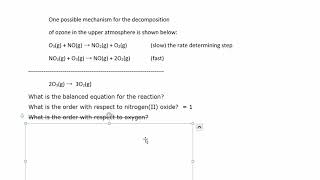
A two-step mechanism for ozone decomposition in the upper atmosphere. NO acts as a catalyst, NO2 is an intermediate, and the slow step determines the rate law: rate = k[O3]. The overall reaction converts 2 O3 into 3 O2.
Questions this video answers
May 18, 2020
2 O3 → 3 O2
Step 1 (slow): O3 + NO → NO2 + O2; Step 2 (fast): NO2 + O3 → NO + 2 O2
rate = k[O3] (first order in O3)
NO is a catalyst (involved in steps but not consumed overall).
Chapters
Analyzing mechanisms, problems. We see here there's a mechanism given for the decomposition of ozone in the upper atmosphere. This is a proposed mechanism, in other words, a proposed series of steps for the chemical reaction between. Well, the chemical reaction whereby ozone makes oxygen. All right, so we may well be asked to analyze this particular scheme. If we have a look here, you can see there are two steps. The first step is a slow step. And the second step is a fast step. In the first step, oxygen collide. Sorry, oxygen, ozone collides with nitrogen monoxide to make nitrogen dioxide and normal oxygen. In the second step, nitrogen dioxide collides with an ozone molecule to make nitrogen monoxide and two oxygen molecules. We could be asked anything about this particular schematic. For example, what is the balanced equation for this reaction? Well, one of the rules of mechanisms is that the sum of the steps of the mechanism must equal the stoichiometric. In other words, the balanced equation. So if we add up, let's take away the frame off here to make it easier. We simply have to add up the two steps, fast step and the slow step. And this will give us, well, ozone. Well, let's put the whole of the first thing. This on the left hand side, ozone plus this on the left hand side. On the right hand side with an arrow we'll have this. Plus this. These are both found on the right hand side. Now if we look here, we'll see that on the left hand side we've now got two ozone molecules. So we can gather them together like this with a number two. On the left hand side we have a nitrogen monoxide molecule. And on the right hand side we have a nitrogen monoxide molecule. And so we can cancel those out. Nitrogen monoxide cancels out with nitrogen monoxide. On the left hand side we have a nitrogen dioxide molecule. And on the right hand side a nitrogen dioxide molecule. And so we can cancel those out. Nitrogen dioxide and nitrogen dioxide. And finally, on the right hand side, you see we have 1, 2, 3 molecules of oxygen. So that gives us, if we gather them together, we can change that two for a three. And now we have the balanced equation for the reaction. So this mechanism is the proposed way that this balanced equation, this stoichiometric equation can occur. What else could we be asked about a mechanism? Well, we could be asked about the rate equation. What is the order with respect to nitrogen 2 oxide? Well, now we must have a look at the speed of the steps. Remember, the slow step is also called the rate determining step. Which means the step that really we're measuring when we measure the overall rate of the reaction. The fast step happens so fast that that it has no overall effect on the rate of the reaction. So in our slow step, we have two particles colliding. An ozone particle and a nitrogen monoxide particle. So this suggests that the order with respect to nitrogen 2 oxide, which is nitrogen monoxide, there is only one particle. So it suggests that the order is one. So for the answer this, the order with respect to nitrogen 2 oxide, nitrogen monoxide is 1, because there is only one particle colliding. What's the order? Whoa, lost the page. What's the order with respect to oxygen? Let's take that back. With respect to oxygen? Well, in fact, in the rate determining step, there is no oxygen at all. In fact, oxygen isn't even a reactant. And so this question, we could really say it's a silly question. It doesn't give us, it doesn't take us anywhere. You can only have something in the rate equation from the reactants. So we just wipe this, wipe this one out. Put a font. Where is it? Where's my font? I'm going to the wrong place, aren't I? I wanted to strike through. There it is. There's the strike through. We'll get rid of that. All right, let's move to the next question. So what's the rate equation for the reaction? Well, the rate equation is of course, the form of the rate equation is rate equals K multiplied by the reactant raised to the power of its order. So in this particular case, the reactant is ozone because it's the only thing that appears on the left hand side. And only one particle of ozone appears in the rate determining step. And therefore it's raised to the power of one. Now, some questions would just allow some. You will see rate equals K just o to the O3 without the power of one being shown. But anything to the power itself, anything to the power of one is itself. So either those would be the correct answer. Moving down. So how could, how could nitrogen monoxide no. Be described in this reaction? Well, nitrogen monoxide is involved in the rate determining step. But you'll see that if we look, we have nitrogen monoxide here, but it also is produced in the reaction. In other words, it's not used up. So it's necessary for the reaction to occur, but not used up. It's therefore a catalyst. A catalyst reduces the activation energy of the reaction. It gets involved in the reaction, reduces the activation energy and is not used up in the process. It is a catalyst. So how could no three be described in this reaction? Well, no. 3 doesn't exist in this reaction. It's a mistake that should have said no. 2. How does no. 2. How can no. 2 be described in this reaction? Well, no. 2 is produced in this first step and I'm going to. It's given a different color for clarity. No. 2 is produced in the first step and then is used up in the second step. So in fact the no 2 doesn't appear in the product at all. So no. 2 is formed during the process of the reaction. It is an intermediate. This is a material or substance that's formed during the reaction process. And then so it's a necessary part of the procedure to get from the reactants to the product. It is an intermediate. Let me see if. No, I can't persuade this to behave itself. So let's just do this. How could oxygen be described in this reaction? Well, oxygen is, it appears here on the right hand side. It appears here. Oxygen is the product in the reaction. So the ozone is the reactant. The oxygen is the product. The nitrogen monoxide or nitrogen 2 oxide if you like, is the catalyst is acatalyst, whereas the intermediate is nitrogen 2 dioxide. These are the kind of questions we could be asked about mechanisms.










