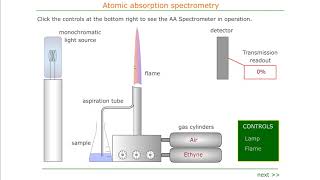
Charles Collingwood explains how atomic absorption spectrometry works: a liquid sample is sprayed into a flame where atoms absorb light from a lamp at specific wavelengths. If 40% of the light is absorbed, 60% passes through, and that absorbance tells you the concentration of the element you're measuring.
Questions this video answers
Air and ethyne.
40% (example), corresponding to 60% transmission.
The lamp contains the metal under analysis (the analyte) at low pressure.
Chapters
Atomic absorption spectrometry. Atomic absorption spectrometry is a way of analyzing the content of solutions in terms of metals. Usually it detects metallic elements. If we have a look on the diagram, you'll see there's a conical flask with the label sample.
This is a solution.
The solution gets sucked up aspiration tube, and then it's going to be blown into a flame. So what we do, the flame is normally made by burning air and ethyne together. So we turn the flame on, okay. And what happens are atoms or ions inside the solution get sucked up and they go into the flame. It's a bit like a glorified flame test. So the flame itself then starts to emit frequencies characteristic of the excited atoms or ions as the electrons move between energy levels. So what happens is, if we pass a monochromatic light source through this excited, this hot flame with elements in it, the monochromatic light will in fact have, have wavelengths removed from it corresponding to the wavelengths of the excited electrons. So if we turn the lamp on without the lamp, of course, there's no, there's no readout without the flame. We'll turn the flame off with just the lamp. The lamp will be sending signals straight through to the detector and it will have a hundred percent readout. Once we turn the flame on, the readout will fall at the particular wavelength that is coming from this monochromatic light source. Now, when it says monochromatic, it means that it's only emitting one particular wavelength. What we try to do is we try to make sure that that wavelength or the element that is being excited in the monochromatic source is the same as the element that that is being analyzed. And that way a proportion of that light will be removed by the element and then it can be detected. The part that's missing, if you like, is being detected. So in this case, 40% has been removed. And what you would do is you would do a calibration curve using known quantities of the same metal in different samples. And from the calibration curve, you could then read off the likely transmission, in this case, 60% against the calibration curve. And this would tell you how much of that element you have. So this is the idea, the methodology. The lamp is used that contains the metal under analysis, under low pressure. When turned on, the lamp emits electromagnetic radiation with spectral lines characteristic of the that element, the analyte. Then the flow of gas into the.
Burner sucks the sample up the aspiration.
Tube into the flame where it vaporizes.
The detector is adjusted to the wavelength of one of the characteristic emission lines of the spectrum of the element under investigation. And so what we get is we get an absorption spectrum as the light.
Is absorbed as it passes through the flame.
So the electromagnetic radiation passes through the aspirated sample, hot sample, and where the vaporized atoms then absorb portions of the characteristic line being used. When there's no sample present, the absorption set to zero, which is 100% transmittance. With the sample, the transmittance is lower. The calibration curve is first plotted using samples of known concentration. The unknown sample can then be run and the concentration read off from the calibration curve. Here we see absorbance or transmittance of the unknown, and then we can read down to find out what the concentration was. This technique is very useful for analyzing trace quantities of metals.