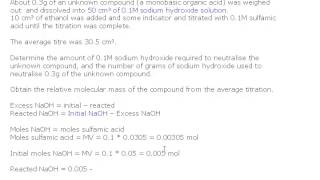
Charles Collingwood performs a back-titration to find how much NaOH reacted with an unknown organic acid. A 0.3 g sample was mixed with 50 cm³ of 0.10 M NaOH, then excess NaOH was titrated with 0.10 M sulfamic acid. The calculations show 0.0195 mol of NaOH reacted with the acid, giving an estimated molecular weight of 153.
Questions this video answers
50.0 cm^3 of 0.10 M NaOH.
0.10 M sulfamic acid, average titre 30.5 cm^3 (0.0305 L).
Back titration. About 0.3 grams of an unknown compound, which is a monobasic organic acid, was weighed out and dissolved in 50 cm cubed, a 0.1 mole of sodium hydroxide solution. So notice that first of all, this word about it means it's not exactly 0.3 grams. So we don't really know what mass is being weighed out. Okay. We do know, however, how much sodium hydroxide solution it was dissolved in. And we just do know, therefore, that it was neutralized by the sodium hydroxide solution. We have to assume that the sodium hydroxide solution is in excess, and I'm sure we'll find out later on. 10 cm cubes of ethanol was added and some indicator and then titrated with 0.1 mole of sulfamic acid until the titration was complete. Okay, so the sulfamic acid is then being used to neutralize the excess sodium hydroxide. And the average titer of sulfuric acid is 30.5cm cubed. So we're asked to determine the amount of sodium hydroxide solution required to neutralize the unknown compound. Okay, now with all back titrations, we work backwards. That is why it's called a back titration. We're analyzing what's left over. So the excess sodium hydroxide in this case will be equal to the initial minus the reacted sodium hydroxide. Okay, so rearranging this, this means that our reacted sodium hydroxide, reacted sodium hydroxide is equal to the initial sodium hydroxide minus the excess sodium hydroxide. Well, we have the initial sodium hydroxide from this value here, The initial. Let's highlight it in blue. So this is the initial sodium hydroxide, what we start with. So all we have to do is to find out the excess sodium hydroxide to get the reactant sodium hydroxide, all right, well, we're given information about the sulfamic acid that was used in the titration. Sulfamic acid has got the formula NH2HSO3. It's like sulfuric acid where an NH2 group has replaced the OH of the sulfuric acid and it reacts as a 1 to 1 in a 1 to 1 way with sodium hydroxide. So we have the same to the moles. Basically, moles of sodium hydroxide is equal to moles of sulfamic acid. Let's keep the spelling consistent. Sulfuric acid and the moles of sulfuric acid. Well, we're given the molarity of the sulfamic acid and we're given the volume of the sulfamic acid. So it's MV molarity times volume, which is equal to 0.1 times 0.0205. We change the centimeters cubed into liters. And if we multiply anything by 0.1, we just move the decimal place one place to the left. So that comes to 0.00305 moles. So now we have the moles of excess sodium hydroxide. So let's look at the initial initial moles of sodium hydroxide. Again. This is M molarity times volume. In this case, from the blue appear 50 cm cubed. 0.1 0.1 times 0.05 equals 0.005 moles. So the reacted sodium hydroxide with the unknown is equal to the initial 0.005. Subtract the excess 0.00305 that equals. Let's bring our calculator in for this point. 005 minus 0.00305 and that comes to.00195. Moles. So that's part of the question. Determine the amount of sodium hydroxide required to neutralize the unknown compound. We also asked to calculate the number of grams of sodium hydroxide. Well, we just get this by mass. Mass equals moles times relative mass. Relative mass is 40 for sodium hydroxide. So we can bring our calculator in and say multiply that by 40. This gives us the actual mass. Not particularly useful value. 0.078 grams. Now the final part of the question. Obtain the relative molecular mass of the compound from the average titration. Well, we can't obtain an exact value because we're told it's about 0.3. But we'll have to use 0.3 as the actual mass. And so the relative mass, we use the same equations we have here. The relative mass, Mr. Equals the mass over the moles. And the mass we take is 0.3. And the moles were given as 0.00195. Bring our calculator in. 0.3 divided by 0.00195 and that comes to 153 point, Which is a reasonable value for a monobasic organic acid. Okay, so summarizing about titration, we must find out what's left over. We get what's left over by the titration of. This is the sulfamic acid value. This gives us the excess sodium hydroxide. The blue gives us the initial sodium hydroxide. We take away the excess sodium hydroxide from the initial sodium hydroxide to get the reacted sodium hydroxide. We're told it's a monobasic acid. So the reacted sodium hydroxide has the same number of moles as the monobasic acid. And we then get the relative mass by dividing the actual mass used by the number of moles of the monobasic acid.