Balancing chemical equations
Charles Collingwood walks through balancing chemical equations using the law of conservation of matter. He works through copper oxide with hydrochloric acid, sulfur oxide with oxygen, ammonia formation, and ammonia combustion, showing why you change coefficients, not formulas.
Chapters
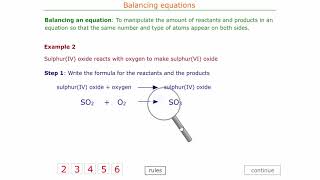
Okay, let's have a look at fulfilling the law of conservation of matter in a chemical reaction. This is often known as balancing equations. We say balance because it has the idea of some scales with the same weight on one side as the other. It's not just weight, it's actually the number of atoms which will produce the same weight. But what we're interested in specifically is the number of atoms either side of the equation. So what we're going to do is we're going to balance equations. And the best way I can explain this is to show some examples. Here's the first example. Copper oxide. We observe that it dissolves in hydrochloric acid and, and it produces a solution of copper, two chloride and water. So the first step is we write down the formula of each of the components that react together and each of the components that are produced. Each of the products. We just write out the formula of each of those. That's the step one, the chemical formula for the reactants and the products. Well, first of all, we've got the name copper oxides reacting with hydrochloric acid to make copper chloride and water. And then we put down the formula of each of these. Now, if we inspect this carefully, we'll see that over here we've got a copper atom and an oxygen atom. And here we've got a hydrogen atom and a chlorine atom. Now that means we must find all four atoms in the product and there must be the same number of these atoms. So let's move over to the products. And here you see, we've got copper chloride, which has got two chlorine atoms but only one copper atom. Well, we can't change the formula of a compound. That would be breaking the law of constant composition, which says that all chemicals have a specific formula. So let's move back over here and say, well, the chlorine occurs in this compound in hydrochloric acid. And the only way to get two chlorines here is to multiply all of the hydrochloric acid. So we multiply the hydrochloric acid by adding a coefficient in front of the hydrochloric acid. Now, this has the consequence of doubling the amount of hydrogen and doubling the amount of chlorine. Well, we know that we want to double the amount of chlorine. What about double the amount of hydrogen? We'll go over to this side again and we'll see that, yes, we wanted two hydrogens anyway. So now if we add up all of the atoms on the left hand side, one copper atom on the right hand side. One copper atom. One oxygen atom on the right hand side. 1 oxygen atom. 2 hydrogen atoms. 2 hydrogen atoms, 2 chlorine atoms. 2 chlorine atoms. The equation is completely balanced. That means we've fulfilled the law of conservation of matter. We haven't created something out of nothing and we haven't lost anything. We haven't made something disappear. Let's look at another example. This time our observations lead us to understand that sulfur 4 oxide reacts with oxygen to make sulfur 6 oxide. So the first step is we write down the equation for the reaction. It is a word equation, sulfur 4 oxide plus oxygen and then we have a reaction arrow takes us to sulfur 4 oxide. This is a misprint. It should say sulfur 6 oxide. You see there sulfur 6. This is sulfur 4. This is a misprint. I'm going to have to correct this in a moment but we're going to put down the correct formula anyway. This is of course the formula for sulfur 6 oxide. So just here we'll note that this is a mistake. It's a typo I've made. I'll correct it next time I. Next time. Next time I have a chance. Alright, so here we've now got the equation written down. So what do we do? Let's inspect it. One sulfur atom, one sulfur atom. Sulfur is alright. Two oxygen atoms and two oxygen atoms make four oxygen atoms. Well over here we've only got three. Now that means we have to increase the amount of oxygen. Well the only way to increase the amount of oxygen is to increase the amount of sulfur 6 oxide. We have to do this by introducing a coefficient of 2. This is going to have the knock on effect of doubling the amount of sulfur as well. So we're going to have to do the same thing over here. So let's have a look at our coefficients. We're going to add the coefficients to balance the equation. Well here we've added it on the left hand side first and on the right hand side. Are we going to get it there? Are we going to make it? Well I want to just take one from here and I'm going to drop it in there because this is the balanced equation. Now we want two sulfur four oxides. That makes two sulfurs this side, two sulfur this side two oxygen. Two O2s make four oxygens. O2 makes six oxygens altogether on the left hand side and on the right hand side we have six oxygens again. So this is balanced. There were a few little errors in this, in this part of the animation. But nothing I can do about that at the moment. All right, let's continue. I want to remove my two that I borrowed from the bottom and let's have a look at another example. Now, this time we're having a look at how nitrogen reacts with hydrogen to make ammonia. So we write down the formula for the reactants and products after having written down the word equation. Nitrogen plus hydrogen gives ammonia. So now we write down the formula for nitrogen, the formula for hydrogen and the formula for ammonia. Here they are. Nitrogen plus hydrogen gives ammonia. So let's inspect it. Well, we've got two nitrogen atoms here. Over here we've only got one. Well, you can see there's a problem straight away. We need double the amount of nitrogen over here. Here we've got two hydrogens. Sorry, did I say double the amount of nitrogen over here? No, there's two nitrogens here. We need double the amount of ammonia to make two nitrogens. This will cause us to have six hydrogens. So we're going to need triple the amount of hydrogen here. So our coefficient in this case involve three hydrogens. And I'm just going to take that up from there. Oh, my goodness me. I can't put it there. There's something in the way. What's in the way? My little animation is not functioning very well at all, is it? Let's have a look, see if I can get the 2 in there. I can't. I can't even put the 2 there. I can't put the 2 there. It should be 2 NH3. All right, I'm gonna. I'm going to mess around with this animation to content to. To correct it later on. We'll continue. Let's see if there's anything that I can do over here. What happens when ammonia reacts with nitrogen 2 oxide? Sorry? It reacts with oxygen to make nitrogen 2 oxide and water. So we write the equation ammonia plus oxygen gives nitrogen 2 oxide and water. We write the formula. This is the formula for ammonia, this is the formula for oxygen, this is the formula for nitrogen 2 oxide and this is the formula for water. Now this is a bit more complicated because if we inspect it, we see we've got one nitrogen and one nitrogen. Nitrogen seems alright, but there's three hydrogens here and only two here. So I'm going to need to at least double this. But if I double that, I'm going to need to double that to make two no. However, we've only got two oxygens here and we've had two no there and one O there. That Means an odd number of oxygens. So we're going to have to have an even number of oxygen atoms there because it's O2. So we can have two O2, three O2, four O2. So this is a very awkward one to actually balance. Now how do I explain how to balance it? Well, many people would do this by trial and error. They would just keep introducing numbers and to see the effect would be. So if I take out a, let's say a two, put the two there. I can't put the two there, I've got something blocking me. Well, let's see what happens when I click on it to see if by numbers we add the coefficients. It's going to be four for this. Now that's going to give four H3, which makes 12 hydrogens. So over here we're going to need a six. We're also going to need four nitrogen monoxides. Am I going to manage to get my six in here? Is it going to behave itself? Five oxygens and Go on, do it. Give me a six, give me a six. Water molecules. Somehow it's not going to do that. I want to see if, ah, what's happened? There's the six. It went to the wrong place. All right, so now if we inspect it, we inspect this equation, you'll see there are four nitrogens and there are four nitrogens. There are 12 hydrogens and there are 12 hydrogens. There are 10 oxygens and there are six oxygens in the water and four here, that makes 10. So all of the atoms are balanced on both sides on either side of the reaction arrow. And this is what we mean by balancing an equation. I must apologize for the errors in the presentation. I promise to do better next time.










