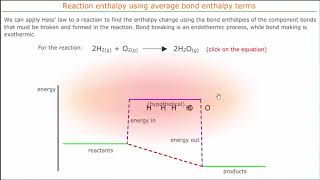
Charles Collingwood (YouTube, Mar 17, 2020) explains how to use average bond enthalpies to estimate reaction enthalpy. Using the reaction 2 H2 (g) + O2 (g) -> 2 H2O (g), he shows bond-breaking (endothermic) and bond-making (exothermic) steps, lists numerical bond energies, and computes an overall exothermic enthalpy change.
Chapters
Here we're going to have a look at how to use average bond enthalpy terms to work out the energy change in a chemical reaction. Point out at this juncture that everything must be gaseous. In this case, we've got two hydrogen molecules or moles reacting with one oxygen, making two water gas particles. Okay, so we have a situation that our reactants have a certain amount of energy and after the reaction they have less energy. It's an exothermic chemical reaction. So the chemical internal energy is released as heat energy and the chemical internal energy goes down and the heat energy goes up. So the system gets hotter. And we can explain this in terms of the breaking and making of chemical bonds in our two water molecules. On the right hand side there are bonds made. And to make these bonds, we have to first of all break the bonds on the left hand side. Now, bond breaking, like breaking anything, requires energy. You can't break a window without a rock. You need to put energy in to break the window. So in order to break the two hydrogen molecules, we must break one bond in each hydrogen molecule. The oxygens need to break a double bond between the two oxygen atoms. So let's have a look at how it works. The hypothetical situation is that we go to individual atoms. So we have the molecules are broken down into three separate atoms. It's hypothetical, of course, but to do so we had to break these bonds over here. Then the atoms all separate can join together. Now the joining together, the making bonds is an exothermic process. So the chemical reaction continues and we have two water molecules. Now our reaction enthalpy then will be the sum of the reactant bond energies. These are the ones that had to be broken apart. So it's an endothermic process minus the sum of the product bond energies over here. So we'll continue this. So our reactants consist of two hydrogen molecules and one oxygen molecule. We have to break all of the bonds in these molecules. So that's two HH bonds and one O O bond. Then we must form all of the bonds in two moles of water, which is 4 oh bonds. So the calculation becomes straightforward. On the left hand side, we're breaking two hydrogen hydrogen bonds because there are two hydrogen molecules and each one requires 436 kilojoules of energy. To break the oxygen oxygen bond requires 496 kilojoules. So the total energy if we add them up is 1368 kilojoules. This is an endothermic process. It's the energy required to break the reactants bonds. Now we're making the bonds in the products. Here we have to make 1, 2, 3, 4 oh bonds because there are two moles of water and each requires or rather releases. It's an exothermic process. Now because we're making the bonds, Each one releases 463 kilojoules per mole of bonds. And so our total energy is 1852. So we must put in energy to break the bonds and then we get energy back it's released by making bonds. The total energy for the reaction then will be the energy required minus bond energies, in other words, adding the exothermic bond energies of the products. So this gives us 1368 positive -1852 negative. And so we get 484 kilojoules of energy. I'm going to emphasize that for this to happen all components must be gaseous because there's an energy difference between a gaseous substance and and for example, liquid water and gaseous water have different enthalpies.