Born Haber Cycles
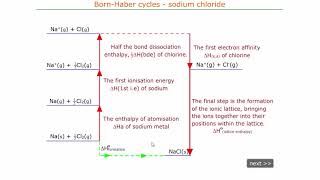
A short instructional video by Charles Collingwood introducing Born–Haber cycles and applying Hess’s law to ionic systems. The chunk uses sodium chloride as the worked example and enumerates the thermochemical steps (atomization, ionization, bond dissociation, electron affinity, lattice formation) that sum to the enthalpy of formation (or, rearranged, give lattice enthalpy or dissociation enthalpy).
Chapters
In this video, we're going to have a look at Born Haber cycles. Born and Haber worked together on the application of Hess's law, which is the law of conservation of energy, to ionic systems. If we have a look at the enthalpy of formation equation for sodium chloride, it's from its elements in their standard states. Well, sodium in its standard state is a solid, it's a metal. And chlorine in its standard state is chlorine gas, diatomic molecules. Now, to write the equation for the enthalpy of formation, we have to form one mole of sodium chloride in its standard state, which is a solid, a solid crystalline lattice. So the equation is na solid + 1/2 CL2. Because we only need one mole of chlorine atoms altogether makes sodium chloride solid. Now, this process, we call it the enthalpy of formation. And according to the law of conservation of energy, if we make sodium chloride solid by any other root, then the energy change will be equal to the enthalpy of formation. And that's precisely what Born and Haber worked on. They said, okay, well, what we need is we need sodium ions and chloride ions in their locations in a crystalline lattice. So what we must do is we must form sodium ions and we must form chloride ions from the starting materials. Now, the first thing we have to do is we have to turn sodium into a gas, because if we're going to put the ions into their positions in the lattice, then they're going to have to be separate ions, in other words, gaseous ions. So the first energy change is the enthalpy of atomization of sodium metal. This takes sodium from solid up to a gas. Then we have to transform sodium into sodium gaseous ions. Now, this stage is the first ionization energy. The definition of the first ionization energy is the energy required to change one mole of gaseous sodium atoms into one mole of gaseous sodium ions. And so this is a value that's very well known, the first ionization energy of sodium. So we're all right. Sodium gaseous ions are ready to go into their position in the lattice. But the chlorine chloride ions are still not formed and they are, in fact, currently stuck as diatomic molecules. So the first thing we need to do is to break the diatomic molecules into chlorine atoms. The this is the bond dissociation enthalpy of chlorine. Not quite, though, because it's only half a mole of bonds, so it's one half the bond dissociation enthalpy of chlorine and this will produce one mole of chlorine atoms. However, we can't put chlorine atoms into the lattice. So we have to now turn the chlorine atoms into chloride ions. And this is the first electron affinity, which is an exothermic process. So the energy of the combined system goes down to give sodium gaseous ions and chloride gaseous ions. Now it's a matter of putting the gaseous ions into their position in the lattice. And this energy change is called the lattice enthalpy of formation, because we're forming an ionic lattice from the gaseous particles. So, according to Hess's law and the law of conservation of energy, the enthalpy of formation of sodium chloride, this step here in green will equal the enthalpy of atomization of sodium plus the enthalpy of atomization of, sorry, the first ionization energy of sodium plus one half of the enthalpy, bond dissociation enthalpy of chlorine plus the first electron affinity of chlorine plus the lattice enthalpy of formation of the lattice, or the enthalpy of formation of the lattice. So it becomes a simple mathematical equation. Now, this cycle, as you can see, you can see now why it's called a Born Harbour cycle, because it is a cycle. It's in a complete circle. This will allow us to calculate mathematically any of the energetic terms, provided we know all of the others. So, for example, if we wish to know the lattice enthalpy, which is from this position here down to here, then we would simply add up all of the other stages, taking into account which direction the arrow goes. So it will be the negative of the first electron affinity minus half the bond dissociation enthalpy, minus the first ionization energy, minus the enthalpy of atomization plus the enthalpy of formation, and that will take us from here to here as well. So that will give us the same value. Likewise, if we wanted to know the enthalpy enthalpy, the enthalpy of dissociation of the lattice, that would mean for going from here, sodium chloride solid up to sodium and chloride ions, well, we would calculate the negative enthalpy of formation plus the enthalpy of atomization plus the first ionization energy plus half the bond dissociation enthalpy of chlorine plus the first electron affinity. And that will take us from the same starting point to the same ending point. So born harbor cycles are put together, considering each of the individual steps required to produce the ions that must go into the lattice. And here are the steps not shown as a cycle, but you can see the individual processes. Atomization makes sodium gas, ionization makes sodium ions. Atomization of chlorine makes chlorine atoms. Electron affinity of chlorine makes chloride ions. And the reverse lattice enthalpy of sodium chloride or the lattice enthalpy of formation of sodium chloride is very exothermic. We need to think, make sure that we. Particularly with lattice enthalpy, there are two definitions. There's the formation lattice enthalpy and there's the dissociation lattice enthalpy. And they have opposite signs. One is exothermic formation and the dissociation is endothermic.










