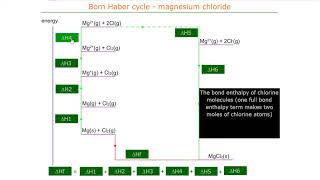
Charles Collingwood walks through the Born-Haber cycle for magnesium chloride, breaking down six thermochemical steps from atomization through ionization energies, electron affinity, and lattice enthalpy. Their sum equals the standard enthalpy of formation of MgCl2.
Chapters
Right here we have the Born Harbour cycle for magnesium chloride. You can see that at the bottom we have magnesium chloride, sorry, magnesium solid plus chlorine gas. And the process that the magnesium has to go through, it has to be atomized, which is delta H1. Then the magnesium gaseous atoms have to be turned to single plus charge ions of the first ionization energy, delta H2. Then delta H3 is the second ionization energy. Then delta H4 is when chlorine must be atomized, which is the bond. In this case, it's the bond dissociation enthalpy of chlorine, because this will give us two chlorine atoms from one mole of bonds. So the bond dissociation enthalpy of chlorine then gives us two chlorine atoms. I haven't put the electrons in this cycle. Now, the next stage then is the chlorine atoms. Pick up the two electrons. The electron affinity of chlorine. This is double electron affinity of chlorine, because, of course, there's two chlorines here. And then finally, the lattice enthalpy in this case, this is the exothermic lattice enthalpy of magnesium chloride. And simply whichever way around we go, the circle around the circle. If we want delta hf, what we have to add in delta HF is from magnesium solid to chlorine. I'm sorry, magnesium solid and chlorine to magnesium chloride. Well, we must go all the way around the circle. So it's Delta H1 plus Delta H2 plus Delta H3 plus Delta H4 plus Delta H5 plus Delta H6 will equal the enthalpy of formation of magnesium chloride.