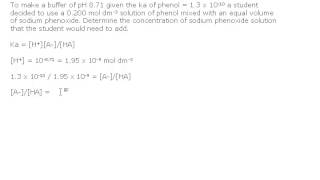
Charles Collingwood walks through a buffer problem step by step: using phenol and sodium phenoxide to hit pH 8.71. He converts pH to [H+], applies the Ka value, calculates the ratio of base to acid needed, then verifies the math checks out.
Questions this video answers
8.71
1.3×10^-10
1.95×10^-9 M
0.20 M
≈0.0133 M (to three significant figures)
Chapters
Okay, buffer question. Where the target ph for the buffer is 8.71 using phenol and sodium phenoxide. And there's a couple of constraints. We have to use the same volume of the sodium phenoxide solution, an equal volume sodium phenoxide solution added to the phenol. Now, with all questions like this, all ph buffer questions, we must start off with the. It's best to start off with the acid dissociation ka over Ha. In this particular case, of course, the A and the Ha are different. So we can work out the H ion concentration. The H ion concentration. We get this from the negative. Remember the ph is the negative log 10 hydrogen concentration. So the hydrogen ion concentration is the is equal to 10. Raised to the power of negative pH. 10 to the minus pH, if you like. 10 to the power of -8.71 out. This comes to 1.95 times 10 to the -9 moles per liter. I can put it. Moles per liter doesn't really make much difference. Okay, now we've also got the value of the Ka. Ka is 1.3 times 10 to the minus 10. And from this relationship you can see if we divide the KA by the hydrogen ion concentration, which is 1.95 times 10 to the minus 9. This is going to give us the relationship between A, which is the sodium phenoxide, the phenoxide ion and the acid concentration. Well, let's work out what this relationship is on the left hand side to find out what a minus over HA must equal. So it's 1.3, 1.3 exponential minus 10 divide by 1.95 exponential minus 9 and that comes to 0.067. Well, we also know that the HA concentration is 0.2, so 0.2. Sorry.02 there 0.2 times 0.067 is going to give us the A minus concentration. That comes to 0.0130133 to three significant figures. So we must add an equal volume of the phenoxide ion concentration of the phenoxide ion to have an equal ratio of moles between the acid and the phenoxide. Let's do a checksum on this. Let's do checksums. Checksum. Alright, with checksum what do we do? Well, we've got the ratio of A if they're equal volumes of the equal number of moles as the. So imagine we add one liter of each component. Well, one liter will have the same number of moles of each. So our mole ratio will be a -0.0133 divided by 0.2 multiplied by HA. Sorry, by H + rather H + times that should equal ka. Our h plus value from this then is going to be ka times 0.2 divided by 0133. That's going to be out comes to ka is 1.3 times 10 to the minus 10 1.3 exponential minus 10 times 0.2 divide 0.0133 and that comes to a very small value and my calculator won't show it. So let's try, let's try it on the. On our normal calculator. Let's have a look. Ka is 1 1.3 exponential 10 change sign equals 1.3 E to the minus 10 times 0.2 divided by 0.0133 and this comes to 1.95 times 10 to the minus 9. 1.95 times 10 to the minus 9. And so our ph. From this equals Take the log of this 8.71 8.71. So that is the correct answer.