Buffers
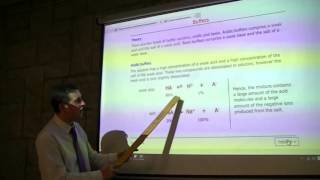
Lecture explaining buffers: definition, biological significance, mechanism (conjugate acid/base pair resists pH change by absorbing H+ or OH-), worked Ka/KB calculations (ethanoic acid/ethanoate and ammonia/ammonium examples), buffer preparation methods, and physiological buffer systems (phosphate, bicarbonate, citrate).
Chapters
Alright, let's get started then. Okay. If you're already. This is going to be fairly short, because nowadays we do not have to do any calculations on buffers. Unless you are doing option B and D, in which case you are going to have to do calculations on buffers. I believe you are doing option D. You are doing option D. B, sorry, D. So, effectively, you probably are going to have to do some work on buffers. You're going to have to do some calculations on it. However, first and foremost, what we need to do is to look at the definition. You could be asked for the definition of a buffer. A buffer is a solution that resists change in ph on addition of small amounts of acid or base. How do you feel about that definition? Do you understand those terms? Do you understand what it means? If you have a solution, that solution will be at a particular ph. If you add a small amount of acid or a small amount of base, the ph will change by only a very small amount. We say it has been buffered. For example, if you compare this with water, if you add a very small amount of acid or base to water, the ph will change enormously. If you add a small amount of acid or base to an acid or a base, it is likely that the PH will change a lot. But buffers resist the change in ph. Why are buffers important? It's there. I was going to ask you, but it's written on the board anyway. Why are they important? Well, bodies. Our bodies are very, very delicate mechanisms. Not just our bodies, but any biological system. What do we rely on for a good operation? Our biological system? No, that's what we need. But what do we rely on? We rely on chemical reactions. We rely on chemical reactions to do everything in our bodies and an animal's body and a plant's body. Chemical reactions have to go on. What regulates the chemical reactions? Anna? Excuse me? What regulates the chemical reactions? Alejandro? Chemical reactions are regulated by. In a biological system? No, by enzymes. What are enzymes made of? And what are proteins made of? Amino acids and amino acids have acid groups and amino groups. They are both acidic and basic, if you like. They have acidic forms and basic forms. They are ph dependent and so are the proteins that are made and therefore the enzymes. The shape of the enzyme depends upon the links between the individual amino acids that make up the proteins that make up the enzyme. And those linkages will change as the ph changes. So if your enzyme is not in the correct ph range, it will not work properly. If the enzymes in your body do not work correctly, what Happens, you die. Correct. You are unwell, you die. Therefore, it is essential that the body maintains the PH at an optimum value. Now, that means if you have an increase in acidity in your body, you could become unwell. There are circumstances in which your body does does change its acidity. So you need something to regulate it. And so the body is regulated by buffers. A buffer is a solution which resists change in ph on addition of small amounts of acid or base. Probably it's obvious, but I don't know. How could your body change acidity? Right. Well, if you have poor disease of the liver, for example, then the liver produces chemicals which are necessary for the good balance of your body. Diseases of the kidneys can change the PH of your body. You can have a condition known as acidosis in which the acidity of the blood increases. Obviously, if that happens, then your buffer system has been overcome. It's not working as efficiently as possible. Perhaps there's too much acidity. And that's something else. It's worth remembering that what it says here is small amounts of acid or base. If you add a whacking great load of acid to a buffer, yes, you're going to change the pH. If you add a whacking rate load of base to a buffer, yes, you're going to get an appreciable change in ph. There are systems that are set up that can handle small amounts of acid or bases. Okay, so because, because it's very important for living systems, it's clearly important that we understand what's going on. It's not just living systems though. There are many chemical reactions which need to be carried out at a specific ph and so too enable that to happen. We can buffer the systems. In industry this may be necessary for producing certain drugs. For example, definition of ph. We've done this before. Ph is a measure of the acidity of an aqueous solution. It's defined as the negative log 10 of the hydrogen ion concentration. There's our formula. All aqueous solutions contain hydrogen ions formed by dissociation of water. It's at equilibrium. And the dissociation constant, Kew, the water dissociation constant is given by H + concentration times. Oh, it's only affected by the temperature. Yeah. All this or most of this should be familiar to you already. Let's move on. Alright, so the theory. There are two types of buffers. An acid buffer or acidic buffer and a basic buffer. Acidic buffers comprise a weak acid and the salt of a weak acid. Name a weak acid. Ethanoic Acid, the salt of ethanoic acid, sodium ethanoate, for example. So a weak acid plus the salt of a weak acid. Now, the basic buffers are fundamentally the same idea. It is a base plus the salt of a weak base, for example, ammonia solution and ammonium chloride. So let's have a look at the acidic buffer. First of all, the basic buffer is fundamentally the same, but just from the point of view of base. Okay, so an acidic buffer has got a weak acid. Here's our weak acid. What do we know about weak acids in solution? They don't dissociate very much. So here our solution will contain mostly ha, the weak acid and a little bit of a produced by dissociation of the weak acid. What do we know about salts? On the other hand, They dissociate 100%. Notice I haven't put an equilibrium arrow here, I put an ordinary arrow. This is an equilibrium, but effectively this goes all the way to sodium ions and the conjugate base ion of the acid. So that means if we mix these two together, which species do we have present in the mixture? Well, we have a large amount of HA from this equilibrium and we have a large amount of A from this equilibrium. So effectively our two main components of the solution are both the molecular form of the acid and its conjugate base. Do you all see that? You see that? Good. Let's move on. See what effect this has. I can, because I put a little thing on there that says back. Why, what's the problem? Oh, I was just covering another. This will be made available for you on manage back. I know, I know. It's like. I know. Yeah, You know. You know what I mean? I have to do my own notes and then I think it's more efficient to do. One said no, I can always edit the video. It's all right. All right, let's go on to the next page. Ha, which represents the weak acid dissociates to give H plus and A minus. Not very much A minus. The sodium, for example, ethanoate, dissociates 100%. So this, whatever number of moles of this you started with, they're all in the form of A minus in solution. So our solution contains both Ha and A in appreciably large amounts. I've represented it here as a diagram. The size of the bar represents the amount of each that we have. Alright, so just. I've only written. Well, actually I've written the equation here. NAA goes, goes to NA plus plus A minus. This provides all of the A minus Here, HA doesn't hardly change. It only makes a little bit of this and a little bit of that. There's a little bit of this. It's made. I've exaggerated it, but it's mainly ha. So our buffer components are ha and A minus. Okay, now what we're going to do is we're going to add some acid to the buffer solution. What effect will adding acid have on this first equilibrium? The answer is none whatsoever because there is no H or OH minus in there. That's the answer you were looking for, isn't it? And this isn't an equilibrium. So adding acid will not affect this at all. What effect will adding H have on this equilibrium? What effect?
Oh, the acid will react with H.
So H will react with H. Star, Thank God. You can edit the video. I'm not going to edit that bit. I'm going to blow that bit up. And write down. This is what Dana said at this point. She said that acid reacts with acid. No, no, no.
With its conjugate base.
So if I add H to this equilibrium, what happens?
Oh, the equilibrium will move.
Moves to which side? To the left hand side. In other words, the H reacts with some of this large amount of A and moves to the left hand side to ha. So we add extra H, but it gets absorbed by the excess A. Let's watch what happens. Add acid, Alejandro. Watch. Watch. We add the acid. The moles of hydrogen ions temporarily increase as we add the acid. The extra hydrogen ions react with the anion from the salt and make more ha, decreasing the hydrogen ions. In other words, we have absorbed the extra acid we added. And so we haven't changed the ph by very much because the acid H that you added got absorbed by the A to make ha. Let's move on. Now, then, what happens when we add base to the same situation? We've got the same buffer here. We've got the same buffer here with a large amount of ha. Large amount of A. We're now going to add oh. What happens to the equilibrium when we add oh, yeah, because.
When you add.
To the left, we're not adding to the left gladiator, are we?
No, no, no, no.
Right. So we're removing this by adding oh. We remove the H by adding oh. If we remove H from this, what is going to happen to the equilibrium? It will move to the right hand side, restoring the H because there's a large reservoir of ha. So we add the base. Let's add the base. The moles of hydrogen ions temporarily decrease as the hydroxide ions react with them. The weak acid equilibrium moves to the right hand side making more hydrogen ions and also salt anions. But that doesn't affect anything and it restores the original ph. So our solution responds to the addition of hydrogen ions by either by absorbing the hydrogen ions using the A, or it responds to the addition of OH ions by losing the hydrogen ions and then making more of them. This is how a buffer works. Here's a basic buffer. Basic buffer consists of a weak base ammonium ammonia plus the salt of a weak base ammonium chloride. This is only dissociated or dissociated is the wrong word really. This only gets reacts with water to the extent of about 1%. So the majority of the solution is ammonia molecules, very few ammonium ions. The Salt however is 100% to the right hand side. And so the two species that are present are ammonia molecules and ammonium ions. There is a large active reservoir of ammonia molecules, ammonium ions. There are relatively few hydroxide ions, hence the solution is weakly basic. This is our basic buffer. Alright, here we are. This is the representation again. We've not got many OH ions in our system. What we're going to do is we're going to add some acid to this. Now this top equilibrium is 100% to the right hand side. That's why we've got a large amount of ammonium ions. This equilibrium is mostly to the left hand side. That's why we've got a large amount of ammonia. So we have a large active reservoir of these two species. If we add acid, which of these two equilibria is it going to interfere with? The bottom one. What's going to happen to the bottom one? If we add H plus ions to.
This, it'll move the equilibrium to the.
Left.
Right. Then it would move. It would move to the left hand. No, move to the right.
If you take from the right, you move to the right to restore it. We are adding acid. If you add H, it will react with this and remove it from the equilibrium. Therefore, the equilibrium moves to the right. Can it move to the right? Yes, because we have a large amount of ammonia, so it can move to the right and in doing so it makes more. Oh, let's add the acid and watch what happens. Initially, the new hydrogen ions react with the hydroxide ions, reducing their concentration. The system responds by moving to the right hand side, restoring the hydroxide ion concentration by hydrolysis of the weak base. In this example. Now what happens if we add base to the buffer?
It'll affect the Top one.
No, it won't. Dana, you're not having a good day, are you? We cannot affect this. It's not an equilibrium. This is where the equilibrium sign is. If we add oh to this equilibrium, we're adding to the right hand side and it will make it go to the left. Can it go to the left? Yes. The OH that's being added can be absorbed by the NH4 by the conjugate acid of the base, the weak base. And that will remove the extra OH that we've added. We'll add the base and watch it. Initially, the concentration of OH ions increases. As base is added, the excess ammonium ions from the salt dissociation are able to absorb react with the new hydroxide ions, making more weak base molecules and reducing the OH back to its almost original level. Now, here's a calculation. Here's the calculation for the buffer to show how it works in a buffer solution. Now, this is a weak acid dissociation. Here we know the weak acid dissociation can be represented by this equation. Ka is the hydrogen concentration plus the salt concentration divided by the acid concentration. Now, in this case, these two species are both present in largeish amounts. This equilibrium must still hold true, though. We cannot affect the value of Ka just by adding chemicals or taking chemicals away, can we? It's a constant. What affects this constant temperature? Only temperature. Good. Only temperature. So we can write this equation down by. And now we can think about the quantities we have from our original buffer materials. If we calculate the PH of a solution, which is 0.1 moles per litre in ethanoic acid and 0.5 moles per liter in sodium ethanoate. Now, in this particular case, because both of the components are in the same solution, we can just work in moles. We don't have to worry about concentrations because the concentrations will cancel out, or rather volumes will cancel out. So in this particular case, we've got our K value. Now, this is the salt concentration from the dissolved sodium ethanoate. So this is 0.5. This is the acid concentration, which to a very close approximation, is the same as the original 0.1. We know Ka and so we can work out H. So we just rearrange the equation to get H on its own. So in other words, we take this acid concentration to the top, the salt concentration to the bottom, and we get this equation H iron concentration is ka times the acid concentration divided by the salt concentration 1.78 times 10 to the minus 5 times 0.1 over 0.5, which gives this for the hydrogen ion concentration. We then take the negative log of the hydrogen ion concentration and we get a ph of 5.45. Okay, so this is the PH of the buffer solution. If we add a small amount of acid or a small amount of base to this, this number will not change very much. It will change, but not very much. Buffers do not prevent a change in ph, they reduce it. This is the same calculation just for a base. In this particular case, I've chosen 0.1 mole per liter ammonia, 0.2 moles per liter ammonium chloride. This is the salt and so this makes ammonium ions at the same concentration. This virtually stays the same concentration, 0.1. So we just put our equation down for KB, which is the ammonium ions, the hydroxide ions divided by the ammonia concentration, substitute our rearrange, substitute the values and we end up with 8.9 times 10 to the minus 6. We take the negative logarithm of that and we get the PoH, which we then subtract from 14 to get the ph. So we have the PH of a basic buffer. Preparing buffers There are two ways to make a buffer. One way, we can simply take our salt and dissolve it in an appropriate concentration of acid. Alejandro. And that's probably the easiest way. But there is a way, another way. This is the easiest way shown here. We're just taking a mass of sodium ethanoate and dissolving it into some ethanoic acid in a 0.1 mole per litre solution. I'm not going to go with the calculation. We don't need the calculation at the moment. But this is a more favoured way of making a buffer. This is by reacting a strong base with excess weak acid. What are we going to get? Well, if it's excess weak acid, we're going to end up with some weak acid. And as you're adding a base to the weak acid, we're going to get the salt of the weak acid. So if you add excess weak acid to a strong base, you will get a buffer mixture and that is something that occurs on a regular basis in the questions from the iv. Alright, there's our summary, summary of what we just discussed. An acidic buffer consists of a weak acid and the salt of a weak acid. The weak acid is partially or very slightly dissociated. So the solution contains a large amount of weak acid. The salt of the weak acid is completely dissociated and so the solution contains a large amount of the conjugate base ions. So our acidic buffer is a mixture of weak acid and conjugate base ions. Likewise, a basic buffer is a mixture of weak base and conjugate acid ions. Each of these two solutions will respond to an addition of small amounts of acid or base to not change the PH very much. Okay, Questions. How was the first way preparating? Preparating. Preparating. I'm going to look that word up in my dictionary. Preparating, preparation or preparing it is simply dissolving the salt in a dilute solution of a weak acid. Now, let's have a look at a comparison. At this stage, I am going to use some numbers. Now, I want to use some numbers. So I don't want to scare you too much. Take a tranquiliser. Here they come. Some numbers. Right. Imagine we have 100 centimetre cubed of water. Tend to centimeter water. All right, let's give it at 25 degrees Celsius. What will the PH be? 7. 7. Ph equals 7.00. All right, I'm going to add to this. Add 1cm cubed of 0.1 mole per liter hydrochloric acid. How do we work out the new ph?
How will we work out the ph of the HCL?
Nope. How do we work out the new pH?
You change the 100 so you find the molarity water.
What do we have to do? First of all.
Add the 1cm cube to the 100.
That makes 101. I've done that. Now what?
Now you change 101 to.
Ah, that's what I was waiting for. We find the moles of acid, we're added. Right. All right, we're going to add some acid. So we need to know how many moles of acid we're adding. So moles of acid added. Moles of acid added. How do we work that out?
Well, you find the moles of each.
That's what it says here. Moles of acid added. How do we work it out?
Well, you do moles equals mass divided by molecular mass. No, the. So you do moles equals the mass of each.
Here we haven't got the mass molarity times the volume. Thank you. 0.1 is the molarity. The volume is 0.001. The moles of acid added then is 0.0001 moles of acid. Now we know it's a strong acid, so it will also be moles of H. Okay, so the concentration of h plus then is the number of mol 0.0001 divided by the total volume. The total volume is 101 cm cubed, which is 0.101 L. So that is our new concentration point.0001 divided by 0.101. And that comes to 9.9 times 10 to the minus 4. 9.9 times 10 to the -4. So the pH is the negative log of that. So we just take log 10 that and it's 3.3.00. Right. So by adding 1cm cubed of 0.1 molar acid, how much has the pH changed by? By four pH units. Agreed. Right. Yes. I have a question. Don't ask me a question. Would this have to be cubed of 01 mole? Would it be like a buffer? No, it is not a buffer. This is demonstrating what happens when you don't have a buffer. What are we adding it to? Water. Now, I'm going to have a hundred centimeter cubed of buffer solution. So I'm going to rub this out. Remember what happened. Remember the whole story here. We're going to change our solution to 100 centimetre cubed of buffer solution. Keep it in black. 400 cm cubed of buffer containing. 0.1 moles of sodium ethanoate, CH3C O O N A dissolved. Actually, I'm going to change it. 0.01. 0.01 moles of sodium ethanolate dissolved in 0.1 mole per liter ethanoic acid. Alright, so this is our buffer. First of all, we need to know what the PH of the buffer is. Ka, remember, is always H times a minus, which in this case is CH3COO all over CH3COOH. I want to know what the hydrogen ion concentration in this solution is. So what do I do? I know what Ka is. It's 1.78 times 10 to the minus 5. Simply because I can remember it. The concentration of the ethanoic acid is 0.1. So I'm changing this equation to leave H on its own. Right? So I'm taking the acid to the top up here and I'm going to bring the salt to the bottom. Now, what's the concentration of the salt? Well, it's 0.01 moles in 0.1 litres. So it's 0.1 moles per lit. Agreed. Now, you can see pretty easily here. The h concentration is 1.78 times 10 to the minus 5. And pH then is 4.75. So there's our solution at 4.75. I've worked it out. Okay. We happy with this? Right. So now I'm going to add to this. We're going to add 1 centimetre cubed of 0.1 mole per liter. HCL. How many moles of this is. We've worked it out before. 1 times 10 to the minus 4, isn't it? Is it? Yeah. No. 1 times 10 to the minus 3.94. No, no.
0.001.
0.001 times 0.1. The moles added. Moles added equals 1 times 10 to the minus 4. Yes. It's 0.1 times 0.001. 1, 2, 3. 1 times 10 to the minus 3, 1 times 10 to the minus 4. Okay.
But why 0.001?
Because it's 1 cm cubed. Ah. This is the volume, this is the molarity. Moles equals molarity times volumes. Yeah, yeah. Okay. Right, so we're adding 1 times 10 to the minus. Now, which of the two equations. Which are the two equations is the acid going to interfere with? Talked about this when I showed you the buffer display. Which of the two reactions, which of the two equations?
Oh, the acid. The one with the acid. The equilibrium.
The equilibrium with the weak acid. So we have Ch3 cooh in equilibrium with Ch3 coo minus plus H plus. Right. Now, we know this equilibrium is fixed. If you like. It's fixed by our Ka value. Yeah. If we add 1 times 10 to the minus 4 moles of this, it is going to come this way by 1 times 10 to the minus 4. So it's going to increase the concentration of that by 1 times 10 to the minus 4 and decrease the concentration of that by a factor involving 1 times 10 to the minus 4 moles. Agreed. All right, so initially we'll do a little bit of a initial moles here. Initial moles looks like it's equilibrium. How many moles of this do we have to start with? Well, we've got 100 centimeter cubed. All right, 0.1 moles per litre. That's 0.1. That's 0.1. So initially there is 0.01 moles, is that correct? Yeah, yeah. Agree. Now, this one initially in our solution we've got 100 centimeter cubed, which contains 0.0. So it tells us already there's a also 0.01 moles of that. We don't know what this is. Well, we do. We put it from here it's 1.78 times 10 to the minus 5 moles per liter. So it's 1.78 times 10 to the minus 6 because we've got a tenth of a litre initially. Now we're going to add after addition, after addition of hydrogen ions. Now the hydrogen ions are going to go up by a factor of. Well, this is far bigger than this, isn't it? Alright, so when we add. It doesn't matter, we're adding it here, but they're going to be absorbed by this. So this is going to go down by minus 0.01 and this is going to go up by 0.01. Agreed. We don't know what's going to happen to this. We'll forget this for the moment because we're going to work this out. But we know that this is going to absorb the. It's going to react with the hydrogen ions. So we'll go down. This is a negative sign. It's subtraction and this is going to go up. So it's a positive sign here. So the new number of moles of Acid is now 0.0101 and the new number of moles of salt is 0.0099. Agreed? Yeah. Do you understand what I'm doing, Alejandro? Kind of. Kind of. Right now we've got the number of moles of salt and the number of moles of acid. We can put them directly into our KA equation. KA equals H plus times salt. I'm just going to say a minus over ha. We know that ka has to be 1.78 times 10 to the minus 5. That's a constant. That equals h plus times. Well, the a minus concentration is now here 0.0000099. And this is 0.0101. So we take our 1.78 times 10 to the -5 multiplied by 0.0101 divided by 0.0099 and that equals the hydrogen ion concentration after addition. So we plug these values in. 1.78 exponential minus 5 times 0.01 UN equals. Divide by 0.0099 equals. And the new hydrogen ion concentration is 1.816 times 10 to the minus 5. H plus IS equals 1.816 times 10 to THE minus 5. So pH equals 4.74. Right. How much has the ph changed? Correct. There's the initial ph and there's the final ph. So what was the effect of having the acid added to a buffer compared to the acid added to water?
The change in ph.
When we added this, we added 1 cm cubed of 0.1 multilitre hydrochloric acid to water. The pH changed by 4.0 naught 4 pH units. When we added it to a buffer system, it changed by 0.01 ph units. Is it not demonstrated that the buffer works? Yes. Now, you don't need to do this treatment. I am doing this treatment because I want you to see it can be done. I want you to see that buffers resist change in ph. Does the PH change? Yeah, of course it does. It does change, but it changes very little. It only changes by a tiny amount.
Mr. For example, in option P, they ask me to calculate the change in ph.
They may ask you to calculate the concentration of compounds in a buffer. They may ask you to calculate the PH of a buffer system. However. Danny, you did this for your internal assessment. You should be very good at this. Now, let's have a look at. You don't need to know the process. You don't. Let's just look at these two equations again just while we're here. Right. CH3 cooh. Ethanoic acid is in equilibrium with CH3 coo minus the conjugate base of ethanoic acid plus H. Ch3 coona. This is a salt of ethanoic acid. Remember, salts are always ionic, and Therefore they dissociate 100% in solution to give CH3COO plus NA. Of course, sodium ions don't affect anything. We forget that they're not a participant in this whole story. This is not a participant in the whole story because it doesn't exist anymore. It's changed to these. So what are our participants? Well, this is the same as this. So this is a participant. This is a participant. And the hydrogen ions are a participant. So they're the only things that we can even talk about. They're the only things that are there in solution. This is in solution. This is in solution. And this is in solution. That's our buffer solution. There's a large amount of this from the second reaction. There's a large amount of this from the first reaction. Now, let's have a look at what each of the species are doing. Alejandro, your phone's not important. I don't care who's sending you messages. You may be in love, you may not be in love. It doesn't matter. What matters is that you understand buffers right now. That's what matters. Okay, let's just take the CH3 cooh. What is happening to that in terms of acids or bases or anything else you want to tell me? What is happening to the ethanoic acid? It's dissociating. What is it losing, then? It's losing our. A hydrogen ion. So this Loses a hydrogen ion. An H plus ion loses a hydrogen ion. Or it donates a hydrogen ion. Maybe we could say that better. It donates a proton. Donates a proton. H+ION. So one of the components donates a proton. Yes. Happy with that? By our definition, Bronsted Lowry acid. Yes. What does this do? In the whole reaction accepts a proton. So our mixture has to have a large amount of something that donates a proton and a large amount of something that accepts a proton. Now, let's look at this system. I'll start with the wrong letter completely there. This is phosphoric acid. The phosphoric acid can react with sodium hydroxide to make a salt. Nah2PO4 plus water. Sodium dihydrogen phosphate. Sodium dihydrogen phosphate. NaH2PO4 can react with sodium hydroxide to make Na2HPO4 plus water. And this na2ph4. Na2hpo4 can react with sodium hydroxide naoh to produce na3po4 plus h2o. Phosphoric acid or phosphorate 5 acid. Orthophosphoric acid. Phosphoric acid. Can make three different salts. These are salts. So what happens to these in solution? Completely dissociated. All right, let's have a look at one of these sods. Doesn't matter which one we have a look at. Let's choose this one. H2PO4 minus. This is the iron, the dihydrogen phosphate ion. Can it donate a proton? Yeah. If it donates a proton, what does it become?
Positive. It would just become H2PO4.
If it donates a proton, what does it become?
It will become 2 positive.
It's already 1 negative. It's donating a proton 2 negative. So it will become HPO4. So this can exist in an equilibrium with HPO4 2 minus H. Can H2PO4 accept a proton? Yes, it can. Plus H would become H3PO4. In other words, if we had a large concentration of that in solution or an appreciable concentration, it can do the job of accepting protons or the job of releasing protons. In other words, what can it do? It can buffer a solution. Now, because this can both remain, release and accept protons, we call it amphiprotic. Can both accept and release. I'll say donate donate protons. So this is an auto buffer system. And in fact, we could use this one as well. The HPO4 2 minus can also release a proton to become PO4 3. Or it can accept a proton to become H2PO4 1. So we've got this, the phosphoric acid and the phosphates. The hydrogen phosphates are often used to make buffers because it's easier to make a buffer with one of these than it is to mix things together. And I believe that the actual buffers that are sold commercially are based around these chemicals. They're based around the hydrogen phosphates. Sodium hydrogen phosphates. I don't know that for certain.
So this auto buffer system is what basically happens in our body. Is what basically happens in our body.
The chemicals that we use to buffer our bodies. We use. I think one of them is that it's a hydrogen carbonate system because we've got a large amount of carbon dioxide is very freely available in the body system. So HCO3 minus can accept a proton to become H2O plus CO2, or it can lose a proton and become CO3. 2. Our bodies have got carbon dioxide in the bloodstream, they've got carbonates in the bloodstream. So this is a system. The other system that the body uses is a citric acid buffer, because citric acid is also a triprotic acid. And so sodium dihydrogen citrate is very similar to this. It can accept hydrogen ions or it can donate hydrogen ions. So our body has various different systems. I believe that the citric acid citrate buffer is the most common one in our bodies, but I'm not certain. Yeah. What do you need to know? Let's get it down to what you need to know. You need to know that how buffer systems work, Alejandro. You need to know that a buffer system doesn't change ph very much. When a large amount or when an amount of acid or base, a small amount, actually a small amount of acid or base is added. You need to know that a substance which can accept and donate protons is called amphiprotic and it can behave as a self regulating buffer. You need to know that buffer systems are very important in biological systems. Buffer because enzymes are made of proteins, proteins are made of amino acids and the whole system is ph dependent. If you change the ph, you change the structure. Change the structure, you change the function. Any questions? No. Is there a question coming? Alexander? Anna?
In a buffer that is not an auto buffer system, one of the things that would act. So you would need the. For example, you would need the CH3 cooh ethanoic acid. Yes.
And you would need an artificially added.
Salt of ethanoic acid to create the CH3COO minus.
You need to have both components there present at the same time. You need something that can accept a proton and something that can release the proton. Both must be in reasonably large quantities. Alejandro. Not yet. Are you still stewing? This lesson was brought to you by Coca Cola.










