Calorimetry
Charles Collingwood explains how to measure heat released in chemical reactions using a copper can, water, and a spirit burner. The core equation is q = m c ΔT, where water's specific heat capacity is 4.18 kJ·kg⁻1·°C⁻1. A worked example shows ethanol combustion releases about 864 kJ per mole, though real experiments lose heat through convection and radiation.
Questions this video answers
4.18 kJ·kg⁻1·°C⁻1
ΔE (or q) = m × c × ΔT (mass × specific heat capacity × temperature change)
Mass of water: 51.35 g; temperature change: from 23.2 °C to 48.6 °C (ΔT = 25.4 °C) resulting in an energy change quoted as 5.45 (kJ)
Mass of water: 56.19 g (0.05619 kg); temperature change: 23.9 °C → 54.3 °C (ΔT = 30.4 °C); energy absorbed: 7.14 kJ
Mass of ethanol burned: 0.38 g (moles = 0.00826 mol); calculated enthalpy of combustion ≈ -864 kJ·mol⁻1
Chapters
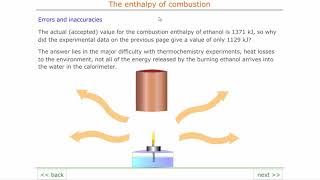
Calorimetry. Calorimetry literally means measuring heat. A typical experiment for measuring heat would be the enthalpy of combustion. Here we have what we call a calorimeter, which is effectively just a copper can which is filled full of water and that can collect the heat produced by burning alcohol, such as ethanol. The flame passes the energy into the calorimeter and then the water heats up and it can be measured. The amount by which it heats up can be measured using a thermometer. When the flame is put out, the mass of the spirit burner and the alcohol will have gone down because of the mass of the ethanol burned. Now, because of the law of conservation of energy, chemical energy is transformed into heat energy by combustion. So the chemical energy change, the enthalpy in the reaction, has become heat energy, which is then collected in the calorimeter. Now, because energy is extensive, that is, the more material reacts, the more energy is either released or absorbed. It means that we can work on a direct proportionality for the energy released and the amount of matter involved in the reaction. However, all substances absorb heat differing amounts. In other words, they respond to the absorption of energy in a different way. And we call this the specific heat capacity. We have a definition, which is the amount of energy required to change the temperature of 1 kg of substance by by 1 degree Celsius is called the specific heat capacity. Water has a specific heat capacity of 4.18 kJkg degrees C. So if we had a kilogram of water, we would need 4.18 kilojoules of energy to increase the temperature by 1 degree Celsius. So our calorimetry experiment, our calorimeter, we can determine the energy change by using the relationship. The mass times the specific heat capacity times the temperature change. In either Kelvin or Celsius Delta E, the energy change equals M, the mass of the water being heated times the specific heat capacity of water times the temperature change of the water will give us the energy change. Now, in order to make sense of it, because all masses of chemicals will have different energy changes, we standardize the energy change and use energy change per mole. In other words, we calculate the value as if one mole of energy were burning, sorry, one mole of ethanol were burning and releasing energy. So what we need to do is we need to divide the energy that we measure in the calorimeter by the number of moles of ethanol that have been burnt for this combustion experiment. And this can be done then by taking the energy and dividing it by the moles of ethanol. The moles of ethanol of course is the mass of ethanol divided by the relative mass. And this gives us a typical example. Let's have a look at this example. We're going to use a spirit burner to heat up a sample of water in the calorimeter. We get the following data. The mass of water in the calorimeter, 51.35 grams. So this is the. This is the substance that's going to absorb the heat energy released in the reaction. The initial mass of the spirit burner and the final mass of the spirit burner. This shows the mass of the ethanol that has released the energy. And then we look at the temperature change. The temperature changes from 23.2 up to 48.6. In other words, there is an exothermic reaction when ethanol burns. So the energy, heat, energy released causes the water to heat up. Then the calculation delta E is mc, delta T, and this is the mass of the water being heated in kilograms, the specific heat capacity of water and the temperature change. In other words, the difference, the starting temperature subtracted from the final temperature. And this gives us an energy change of 5.45. Now, this is an exothermic reaction, so this should be an exothermic, a negative sign. So, to calculate the energy change per mole of ethanol burned or combusted, we need to calculate the moles of ethanol, which is the mass burned, divided by 46, the relative mass, which in this case is 0.00483 mol. We would then divide the energy change 5.45 by the number of moles to give a value for the energy change per mole. Now, the value will lie well below the accepted value for the enthalpy of combustion of ethanol. And the reason for this is obvious, is that much of the heat energy produced in the chemical reaction does not arrive in the copper calorimeter or in the water, instead gets sent away by the usual energy transfer mechanisms of convection, conduction and radiation. We see the flame, so obviously there is radiation going on, but of course there is heat radiation as well coming from the flame. We could feel the heat if we put our hands near it. We also have to heat up the copper calorimeter. That's another problem. However, these problems can be not cancelled out, but they can be. They can be accommodated for using calibration. We could calibrate the apparatus using a known chemical reaction. So we could see how much energy is needed to heat up a piece of apparatus. And if we know the amount of energy needed to change the temperature of a piece of apparatus by 1 degree Celsius. Well, we can then, by measuring the number of degrees Celsius, know what the energy absorbed was. However, this doesn't stop us losing heat energy by radiation. Why does combustion release energy? Well, we have to break the bonds of the ethanol, the fuel, and we have to make new bonds. Breaking the bonds of the reactants, ethanol and oxygen, requires less energy than making the new bonds. Now, in this particular case, we've used the bond energies to get an energy difference. However, this is not a valid number because we've got liquid ethanol and we've got liquid water in the equation. And bond energy values are only valid for gaseous reactants and products. So to look at a typical experiment. Let's have a look at a typical experiment. We've got a Bunsen. Sorry, We've got a Bunsen burner. We've got a spirit burner. The spirit burner has a mass of 84.74 grams. That includes the ethanol, of course. In the calorimeter, we have 56.19 grams of water. We know what the initial temperature is, and so all we need to do is to set the spirit burner burning. As the spirit burner burns, we see that the temperature changes. The temperature is changing here. The spirit burner mass is going down as the ethanol is burned. And when we turn, turn the spirit burner out, we have a new mass, 84.36 grams. And so we find that we've used 84.74 minus 84.36. We've used 0.38 grams of ethanol in the reaction. So we know how much ethanol has burned. 3.38 grams. So we can work how many moles of ethanol was burnt. We also can work out how much energy has been absorbed by the calorimeter. We know the mass, we now know the temperature change, and we know the specific heat capacity. So that's our first step. Our first step is to call up a calculator and to calculate the energy absorbed by the calorimeter. So we've got. The mass is 0.05619 kg times 4.18. That's a specific heat capacity. Times. Now we want the temperature change. Well, the water went from 23.9 to 54.3. That's 30.4. So we multiply by. Oh, I made a mistake there, haven't I? I pressed the multiplication. So we start again here. All right, so it's point 05619 times 4.18 times. What did we say it was? 30.4, 30.4 equals. So that's 7.14 kilojoules. We'll put that into the memory. And now we'll have a look at the mass of the ethanol burnt, which is, what did we say? 0.38. So it's 0.38 divided by, is it 0.38? I'm just checking now, see if I remember rightly. The mass of the burner. This is 0.38. You divide this by the relative mass which we're given as 46, and this is, that's the number of moles. So we know that's 0.0826. 0.00826. So it's memory recall divided by 0.00826, that gives us 864 kilojoules. So remember, it's negative 864 kilojoules per mole. And we check that out and we've got the answer correct. So we can see that we can use calorimetry to find the energy released per mole when ethanol is burnt. We call this the enthalpy of combustion. So here's our summary. Our summary, Energy can be neither created nor destroyed. The energy is extensive. Combustion enthalpy is one of the easiest energy changes to measure experimentally. It's the historic basis of the study of energetics. The experimental study of energy changes is called calorimetry. The major error in simple calorimetry experiments is heat loss to the environment. Now, this is the bomb calorimeter is how it's done professionally to minimise heat losses to the environment. The bomb calorimeters used the fuel and oxygen are injected into this region here, the known mass of fuel, excess oxygen. A heating coil applies some heat, they blow, they release lots and lots of energy and is absorbed by a known specific or a known heat capacity apparatus called the bomb. And then from the temperature rise here, we can calculate the energy absorbed and we can subtract the energy that was applied by the heating coil. This is called the bomb calorimeter. Okay, so that's calorimetry, the study of measuring heat in chemical reactions.










