Combustion Enthalpy
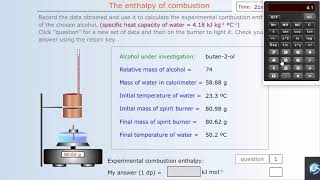
Charles Collingwood walks through calorimetry tests for combustion enthalpy using butan-2-ol and ethanol. He measures temperature change in water, applies E = m·c·ΔT to find energy released, then converts burned mass to moles to get experimental values: butan-2-ol around -1360 kJ/mol and ethanol around -735 kJ/mol. Experimental results are lower than literature values because heat escapes to the environment.
Questions this video answers
4.18 (J·g⁻1·°C⁻1 shown as 4.18)
74 g·mol⁻1
46 g·mol⁻1
58.88 g
Initial 23.3 °C; Final 50.2 °C
Chapters
Okay, Charco here just to take you through the calorimetry tests. Typical experiment, the experimental data. Let's have a look. I'm going to put my name in here. Charles Collingwood. There we are. And email address chadgo. Chem.com I spelled it wrong, of course. That's good, isn't it? We're going to answer five questions. Five questions and the program will automatically calculate. Up here. We'll see up here we've got the time, five minutes per question. We've got 24 minutes. I hope I won't take anything like that long to explain the test. Okay, so we'll just take off the magnifying glass. Now, you see, this is. We're told that we have to record the data obtained and use it to calculate the experimental combustion enthalpy of the chosen alcohol. We're given the specific heat capacity of water and the instructions are we click question for a new set of data and then on the burner to light it. We're going to check our answer using the return key. So we need some data to start. So let's click the question and we. We'll see that our data. We're going to investigate Butanol Butan 2ol, which has got a relative mass of 74. And in our calorimeter, which is over here, we call it a calorimeter. It's really copper can, isn't it? But this is quite common. We have the mass of water which we've weighed out in the calorimeters, 58.88 grams. The initial temperature of the water taken by the thermometer is 23.3 grams. And, and the initial mass of the spirit burner, which is sat on top of a balance here just to make life easy for us, is 80.98 grams. So now we'll get the lighter and click on the spirit burner to get it going. And we'll watch the spirit burner heat up and you'll see the temperature slowly going up here as the spirit burner warms up the water in the calorimeter. Notice also the mass of the spirit burner is decreasing as some of the butan tool is used up. Now the spirit burner has gone out. So now we've got a maximum temperature 50.2 degrees C, the final temperature of the water and we've got a final mass of the spirit burner, 80.62 grams. So the first thing we need to do is we need to work out the energy that's been absorbed by the calorimeter. Well, the Energy is calculated by E equals MC delta T where M is the mass of water. So if we call up our calculator at this point here, we want the mass of water in the calorimeter being heated in kilograms. Now this is in grams. 58.88. We want it in kilograms. Alright. So that's 0.0. No, no, too many zeros. I'm going to go back again. Go off. Start again. Point 058-8838. There we are. This is the number of kilograms. Now we multiply this by the specific heat capacity 4.18. And then we multiply by the temperature change. And the temperature change. The initial temperature was 23.3. The final temperature is 50.2. So we must subtract 23.3 from 50.2. That's. I believe that's 26.9. Is that correct? It looks like it. 26.9. Yeah. 26.9. So we multiply them by. Press the multiplication button twice and I can't go back. I'm going to start again. Well, let's start with 26.9. 26.9 times 4.18 times the mass, which is 0.05888. And this gives us our energy in kilojoules. Now this is. This is no good for us as it is. We need it per mole because the energy enthalpy of combustion is given per mole. So we need to divide by the number of moles. Now, the number of moles would be the mass of the spirit burners. Let's put this into the memory plug. We'll put this into the memory. 6.62. Okay, now let's calculate the actual number of moles by finding out the mass of the spirit burner that's gone down. So the mass of the spirit burner has decreased by 0.36 grams. So we have 0.36 grams of Butan 2 olive burned. And we divide that by 74. And that gives us 0.00486 to three significant figures. Now we need to multiply our memory recall by this number. Alternatively, we could multiply it by the reciprocal of this number. So we'll take the reciprocal of this number and then multiply it by memory recall to give us our answer. 1360. So we'll enter our number 1360. Now, it's experimental combustion enthalpy. We mustn't forget that this is a negative value. It's an exothermic reaction. So let's press return and we're correct. We've got an answer? Minus 1,360 kilojoules per mole. And we were given five minutes per question. We took a little over five minutes. So let's do the next question. I think we can probably get by with just two questions. So now click on the question button and it's generated as a new question. This time we have ethanol. And we told the relative mass of ethanol, the initial mass of water in the calorimeter, and the starting temperature is 23.2 degrees Celsius. The initial mass of the spirit burner is registered here, 80.79 grams. Let's click on the spirit burner and we'll see. Once again, the temperature starts to go up. Spirit burner is releasing energy as the ethanol burns. And that energy is going into the calorimeter and heating the water up in the calorimeter. It's gone out now and we'll see the mass of ethanol that's burned has now gone down from 80.79 to 80.3 0.4 grams of ethanol. So once again, let's calculate the energy absorbed by the calorimeter. So we'll call up our. Our calculator. The energy, the energy is equal to MC Delta T. Well, Delta T, in this case, it's 23 point. Let's do it. Show you 51.6 minus 23.2. 23.2. So the temperature has gone up by 28.4. We'll multiply this by 4. 0.18. And then we'll multiply this by the mass of water being heated up, which is 0.05388. And this gives us the energy that has been absorbed by the water in kilojoules, 6.396 or 6.4. Let's put this into the. First, we'll cancel the memory, make sure there's nothing in there. Let's put this into the memory. And now let's see how much ethanol has actually burned. The ethanol burnt 0.4 divided by 46, 0.4 grams. 0.4 divided by 46, and that gives us 0.008695 by 87. So once again, we have to divide what's in the memory, the energy, by the number of moles, to get the answer. Now, once again, divided by the number of moles is the same as multiplying by the reciprocal. So it's just as easy for me to do this. That multiplied by memory recall, and that gives me 735. So let's put into the answer here 735. Don't forget it must be negative because enthalpies of combustion are negative. We'll check that out and we see, yes, we've got the correct answer. So this is a way we can test the students or self test ourselves to make sure we've got the idea of how to carry out calorimetry experiments. Don't forget, the values that you will always get in an experimental combustion enthalpy experiment will be well below the the actual literature values because this particular method loses a fair amount of heat to the environment. Okay, that's all. See you soon.










