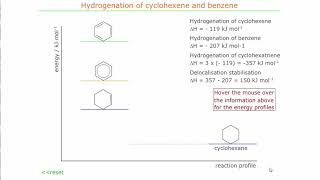
Benzene's hydrogenation releases 207 kJ/mol versus 119 kJ/mol for cyclohexene. If benzene had localized bonds, it should release 357 kJ/mol, but it doesn't. That 150 kJ/mol difference is resonance stabilization energy.
Chapters
Okay, we're going to have a look at the resonance stabilization of benzene. We see on the left hand side here we've got two molecules, benzene and cyclohexene. Now the best way to appreciate the stability, the stability, the resonance stabilization of benzene is to compare its reactions with something that's very similar. So we know that benzene, if we look at benzene structure here, this is a potential picture of its structure with three alternating double bonds. This is a simplified or simplification as we know now, but it serves the purpose at the moment. These double bonds can add hydrogens, okay. Under certain circumstances. And the energy of the reaction can be shown. So benzene can add three hydrogens to make cyclohexane. And when this happens, there is a change in energy on of negative 207 kilojoules per mole. In other words, it's an exothermic reaction and it gives out 207 kilojoules. So cyclohexane is more stable than benzene by a factor of 207 kilojoules per mole. Or probably best to say that cyclohexane is more stable than benzene and hydrogen. No, but that's not fair because we're comparing benzene, cyclohexane right now if we look at the similar reaction here down the bottom, if we've got cyclohexene, it's very similar except it's only got one double bond. So treating benzene simply as three double bond, three double bonds, cyclohexene as one double bond. When we hydrogenate cyclohexene, we only get, we get an exothermic reaction releases 119 kilojoules per mole. Well, logically, if cyclohexene's got one double bond and benzene has got apparently three double bonds, you would expect three times the amount of energy to be released by hydrogenating benzene. But as you can see, the actual amount of energy that's released by the benzene being hydrogenated is nowhere near three times that of the cyclohexene. So something's going on. We can probably represent it better graphically. Let's have a look at a graph of the situation here. Alright, so what we're talking about, in both cases, the final product is cyclohexane. So our cyclohexene over here, cyclohexene, will react with the hydrogen to make cyclohexane. And the difference here is the enthalpy of the reaction, which is negative 119. So we would expect benzene to be way up here three, three times. We would expect benzene to release three times that energy, or 357 minus 357 kilojoules. But it doesn't. It only releases 207 kilojoules. So that means benzene is stabilized. It's relatively stabilized to the tune of 150 kilojoules. The benzene molecule itself is stabilized by delocalization. It's already less stable. Sorry, it already has less energy. It is more stable than the proposed cyclohexatriene molecule. And we call this, you can see in red on the graph there, the delocalization cycle stabilization energy. So the more delocalization stabilization a molecule has, the lower in energy it is overall, which means the less energy it can release on reaction.