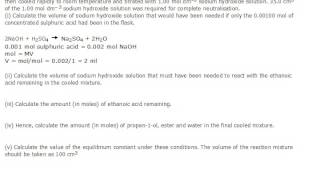
Charles Collingwood solves a 2001 Edexcel equilibrium problem. A mixture of ethanoic acid and ethanol starts with 0.100 mol each. After reaction, titration shows 0.033 mol acid remains, meaning 0.067 mol ester formed. The equilibrium constant KC works out to about 4.0.
Questions this video answers
0.002 mol
0.002 L (2.0 cm^3 / 2.0 mL)
33.0 cm^3 (0.0330 L), equivalent to 0.0330 mol NaOH
0.100 mol each
0.033 mol
Chapters
Okay, equilibrium question. We're given some details about a reaction between ethanoic acid and propan1ol. These will, of course, make propyl ethanoate. We're told that after the mixture was heated, it was then cooled rapidly and titrated with one molar sodium hydroxide solution. We know how many moles of concentrated sulfuric acid were added. So we know how much acid needs to be neutralized before we can detect any of the acid from the ethanoic acid mixture with the propan one. Okay, let's just take the question one bit at a time. Calculate the volume of sodium hydroxide solution that would have been needed if only 0.001 moles of concentrated sulfuric acid been in the flask. So what we need to do is we need to put down the equation for the reaction. Naoh is going to react with H2SO4. Now, we should be able to see here that there are two hydrogen ions from the sulfuric acid. Two hydrogen ions from sulfuric acid, which means that we would be expecting there to be two sodium hydroxides needed. In fact, this is the case. The equation for the reaction gives us NA2, so 4 +2H2O. Want to put these. I'm going to format these. Now, this basically gives us the ratio of sulfuric acid to sodium hydroxide. You see, it's two sodium hydroxide moles for one sulfuric acid mole. So if we start. If we have 0.001 moles of sulfuric acid. 0.001 moles. Sulfuric acid is equivalent to. Put equals here. I'll do sulfuric. Sulfuric acid will be equivalent to twice as many moles. 0.002 moles of sodium hydroxide. So we need to know the molarity of the sodium hydroxide. Right, the molarity. So we want the volume. So the volume. Well, first of all, just remember that moles equals molarity times volume. Therefore, the volume equals moles over molarity, which in this case is equal to. Well, the number of moles is 0.002. And the molarity, we're told, is 1. So that equals 0.002 liters or 2 cm cubed 2 ML. I wanted to format this in a nice color. There we go. Let's take it into blue so we can see it. Right. Nice. Nice blue color. Calculate the volume of sodium hydroxide solution that must have been needed to react with the ethanoic acid remaining. Right. Well, you must have been needed to react with ethanolic acid. So we're going to take off the 2 ML. And we were told that 35.0 cm cubed were required. So in fact, 35 minus 2 equals 33 ML of NaOH neutralized. Diethanoic acid. And that equals. Well, it's one molar. So it's 0.033 moles. We open the volume. Sorry, I've jumped ahead. We're only asked for this. I'm going to cut that out. X. All right, so 33 must have been needed. So the amount of moles and ethanoic acid. Well, ethanoic acid, ethanoic acid moles is equal to sodium hydroxide moles. And we've just worked that out. So naoh, that neutralizes the ethanoic acid is 0.033 mol. I say ethanoic acid. Yes, ethanoic acid, that's right. Hence, calculate the amount in moles of propan1ol, ester and water in the final cooled. Well, we've got here alcohol or acid. Acid plus alcohol equals ester plus water. What was mixed together? 6 grams of ethanoic acid, 6 grams of propyl monol, and that amount of concentrated sulfuric acid. Okay, so. Well, let's see. Initially, initially, initial mass from the acid, there was six grams of acid. From the alcohol there was six grams. And of course, there was nothing from the ester and there was nothing from the water. Now let's look at initial moles. Now, Initial moles. Well, it's ethanoic acid, which has got a relative mass of 60. So 6 grams is 0.1 of the moles. That's 0.1. The alcohol, however, is propan1ol. Propan1ol. Let me just. I'm going to just put it in here. Propan1ol. We need to know the formula, which is C3H7. Oh, that's Propyn1ol. So our relative mass is 36 and 8. 44. Oh, it's also 60. That's really nice and handy, isn't it? So that's 0.1, is that right? 60. Just check that. 36, 37, 44, 44 and 16 60. That's right. So 0.1 moles as well. So now moles at equilibrium equ. Moles. Well, 0.033 moles of ethanoic acid is left. So equilibrium moles 0.033. Which means that as acid reacts with the alcohol in a one to one. This must also be 0.033. And it means that 0.1, 0.067 have reacted. So that's 0.067. 0.067 moles. So now we can use the KC. KC equals. It's ester and water concentration. Ester and water moles copy ester concentration. Now, in fact, they're all in the same. They're all in the same container, so they're all at the same volume. So we can use moles as concentration. We divide that by the acid and the ester. Sorry, the acid and the alcohol. Did I say acid and ester? Acid concentration. Alcohol concentration. So KC equals. Well, the ester and the water's. 6, 7. 0.0. 0.0067. Times 0.067 divided by 0.033. Divided by. Sorry. Times 0.033. Well, you can see that 3. 3 goes into 6, 7 twice. So that goes 2. That goes 2. So KC. KC equals 4. Oh, I've jumped ahead. Calculate the amount of moles in the final cool. In fact, that's what I should have done. I'll take that there. We should have done the KC value here. That's our KC calculation. The final cooled mixture. And this is our mass in the final cooled mixture. Okay, so that's the calculation completed.