Enthalpy of formation of ammonia calculation
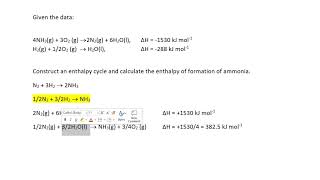
Charles Collingwood demonstrates how to calculate the standard enthalpy of formation of ammonia. He constructs the target formation reaction (1/2 N2 + 3/2 H2 -> NH3), manipulates two given thermochemical equations by reversing, scaling (divide by 4; multiply by 3/2), and adding them, carries through the corresponding enthalpy sign/scale changes (1530/4 = 382.5 kJ; -2883/2 = -432 kJ), and obtains a final enthalpy of formation of -49.5 kJ per mole NH3.
Chapters
Okay, the first stage in these questions is always to construct the equation for the thing that you want and you want the formation of ammonia. All right, so N2 plus 3H2 we know that gives ammonia. All right, this is the. We're not quite yet there yet. All right, bear with me for a moment. This is this, this shows a balanced equation to form ammonia. Right, I'm going to keep this. Going to make it nice and tidy. All right? Okay. Now that's the balanced equation. But the definition of enthalpy of formation requires only one mole of ammonia. So we must divide each of these components by two and this by two. Right, so we'll just copy that again. And so the enthalpy. So the equation that we're after, the equation that we're after looks like this. 1/2 N2 plus 3 over 2 H2 gives NH3. This is the equation that we need to construct. Now there's two ways to go about doing this sort of question. The first way I'm just going to show using mathematics. Now, it's very simple. We look at these two equations. Which of these two equations has got the ammonia in it? Well, you can see it's the first equation and that ammonia is on the left hand side. We don't want it on the left hand side, we want it on the right hand side. So we turn all this equation round. All right? I'm going to put it underneath. Now I want to simply copy it and put it underneath and then I'm going to turn it round. So just take that side out and put it to this side and take that side out and put it to this side. We've reversed the equation, get rid of that comma, because there's no business being there. So now we've got the ammonia on the same side. Now if we reverse an equation, we have to also reverse the enthalpy change. Now to reverse an enthalpy change, it's simply a matter of changing the sign. It becomes A plus. Alright, so all we've done, reverse the first equation and change it to A plus. But we don't want four ammonias, we only want one ammonia. So now we're going to divide the whole equation by four. All right? Divide all that equation by four. So let's copy it out, let's put it down here underneath. Now if you divide two by four, what do you get when you get half, don't you? You get one over two. Divided that by four, we divide six by four. I'm just going to write six over four. Just to make it easy. Well, now let's make this. Let's cancel it down to three over two. All right? Three over two. Divide four by four, you get that? Divide three by four, you get three over four. All right? So if we divide everything by four, we must also divide this by four. So we get that over four. I don't know what that comes to. I've got a calculator handy. So let me just Turn the calculator on. 1530 divided by 4 is equal to 382.5 equals 38 2.5 kilojoules per mole. Right? Okay. But this is the way we know. So we've got this happily, right, We've got the ammonia on the right hand side, which is what we wanted. But now what we've got to do is we've got to get rid of. Well, we need. We want half, half, N2, don't we? That was. I want to change the color because this is the target. This is the target. We're after there. So just keep reminding. We've got the half N2. Now we've got some water. We don't want three over two. H2. Well, let's go up to this equation up here. So 3 over 2, h2o. If we multiply this equation by 3 over 2, that will give us exactly the same amount of water, but on the right hand side. So we just make that water here exactly the same as this water here. So we just multiply this equation by 3 over 2. So I'm going to copy it and I want to put it down here. And I'm going to multiply everything by three over. Whoops. Three over two. So we multiply hydrogen by three over two. Now if we multiply oxygen, what, half O. Two by three over two by one and a half. That's going to give a very awkward number, isn't it? Is there a problem here? H2 plus a half O2 is H2O. That's fine. All right, that's going to multiply that by three over two and we're going to get three over four, three over four and three over four. Oh, two. And the water, we multiply by three over two. Three over two. Now let's look at these two equations. Ah, sorry. First of all, we must. We've changed this equation. So we must take the energy change here and multiply that by three over two as well. So that's times. Times three over two. So I want minus 288 times three over two. What is it? 288. 288. That's me sneezing. Right. 432. I must be covered. There we are. So it's a negative sign. Don't forget the negative sign. Negative four three two. Now if we add these two equations together what's going to happen? Well let's have a look. That's wrong. Let's just go put line underneath and just write add. Remember we're adding this one which I'm going to color green and this one which I'm going to color green. Right. I'm going to add them both together. So on the left hand side what have we got? We've got half N2. Let's copy that. Put it down here. Oops. Underneath half N2 and the next thing we've got we've got plus 3 over 2 H2 here. But on the right hand side we've got 3 over 2 H2 here as well. So effectively we can strike out. If I can do strike out on this, can I strike out? I should be able to. It's on a font. There we go. Strike out. Strike through. We can that strikes through. With that we get rid of it. In other words, strike through. All right, now let's keep looking. So the left hand side we've got three over two H2. Nothing that doesn't cancel out with anything. So we'll put three over two H2 here plus three over four oh two. Well look at this. On the left hand side we've got three over 402. And at the top here we've got three four zero two as well. So we can strike those two out as well. We can strike that out. And we can strike that out. Alright. So our left hand side is completely finished. And let's look at what's left on the right hand side. On the right hand side all we've got is NH3ammonia. So I want to copy the arrow and the NH3. Put them there. So what did we do? Well we just added these two equations together. So what we have to do is we have to add these two values together. So we need to say that plus and this value is a negative negative that copy and Those equal. So 382+ minus 432. What's that? 38 2.5 minus 43 2. Oh my. Yeah yeah yeah. Didn't I Didn't work. Didn't press the calculated button correctly. Four better. And that comes to minus 49.5 kilojoules. So that is the enthalpy of formation of ammonia as defined. Except the K should be short, small, and the joules should be large. Is that better? Kilojoules. Okay.










