This content was created by Charles Collingwood. This content was uploaded by Charles Collingwood. This is a YouTube video titled "Equilibrium 01" featuring a lecture or explanation by Charles Collingwood on equilibrium problems in chemistry, focusing on stoichiometry and the calculation of equilibrium constants.
Chapters
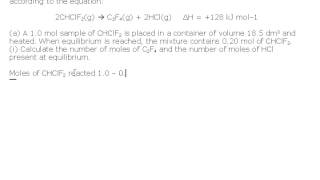
Okay, equilibrium problem. In reality, the big problem with equilibrium is not the actual equilibrium state, it's the moles. It's a stoichiometry type question. The key is to understand what the equation means. The equation saying here that two moles of this component produces one mole of this component and two moles of this component. Although in reality we're probably only interested in these first two components. In this case, I don't know. Now this means that however many moles of this react will produce half as many moles of this. And by converse argument, however many moles of this are produced, twice as many moles of this must have reacted. This is the key to it. So if we're told there's a one mole sample of this left hand component, doesn't matter what volume it's in at the moment, that can be used for working out the equilibrium quantum. When equilibrium is reached, the mixture contains 0.02 moles of this. Hang on, of the very first component. Okay, well that means how much has reacted? Well, you can see that moles. Moles of this reacted. Moles of that reacted. Well, it must be the difference. You start off with 1 and we end up with 0.20. Well clearly how much has been used up? 1.00 minus 0.2 0.0.80 as reacted. Okay, now from the, from the equation, from the equation, two moles of this make one mole of the product. So we always. The moles of. I put this. Reacting moles of that reacting. Reacting makes exactly half the moles of. And we'll put in this as our product. Well, you know how much moles have reacted. Hence, hence moles of tetrafluoroethene equals 0.80 over 2 equals 0.40 mol. Now by the same argument from the equation, exactly the same number of moles of the reactant in hydrochloric acid. Well, so moles of HCL produced equals moles of this reacted equals 0.80 and that's it. Now if you want to go on to work out the equilibrium constant, well, you just basically you have the moles of all the components. You divide all of those by the volume to get equilibrium, get them into concentrations and then put them into the equilibrium constant equation. That's it.