F21H1
Charles Collingwood works through chemistry problems covering stoichiometry, molecular formulas, reaction products, and thermodynamics. The lecture tackles a series of questions with detailed explanations and solutions for each.
Chapters
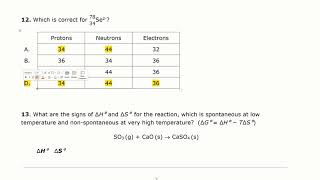
Question one, how many moles of strontium hydroxide are produced along with one mole of ammonia? Well, you can see in the equation the coefficient for ammonia is two. We've only got one and so we've only got half as much ammonia. Therefore we'll only get half as much strontium hydroxide. Half of three is indeed one and a half. Question two. What is the molecular formula of a hydrocarbon containing 84.6% carbon by mass? It's a hydrocarbon, so it contains only carbon and hydrogen. Now we know the way to get the relative amount of carbon is to divide the percentage given by its relative mass. So it's 84.6 divided by about 12. Now we're not allowed calculators, so we have to do an approximation here. So twelves into 84. Seven twelves are 84. So it's about seven. Alright, now we can see none of those actually fit seven. Well, we don't know how much carbon there is, but sorry, hydrogen there would be about 15. So it's about 7 to 15. Right, about 7 to 15, which is about approximately 1 to 2. So there's twice as many hydrogens we expect twice as many hydrogens approximately as carbons. That's approximate. Now you see this is they've all got approximately twice as many high and this one hasn't. B is not a possibility. CS approximately twice as many, D approximately twice as many. So it's either A, C or D. How do we decide? Well, the next thing we've got is we've got 142.3. So we say to ourselves, okay, if there's 142.3, how many carbons could it have? Well, 1212 are 144. 11 twelves are 132. If it had 11 carbons, that's this one and 10 hydrogens, that would actually fit, wouldn't it? But remember, C wasn't a possibility because C we have to have approximately twice as much hydrogen as carbon. So let's go back down, cut back down to this one. C10H22. Well, 10, 12 are 120 and 122 is 142. So this fits both the empirical formula and and the relative mass. And so as far as we're concerned, this must be the molecular formula. Just as a check, this has got the requirements for about the approximately one to two ratio. But here if we add 5, 1260 and 1171, nowhere near 142. And remember, this is the molar mass. So the answer Here must be C. Question 3. What are the products of the reaction between sulfuric acid and potassium hydrogen carbonate? Potassium hydrogen carbonate. KHCO 3. It's a hydrogen carbonate. It reacts with an acid to make potassium sulfate and water. Sorry, Potassium sulfate and carbon dioxide. And water, It's a hydrogen carbonate. And the only choice we have there is water and carbon dioxide. This is the correct formula of potassium sulfate. Of course, the other formula given up there is not potassium sulfate because potassium has got a valency of 1, whereas the sulfate polyatomic iron has got a valency of 2 minus. All right, question 4. Let's just jump it to the next page so we can see it properly. What's the sum of the integer coefficients when pent1ene undergoes complete combustion? Right, so here we've got each of the carbons goes to carbon dioxide. So let's start by playing around with it. Right, so that went five carbons would make five carbon dioxide. But now we've got 10 hydrogens will make five water molecules. But now we've got an odd number of oxygens. So we can't have an integer here. So we have to start by doubling everything. So double that. Remember to double this one. So we've got 10 carbons on the left, 10 carbon dioxide, 20 hydrogens on the left. So we must have 20 hydrogens on the right. Now we add up the oxygen 10:02, another 5:02 makes 1502. So we've got to add all of these up, 2 and 15, 17 and tens 27 and tens 37. The answer is B. Question 5. The volume of a sample of gas measured at 27 degrees C is 10 liters. What's the temperature when the volume is reduced to nine? So the volume is going down from 10 to nine, plus it's going down by one from 10. This is going down 10% or a 10th. Remember, according to Charles Law. Well, let's just do the. It's got PV equals nrt. That's our gas law, isn't it? If you look at this, we're talking here about volume and temperature, okay? So our volume is proportional to the temperature, all right? So as the volume goes down, so the temperature goes down. Or to put it another way, this is Charles Law statement of Charles Law. V over T is constant, it's a constant value. So the volume of the temperature will not change. So as we have to keep them at the same proportion. Well, the volume is going down, as I said, from 10 to 9, so the temperature must go down from whatever value it has to 1 what, a 9/10 of that value? Well, we told that the temperature is 27 degrees. 27 degrees Celsius. 27 degrees Celsius. All right, so, and that in Kelvin, of course, is 273 +27, which is 300kelvin. 300kelvin. So if we're going to decrease the temperature, we must decrease the temperature to. Well, a tenth of 300 is 30. So it's down to 270 Kelvin, which is 3 degrees below 273. So this is minus 3 degrees Celsius. So the answer is a highlight that A. Let's just jump this to the next page. Which value of Q, which is the heat, remember, in joules has the correct number of significant figures. Oh, in fact, we don't even need to worry about the calculation here. We've got how many significant figures here? Well, there's four significant figures here, there are three significant figures here, but there are only two significant figures here. So we can only express our answer to two significant figures. And so this is the correct answer. 6.3. It's expressed to two significant figures. Number seven. The index of hydrogen deficiency. What happened there? Index of hydrogen deficiency of this, this molecule here, I remember this is a skeletal molecule. So the double bond double bond represents one hydrogen deficiency. So the two double bonds here, three double bonds here, that's five double bonds and two rings, that's six, seven. So we suspect it's this one. But let's check, shall we? Let's check by counting up the atoms. Well, we can see that there are 10 carbon atoms, so we would expect it's 2N plus 2 or 210 plus 2 is 22. So let's count the hydrogens. 1, 2, 3, 4, 5, 6, 7, 8. So it's 22 minus 8 is 14. And 14 divided by 2, of course is 7. So the index of hydrogen deficiency is indeed 7 phenaphalene. Question 8. Which diagram represents a heterogeneous mixture? Well, if you have a look at the four pictures, the first one, you've got two material, two substances, and they're not mixed in a finely divided way. The second picture shows a much more homogeneous mixture. Third picture shows a pure substance. And the fourth picture shows what looks like looks to be a regular array, such as an ionic crystal. So the answer here will be the first one, where we've got two materials. Particles are two materials, but they're not mixed together. It is a mixture because there are two materials there, but they're not intimately mixed into a homogeneous mixture. It's a heterogeneous mixture. A number nine was the ratio of areas of the signals. The 1h of pentan 3ol. That probably helps to draw out pentan 3ol. Here. Pent up is five. That's carbon. So CH3, CH2. What is it? Three ol CH brackets. Oh, just make it easy with the brackets. CH2, CH3. Okay, so that's. There's five carbons. And of course, the hydrogens are in the first two environments. Here, the C2H5, the first two is identical to the second two. So in fact, there are six hydrogens in this environment. There are four hydrogens in this environment, and there's two ones. So it's six to four to one to one. So the answer is a question 10. Which of the following transitions in the hydrogen atom emit. So it's going from high to low. All right, the least energy. So it's going to the highest level. So high to low to the least energy is this one.4 to 3. That will emit the least energy because the energy levels get closer together as we go higher up. Obviously, 3 to 4 here is an absorption of energy. And 4 to 2 is more energy. Down to 1 is even more energy. Question 11. What is the percentage yield when 7 grams of ethene produces 6 grams of ethanol? Well, this is a question of 7 is the amount of ethene in grams. The relative mass is 28. So 7 represents 0.25 moles. Okay, so if we put 0.25 moles of ethene from this equation would be expected to produce 0.25. So 100%. 100% is 0.25 times the relative mass, which is 46 of the ethanol. This is the actual theoretical yield in grams. So the actual yield, which is 6 grams, would be 6 divided by this yield multiplied by 100 to give the percentage. So it's 100 times 6. Oh, in fact, I've actually done the first part. I got the 0.25 by dividing 7 by 28. And so divide 7 by 28 was divided. So it's divided by. It's over 7. And then 28 goes on the top times 28. So it's just manipulating the numbers mathematically. So it's 6 times 28 times 100, which is the last one over 7 times 46. So the answer here is D, which is correct for 78 over 34. Selenium. Well, 34 gives the atomic number. So that's protons. Yes. It's only one of the first two the neutrons. Well, do we bother? Well, they're both the same, so it doesn't matter. We don't have, we can't differentiate. So we know it's still the first two. And now what? Let's look at it. It's a two minus iron, so two more electrons than the 34, so it must be 36 electrons. All right, so the answer here is d again. Question 13. What are the signs of the enthalpy change and the entropy change for a reaction which is spontaneous at low temperature and non spontaneous at high temperature? So high temperature, when T is high, delta G becomes positive. So that sign there, that negative sign must be giving the T delta S a positive sign. So delta S must be negative. All right, so we've got already decided that delta S is negative. Now if delta S is negative, the only way the reaction can happen at all is if delta H is also negative, because otherwise you could never ever get a delta G value that was negative. And of course for a reaction to occur we have to have delta G as negative. Question 14, Which describes the oxide of sodium Na2. Okay, bonding. Well, it's an ionic, it's metal and non metal, it's an oxide. So either those last two work. Conduction of electricity. Solid. Solid ionic substances do not conduct electricity. So as a liquid only. We don't even need to look at the last column. The answer is D. Question 15. The hybridization of the circle. Carbon, oxygen, nitrogen. Let's start with the carbon. Where's the carbon? CH3. It's bonds to four things, so it's Sp2. So it's this one or this one? Sp2. They're the only Sp2. Oxygen. Oxygen's got two lone pairs and double bonds. There's a three domains, so it's Sp2. So if that were here, oxygen, Sp2, and that sorts that out. Oh, sorry, I've done it wrong, haven't I? What did I do? I said sp2. For the carbon, it's clearly. It's sp3. What am I talking about? Did not say sp3. A moment's horror. I meant to say sp3 is bonded to four different atoms. The carbon, of course it is tetrahedral sp3, so it's one of those two. And the oxygen is sp2, it's one of those two. And now I've got no choice. There's the nitrogen must also be sp2. And it is indeed got three electron domains. So the answer is D. A moment's panic. Which species does not have linear geometry? Well, CO2 does SiO2. Whoa. It's the old favorite, the SiO2. Giant structure. Not linear at all. And just to check, the triiodide ion is indeed linear, as is the nitronium ion. Anyone gets that one wrong, I'd be so unhappy. Right. Number 17. When equal masses of X and Y absorb the same amount of energy, their temperature rises by different amounts. X, it takes more energy to increase the temperature. So it must have a higher specific heat capacity. So the specific heat capacity of X is twice that of Y. And just remember the equation E equals MC theta, M is the same so as E is proportional to C theta, which means that if we. If the same amount of energy, so we just turn it around the other way and we find that. So if that's a. So the energy which is. Which means that c theta must c1 theta1 must equal c2 theta2. So however much the heat goes up by, the specific heat capacity must go down by. On to number 18. Methane undergoes incomplete combustion. Just interesting. Incomplete combustion. So this. So it doesn't produce carbon dioxide, it only produces carbon monoxide. Oh, we've got to use bond enthalpies. And here's the bond enthalpy terms. Whoa. Kier Royal, what's the enthalpy change using the bond enthalpy? Well, here there are eight CH bonds, so we must look for eight. These have. This is positive. It's 8 times 4, 1 4. And there's an 8 times 4, 1 4. And we're breaking those bonds. So it must be positive. I can't actually see an 8 times 414 in any other place. Yeah. So the negative 8 point, that's no good because we're told it's positive. Let's just check it out. So it's eight. So it's plus three times the oo. Plus three times that. Yeah, it's obvious in it. It's getting there. And then we're making these bonds, two carbonyl bonds, which is CO2 times 1077. Yes. Negative. Yeah. So C. We've done enough checksum on that. I don't need to go any further. Question 19. Which equation represents lattice enthalpy? Right. So this is the enthalpy change when a crystal lattice in its natural state, in its solid state is broken into gaseous ions. So it's licl. Solid, just Li. This is the endothermic lattice enthalpy. And then are no other choices. So It's B. Question 20. What can be deduced from a 1h NMR spectrum of a compound? The functional groups Present, not really the number of hydrogen environments. Of course, we can see that straight away. Question 21. Same amounts of two gases and two identical contains at the same. This is crucial at the same temperature because it means that the average kinetic energy is the same. Right, the same temperature. It's important here. So if the average kinetic energy is the same and yet the velocity of X is less than Y, it's the same temperature. Right. Remember temperatures. Absolute temperature is proportional to the kinetic energy. The average kinetic which is also proportional to the average velocity. But here we can see the molecular speed is less for X, so it must be heavier. So the kinetic energy is equal because the heavier masses are going at slower speed. And kinetic energy is half MV squared. Alright, So X has the higher molar mass. What decreases the activation energy? A catalyst. Blah, blah, blah. You get one and a half minutes to answer some questions. And it takes a second. Several reactions of calcium carbonate with dilute hydrochloric acid are carried out at the same temperature. Which reaction is the greatest rate? Well, higher concentration. Boom. No problem with that. So it's either that or that and what we're reacting it with Calcium carbonate solid. So it's the surface area. So will it react faster with larger or smaller lumps? And it'll go faster with smaller bits because it's got a higher surface area. Oh, surface. Careful. I thought these were bits. I misread the question. The surface area. If the surface area is larger, it will react faster. Nearly caught me out. Have to get a burley to catch me out. But that one nearly caught me out. I thought this was the size of the bits. Right. And I made the exam as well. What's the order reaction with respect to each reactant? Well, we just have to look at how it changes the rate when we keep one the same. So this one and this one. So in those two, when those two are kept the same, what happens to the rate? Well, we double chloride. We double the rate. So it's chloride order one. So it's any of those three are order one. So now let's keep which ones keep the same. This one, let's make it green. Stays the same with this one. And so in these two cases we're changing that one and that one. Make it green. I want to make it green. Because it doesn't matter now. All right, so this one doubles, this one stays the same. And so whatever happens to the rate. And the rate multiplies by 4. So the order with respect to no is 2. So it's 1, 2. Go back to yellow and the answer is C. Questions 25 and 26 both contain typos which somehow escape the editing. Question 25, the equilibrium question should have said to the left because there are in fact three things that will move the system to the right hand side which are increasing pressure, increase in nitrogen monoxide and decrease in oxygen. All of those will push the system to the right hand side. So the answer should have. The question should have said left here, not right. Question 26. In fact, the answer, question 26 was not one of the choices given here for the reason. Well, the question contained a mistake, so both these questions were cut out of the test. The major reason for the PH of unpolluted rain is less than 7. This is because carbon dioxide is present in all atmospheres. Very easy. That's the puzzlement of the previous question is compensated for by how easy that one is. Question 28, what's the order of increasing ph for the following solution? We're increasing ph. So that means we're getting more basic. That. Well, that's an acid at the end. That's the NH3CL. Should be NH4CL as well. Doesn't really matter. It's clearly not the right answer. This is basic. This is basic. So it's one of these two. So this is slightly. Actually this is basic as well. We've got three basic compounds there. We don't know which way round to go. So which is the most acidic? Well, here we've got ammonium chloride, which in fact has got an error. It should be NH4CL. I might wipe this question out as well because this is the answer. In fact, it's C is the answer. But I'm not happy with it because that should have been NH4. There was a misprint here. It should have been NH4 seal. How was that missed? Just take that question out. All right, so this, this paper will be out of 38. All right, consider the reaction. What have we got here? 2n 2o plus 2n goes to 2n 2o 2 values of KC. What's happening? So as we increase the temperature, the value of KC goes up. All right, so if KC goes up, we get more of the right hand side as we increase the temperature. So it's telling us the forward reaction is favored. Well, hardly, hardly. You know, it's actually, sorry, at the higher temperature, KC is greater than. It's greater than 1. So we've got more of the reactants than we've got a product because KC is greater than one. So the forward reaction is indeed Favored the rate of the reverse reaction is greater than the rate at higher temperature. Is not true. The concentration of both reactants and products increase. Not true. The answer is the forward reaction is favoured at higher temperature because the value we have has gone over one. So that means there's more of the right hand side than there is of the left hand side. Whereas there wasn't at lower temperatures. Question 30. Where is the buffer region? It's B. You don't need to do any working out. B is where the, the titration curve flattens. It's the place that contains the weak acid with its solution of its salt. Question 31. The following reaction occurs in a voltaic galvanic cell. Fair enough. Which reaction takes place? Each electrode. Alright, so it's a voltaic cell. That means it's producing electricity. So the magnesium is passing electrons to the silver. Remember, oxidation happens at the anode and oxidation is where the magnesium is losing electrons. So Magnesium goes to Mg2. This must be happening at the anode oxidation, which means the cathode, the silver must be gaining electrons. And indeed it is cathode reduction occurs. So there's our answer. C Very, very easy to pick that up.32. In the following, the following table of standard electron potential electrode potentials. Strongest reducing agent here. Well, this is the most negative. So this one tends mostly to the, to this side. In other words, the reaction to the left towards the left is much more favorable. In other words, it will provide electrons more easily. So aluminium is the strongest reducing agent. Which compound is the highest boiling point? Well, what we're looking for is in this case we're comparing branching and you see the degree of branching decreases to A. So the one with the least branching will have the highest boiling point. 34. Which monomer could create this polymer will. Well, here it looks like we've got there's a CH3 at every carbon. So that means we must have a double bond in the middle of a 4 carbon chain. So it must be but 2 ene only possibility. I'm just looking at, just looking at what would happen with me. Two methyl proponents. Let's just draw it out just to convince myself. Two methyl proponents. So that's CH2 double bond, double bond, CH brackets CH3, 2. This is two methyl prop one. And what would happen if we. Now you see this one, you would always have one carbon here which would not have a side chain. And you can see that if you, if you open up this double bond, open up this double bond, you would have, you'd have two C8. Two carbons. Two, two CH3 attachments on this carbon. So you'd be CH2C, CH3, 2 and then CH2. So it's not this one, so it's but two. What's the name of this compound? Using IUPAC rules 1, 2, 3, 4, 5, 6. There are six carbons. If you number from this side, you get 1, 2, 3 methyl 4. So 3, 4 dimethyl. If you number from the other side, you get 3, 4 dimethyl. So. So it's 3, 4 dimethyl hexane. Doesn't matter which way you number it. How many chiral atoms are present in one molecule of this? Whoa, look at this. Look at this creature. Let's just separate it out a little bit. I'm going to copy it, actually. Let's copy it and let's put it down here so I can play with it. Right, so I'm gonna. Here we've got a single bond here, chcl. So there's our single bond, chbr. Right, so it's like this. Well, this carbon has got all of this chain, an H, a Br and Ch3. So, yes, that's chiral. This carbon has got a Ch, a Cl, all of that and something with the bromine. So, yes, this is chiral as well. This, however, has got two CH3 groups, so it can't be chiral. Two groups the same. And this one can't be chiral. So the answer is two. There are two chiral carbons there. Which compound can exist as two configurational isomers? Remember, configurational, it means that the atomicity is different. Well, not necessarily. Sorry. It just means that the arrangement of the atoms allows for isomerism, but it's not conformational, because conformational means by twisting the molecule round, you'll be able to get to the one isomer will get to the other. So configurational. So we're looking at what we would call a CIS trans isomer or an EZ isomer. You can't have EZ isomers when you've got both atoms the same on one carbon. So A doesn't work, B doesn't work. C is has no double bond at all. So you can get a conformational isomer with C, but not a configurational. So D, you can see they've got two separate atoms on the two carbons of the double bond. So D is our answer. Question 38. Which class of compound is formed when a ketone is reduced? Now, remember, ketone is a carbonyl in the middle of a chain, which means when it gets reduced, it can get reduced to a secondary alcohol. Which is correct for benzene. It readily undergoes addition reactions. No, it doesn't. Benzene undergoes electrophilic substitution. It contains alternate signal and double carbon carbon bonds and is planar. You could argue that it does, but it doesn't really. We know that they're not alternate single and double. They're actually in actual fact there's delocalization, so I'm not happy with that. It's 1H NMR spectrum, so six signals. Now, all the hydrogens are equivalent, so it must be the Last1. It's one HNMR shows one signal and it forms a single isomer. This is absolutely correct. This is the answer. It forms a single bromide isomer. Substituted bromide isomer. And question 40. The following data recorded for determining the density of three samples of silicon. All right, this is data which average density value has been calculated to the correct number of significant figures. Significance again. Well, here we can see that there are two significant figures in the volume. So we can only have the answer to two significant figures. Remember, the answer can only be expressed to the least significance or to the significance of the least of the data with the least significant figures. Okay. I don't know how long that took. Eighteen, six. About half an hour.










