Hess' law and it's application
Hess's law lets you calculate reaction enthalpies from energy conservation. Learn four methods: combustion data, standard formation enthalpies, bond energies, or any convenient route. One example shows how to get ΔH = −147 kJ.
Chapters
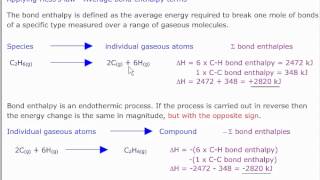
Hess's law derives directly from the law of conservation of energy. This tells us that energy can be neither created nor destroyed. That means that if you were to go from one situation to another situation, for example, here state one to state two, the energy change must always be the same, regardless of which route you take to get there. If we take a direct root, we could call that delta H of reaction. However, if we go via an intermediate such as root 1, then the sum of the two energy changes, delta H1 and delta H2 in this case must be equal to delta H reaction. If we go via root 2, the sum of Delta H3 and Delta H4 must also be equal to delta H reaction. We cannot change the difference in energy between two states. So regardless of how we get from state one to state two, the energy change will always be the same. We can apply this to, for example, combustion enthalpies. In the case of having substances that actually burn. Combustion, of course, is just the reaction between a substance and oxygen to produce combustion products. Combustion enthalpies are historically very useful because they can be measured using a bomb calorimeter measured by experiment. We can't actually reverse the reaction in practice, but according to the law of conservation of energy, the reverse process must have exactly the same magnitude but the opposite sign. So if we look at the combustion of carbon, carbon plus oxygen gives carbon dioxide. The enthalpy of combustion of carbon is minus 484 kilojoules. This means that were we to drive the reaction in the opposite direction from carbon dioxide back to carbon and oxygen, the magnitude must be exactly the same, but the sign opposite. If we want to use combustion enthalpies to work out reaction enthalpy, what we have to do is we have to go via the combustion product in the same way as we went via an intermediate state before. In this case, delta H reaction is equal to Delta HC1. And now we're actually going against the combustion enthalpy of the product ethane. So we must subtract the combustion enthalpy of ethane. If you go the opposite direction to an arrow, you must subtract it rather than add it. So in this particular case, our delta H reaction is equal to Delta HC1 minus Delta HC2. Now we can use from this we can get a general form for combustion enthalpy. As we're going from reactants to the combustion products, and the combustion products, we're going against the combustion enthalpy to the products. Well, it's delta HC reactants minus delta HC products. Let's have a Look at an example. Here we've got the reaction, which is ethene plus hydrogen gives ethane. Both ethene and hydrogen burn to make combustion products. Ethane must clearly make the same combustion products. So here we take enthalpy of reaction is equal to the enthalpy of combustion of the reactants minus the enthalpy of combustion of the products. So in this particular case, it's enthalpy of combustion of ethene and hydrogen, which is minus 1411 plus minus 286. Subtract the enthalpy of combustion of the product and that gives us clearing out the signs. We get -1411, -286 +1086. Gathering the terms, which gives us an overall enthalpy change of -147. Hess's law to apply enthalpy of formation. Well, in this particular case, the enthalpy of formation is defined as the energy change when one mole of a substance is formed from its constituent elements in their standard states. So in other words, we start off with elements in standard states and we end up with a particular substance and we call this energy change the enthalpy of formation. Were we to carry it out in reverse, change a substance back to its elements, well, this must be the opposite of enthalpy of formation. So it's the same magnitude but with the opposite sign. Now, it's very difficult or difficult. It's usually impossible to measure these changes by direct experiment. However, they can be found out using other enthalpy changes, applying Hess's law. Now, if you want to use formation enthalpies, what we're doing is we're going from the reactants to the products, in this case ethium plus hydrogen to ethane. So ethene plus hydrogen to the elements in the standard states. Well, this is the negative of the enthalpy of formation, because enthalpy elements in standard states back to these compounds and hydrogen, this would be the enthalpy of formation. So we're going against the enthalpy of formation here. So it must be negative enthalpy of formation. And then from the elements in the standard states to the products, well, this is enthalpy of formation. So here, to get the enthalpy of reaction, it's negative enthalpy of formation of reactants plus the enthalpy formation of the products. And this gives us a general form. Remember, we're going from the reactants to elements, elements to products, reactants to elements is the negative of the enthalpy of formation, and then the positive of the Enthalpy of formation of the products. So reaction enthalpy is negative enthalpy. Formation of reactants plus enthalpy of formation of products. If we apply average bond enthalpy terms. Well, bond enthalpy is defined as the average energy required to break one mole of bonds of a specific type, measured over a range of gaseous molecules. So in other words, we break a species up into individual gaseous atoms. Well, this is the sum of the bond enthalpies of the bonds within the species. In this particular case, if we take C2H6, we break it up, we get two carbon and six hydrogen atoms. And so there are six CH bond enthalpies. One CC bond enthalpy, the total is equal to 2, 820. For example, were we to do it in the reverse, well, it would be minus 2,820. So it's 2C gas plus 6,8 gas, making C2H6. This would give us minus 2,820. So now we can apply Hess's law going via gaseous atoms. If we start off with two gaseous molecules, ethene and hydrogen, to break these into the gaseous atoms is the bond enthalpy terms, the sum of the bond enthalpy terms. And then to make these gaseous atoms into ethane, this is the negative of the bond enthalpy terms. So this gives us a general reaction. The reaction enthalpy is the sum of the bond enthalpy terms of the reactants minus the sum of the bond enthalpy terms of the products. So because we're going from reactants to individual gaseous atoms, this is breaking the bonds, an endothermic step, and then individual gaseous atoms to the products. This is making bonds. So this is an exothermic step. It's useful to remember here that there are limitations using bond enthalpies because the reactants may not always be gaseous or the products. And also, average bond enthalpy is not necessarily a good measure for the strength of specific bonds in a specific molecule. We can also apply Hess's law if we can find any intermediate stage that we can passed through, provided we know the first step and we know the second step, or the reverse of either the first step or the second step, we can apply Hess's law. We can say reactants via an intermediate stage to products. So delta H1 plus delta H2 equals delta H reaction. If we look at an example of this, the enthalpy of hydration of copper sulfate, we can't measure CuSO4 +5H2O give CuSO4.5H2O. This is anhydrous copper sulfate and five water molecules making hydrated copper sulfate. We can't measure it directly, but we do know that both of them dissolve in water. So we could go via the aqueous solution. So we add copper sulfate anhydrous to a large quantity of water and measure the enthalpy change. We add copper sulphate hydrated to a large quantity of water and measure the enthalpy change. Now we can see that to go from the left hand side to the right hand side, but against this arrow. So it's therefore delta H1 minus delta H2. So, a summary. We could apply Hess's law to reactions provided we have some kind of situation attainable from both reactants and products. In this case it will always be the enthalpy of step one minus the enthalpy change of step two. We can add in any reagent to the left hand side and to the right hand side to make these, because anything we add equally to both sides will cancel out. Therefore, we can generate an equation which gives us a general idea. The reaction enthalpy is equal to Delta H step 1 minus Delta H step 2.










