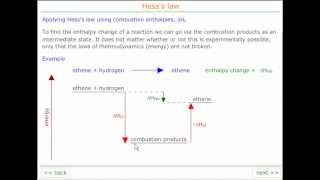
A short lecture explaining Hess's law as an expression of energy conservation and showing how to use measured combustion enthalpies to calculate reaction enthalpies (reactants' combustion enthalpies minus products'). The video includes a numeric example (hydrogenation of ethene to ethane) and defines enthalpy of formation and its relation to Hess's-law constructions.
Chapters
Hess's law. Hess's law is really just a statement of the law of conservation of energy, that energy can be either created or destroyed. What Hess says is that if you have one state one and you wish to go to state two, it doesn't matter which route you take to get there, the energy change will always be the same. For example, if you go via Route 1 here, the first enthalpy change, Delta H1, plus the second enthalpy change, Delta H2, will give you the delta H of the reaction. So wherever root one happens to be, whatever happens to be at position root one is irrelevant. You just know that the total energy change, the sum of the two individual energy changes, delta H1, delta H2 will equal delta H reaction. So root 2 in this case delta H3 plus delta H4 will exactly equal delta H reaction as well. This is all Hess's law tells us. It doesn't matter where we go. Now this is really good because we can go via hypothetical places and we know that provided we go from state one to state two, the energy change will be correct. So if we use combustion enthalpies, what we're saying here is we're saying that when we burn something, we get combustion products and we could call that delta HC enthalpy of combustion. Now, the reason why combustion enthalpies are useful is because they can actually be measured. We can measure them using a calorimeter. Now, the enthalpy of combustion is done is defined as the energy released when one mole of a substance, understand the conditions, is burnt in excess air or oxygen. So the enthalpy of combustion of carbon is carbon plus oxygen gives carbon dioxide. The enthalpy reverse of this reaction, well, according to the law of conservation of energy must be the reverse of the energy change as well. So if the enthalpy of combustion of carbon plus oxygen to carbon dioxide is minus 484 kilojoules, well, if we imagine doing it the other way, you can't do it the other way around. But if you imagine doing it the other way around, well, it would be exactly the same magnitude but opposite in sign. This allows us to go via combustion enthalpies, provided our reactants burn and our products burn. In this particular case, when we burn ethene and hydrogen, well, we could go via the combustion products if we imagine to go from ethane to the same combustion products. And they must be the same combustion products, because the number of atoms in ethane and hydrogen must be the number of atoms in ethane. If we go via the combustion products well, following the arrow down, this is the enthalpy of combustion of ethene and hydrogen. But of course, this arrow is the reverse of the enthalpy of combustion of ethane. Now, to get from reactants to products, we must go via the enthalpy change. So in this case, delta H reaction is equal to the combustion enthalpy of the reactants minus the combustion enthalpy of the product, because we're going in the opposite direction. So, to summarize combustion enthalpies, basically what we take is we take the reactants via the combustion products to the products. Step one must always be the combustion enthalpy, and step two must always be the reverse of the combustion enthalpy of the products. In other words, the reaction enthalpy is equal to the enthalpy of combustion of reactants minus the enthalpy of combustion of the products. Take an example. Here's the example from before. We've got ethene plus hydrogen gives ethane. We've got enthalpies of combustion given. Now, we know that the enthalpy of reaction is equal to the enthalpy of combustion of the reactants minus the enthalpy of combustion of the products. Well, in this case, it's -1411 + +286 + minus -1560. In other words, it's the enthalpy of Ethene + the enthalpy of combustion of ethene plus the enthalpy of combustion of hydrogen minus the enthalpy of combustion of ethane. And this comes to working through -147 kilojoules. So this is the enthalpy of the reaction between hydrogen and ethene to meet ethane. And we can also apply this to the enthalpy of formation. Now, the enthalpy of formation is defined by the amount of energy change when the elements in their standard states make one mole of a substance in its standard state. We call this delta hf. Now, if we carried out the process in reverse substance to the elements in the standard states, it would be minus delta hf. Now, we can't measure these states, but we can calculate them from other factors. Often we can't measure them. So it would be possible then to go via the elements in their standard states from one reactant to a product, in which case we'd have the negative of the enthalpy of formation because we'd be breaking the substance into into its elements, and then we'd have the enthalpy of formation of the products.